
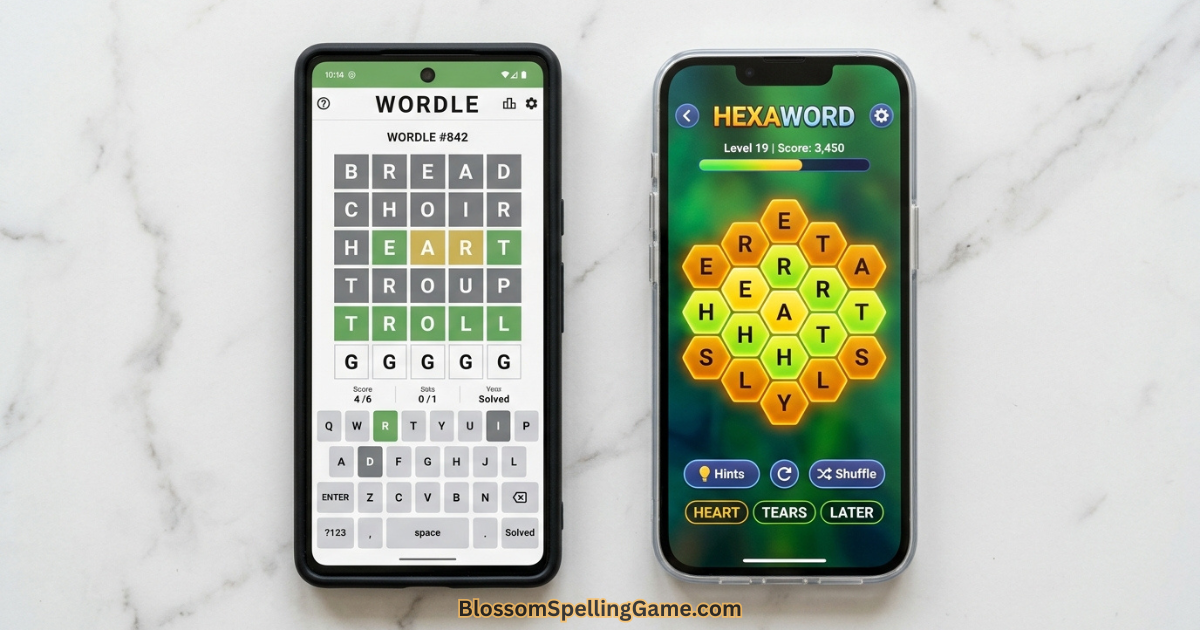
Picture this. It’s 8:00 AM. You’ve got coffee, five minutes, and the familiar pull of a daily word puzzle. lets know about Blossom Word Game vs Wordle.
If you’ve been playing Wordle, you know the drill — one five-letter word, six guesses, green and yellow tiles that either validate or crush you. It’s sharp, fast, almost confrontational in its simplicity. You either get it or you don’t.
Now picture the same morning, same coffee, but you’re staring at seven letters arranged in a flower. No hidden target word. No color-coded feedback. Just you, a set of letters, and the question: how many words can you pull out of this?
Same genre label — “daily word puzzle.” Completely different experience.
This comparison exists because millions of people play both, and almost as many are wondering which one to bother with. Maybe you’re a Wordle veteran curious about Blossom. Maybe you’ve been playing Blossom at BlossomSpellingGame.com and someone keeps mentioning Wordle like it’s the obvious choice. Maybe you just want to know: if I only have ten minutes a day for a word game, which one actually deserves them?
Here’s the honest breakdown — not a surface-level spec list, but a real comparison of how each game thinks, what each game teaches, and which one is the better fit depending on who you are.
The 30-Second Version: How They’re Different at the Core?
⚡Wordle is a deduction game — one hidden five-letter word per day, six attempts, color-coded feedback tells you which letters are right or wrong. Blossom is a generation game — seven letters in a flower grid, you create as many valid words as possible within your 12-word slot budget. Wordle tests logical elimination; Blossom tests vocabulary breadth and strategic prioritization. They share the “daily word puzzle” label and almost nothing else.
| Wordle | Blossom Word Game | |
|---|---|---|
| Core mechanic | Guess the hidden word | Generate words from given letters |
| Word count | 1 target word | Up to 12 words per session |
| Session length | 2–5 minutes | 10–30 minutes |
| Feedback system | Green/yellow/gray tiles | Accept/reject + score |
| Primary skill | Deduction & elimination | Vocabulary & strategy |
| Answers vary daily? | Yes, one new word | Yes, new 7-letter set |
| Cost | Free (NYT Games) | Free (BlossomSpellingGame.com) |
| Word list | NYT curated | Merriam-Webster dictionary |
| Difficulty ceiling | Moderate-high | High |
| Time pressure | None (but one chance) | None |
How Wordle Works? A Quick Refresher
If you’re coming to this article as a Blossom player curious about Wordle, here’s the fast version.
Every day, Wordle reveals one specific five-letter word. You have six attempts to guess it. After each guess, the tiles change color:
- Green: That letter is in the correct position
- Yellow: That letter is in the word but in the wrong position
- Gray: That letter isn’t in the word at all
The game is pure deduction. You’re using elimination logic — ruling out possibilities with each guess, narrowing the solution space — until you either land on the word or exhaust your six attempts.
Every player worldwide gets the same word on the same day. That universal shared answer is a huge part of Wordle’s social appeal — you can compare results with friends without spoilers, because you’re all solving the same puzzle.
The game takes a few minutes at most. It was created by Josh Wardle (yes, the name is intentional) as a gift for his partner, went viral in late 2021, and was acquired by the New York Times in early 2022. Today it sits behind the NYT Games paywall — free with registration for a limited number of plays, then requiring a subscription.
One defining characteristic: Wordle ends decisively. You either solved it or you didn’t. There’s no partial credit, no consolation rank. Binary outcome.
How Blossom Word Game Works: The Key Mechanics
If you’re a Wordle player who hasn’t tried Blossom yet, here’s what’s waiting for you.
Every day at midnight Eastern Time, Blossom presents seven letters arranged in a hexagonal flower shape — one center letter, six surrounding petals. Your job is to build valid English words from those seven letters, with two non-negotiable rules:
- Every word must include the center letter — no exceptions, no matter how good the word is otherwise
- Words must be at least four letters long
You have 12 word slots. Each valid word you submit fills a slot. When all 12 are filled, your session ends and your score is locked.
Scoring rewards length dramatically: a four-letter word earns 1 point, a five-letter word earns 5, and every letter beyond that adds 1 more. The crown jewel is the pangram — a word that uses all seven available letters — which earns a +7 bonus on top of its length score. A highlighted bonus petal letter adds +5 every time it appears in any submitted word. For the full scoring breakdown, see our Blossom Scoring Guide.
Unlike Wordle, there’s no hidden answer to deduce. You’re not trying to figure out what the game wants from you. You’re generating — pulling words out of your own vocabulary and testing them against the letter set in front of you.
The Fundamental Skill Gap: Deduction vs. Generation
This is the most important distinction — and it’s worth spending real time on, because it explains why people who love one game don’t always love the other.
Wordle Is a Deduction Game
Wordle gives you all the information you need to find the answer — you just have to use the feedback efficiently. Each guess is a data point. Green tiles confirm. Yellow tiles redirect. Gray tiles eliminate. By guess four or five, a good player has usually narrowed the possibilities down to one or two candidates.
The skill in Wordle is logical elimination — starting with high-information opener words (words that test common letters in useful positions), reading the feedback accurately, and making probability-based decisions. It’s closer to logic puzzle solving than vocabulary testing. You don’t need to know an enormous number of words — you need to think systematically about the ones you do know.
This is why people with strong analytical or logical thinking styles often gravitate to Wordle. It rewards structured reasoning above raw vocabulary depth.
Blossom Is a Generation Game
Blossom gives you the letters and asks you to produce words from them — with no hints, no feedback between attempts (only accept/reject), and no target answer to home in on. The challenge is entirely generative: you have to access your own vocabulary and pattern recognition to find words that satisfy the letter constraints.
The skill in Blossom is vocabulary breadth combined with strategic prioritization — knowing enough words to find long ones, and being smart enough about your 12-slot budget to submit the right words at the right time. A player who knows many words but uses all 12 slots on four-letter throwaway words will score worse than a player with slightly smaller vocabulary who hunts for the pangram first.
This rewards a different cognitive profile: people who are natural word-associators, who think in word families and suffixes, who enjoy the open-ended search more than the constrained deduction.
The practical implication: Many Wordle players who try Blossom initially feel disoriented — there’s no feedback loop to guide them, no systematic process to follow. Many Blossom players who try Wordle feel confined — one word, six guesses, and it’s over. Both reactions are valid. The games exercise genuinely different mental muscles.
Difficulty Compared: Which Game Is Harder?
Another question without a clean answer — because difficulty depends entirely on what kind of thinking you find challenging.
Wordle’s Difficulty Curve
Wordle has a moderate but fairly consistent difficulty ceiling. Most days, a competent player with good opening strategy solves it in three or four guesses. Occasionally a puzzle uses an obscure word or an unusual letter pattern that extends the solve to five or six guesses. Very rarely does a competent player fail entirely.
The game’s difficulty is relatively flat — it doesn’t get dramatically harder as you get better at it. Once you’ve internalized good opening words and elimination logic, most puzzles fall in a predictable solve range. The ceiling is reached fairly quickly.
Hard Mode — where confirmed letters must appear in all subsequent guesses — raises the difficulty meaningfully by forcing you to use what you know rather than treating each guess independently. It’s worth trying once you’ve mastered standard mode.
Blossom’s Difficulty Curve
Blossom’s difficulty is more variable and has a significantly higher ceiling. Some letter sets yield obvious pangrams and familiar word families — those days feel almost easy. Other configurations push you into obscure vocabulary territory, feature rare center letters like X or Z, or hide the pangram inside an unexpected compound word.
More importantly, Blossom gets progressively harder as your ambitions rise. A beginner shooting for 6 words has one experience. An intermediate player chasing 12 words with all long entries has a much harder experience. An advanced player trying to maximize their 12-slot budget — finding the pangram, stacking high-value words, working the bonus petal — is playing a different game entirely from a beginner using the same letters.
The ceiling in Blossom is genuinely high. Consistently hitting Genius rank requires vocabulary depth, strategic discipline, and pattern recognition that takes real time to develop.
Verdict: Wordle has lower variance and a moderate, flatter difficulty curve. Blossom has higher variance and a steeper skill ceiling. Wordle is more approachable for casual players. Blossom rewards long-term investment more generously.
Time Commitment: Which Game Fits a Busy Schedule?
This is where the comparison gets genuinely practical.
Wordle: Built for Five Minutes
A standard Wordle session takes two to five minutes. Start to finish. You type six guesses maximum, see the result, share the Emoji grid if you want to, close the tab. It’s the fastest complete daily word game experience available — shorter than most bathroom breaks.
This is a genuine advantage for people with inconsistent schedules. A two-minute solve fits anywhere: waiting for coffee to brew, sitting in a meeting lobby, a red light (please don’t). The constraint — six guesses and you’re done — is also what makes it so time-efficient.
Blossom: Built for a Proper Sit-Down
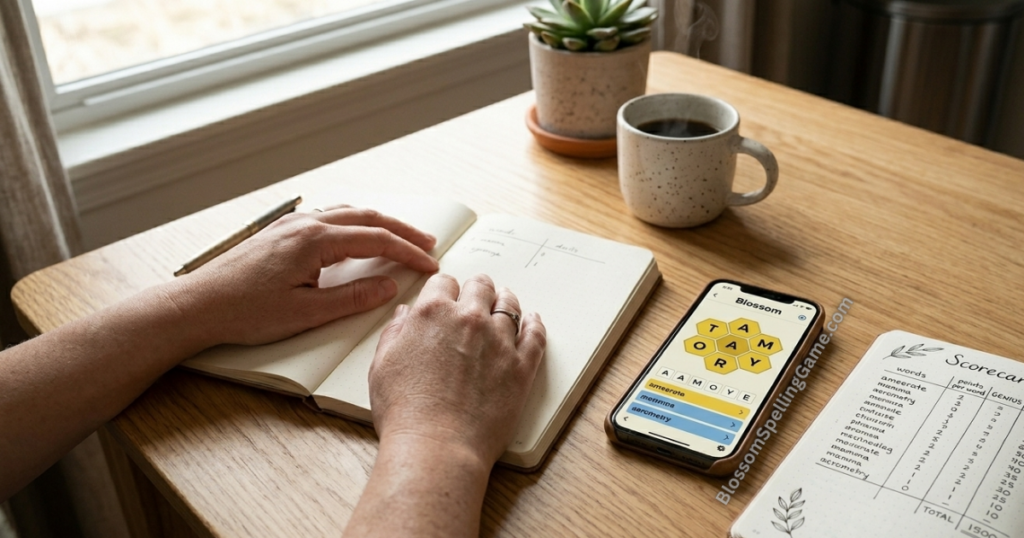
A standard Blossom session takes 10 to 30 minutes, depending on how aggressively you’re playing and how well the letters are working for you. Filling 12 slots with genuinely good words — especially while hunting the pangram — requires focused attention over a real window of time.
This isn’t a criticism. Blossom is designed to be a proper daily mental workout, not a commute filler. Players who approach it with dedicated time tend to score significantly better and enjoy the game more than those who try to squeeze it into stolen two-minute gaps.
Verdict: If your daily schedule is unpredictable and you need a word game that fits in five minutes or less, Wordle wins on pure time efficiency. If you can carve out 15–20 focused minutes — ideally in the morning, ideally with coffee — Blossom offers more depth per session. Many players find room for both: Wordle as the quick morning opener, Blossom as the sustained daily workout.
Scoring and Progression: Does Your Performance Actually Mean Anything?
One underrated aspect of daily word games is whether they give you meaningful feedback on your own improvement over time.
Wordle: Binary Outcome, Limited Progression Feedback
Wordle tells you whether you solved it and in how many guesses. That’s it. The game tracks your guess distribution (how often you solve it in 2, 3, 4, 5, 6 guesses) and your current streak. But there’s no skill-based ranking, no score that distinguishes a brilliant three-guess solve from a lucky three-guess solve.
The binary pass/fail structure means most sessions feel equivalent — you either got it in three guesses or four guesses, and the difference doesn’t compound into a meaningful progression story over time.
Blossom: Layered Scoring With a Real Progression Curve
Blossom’s scoring system creates a genuine, differentiated measure of performance that improves with skill. Blossom scores words by length — 4-letter words earn 1 point, 5-letter words earn 5, and every letter beyond that adds 1 point. The pangram earns a +7 bonus on top. The bonus petal letter adds +5 per word containing it. For the full breakdown, see our Blossom Scoring Guide.
This creates a system where a skilled player’s 12 words can score five to ten times more than a beginner’s 12 words — using the same letter set. A 4-letter word earns 1 point. An 8-letter pangram earns 15. That gap is measurable, trackable, and improvable.
The rank system — from Beginner through Genius — responds to your score, not just whether you “completed” the puzzle. Watching your average rank climb over weeks of consistent play is a genuinely satisfying progression arc that Wordle’s binary outcome can’t offer.
Verdict: For players who are motivated by measurable improvement and a clear sense of whether they’re getting better, Blossom’s scoring architecture is far more informative and satisfying. Wordle’s value is in its simplicity and social shareability — not in telling you how skilled you are.
Replayability and Variety: What Keeps You Coming Back?
Wordle: The Sameness Is the Point
Every Wordle session feels roughly the same — because the structure never changes. Six guesses, one word, same process. Some words are harder than others, but the experience of playing doesn’t vary significantly from day to day. That consistency is part of its appeal: you know exactly what you’re getting.
The “what keeps you coming back” answer for Wordle is almost entirely streak psychology and social sharing. You return because your streak would break if you didn’t, and because your group chat expects the emoji grid every morning.
Blossom: Every Day Is Genuinely Different
Blossom’s day-to-day variety is dramatically higher. Different letter sets produce wildly different strategic challenges. A letter set with E as the center letter opens up enormous vocabulary territory. A set with X or Z as the center letter is a completely different kind of puzzle. Some days the pangram is a common everyday word you find in five minutes. Other days it’s hiding inside something obscure that takes thirty minutes of focused effort.
Beyond the letters, the 12-slot budget mechanic means that even with the same vocabulary, different strategic decisions lead to different outcomes. You’re not just playing against the letters — you’re playing against your own prioritization choices.
Verdict: Wordle offers consistent, predictable variety (same structure, different word). Blossom offers genuine structural variety (different letters + different strategic puzzle each day). If you crave novelty and a sense that each session is its own distinct challenge, Blossom has a clear advantage.
Which Game Builds Better Vocabulary?
Here’s a question most people don’t think to ask when comparing word games — and the answer is more interesting than you’d expect.
Wordle: Vocabulary as a Tool, Not the Goal
In Wordle, you’re using vocabulary to solve a logic puzzle. Knowing more words helps — it expands your opener choices and gives you more options when you’re narrowing down possibilities. But the game’s core challenge is deduction, not vocabulary recall. A player with a modest vocabulary who thinks systematically will usually outperform a player with a massive vocabulary who guesses intuitively.
As a vocabulary-building tool, Wordle is limited. You encounter one new word per day (the answer), and the learning moment only arrives if it’s a word you didn’t know — which for most players is relatively rare.
Blossom: Vocabulary Is the Whole Game
Blossom’s core activity is vocabulary generation — pulling words from your mental lexicon and testing them against letter constraints. The more words you know, the more you find. The game also actively exposes you to words you didn’t know when you submit a longer guess and it gets accepted. That moment — “wait, CALYPSO is a word?” — happens regularly in Blossom and never in Wordle.
The 12-slot budget adds a particularly effective learning dimension. When you submit a short word early and later find a long word you missed, the regret of having wasted a slot cements that long word in your memory more effectively than simple exposure would. Regret-based learning is real and documented — high-stakes decisions create stronger memories.
Over six months of daily play, Blossom players encounter and actively engage with vastly more vocabulary than Wordle players. The generative nature of the challenge — searching your own mental word bank rather than being guided by feedback — also produces stronger retention.
Verdict: Blossom is meaningfully better as a vocabulary-building tool. Wordle is better as a logic puzzle wrapped in word clothing. If your goal is expanding your working vocabulary, Blossom is the more effective daily exercise.
Social Sharing and Streak Culture
This one has a clear winner, and it’s not Blossom — at least not yet.
Wordle: The Gold Standard of Social Sharing
Wordle’s emoji grid share format — those green, yellow, and gray squares that communicate your result without spoiling the word — is genuinely brilliant design. It’s spoiler-free, instantly readable, and lets you compare performance with anyone who played the same puzzle. The format went viral in early 2022 and essentially invented the modern social sharing meta for daily word games.
Wordle has by far the most established daily sharing culture. Group chats, social media, workplace conversations — “did you get Wordle today?” is a genuine daily social ritual for millions of people. The streak counter adds accountability that brings people back not just for themselves but because their social context expects them.
Blossom: Growing Social Layer, Different Social Experience
Blossom has a score-sharing feature, and BlossomSpellingGame.com makes it easy to share your daily result. But the sharing format is less universally readable than Wordle’s emoji grid — your Blossom score requires more explanation to people who haven’t played.
The social experience in Blossom is more about individual improvement and self-competition than the communal “same puzzle, compare results” ritual that Wordle delivers. That’s a different kind of social motivation — less viral, but arguably more sustainable for long-term habit formation.
Verdict: Wordle wins social sharing decisively. If your primary motivation for playing is connection with others over a shared daily experience, Wordle’s established social infrastructure is hard to match. Blossom’s social layer is real but smaller, and more focused on individual achievement than group comparison.
Cost and Accessibility
Both games are free in their primary forms — but with different structures.
Wordle is free with a basic NYT registration for a limited number of plays. Full access without limits requires a NYT Games subscription. For players who are already NYT subscribers (for news, crossword, or other games), Wordle comes at no additional cost. For players subscribing purely for Wordle, the cost is real.
Blossom Word Game at BlossomSpellingGame.com is completely free with no registration, no account, no subscription. Open the browser, play the puzzle. That’s it. No payment wall at any point.
Verdict: Blossom wins on pure accessibility. For players who want a free daily word game with no strings attached, Blossom is the cleaner option. Wordle’s free tier exists but has limitations depending on how you access it.
The Cognitive Science Behind Each Game
Both games are marketed as brain workouts — but they exercise different cognitive functions, and the research on each is interesting.
Wordle and Logical Reasoning
Wordle’s deduction mechanic engages working memory (holding previous guess results in mind), systematic elimination reasoning, and probabilistic decision-making. Research on daily logic puzzle habits suggests benefits for executive function — the cognitive system responsible for planning, reasoning, and cognitive flexibility.
Studies on similar deduction tasks show that systematic daily practice can maintain these functions as we age, particularly in adults over 40. The short session length also means high compliance — people actually do it every day, which matters for cumulative benefits.
Blossom and Verbal Fluency
Blossom’s generative mechanic engages verbal fluency (the speed and ease of word retrieval), working memory (holding letter constraints in mind while searching vocabulary), and semantic memory (accessing word meanings and word family relationships).
Research on verbal fluency tasks consistently shows that regular practice improves the speed and breadth of word retrieval — the exact skill Blossom exercises. Vocabulary generation tasks also produce stronger memory encoding than recognition tasks, which means the words you find in Blossom are more likely to stick than words you simply read or hear.
The combined case: The most cognitively complete daily routine might actually be both games — Wordle for the logical deduction exercise, Blossom for the verbal fluency workout. They activate different enough cognitive systems that there’s a genuine complementary benefit to playing both. Ten total minutes for Wordle, twenty for Blossom — a thirty-minute cognitive workout that covers more mental ground than either game alone.
Which Game Should You Play? (By Player Type)
Play Wordle if you:
- Have five minutes or less and need a complete, satisfying experience in that window
- Are motivated primarily by social sharing and comparing results with friends
- Prefer the clarity of a single right answer over an open-ended word search
- Enjoy logic puzzles and systematic elimination over vocabulary breadth
- Are already an NYT subscriber with Games access
- Want a game with a low time barrier you’ll actually complete every day
Play Blossom Word Game if you:
- Want a richer, more layered daily word experience
- Are building vocabulary actively and want measurable daily improvement
- Enjoy the strategic element of managing limited resources (12-slot budget)
- Have 15–20 focused minutes and want to use them well
- Prefer a free game with no subscription or paywall
- Are motivated by self-competition (beating your own score) more than social comparison
- Want a game with meaningful scoring that reflects skill improvement over time
Play both if you:
- Have 25–35 minutes available for word games daily
- Want to exercise both logical deduction AND vocabulary generation
- Are serious about cognitive fitness and want complementary daily exercises
- Enjoy variety in your puzzle routine
The honest truth: most people who try both keep both. They solve different puzzles — in both senses of that phrase.
FAQ
What is the main difference between Blossom Word Game and Wordle?
Wordle is a deduction game — you guess one hidden five-letter word using color-coded feedback across six attempts. Blossom is a generation game — you create valid words from seven given letters across up to 12 submissions, with scoring based on word length and a pangram bonus. They share the “daily word puzzle” label but test completely different cognitive skills.
Is Blossom Word Game harder than Wordle?
They’re hard in different ways. Wordle has a moderate, consistent difficulty level that plateaus fairly quickly once you develop good opener strategy. Blossom has a higher ceiling — reaching top ranks requires deep vocabulary, strategic slot management, and pangram-hunting skill that takes much longer to develop. For long-term challenge, Blossom is harder. For day-to-day frustration, Wordle’s occasional obscure answers can feel more punishing.
Does Blossom Word Game have a time limit like Wordle?
Neither game has a time limit during play — both are turn-based. The key constraint in Wordle is six guesses (not time). In Blossom, it’s 12 word slots. Wordle sessions typically take 2–5 minutes by nature; Blossom sessions typically take 10–30 minutes.
Can you play Blossom Word Game and Wordle on the same day?
Absolutely. They’re completely separate games that don’t interfere with each other. Many daily players do both — often starting with Wordle as a quick morning opener, then spending more time with Blossom afterward. Both reset at midnight Eastern Time.
Is Blossom Word Game free compared to Wordle?
Blossom at BlossomSpellingGame.com is completely free — no registration, no subscription, no payment. Wordle is free with basic NYT registration but full unlimited access requires a NYT Games subscription. If cost is a factor, Blossom has no paywall at all.
Which game is better for improving vocabulary — Blossom or Wordle?
Blossom is significantly better for vocabulary building. The game requires actively generating words from your own mental lexicon rather than deducing a single answer, which produces stronger vocabulary engagement and retention. Wordle primarily exercises logical deduction — vocabulary is a supporting skill, not the core challenge.
Do Blossom Word Game and Wordle reset at the same time?
Yes — both reset at midnight Eastern Time daily. A new Wordle word and a new Blossom letter set are both available at 12:00 AM ET each day. See our Blossom reset time guide for a full timezone breakdown.
Which is better for beginners — Blossom or Wordle?
Wordle has a faster learning curve because the rules are simpler and the feedback system guides you toward the answer. Blossom’s open-ended nature can feel harder to navigate at first. That said, Blossom’s natural session endpoint (12 words and done) prevents the open-ended overwhelm that some beginners experience with games like the NYT Spelling Bee. For absolute beginners to word games, Wordle is slightly easier to learn; Blossom is slightly more rewarding once you get comfortable.
Can you share your Blossom score like you share Wordle results?
Yes. BlossomSpellingGame.com has a score-sharing feature. The format is different from Wordle’s iconic emoji grid — it shows your score, rank, and words found. The sharing culture around Blossom is smaller but growing, while Wordle’s sharing format remains the most socially recognizable in the genre.
Which game do word game experts prefer?
Most serious word game enthusiasts play both and value each for different reasons. Wordle is praised for its elegant simplicity and social layer. Blossom is praised for its strategic depth and vocabulary workout. Neither has a consensus “expert preference” — they attract different playing styles that aren’t mutually exclusive.
Final Thoughts
Here’s the honest verdict after playing both games seriously: Wordle and Blossom are not competing for the same slot in your daily routine. They’re different enough — in mechanics, time commitment, cognitive demand, and social experience — that most players find room for both without one cannibalizing the other.
Wordle is the sprint. Fast, decisive, social. You know in five minutes whether you won. Blossom is the workout. Longer, more layered, more personally meaningful in terms of measurable improvement.
If you only have time for one: your social life points toward Wordle, your vocabulary and your score history point toward Blossom.
But if you’ve never tried Blossom and you’re a daily Wordle player — give it a week. The first day will feel disorienting because there’s no feedback loop guiding you. By day three, you’ll start seeing word families. By day seven, you’ll be hunting the pangram before you submit anything else, and your score will be climbing.
Play today’s Blossom puzzle at BlossomSpellingGame.com — free, no sign-up, ready right now. Your seven letters are waiting.