
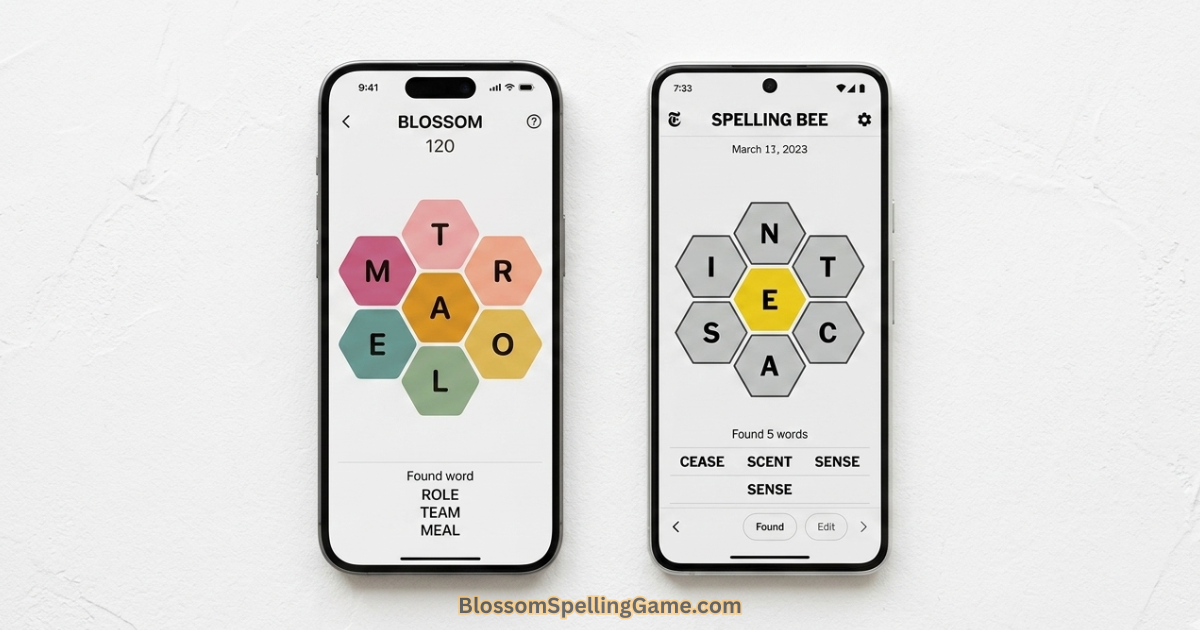
Blossom Word Game vs NYT Spelling Bee Both games. Seven letters. A flower-shaped grid. One mandatory center letter. On paper, they look almost identical — and if you’ve played both for even five minutes, you’ll feel the surface-level similarity immediately.
But here’s the thing that nobody seems to write about honestly: these games feel completely different to play, and the reasons why go much deeper than the basic rules. The word lists work differently. The scoring philosophy is different. The psychological experience of playing each one — the pressure, the satisfaction, the frustration — is different in ways that matter a lot if you’re trying to figure out which game deserves a permanent spot in your daily routine.
This isn’t a comparison article that just lists specs side by side. Those exist already — and they mostly tell you things you could figure out in two minutes of playing. This guide goes further: which game is genuinely harder, which one builds vocabulary faster, which one is better for beginners, and — maybe most importantly — what each game is actually designed to make you feel.
After playing both games daily for months, here’s the honest breakdown.
The Quick Overview: What Makes Each Game Distinct?
⚡ The Answer is : Both Blossom Word Game and the NYT Spelling Bee use seven letters in a hexagonal flower layout with a mandatory center letter, but they diverge significantly in four key ways: Blossom limits you to 12 word submissions while Spelling Bee is open-ended; Blossom uses Merriam-Webster’s full dictionary while Spelling Bee uses a curated editorial list; their scoring systems work on completely different logic; and Blossom is free while Spelling Bee requires a NYT subscription.
For a quick spec comparison, see our Blossom Rules Guide. What this article focuses on is everything that table can’t tell you — the strategic, psychological, and practical differences that only reveal themselves through actual play.
The Word Cap Difference — Blossom’s Biggest Strategic Differentiator
This is the single rule that changes everything about how you think while playing — and it’s consistently underappreciated in most comparisons.
NYT Spelling Bee: No word cap. Your goal is to find every valid word the letter set allows. You can submit words all day. There’s no penalty for finding too many. The puzzle is open-ended, and “Queen Bee” status (finding every valid word) is the ultimate achievement.
Blossom Word Game: You get exactly 12 word slots. Once all 12 are filled, the game ends and your score is locked. Every slot you fill is gone permanently — whether you spent it on a 4-letter throwaway or a 9-letter pangram.
Here’s why this matters enormously: in Blossom, every word submission is a strategic decision, not just a discovery. If you find “LANE” in the first two minutes and submit it, that’s one of your 12 slots spent on 1 point. If you later find “PLANETARY” — a pangram worth 9 base points plus 7 bonus — you’ve used a high-value slot budget on a low-value word, and you can’t get it back.
This creates a fundamentally different mental game. Spelling Bee rewards breadth — find everything you can, in any order, as fast as you can. Blossom rewards patience and prioritization — hold back, scan for big words first, and treat your 12 slots as a limited resource to be allocated wisely.
The practical implication: Blossom players who don’t understand the word cap tend to fill early slots with obvious short words and then feel stuck when the higher-value words finally appear. The strategic shift — waiting to submit 4-letter words until you’ve exhausted longer options — is what separates average Blossom scores from great ones.
Spelling Bee players switching to Blossom often struggle with this at first. The instinct in Spelling Bee is to submit anything valid the moment you find it. That instinct will hurt your Blossom score.
Which Game Has the Harder Word List?
This is probably the most-debated question among players who play both games, and the answer is more nuanced than most people expect.
NYT Spelling Bee: The Curated Editorial List
The Spelling Bee uses an internally curated word list maintained by NYT editors. This means two things that significantly affect the playing experience:
What it accepts: The editors specifically select words they consider fair and interesting. Common words, some technical vocabulary, a deliberately cultivated range of difficulty. The list is designed as a puzzle curation decision, not a dictionary lookup.
What it rejects: And here’s the famous frustration point. The NYT list regularly rejects perfectly valid English words. Common words. Words you’d find in any dictionary. Words you’d use in everyday speech. This has spawned an entire genre of complaint from long-time Spelling Bee players — and it’s a genuine grievance, not just sour grapes. When a game rejects “TEMPS” or “FRAT” or “ALOUD,” it feels arbitrary, because the standard is invisible.
Blossom: The Merriam-Webster Standard
Blossom’s word validation runs against Merriam-Webster’s comprehensive dictionary — one of the most complete records of American English in existence. The standard is clear: if Merriam-Webster lists it as a valid word, Blossom accepts it.
What this means in practice: Blossom tends to accept a wider range of words than Spelling Bee. Less common but legitimate vocabulary — technical terms, variant spellings, uncommon plurals — has a better chance of being accepted because the standard is the full dictionary, not an editorial selection.
The trade-off: Because the dictionary is broad, some Blossom puzzles will accept words that feel almost unrecognizably obscure. But at least when a word gets rejected, the reason is clear: it’s not in the dictionary. No mystery, no editorial whim.
Which Word List Is “Harder”?
Spelling Bee’s curated list makes it harder to predict which words will work — that unpredictability is itself a form of difficulty. Blossom’s dictionary-based approach makes individual word acceptance more consistent, but the puzzles can still be challenging based on which letters are available.
Most experienced players find Spelling Bee’s word list more frustrating in the early stages because of the rejection problem. Blossom’s word list feels more fair even when it’s challenging, because the standard (Merriam-Webster) is a known quantity.
Scoring Systems Compared: Two Very Different Philosophies
The scoring systems reveal the fundamentally different things each game is trying to reward.
Blossom’s Scoring: Length Is Everything
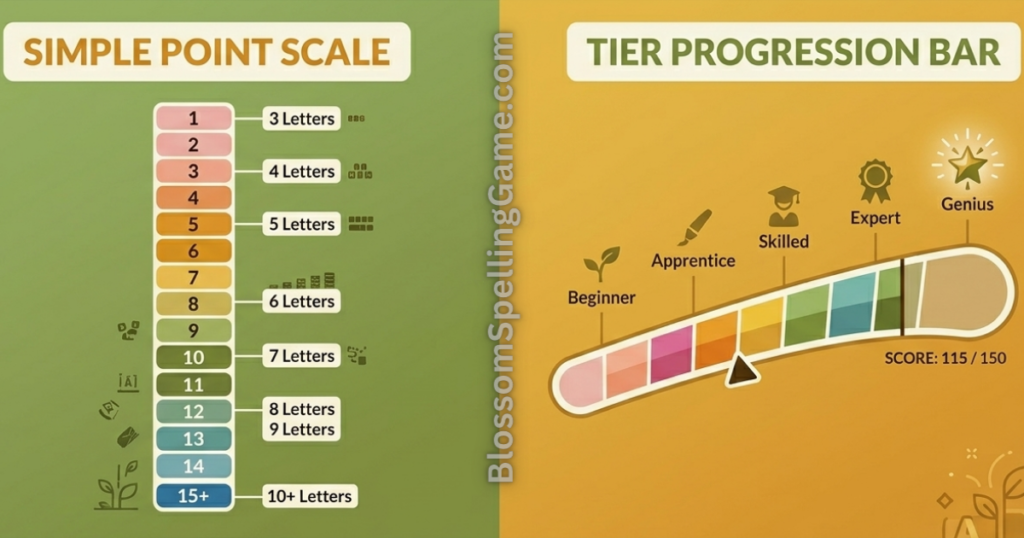
Blossom scores words by length — 4-letter words earn 1 point, 5-letter words earn 5, and every letter beyond that adds 1 point. The pangram (using all 7 letters) adds a +7 bonus on top. One highlighted bonus petal letter adds +5 every time it appears in a word. For the complete breakdown with examples, see our Blossom Scoring Guide.
The scoring message is blunt: short words are nearly worthless, long words are the whole game. A single 8-letter word earns 15 points — the same as fifteen 4-letter words. This design pushes players toward vocabulary depth and discourages grinding on obvious short words.
NYT Spelling Bee’s Scoring: The Tier System
Spelling Bee uses a different approach entirely. Points are awarded based on word length with a specific structure:
- 4-letter words: 1 point
- 5+ letter words: 1 point per letter
- Pangrams: base word score plus a 7-point bonus
So far, similar to Blossom. But the crucial difference is that Spelling Bee has no word cap — which means score accumulates as you find more words, not as you optimize which words you choose. In Spelling Bee, finding 40 four-letter words is a legitimate strategy because there’s no ceiling on submissions.
In Blossom, finding 12 four-letter words is a losing strategy because those 12 slots are your entire budget.
What This Means for How You Think
Spelling Bee scoring rewards volume and breadth — find as many valid words as possible, of any length.
Blossom scoring rewards quality over quantity — find the best possible words within your 12-slot budget.
Neither approach is objectively better. They create genuinely different intellectual experiences, and different players connect with one more naturally than the other.
Rank Systems: Genius vs. Genius
Both games use a rank progression system that grades your performance — and both call the top tier “Genius.” But the mechanics are meaningfully different.
Blossom’s Rank System
Blossom’s ranks (Beginner → Good → Solid → Great → Amazing → Genius) are calculated based on your score relative to the day’s total possible points. Because Blossom also caps you at 12 words, reaching the top ranks requires both finding high-value words and choosing them wisely within your slot budget.
Reaching Genius in Blossom on any given day means you’ve scored near the top tier for that specific puzzle — which almost always requires finding the pangram and stacking your 12 slots with long, high-value words.
NYT Spelling Bee’s Rank System
Spelling Bee’s ranks (Beginner → Good Move → Moving Up → Good → Solid → Nice → Great → Amazing → Genius → Queen Bee) are calculated as a percentage of the total possible points for the day’s puzzle. Reaching Genius requires hitting roughly 70% of the total possible points. Reaching Queen Bee — the true top achievement — means finding literally every valid word.
The Spelling Bee rank system has more tiers (9 vs. Blossom’s 7) and the Queen Bee designation is a distinct achievement above Genius. Regular Spelling Bee players treat Queen Bee as the real goal; Genius is just a milestone on the way.
Which is harder to reach?
Genius in Spelling Bee requires hitting ~70% of the puzzle’s total score, which typically means finding a substantial number of the available words — including the pangram. Many experienced players hit Genius regularly.
Genius in Blossom requires maximizing your 12-slot budget — finding the pangram, avoiding low-value early submissions, and consistently choosing longer words. In some ways, this is harder to execute because it requires forward-thinking strategy, not just vocabulary recall.
Which Game Is Harder?
Here’s the honest answer: it depends on what “hard” means to you.
Spelling Bee is harder if “hard” means:
- Finding every valid word (Queen Bee is genuinely difficult)
- Dealing with an unpredictable word list that rejects words you’re sure are valid
- Having a longer rank ladder to climb
- The sheer volume of words you need to know to reach the top
Blossom is harder if “hard” means:
- Making optimal decisions under constraint (12 slots forces strategic thinking)
- Finding the pangram with fewer overall words available to work from
- Achieving top ranks without the ability to compensate with volume
- Managing the bonus petal letter mechanic alongside everything else
Most players who’ve played both seriously for a month or more arrive at a similar conclusion: Spelling Bee has a higher ceiling (finding every valid word is an extraordinary achievement) but Blossom has a steeper strategic curve (the word cap means you can’t compensate for poor decision-making with more play time).
One honest observation: casual players tend to find Blossom less frustrating than Spelling Bee, largely because the word acceptance is more consistent. Intermediate players tend to find Spelling Bee more expansive because the open-ended format lets them keep finding words as long as they can. Advanced players appreciate both for different reasons.
Which Game Is Better for Beginners?
If you’ve never played either game and you’re deciding where to start, this section is for you.
Start with Blossom if:
- You’re completely new to this genre of word puzzle
- You want clear, consistent feedback on why words get accepted or rejected
- You prefer a focused, bounded session (12 words, done) over an open-ended hunt
- You’re playing primarily on mobile and want a clean interface
- You don’t want to pay for a subscription before you know if you’ll enjoy the format
Start with Spelling Bee if:
- You’re already a crossword player or serious word game enthusiast
- You enjoy the challenge of an open-ended puzzle with no artificial cap
- You don’t mind (or actively enjoy) a word list that occasionally feels arbitrary
- You’re already a NYT subscriber with Games access
The beginner learning curve in Blossom is gentler for one specific reason: the word cap gives you a natural exit point. In Spelling Bee, it can be hard to know when to stop — there are always more words to find, and the open-endedness can feel overwhelming for new players. Blossom’s 12-word structure says “you’re done now” in a way that feels satisfying rather than abandoned.
For most absolute beginners, Blossom is the better starting point. The rules are clean, the feedback is consistent, and the session length is naturally bounded. Get comfortable here, then try Spelling Bee when you’re ready for a more expansive challenge.
Which Game Teaches More Vocabulary?
This is a question I find genuinely interesting — and the answer surprised me.
You’d intuitively think Spelling Bee teaches more vocabulary, because it exposes you to more words per session (no cap) and has a post-puzzle word reveal that shows everything you missed. And in raw terms of words-encountered-per-session, that’s probably true.
But here’s what Blossom does that Spelling Bee doesn’t: the 12-slot constraint forces you to think harder about each word before you commit. In Spelling Bee, you find a word and submit it immediately. In Blossom, you find a word and have to evaluate it — is this long enough to be worth a slot? Should I hold this 5-letter word and keep hunting for something longer?
That active evaluation — sitting with a word, thinking about its value, comparing it to alternatives — is cognitively different from the rapid-fire submission of Spelling Bee. And cognitive science research consistently shows that active, effortful processing of vocabulary items leads to better long-term retention than passive exposure.
The words you agonize over in Blossom — the ones you nearly submit and then hold back — tend to stick in memory better than words you submit instantly in Spelling Bee.
The practical answer: Both games build vocabulary over time, and consistent daily play is more important than which game you choose. But Blossom’s strategic layer creates a slightly different type of vocabulary engagement that may, for many players, lead to deeper word learning per session.
The Social and Community Dimension
This is a dimension that matters more than most players admit, and it heavily favors the Spelling Bee.
NYT Spelling Bee has been around longer, has a massive installed user base, and has developed a genuine cultural presence — subreddits, Twitter communities, group chats, family traditions built around the daily puzzle. The NYT’s brand and subscriber base has given Spelling Bee a community flywheel that generates enormous organic engagement.
Blossom is newer to mainstream awareness and has a smaller but growing community. The share feature is there. The score comparisons are there. But the established social rituals — the group chats, the Reddit threads, the coworker conversations — are less developed.
What this means practically: If your enjoyment depends significantly on comparing scores with friends, sharing results publicly, or being part of an existing community conversation, Spelling Bee currently has the advantage. If you primarily play solo and the social layer is secondary, this difference doesn’t affect your decision.
It’s worth noting: community size typically tracks time in market, not quality. Blossom’s community is growing, and the game’s fundamentals are strong enough to support that growth over time.
Cost: Free vs. Subscription
One comparison that’s straightforward: Blossom Word Game is free. The daily puzzle at BlossomSpellingGame.com requires no account, no subscription, and no payment of any kind.
NYT Spelling Bee is behind the NYT Games paywall. As of 2026, this requires either a standalone Games subscription or a broader NYT subscription. Pricing has changed over the years, but it’s a recurring cost regardless.
For players who are already NYT subscribers for news or crosswords, Spelling Bee comes at no additional marginal cost — it’s bundled in. For players who only want the word game, paying specifically for Spelling Bee access feels steep when Blossom (a comparable experience) is available for free.
The honest take: Cost shouldn’t drive you toward a worse fit just to save money. If Spelling Bee genuinely suits your playing style better, the subscription cost is probably worth it. But if you’re genuinely undecided between two comparable games, the price difference is a meaningful tiebreaker.
The Psychological Experience of Each Game
This is the section most comparison articles skip entirely — and it’s arguably the most important one for deciding which game actually belongs in your daily life.
Playing the NYT Spelling Bee feels like: A scavenger hunt with no time limit and no defined endpoint. You’re hunting through a large, unknown word space, and you don’t know how close you are to “done” until you check your rank against the available word count. There’s a particular satisfaction in watching your rank climb from Solid to Great to Amazing. But there’s also a particular frustration in knowing there are still words you’re missing that you simply can’t find — and the post-puzzle reveal can sting when you see obvious words you inexplicably missed.
The Spelling Bee experience tends toward expansive — you always feel like there’s more to find, which can be motivating or anxiety-inducing depending on your personality.
Playing Blossom Word Game feels like: A resource allocation puzzle wrapped around a vocabulary test. You’re making active decisions — not just finding words, but choosing which words to commit to. The 12-slot boundary creates a satisfying sense of completeness when you fill all 12. The pangram hunt is more urgent because your slot budget is finite. Finding a high-value 8-letter word in slot 10 feels different than finding it in Spelling Bee, because in Blossom, that word is a choice — it beats whatever you might have submitted instead.
The Blossom experience tends toward focused — a defined beginning, a constrained middle, and a clear end. For players who like sessions with natural stopping points, this is a significant quality-of-life advantage.
Which Game Should You Play? (By Player Type)
After everything above, here’s the practical framework:
Choose Blossom Word Game if you:
- Are new to this game format and want the gentler learning curve
- Prefer focused, bounded sessions over open-ended hunts
- Play primarily on mobile and want a free, no-download option
- Value consistent word acceptance over editorial curation
- Are motivated by strategic optimization (slot management, bonus petal, pangram priority)
- Don’t want or can’t justify a subscription cost for a word game
- Play at BlossomSpellingGame.com where the past puzzle archive adds long-term learning value
Choose NYT Spelling Bee if you:
- Are already an NYT subscriber
- Enjoy the open-ended format and want the challenge of finding every word
- Are comfortable with (or enjoy) a curated word list even when it feels arbitrary
- Are motivated by community — the Spelling Bee has a much larger established player base
- Want the prestige mechanic of Queen Bee status
- Have been playing word games seriously for years and want a longer daily session
Play both if you:
- Have 20–30 minutes for word games in your day
- Want to engage different strategic muscles (breadth vs. depth)
- Are serious about vocabulary building and want maximum daily practice
Genuinely, there’s no wrong answer here. These games complement each other more than they compete. Most serious word game players end up enjoying both for the different things they demand.
FAQ
What is the main difference between Blossom Word Game and NYT Spelling Bee?
The biggest difference is the word cap: Blossom limits you to 12 word submissions, making every choice a strategic decision, while Spelling Bee is open-ended and rewards finding as many words as possible. Blossom is also free and uses Merriam-Webster’s full dictionary, while Spelling Bee requires a NYT subscription and uses a curated editorial word list.
Is Blossom Word Game the same as NYT Spelling Bee?
No. They share the same core format — seven letters in a hexagonal flower layout with a mandatory center letter — but differ significantly in word cap, scoring, word list, cost, and strategic emphasis. Playing both regularly, the differences become very apparent within the first week.
Which is harder, Blossom or NYT Spelling Bee?
Spelling Bee has a higher ceiling (Queen Bee status requires finding every valid word) but Blossom has a steeper strategic curve (12-slot budget forces prioritization decisions that pure vocabulary games don’t). Most players find Spelling Bee more frustrating due to its unpredictable word list rejections, while Blossom is more strategically demanding within a defined session.
Is Blossom Word Game free unlike the NYT Spelling Bee?
Yes. Blossom Word Game is completely free to play at BlossomSpellingGame.com — no account, no subscription, no payment required. NYT Spelling Bee requires a paid NYT Games subscription.
Do Blossom and Spelling Bee use the same word list?
No. Blossom uses Merriam-Webster’s comprehensive dictionary. The NYT Spelling Bee uses an internally curated editorial word list. A word that Blossom accepts may be rejected by Spelling Bee, and vice versa. The dictionary-based approach tends to make Blossom’s word acceptance feel more consistent and less arbitrary.
Which game is better for beginners?
Blossom is generally the better starting point for beginners. The rules are simpler to internalize, word acceptance is more consistent, and the 12-word cap creates a natural, satisfying session endpoint. Spelling Bee’s open-ended format can feel overwhelming for players who are new to the genre.
Do both games have a pangram?
Yes. Both Blossom and NYT Spelling Bee feature a pangram — a word using all seven available letters — that earns a bonus 7 points on top of its base word score. In both games, finding the pangram is one of the most satisfying single moments in any puzzle session.
Can you play Blossom on the same device as Spelling Bee?
Yes — they’re completely separate games that don’t interfere with each other. Many daily word game players play both every morning, typically starting with one and finishing the other before moving on with their day.
Which game resets at the same time?
Both games reset at midnight Eastern Time. A new puzzle is available on both platforms every day at 12:00 AM ET. See our Blossom reset time guide for a full timezone breakdown.
Is there a way to play Spelling Bee for free?
The NYT Spelling Bee is behind a paywall, though the NYT occasionally offers free trials. If cost is a concern, Blossom at BlossomSpellingGame.com offers a comparable daily word puzzle experience with no payment required.
Final Thoughts
Here’s the honest bottom line after months of playing both games seriously:
They are not the same game wearing different clothes. The shared format — seven letters, flower grid, center letter, pangram — is where the similarity ends. What they do with that format is genuinely different in ways that create different intellectual and emotional experiences.
Spelling Bee is a vocabulary marathon. Blossom is a vocabulary sprint with a budget. Both are worth your time. Neither is objectively superior — only better or worse for your specific habits, preferences, and playing style.
If you’re still undecided: play Blossom first. It’s free, it’s immediately accessible at BlossomSpellingGame.com, and its focused format makes it easier to evaluate whether this type of game is for you before committing to a subscription for Spelling Bee.
Play today’s puzzle. Give it a week. Then you’ll know which game you actually want in your daily rotation — and you might end up keeping both.