
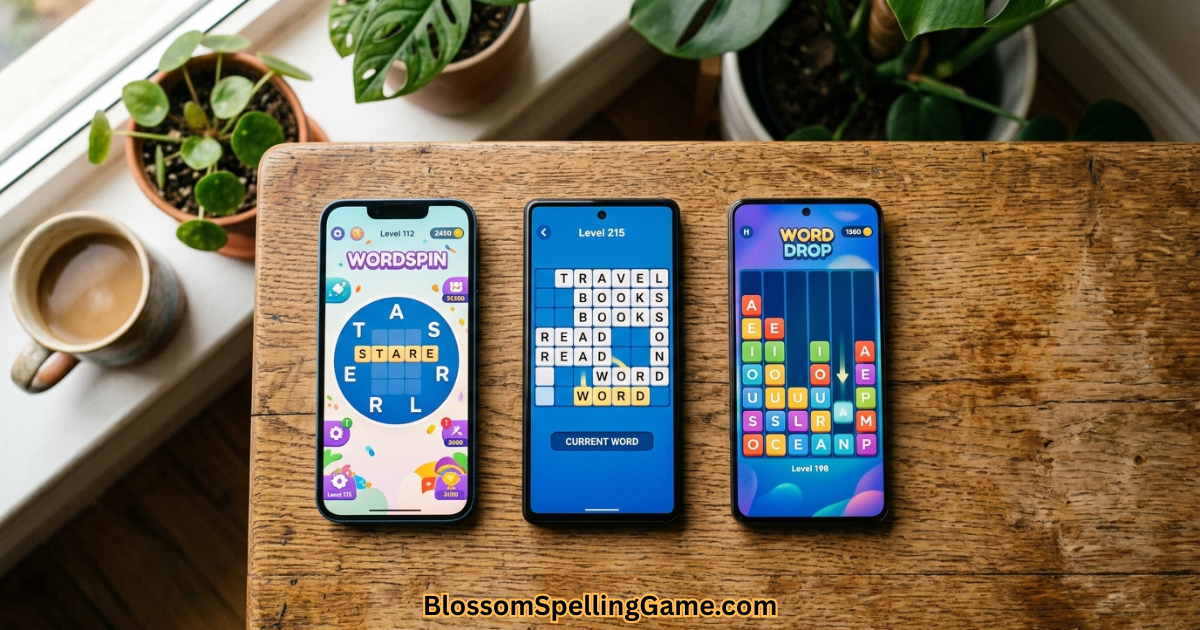
You’ve played today’s Blossom puzzle. You found the pangram. You filled all 12 slots with words that actually made you feel clever. And now you’ve got twenty minutes left in your lunch break and nothing to do with them.
Sound familiar?
It’s the specific problem that dedicated Blossom players run into — the daily puzzle scratches a very particular itch, and when it’s done, it’s done until midnight. One puzzle per day is a feature, not a limitation. But that doesn’t stop you from wanting more of that exact feeling: the hunt, the vocabulary stretch, the satisfying click when a word you almost didn’t try gets accepted.
The good news is that the daily word puzzle genre has exploded in the last few years, and there are genuinely excellent games sitting in your browser right now that deliver variations of that same feeling — some through different mechanics, some through different vocabulary challenges, some through completely different strategic layers.
This list is built around what Blossom players specifically tend to enjoy: vocabulary generation over deduction, daily puzzles with fresh content, meaningful scoring that rewards skill, and free access without subscription pressure. Games on this list were chosen because they complement Blossom’s strengths, fill gaps it doesn’t cover, or offer the same satisfying word-finding experience through a different lens.
A quick note before we dive in: Wordle and NYT Spelling Bee are the two most obvious comparisons to Blossom, and we’ve already covered them in depth — Blossom vs. Wordle and Blossom vs. NYT Spelling Bee. They won’t appear in this list so we can focus on ten games you might not know as well.
Let’s get into it.
What Makes a Word Game Worth Playing After Blossom?
Not every word game scratches the same itch. Before jumping into the list, it’s worth being clear about what Blossom players specifically tend to value — because a game that’s great for a Wordle fan might feel completely flat to someone who loves Blossom’s vocabulary-generation mechanic.
Blossom players tend to appreciate:
- Active vocabulary generation — creating words from given letters, not guessing a hidden answer
- Meaningful scoring — a system where skill translates to a measurable, improvable result
- Daily freshness — new content every day without grinding through hundreds of levels
- Depth within simplicity — clean rules with strategic layers underneath
- Free access — no paywall blocking the core experience
The games on this list score well on at least three of those five criteria. Some are very close to Blossom in mechanics. Others are different enough to exercise a complementary set of vocabulary skills. All of them are worth your time.
Top 10 Word Games Like Blossom Word Game
1. Quordle
Best for: Blossom players who want more puzzle per session without leaving the word-guessing format
Where to play: Quordle (free)
How it works: Think Wordle — but you’re solving four five-letter words simultaneously with nine total guesses. Every guess you make applies to all four boards at once. You have to track four separate sets of color-coded feedback at the same time, which creates a genuinely different cognitive challenge from single-word guessing games.
Why Blossom players like it: Quordle doesn’t just stack four Wordles — it changes the strategic game entirely. You’re constantly balancing progress across multiple boards, deciding which word to sacrifice guess efficiency on to unlock information elsewhere. That multi-track thinking has something in common with Blossom’s 12-slot budget management — both reward strategic prioritization, not just word knowledge.
Session length: 5–15 minutes
Difficulty: Moderate to high — harder than Wordle, especially early in the week when letter sets are trickier
One thing I noticed: Players who find Wordle too easy often describe Quordle as the first daily word game that genuinely challenged them. The simultaneous four-board format makes even experienced word game players feel like beginners again for the first week or two.
2. NYT Connections
Best for: Blossom players who want to exercise categorical thinking alongside vocabulary
Where to play: NYT Games (free tier available; full access with subscription)
How it works: You’re presented with 16 words and have to group them into four categories of four words each. The categories are thematic — things that share a hidden connection — and they range from obvious to fiendishly obscure. You get four attempts before the puzzle locks you out.
Why Blossom players like it: Connections tests a different type of word knowledge than Blossom — not “what words can I make from these letters?” but “what do these words have in common?” It exercises semantic memory and associative thinking rather than generative vocabulary recall. For Blossom players, it’s a satisfying cognitive gear-shift that feels related but different enough to be fresh.
Session length: 3–8 minutes
Difficulty: Variable — the purple category (hardest) regularly humbles even experienced players
The trap everyone falls into: The categories often contain red herrings — words that seem to belong together but don’t. The most satisfying Connections sessions are ones where you see through a deliberate misdirection and find the actual grouping underneath. This lateral thinking dimension has no equivalent in Blossom, which makes Connections an excellent complement.
3. NYT Strands
Best for: Blossom players who love the hidden-word-within-a-grid feel
Where to play: NYT Games (free; full access with subscription)
How it works: A daily word search — but with a twist that makes it genuinely strategic. You’re given a grid of letters and a daily theme. Your job is to find hidden words that all relate to the theme, plus one “spangram” — a theme word that stretches across the entire board and connects two opposite edges. Unlike traditional word searches, every letter in the grid belongs to exactly one word, so finding one word helps reveal others.
Why Blossom players like it: The spangram hunt in Strands is almost identical in feel to the pangram hunt in Blossom — that one high-value word hiding inside the puzzle that unlocks a satisfying bonus. Blossom players who’ve trained themselves to hunt pangrams systematically often find the spangram comes naturally. The theme-based word grouping also adds a vocabulary dimension that pure letter scrambles don’t have.
Session length: 5–15 minutes
Difficulty: Moderate — easier than the NYT crossword but harder than a standard word search
What makes it special: The constraint that every letter belongs to exactly one word turns the puzzle into something elegant. Every section of the grid is a clue to what’s near it. Once you grasp this, you start solving Strands spatially in a way that’s genuinely satisfying.
4. Waffle
Best for: Blossom players who want a spatial word puzzle that rewards rearrangement thinking
Where to play: wafflegame (free)
How it works: Six five-letter words arranged in a waffle-shaped grid (three horizontal, three vertical, sharing intersection letters). All the letters are present — but they’re in the wrong positions. You swap letters to move them into their correct spots, with a maximum of 15 swaps to achieve a perfect solve. Green letters are already correct, yellow letters are in the wrong position.
Why Blossom players like it: Waffle exercises the same spatial-vocabulary thinking that Blossom’s flower grid demands — you’re thinking about letters in positions, about which combinations are valid, about how moving one piece affects everything else. The constraint mechanic (15 swaps for perfect; fewer for a higher star rating) creates the same kind of efficiency pressure that Blossom’s 12-slot budget does.
Session length: 5–10 minutes
Difficulty: Low to moderate — most players complete it consistently, but perfecting the swap count is genuinely challenging
The star rating system: Waffle awards 1–5 stars based on how few swaps you used. A five-star solve (using the minimum possible swaps) is the Waffle equivalent of finding the pangram in Blossom — achievable with practice, genuinely satisfying when you get it.
5. Semantle
Best for: Blossom players who want to explore vocabulary meaning rather than vocabulary spelling
Where to play: semantle (free)
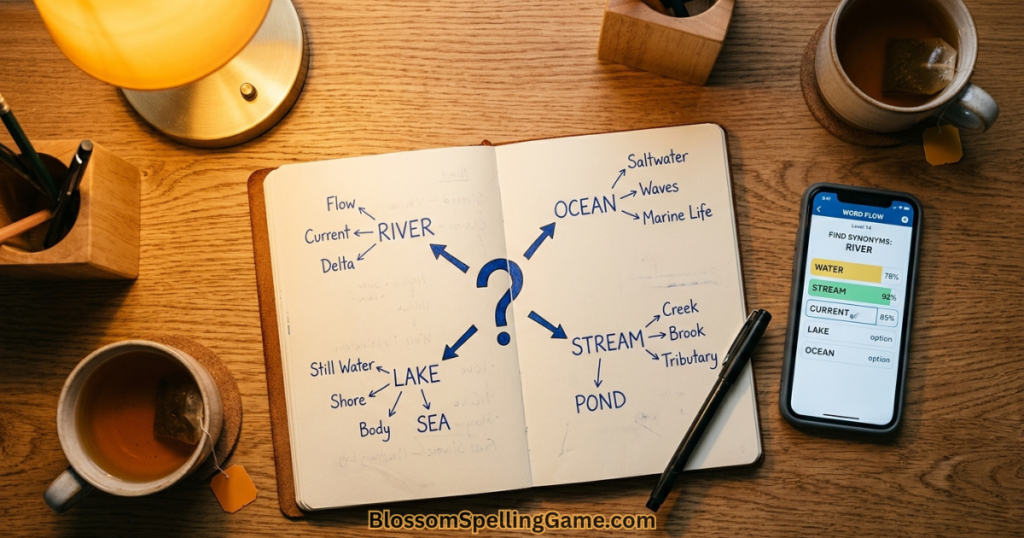
How it works: Every day, there’s one secret word. You guess words, and the game tells you how semantically similar your guess is to the answer — measured as a number from 0 to 100 based on word vector proximity in a language model. You’re not looking for spelling patterns; you’re searching for meaning relationships. A guess of “ocean” might be 72% similar to “water.” A guess of “desk” might be 3%.
Why Blossom players like it: Semantle exercises a completely different dimension of vocabulary knowledge — not how words are spelled or constructed, but how they relate to each other in meaning. For word game enthusiasts who’ve been playing Blossom long enough to have internalized common letter patterns, Semantle offers a fresh challenge that’s entirely about semantic association rather than orthographic structure.
Session length: 10–30 minutes (highly variable — some days you solve it in 20 guesses, some days you’re still at it after 100)
Difficulty: High to very high — this is the most cognitively demanding game on the list for many players
A fair warning: Semantle can be frustrating in a way other games aren’t. There’s no color feedback, no clear narrowing-down process, and some solutions are words you’d never have reached through logical elimination. But when you’re in the warm zone (70+) and closing in on the answer, it’s uniquely satisfying.
6. Letter Boxed
Best for: Blossom players who want a vocabulary challenge with a spatial constraint twist
Where to play: NYT Games (free tier available)
How it works: 12 letters arranged on the four sides of a square — three letters per side. Your challenge: use all 12 letters to make words, where each consecutive letter in a word must come from a different side of the box. Words chain together (the last letter of one word becomes the first letter of the next), and you’re trying to use all 12 letters in the fewest words possible.
Why Blossom players like it: Letter Boxed shares Blossom’s love of making the most of a constrained letter set — and it adds a spatial rule (letters on the same side can’t follow each other) that creates delightful puzzle moments where a word you’d normally reach for suddenly doesn’t work. The “fewest words” optimization is a close cousin to Blossom’s “best possible 12 slots” optimization.
Session length: 5–20 minutes
Difficulty: Moderate — two-word solutions exist for every puzzle, but finding them requires vocabulary breadth and creative routing
The two-word solution hunt: Every daily Letter Boxed has at least one two-word solution — a pair of words that together use all 12 letters. Finding it is Letter Boxed’s equivalent of the pangram. Some days it’s immediately obvious; other days it takes the full twenty minutes. Blossom players who’ve practiced systematic pangram hunting tend to adapt this skill well here.
7. TypeShift
Best for: Blossom players who want an infinite daily word puzzle with a column-sliding mechanic
Where to play: iOS App Store (free with optional paid puzzles); zachtronics.com
How it works: Three or more columns of letters on a wheel — each column rotates independently. Your goal is to form valid words using one letter from each column simultaneously, and every letter gets “checked off” once it’s been used in a valid word. The puzzle is complete when every letter in every column has been checked off at least once.
Why Blossom players like it: TypeShift rewards the same kind of letter-combination thinking that Blossom does — you’re constantly asking “what word can I make from this specific constraint set?” The column-rotation mechanic creates a spatial puzzle layer that Blossom doesn’t have. When you find a word that checks off several hard-to-reach letters in one move, it delivers the same click of satisfaction as finding a long word in Blossom that uses the bonus petal letter three times over.
Session length: 5–15 minutes per puzzle
Difficulty: Low to moderate — the puzzle format is forgiving enough for beginners while offering elegant optimization for advanced players
What sets it apart: TypeShift is designed by Zach Gage, one of the best mobile game designers working today (also behind SpellTower, which appears later on this list). His games are consistently polished in a way that’s rare in the word game genre.
8. Squardle
Best for: Blossom players who want Wordle-style mechanics pushed to their logical extreme
Where to play: fubargames.com/squardle (free)
How it works: A six-word grid where you’re guessing all six words simultaneously — horizontally and vertically. Every guess updates feedback across the entire grid at once. You’re solving a crossword and a Wordle at the same time, with color-coded feedback telling you which letters are correct, present, or absent across multiple intersecting words.
Why Blossom players like it: Squardle rewards the kind of systematic, multi-track thinking that Blossom’s 12-slot budget demands. You’re not just solving one puzzle — you’re managing information across six interdependent solutions, deciding which board to prioritize, and letting progress on one word inform your guesses on intersecting ones. The complexity is addictive for players who’ve graduated past single-word daily puzzles.
Session length: 15–30 minutes
Difficulty: High — this is a game for players who genuinely want a challenge
The learning curve: Squardle takes a few sessions to really click. The first time you play, the simultaneous six-board feedback can feel overwhelming. By session four or five, you’ll start seeing the elegant logic underneath, and that’s when it becomes genuinely compelling.
9. Wordscapes
Best for: Blossom players who want a polished mobile experience with a similar core mechanic
Where to play: iOS App Store / Google Play (free with optional purchases)
How it works: A circular letter arrangement — similar in spirit to Blossom’s flower — where you swipe between letters to form words that fit into a crossword-style grid of blank spaces. Find all the words that fit the grid and you complete the level. New levels are added constantly.
Why Blossom players like it: Wordscapes is the closest mobile game to Blossom’s core mechanic on this list. You’re forming words from a constrained letter set, the circular layout has visual similarities to Blossom’s flower grid, and the crossword integration adds a satisfying “does this word fit the grid?” constraint on top of “is this a valid word?”
Session length: 5–15 minutes per level; open-ended (hundreds of levels available)
Difficulty: Variable — early levels are accessible for beginners, later levels require real vocabulary depth
The trade-off versus Blossom: Wordscapes isn’t a daily puzzle — it’s a level-based progression game with hundreds of levels. This is both its strength (you never run out of content) and its limitation (it doesn’t have the shared daily experience of a synchronized puzzle). If you love Blossom’s daily-reset structure, Wordscapes works best as a between-days supplement rather than a replacement.
10. SpellTower
Best for: Blossom players who want a vocabulary challenge with timing pressure and cascading satisfaction
Where to play: iOS App Store / Google Play (paid, ~$3–5; worth every cent)
How it works: A tower of letter tiles fills the screen. You swipe to connect adjacent letters and form words — longer words clear more tiles, and unused tiles cause the tower to rise. The game ends when the tower overflows the screen. SpellTower rewards long word formation with powerful tile clears, and punishes short-word grinding with an ever-rising tower.
Why Blossom players like it: SpellTower’s scoring philosophy is almost identical to Blossom’s: long words dramatically outperform short words, and grinding four-letter words is a losing strategy. Blossom players who’ve already internalized “find the longest word possible” are well-prepared for SpellTower’s tile-clearing economics. The satisfying cascade when a long word clears a section of the board is the closest tactile equivalent to finding the pangram in Blossom.
Session length: 10–30 minutes (open-ended; ends when the tower overflows)
Difficulty: Moderate to high — casual mode is accessible; the competitive Rush mode will test even experienced players
Why it’s the only paid game on this list: SpellTower is one of the few mobile word games that genuinely justifies a price. It was designed by Zach Gage (same designer as TypeShift), it’s been consistently updated for over a decade, and it has no in-app purchase model — one payment, full game. In a genre full of ad-laden free games, that’s worth acknowledging.
Honorable Mentions
These two deserve recognition but appear elsewhere on the site with full dedicated coverage:
NYT Spelling Bee — The most direct Blossom competitor. Open-ended word generation from seven letters with a mandatory center letter, curated word list, and the Queen Bee achievement as the ultimate goal. Full comparison: Blossom vs. NYT Spelling Bee.
Wordle — The game that launched the daily puzzle boom. Five-letter word deduction in six guesses, shared daily answer, iconic emoji share format. Full comparison: Blossom vs. Wordle.
How to Build the Perfect Daily Word Game Routine?
If you’ve made it this far, you’re probably not a casual “one puzzle a week” type. You’re someone who genuinely enjoys this genre — which means a multi-game daily routine is worth thinking about intentionally.
Here’s a framework that works well for serious word game players without eating your entire morning:
The Quick Opener (5 minutes): Quordle or Waffle. Something that gives you a complete, satisfying experience fast. Get the quick win before anything else.
The Main Event (15–20 minutes): Blossom at BlossomSpellingGame.com. This is your vocabulary workout — the puzzle that demands the most from your word generation and strategic thinking. Approach it after the quick opener, when your brain is already warmed up.
The Thinker (5–10 minutes): NYT Connections or Semantle. One exercises categorical vocabulary, the other exercises semantic association. Both demand a different kind of thinking than Blossom and make you better at vocabulary in dimensions the letter-generation games don’t cover.
The Evening Wind-Down (optional, 10–15 minutes): SpellTower or Wordscapes. Something slightly more relaxed, open-ended, and pressure-free. Good for processing and consolidating the vocabulary you’ve engaged with throughout the day.
Total time investment: 35–50 minutes across the day, split into natural breaks. For players who genuinely want to build vocabulary while maintaining a sustainable daily habit, this is the architecture that delivers the best results without burning out.
FAQ
What games are similar to Blossom Word Game?
The closest games to Blossom’s core mechanic are NYT Spelling Bee (open-ended seven-letter word generation with a mandatory center letter), Letter Boxed (word formation from a constrained 12-letter set), and Wordscapes (swiping through circular letter arrangements to fill crossword grids). For the same satisfying long-word prioritization feel, SpellTower and TypeShift are excellent alternatives.
Are there free word games like Blossom Word Game?
Yes — most of the games on this list are free. Quordle, Waffle, Semantle, and Letter Boxed are all free to play in a browser with no account required. NYT Connections and Strands have a free tier. Only SpellTower requires a one-time purchase (~$3–5). Blossom itself remains completely free at BlossomSpellingGame.com.
What word game should I play if I like the pangram mechanic in Blossom?
NYT Strands has a “spangram” — a theme word that spans the entire board — that delivers a very similar hunt-and-find satisfaction to Blossom’s pangram. Letter Boxed’s two-word solution hunt is also a close equivalent. For a pure letter-generation challenge, NYT Spelling Bee has a pangram with the same +7 bonus structure.
Is there a word game with the same 12-word limit as Blossom?
Blossom is relatively unique in its 12-slot budget mechanic among major daily word games. No other game on this list uses the same structure. However, Waffle’s swap-count optimization (minimizing moves for a higher star rating) creates a similar efficiency pressure that Blossom players tend to find engaging.
What’s the hardest word game on this list?
Semantle is the most cognitively demanding for most players — there’s no letter-based feedback, the semantic similarity system can feel opaque, and solutions can require hundreds of guesses. Squardle is the hardest structurally — simultaneously solving six interconnected word puzzles is genuinely difficult. Both reward investment more than most casual daily puzzles.
Which word games on this list work on mobile?
All of them have good mobile experiences. Wordscapes, SpellTower, and TypeShift are natively designed for mobile (iOS/Android apps). Quordle, Waffle, Semantle, Letter Boxed, Connections, and Strands all work well in mobile browsers. Squardle is playable on mobile but was originally designed for desktop — the grid can feel cramped on smaller phone screens.
Can I play these word games offline?
SpellTower and TypeShift work offline as downloaded apps. Wordscapes downloads levels for offline play after an initial connection. The browser-based games (Quordle, Waffle, Semantle, Letter Boxed, Connections, Strands, Squardle) require an internet connection to load the daily puzzle.
How is Blossom Word Game different from Wordscapes?
Both use a circular letter arrangement and require forming words from a constrained letter set. The key differences: Blossom is a daily puzzle (one fresh puzzle per day, shared by all players) while Wordscapes is level-based (hundreds of sequential levels with no daily reset). Blossom has a 12-slot budget mechanic and a pangram bonus; Wordscapes fills a crossword grid without those specific constraints. Blossom is browser-based and completely free; Wordscapes is app-based with in-app purchases.
Final Thoughts
The daily word puzzle genre is richer than most people realize — and Blossom is a genuinely excellent entry point into it. But once you’ve got the flower grid in your muscle memory and the pangram hunt in your instincts, branching out into complementary games is how you keep growing as a word player.
The ten games on this list aren’t replacements for Blossom. They’re additions — each one exercising a slightly different vocabulary muscle, offering a slightly different kind of satisfaction, and filling different time slots in a daily routine that Blossom can’t fill on its own.
Start with whatever sounds most interesting from the descriptions above. Give it three to five days before you judge it — most of these games take a few sessions to reveal their real depth. And keep coming back to BlossomSpellingGame.com for your daily puzzle, because the vocabulary foundation you build there makes every other word game on this list feel more accessible.
Today’s Blossom puzzle is already waiting. Play it first — then explore the rest.