
You just finished a round of Blossom, stared at your score, and thought — is that good? Maybe you hit 180 points and your friend hit 310. Now you’re wondering where you actually stand.
Here’s the thing: Blossom word game scoring confuses a surprising number of players, even ones who’ve been playing for months. The system looks simple on the surface — find words, earn points — but there’s a layered mechanics underneath that most people never fully figure out. And that gap is exactly what keeps casual players stuck at “Good” while others are climbing to “Genius” or beyond.
This guide breaks down everything. How the scoring system actually works, what counts as a competitive score in 2026, what the pangram bonus really does to your total, and the common patterns that separate average players from top-tier ones. Whether you’re brand new or just looking to finally crack that high score you’ve been chasing, this is the most complete breakdown you’ll find.
Let’s get into it.
Scoring in Blossom Word Game — The Complete Breakdown
Blossom scores every valid word based on its length. The longer the word, the more it’s worth — and the jump between 6 and 7 letters is dramatic enough to completely change how smart players approach each puzzle.
| Word Length | Points Earned | Notes |
| 4 letters | 1 point | Flat rate — minimum entry |
| 5 letters | 5 points | 5× more than a 4-letter word |
| 6 letters | 6 points | 1 point per letter |
| 7 letters | 7 points | 1 point per letter |
| 8+ letters | 1 point per letter | Keeps scaling |
| Pangram (any length) | Base score + 7 bonus | Uses all 7 letters at least once |
| Bonus petal letter | +5 per word | Applies when word includes the highlighted petal |
Key insight most players miss: A single 7-letter word earns 7 points. That’s the same as seven 4-letter words. One well-chosen long word can undo twenty minutes of short-word grinding. This is why experienced players always hunt for longer entries first, not last.
About the bonus petal: One of the six outer letters is highlighted each puzzle. Every word you submit that includes this letter earns an additional +5 on top of the base score. Across a full session of 10–15 words, that can add 50–75 extra points. Most beginners ignore it entirely.
The game requires every word to be at least 4 letters long and must include the center letter — the one positioned in the middle of the flower. That’s non-negotiable. You can find a perfectly valid English word, but if it skips the center letter, it simply won’t register.
What makes this especially interesting is how the center letter functions almost like a filter. Each daily puzzle is built around a specific combination of 7 letters, and the center letter is usually chosen to create a healthy but challenging set of valid words. Some days it’s generous; other days it feels almost cruel.
One thing I noticed when playing consistently: the game rewards breadth almost as much as depth. Finding 20 short valid words often beats obsessing over one rare 9-letter word you can’t quite form.
What Is a Good Score in Blossom Word Game?
This is the question everyone actually wants answered. And the honest answer is — it depends on the puzzle, but there are reliable benchmarks.
Generally speaking:
Score Range / Performance
Level1 – 49 Beginner
50 – 99 Moving Up
100 – 149 Good
150 – 199 Solid
200 – 249 Great
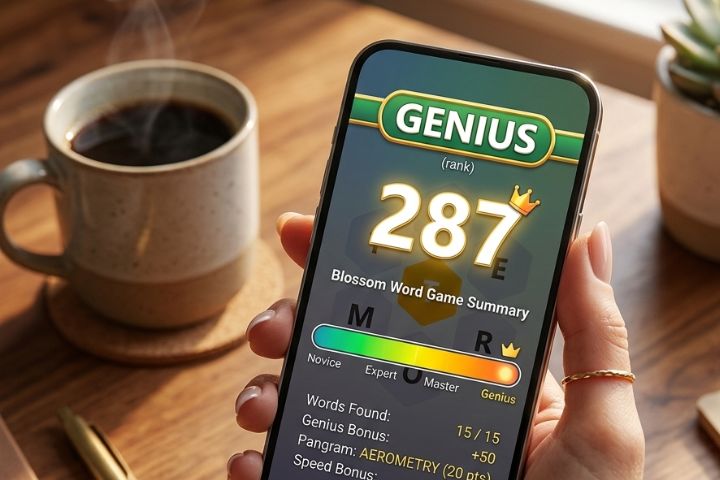
250+ Genius / Expert
Hitting 150+ points in a single session puts you solidly above average for casual players. Crossing 200 points consistently means you’re genuinely developing strong word pattern instincts.
Here’s what most beginners don’t realize: the maximum possible score varies from puzzle to puzzle. Some daily configurations allow for many more valid words than others, which means your 220-point session on a “hard” puzzle day might actually outperform a 260-point session on an “easy” day in relative terms.
So while raw score matters, how many of the available words you found is the real measure of skill. That said, most players don’t have access to the total word count before finishing, so chasing a raw score target of 150–200 is a practical and solid goal for beginners.
Understanding Rank Tiers
Blossom shows your rank during and after each game. Think of it like a progression ladder that responds to how deep you dig into the available word pool.
The rank names add a nice layer of motivation — nobody wants to stay at “Beginner” forever. There’s something psychologically compelling about watching that label upgrade mid-session when a word click pushes you over a threshold. It’s a small thing, but it keeps you hunting for just one more word.
For context, many experienced players report that reaching “Genius” tier on any given day requires finding a substantial portion of the total available words — not just the obvious ones. That typically means actively hunting for less common but valid words, not just the first 10 that come to mind.
A common mistake? Stopping as soon as you hit “Good.” That’s often right around the 100-point mark, and it feels satisfying in the moment — but there are almost always another 50–100 points sitting in the puzzle waiting to be found.
The Pangram Bonus — Why It’s a Game Changer
If there’s one mechanic that separates competitive Blossom players from casual ones, it’s the pangram.
A pangram in Blossom is a word (or sometimes a pair of words, depending on the variant) that uses all seven letters at least once. Finding it triggers a bonus that can significantly jump your score in a single moment.
Most days, there’s exactly one pangram. Occasionally there are two. Rare days have none (though the game designers typically ensure at least one exists per puzzle).
The pangram bonus isn’t just about the points. Finding it also tends to psychologically shift how you approach the rest of the puzzle — once you’ve found that satisfying word, you naturally feel more confident, and often that confidence translates into finding more words overall.
Finding the pangram earns a +7 bonus on top of the word’s base score — making it the single most valuable play in any puzzle. For strategies on how to find it, see our pangram guide. Here, we’ll focus on what it’s worth when you do.
How Word Length Affects Your Score?
Let’s talk numbers, because this is where beginners often leave the most points on the table.
The scoring in Blossom scales with word length:
- 4-letter words: Base score (minimum points per word)
- 5-letter words: Noticeably higher per-word value
- 6-letter words: Strong individual contribution
- 7+ letter words: High-value, and pangrams among these carry the bonus on top
What this means practically: chasing longer words is worth it when you can. A single 7-letter word can outscore three or four 4-letter words combined.
That said, don’t ignore the short words. They add up fast, and on days when longer words are elusive, a collection of solid 4- and 5-letter finds can still push you into impressive score territory.
One approach that works well: sweep first, then hunt. Quickly run through every obvious 4-5 letter word you can spot, bank those points, then shift focus to longer combinations. You’ll feel less pressure and often spot longer words more naturally once the “easy” layer is cleared.
What Is the Highest Score in the Blossom Word Game?
This is where things get genuinely interesting — and a little hard to pin down.
The maximum possible score on any given day depends entirely on the word list the puzzle is built around. A puzzle with a deep, rich word pool can theoretically generate a maximum score in the 400–600+ range for a player who finds every valid word. But most days, a “perfect” score in practical terms is somewhere in the 300–450 range, depending on the configuration.
Here’s the catch: very few players ever find every valid word. The game’s word list includes obscure but technically valid English words that most people simply don’t know. So the real benchmark isn’t the theoretical maximum — it’s how close you can get to it.
What counts as a high score in real-world terms? Community discussion among active players suggests that consistently scoring 250+ puts you in an elite tier. Anything above 350 on a standard puzzle is genuinely exceptional.
If you’re competitive and want to chase high scores, the best approach isn’t memorizing rare words (though that does help over time). It’s developing systematic thinking patterns — more on that in the strategies section below.
Common Scoring Mistakes Beginners Make
After playing and watching how players typically engage with word games like this, a few patterns stand out as the most common score-killers.
1. Forgetting the center letter rule. It sounds basic, but mid-game it’s easy to try a word instinctively and get confused when it doesn’t register. Every word must use the center letter. If you’re repeatedly hitting dead ends, double-check you’re including it.
2. Only thinking in obvious word forms. Most beginners try nouns and common verbs. But the game accepts a wide range of word forms — plurals, past tenses, gerunds, comparative adjectives. “RUNNING” isn’t just a verb; it’s also a noun. Think flexibly about word forms.
3. Ignoring less common but valid words. The game’s dictionary is broader than you might expect. Words you’d use in Scrabble but never in daily conversation are often valid here. If you know Scrabble vocabulary, you have a built-in advantage.
4. Stopping too early. This is the big one. Most players who plateau at “Good” do so because they stop hunting once they feel satisfied. The jump from Good to Genius almost always requires another 15–20 minutes of determined digging.
Strategies to Boost Your Score
Here are approaches that consistently move the needle:
Start with the center letter as your anchor
Build outward from the center letter rather than scanning the full board at once. Think: “What words can I make where [center letter] appears?” This narrows your mental search space productively.
Work prefix and suffix patterns
Once you find one word, think about whether adding a prefix or suffix creates another valid word. Find “PLANT”? Try “PLANTS,” “PLANTING,” “PLANTED.” This multiplier approach efficiently converts one discovery into several.
Think in vowel clusters
Most valid English words follow predictable vowel patterns. Mentally group the available vowels and identify which consonants pair well with them. This becomes almost automatic with practice, but even consciously applying it speeds up your word-finding significantly.
Keep a mental “tried” list
It sounds tedious, but even vaguely remembering what you’ve already attempted prevents wasted time re-entering words that didn’t work. Some players actually keep a quick scratch pad nearby for longer sessions.
Hunt prefixes deliberately
Common prefixes like UN-, RE-, IN-, PRE- can unlock multiple words if those letters are available. If you see U, N, and the relevant combination letters, systematically run through UN-[something] patterns.
Blossom releases a new puzzle every day — for exact reset timing by timezone.
Quick Summary Box
Blossom Word Game Scoring at a Glance:
Every word must be 4+ letters and include the center letter
Longer words score more points
The pangram (using all 7 letters) triggers a significant bonus
150–200 points = solid performance for most daily puzzles
250+ = top-tier / Genius-level play
A new puzzle releases every day
FAQ
How does scoring work on Blossom?
Each valid word earns points based on its length — longer words score more. You must use the center letter in every word, and words must be at least 4 letters. Finding a pangram (a word using all 7 letters) earns a bonus on top of the base word score.
What is a good score in the Blossom word game?
For beginners, hitting 100–150 points is a strong start. Reaching 200+ consistently signals above-average skill, and scores of 250+ place you in the top tier of regular players.
What is the highest possible score in Blossom?
It varies daily based on the available word pool, but theoretically a player who finds every valid word on a generous puzzle could score 400–600+. In practical terms, most top players consider 300–350+ on a standard day an exceptional performance.
Is there a ranking system in Blossom?
Yes. The game assigns rank titles based on your score progress — from Beginner at the low end to Genius (or equivalent) at the top. Rankings update in real time as you find words.
Does the pangram always exist in every puzzle?
In most well-designed daily puzzles, at least one pangram is guaranteed. Finding it requires using all 7 available letters in a single valid word, and it carries a notable bonus.
Can you get extra points for finding rare or long words?
Yes — word length directly determines point value. Longer words score more than short ones. There’s no separate “rare word bonus,” but finding 8- or 9-letter words naturally earns more points than finding multiple 4-letter words.
How many words are there in a typical Blossom puzzle?
This varies, but most puzzles have somewhere between 30 and 70+ valid words, depending on the letter combination. Many players discover only a fraction of the total available words in any given session.
What happens if I use a word not in the game’s dictionary?
The game simply won’t accept it — you’ll get a “not in word list” message. The dictionary is curated, so some valid English words may not register while some less common ones will.
How often does Blossom release new puzzles?
Every day. The game refreshes with a new puzzle daily, making it a consistent part of many players’ daily routines.
Is there a way to see all the words I missed after finishing?
Many versions of the game allow you to view the complete word list after the daily puzzle closes, which is a great way to learn new words and improve for future sessions.
Conclusion
Blossom word game scoring isn’t complicated once you understand what the game is actually rewarding. Length matters. The center letter is everything. And the pangram isn’t just a bonus — it’s often the moment that defines whether you have a good session or a great one.
If you’re just starting out, aim for 100–150 points and focus on building word pattern instincts. If you’re already comfortable, challenge yourself to push past 200 consistently by sweeping short words first, then systematically hunting longer combinations. And if you’re chasing elite scores — start memorizing which word forms the game’s dictionary tends to accept.
Most importantly, play daily. The rhythm of a new puzzle every day is what builds real skill over time. Each session teaches you something about the letter combinations, the valid word pool, and your own pattern-recognition blind spots.