
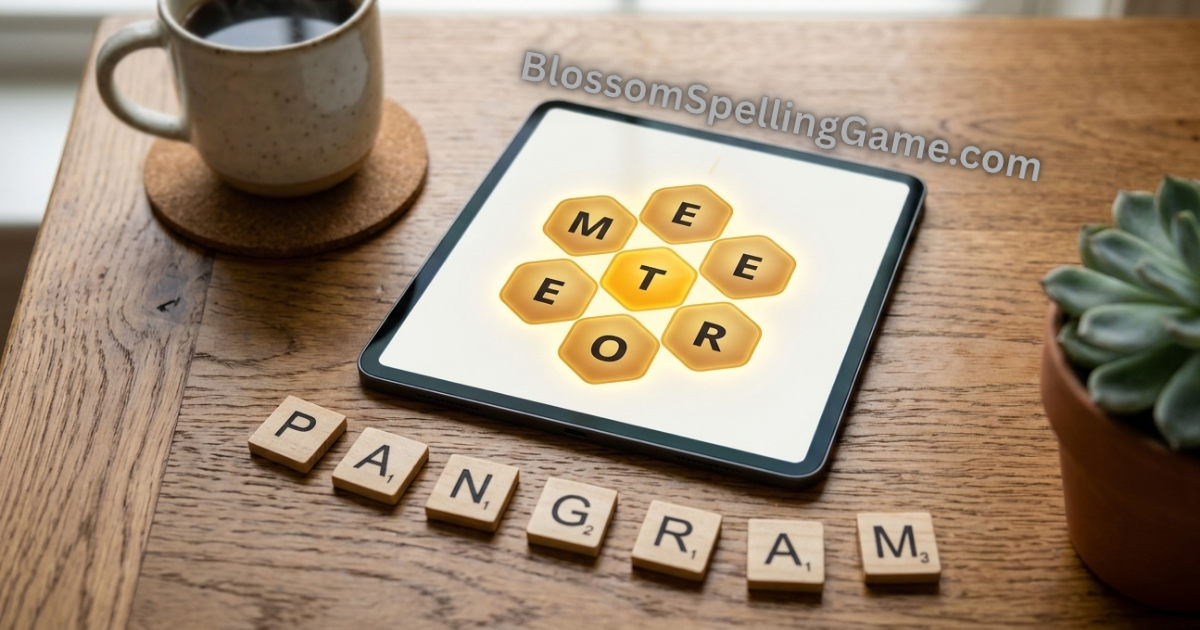
In Blossom, the pangram is the single highest-value play available to you each day. This guide is entirely about finding it faster, more consistently, and understanding exactly what it does to your score.
What Is a Pangram in Blossom Word Game?
⚡ Quick Answer: In Blossom Word Game, a pangram is a valid word that uses all seven letters displayed in the flower-shaped grid — each at least once. Finding it awards a significant score bonus on top of the word’s base points, and it’s usually the highest-scoring single play in the puzzle.
Here’s the interesting part: Blossom always guarantees at least one pangram per daily puzzle. The game designers build each flower grid around it. So that perfect word? It’s definitely there. You just need to know where to look.
The word must use the center letter (the one in the middle petal — that’s mandatory) and can use the outer six letters in any combination, as long as all seven appear at least once. Words can repeat letters, so a nine-letter word using two of the same letter is perfectly valid as a pangram, provided every letter in the set shows up somewhere.
Most pangrams in Blossom fall between 7 and 10 letters long, though shorter or longer ones do appear occasionally. When you hit one, you’ll see a satisfying visual burst and a noticeable jump in your score. That’s the moment.
How Scoring Works in Blossom Word Game Pangram
Scoring in Blossom follows a straightforward structure, but there are a few layers most new players miss. Let’s break it down properly.
Base Word Points
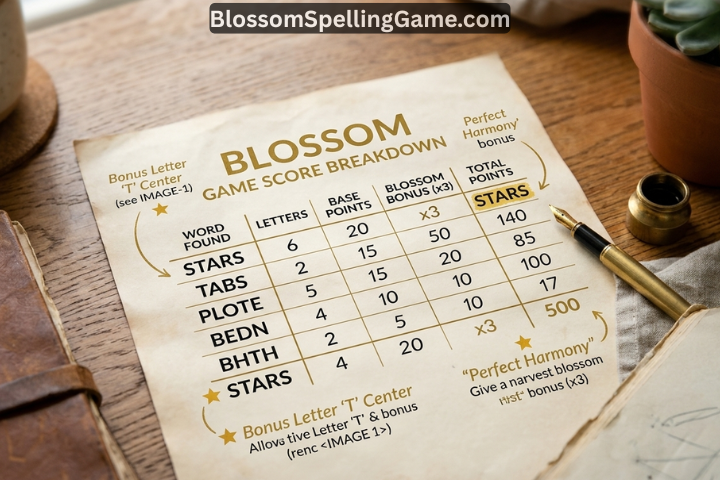
Blossom scores words by length — 4-letter words earn 1 point, 5-letter words earn 5, and every letter beyond that adds 1 point. Finding the pangram (the word using all 7 letters) adds a +7 bonus on top. One highlighted petal letter also adds +5 every time it appears in a word. For the complete breakdown with examples, see our Blossom scoring guide .
Notice how four-letter words only give you a single point. That’s by design — the game rewards you for finding longer, less obvious words rather than grinding through short ones. It’s a clever mechanic that keeps the puzzle challenging.
The Pangram Bonus
Here’s where it gets exciting. Finding the pangram earns a substantial bonus on top of the word’s base score. In most Blossom puzzles, a pangram can be worth significantly more than any other individual word — sometimes representing 20–30% of a high-end total score on its own.
This is exactly why hunting the pangram isn’t optional if you want a great score. It’s practically essential.
One thing most players overlook: There can occasionally be more than one pangram in a single Blossom puzzle. If you find one, keep looking — you might find another and double that bonus.
What Is a Good Score in Blossom Word Game?
This is one of the most-searched questions about the game, and honestly, the answer is more nuanced than most sites will tell you.
A “good” score in Blossom depends on whether you found the pangram. Two players could find the exact same set of common words, but the one who spotted the pangram could finish with double the points. That gap is that significant.
Players who find the pangram consistently score 50–100% higher than those who don’t — that gap is what separates the middle tiers from the top ones. For full score benchmarks by level, see our Blossom Scoring Guide.
In practice, scoring anywhere above 70–80 points on a given day means you had a genuinely good session. If you’re consistently hitting that range, your word recognition is solid. But if you want to push into the triple digits — that means making the pangram your priority, not an afterthought.
“The pangram isn’t the finishing touch on a great score. It’s usually the foundation.”
The maximum possible score varies from puzzle to puzzle because each daily grid has a different set of valid words. Some puzzles have more accepted words, longer words, or multiple pangrams — all of which affect the ceiling.
Most puzzles have a “perfect” score — meaning every valid word found — that sits somewhere in the range of 200 to 400+ points for advanced players who know obscure vocabulary. For everyday players, consistently clearing 100–150 points represents an exceptional performance.
One thing worth noting: Blossom tracks your performance with a rank system (think Beginner → Solid → Good → Great → Expert → Genius), and reaching “Genius” status — the highest rank — typically means you’ve found a high percentage of available words, including the pangram. Most players never reach Genius regularly, which is what makes it so satisfying when you do.
Practical tip: Don’t get discouraged chasing the theoretical maximum. Focus on consistently finding the pangram first, then work on expanding your word list from there.
How to Find the Pangram — A Practical Method
Okay, this is the section most guides skim over, and that’s a shame — because there’s actually a reliable system for hunting pangrams that works across almost every puzzle.
Step 1: Start with Common Word Endings
Most English pangrams follow familiar patterns. Before you start randomly combining letters, try mentally testing common suffixes against your available letters: -ing, -tion, -ment, -ness, -ful, -less, -able, -er. If you see letters that could form one of those endings, work backward from there.
Step 2: Identify the “Rare” Letters First
In any set of seven letters, some are going to be harder to use than others. Spot the uncommon letters — the Q, Z, X, or even just a W or V — and ask yourself: what words actually use that letter? That narrows your search dramatically.
Step 3: Count Your Vowels
Pangrams need all seven letters, which means the vowel-to-consonant balance matters. If your grid has three vowels and four consonants, you’re looking for a word that uses all three vowels at least once. That rules out a lot of options quickly — which is actually helpful.
Step 4: Think in Word Families
Sometimes the pangram is hiding inside a word family you know well. If you found “garden,” ask yourself — what else comes from that root? “Gardening” might be your pangram if those letters are all present. Word families are often the fastest path.
Common mistake: Most beginners hunt pangrams by randomly stringing letters together. That’s exhausting and rarely works. The method above — starting from patterns, rare letters, and word families — is far more efficient.
Common Mistakes Beginners Make (And How to Fix Them)
Giving up on the pangram too early: The pangram often feels impossible until suddenly it isn’t. Give it time — the click of recognition usually comes after you’ve warmed up with other words.
Thinking obscure = impossible: Many Blossom pangrams are totally everyday words that just feel hard because all seven letters need to appear. Trust common vocabulary first.
How Many Levels Are There in Blossom Word Game?
Blossom uses a rank-based progression system rather than discrete “levels” like some other mobile word games. Your rank for any given puzzle shifts based on how many points you’ve accumulated in that session.
The rank ladder generally looks like this:
- Beginner — just getting started
- Good — you’re in the flow
- Solid — solid vocabulary at work
- Nice — consistent word-finding
- Great — excellent performance
- Amazing — approaching expert territory
- Genius — top-tier, near-perfect session
The exact score thresholds for each rank change daily because they’re calculated as a percentage of the total possible score for that puzzle. That’s actually a thoughtful design choice — it keeps the ranks meaningful across easier and harder puzzles alike.
A new puzzle drops every day — your pangram hunt resets with it.
Pro Tips for Climbing the Ranks Faster
Here’s the practical stuff — the observations that actually move the needle for most players.
Play in Two Phases
Think of every Blossom session in two distinct phases. Phase one: warm up with whatever words come naturally, no pressure. Phase two: switch to active pangram hunting using the method described earlier. Keeping those phases separate prevents you from burning mental energy on both at once.
Learn Word Roots, Not Just Words
Knowing that -graph, -phon-, -bio-, and -cycle are common roots gives you a searchable mental library. When you see letters in a puzzle that could form one of those roots, you can test words built around it fast.
Track Patterns Across Puzzles
One thing I noticed while playing regularly: Blossom tends to favor certain word categories — nature words, everyday nouns, -ing forms — more than extremely obscure terms. The dictionary is curated for accessibility. That’s your advantage. If you’re deliberating between a common word and a very obscure one, try the common one first.
Use the Hint Sparingly
The hint feature exists for a reason — use it when you’re genuinely stuck on the pangram for an extended time. Saving your hints for pangram moments specifically is more satisfying (and more useful) than burning them on regular words.
Share Your Score to Stay Accountable
The game’s share feature isn’t just social — it’s motivational. When you share your score, you create a little public record of your performance. Many players find that mild accountability drives them to play more deliberately.
FAQ
What is a pangram in Blossom Word Game?
pangram in Blossom is a valid word that uses all seven letters shown in the flower-shaped grid at least once. Every daily puzzle contains at least one pangram, and finding it awards a significant bonus score.
How does scoring work in Blossom Word Game?
Words score based on length: 4-letter words earn 1 point, 5-letter words earn 5 points, and longer words earn 1 point per letter. The pangram earns extra bonus points on top of its base score, making it the most valuable single play in any puzzle.
What is a good score in Blossom Word Game?
For beginners, scoring above 30–40 points is a solid result. Intermediate players typically aim for 70–120 points, which generally means finding the pangram. Scores above 150 are excellent, and breaking 200 points puts you in elite territory for most daily puzzles.
What is the highest score in Blossom Word Game?
The maximum varies by puzzle, but “perfect” scores — finding every valid word — typically fall in the 200–400+ point range. Reaching “Genius” rank means you’ve scored near the top tier for that day’s specific puzzle.
How many levels are there in Blossom Word Game?
Blossom uses a rank system rather than fixed levels. Ranks run from Beginner up through Genius, with the score thresholds shifting daily based on the total possible score for that puzzle.
How often is Blossom Word Game updated?
A new puzzle is released every day — typically resetting at midnight. App features and word lists receive periodic updates separately from the daily puzzle cycle.
Can there be more than one pangram in a Blossom puzzle?
Yes. While every puzzle guarantees at least one pangram, some daily grids contain two or more. If you’ve already found one, it’s always worth continuing to look.
Does the center letter have to appear in every word?
Absolutely. The center petal letter is mandatory in every valid submission — including the pangram. Words that don’t contain it won’t be accepted, no matter how long or impressive they are.
Conclusion: The Pangram Changes Everything
Here’s the honest takeaway from everything above: in the Blossom word game, the pangram isn’t just a bonus. It’s the centerpiece. It shapes how you think about the puzzle, it drives your score into genuinely competitive territory, and finding it delivers a satisfaction that no stack of four-letter words can match.
If you’re just starting out, give yourself permission to be slow about it. Learn the two-phase approach. Practice spotting rare letters first. Build word root awareness over time. None of this happens overnight — but the improvement curve in Blossom is genuinely steep once you’re thinking strategically.
Come back daily. The puzzle resets at midnight, which means you always get another shot. And sooner than you’d think, finding that pangram will start feeling less like a miracle and more like a habit.
Ready to play? Head over to Blossom Spelling Game and put today’s strategy to work. Good luck — you’ve got this.