
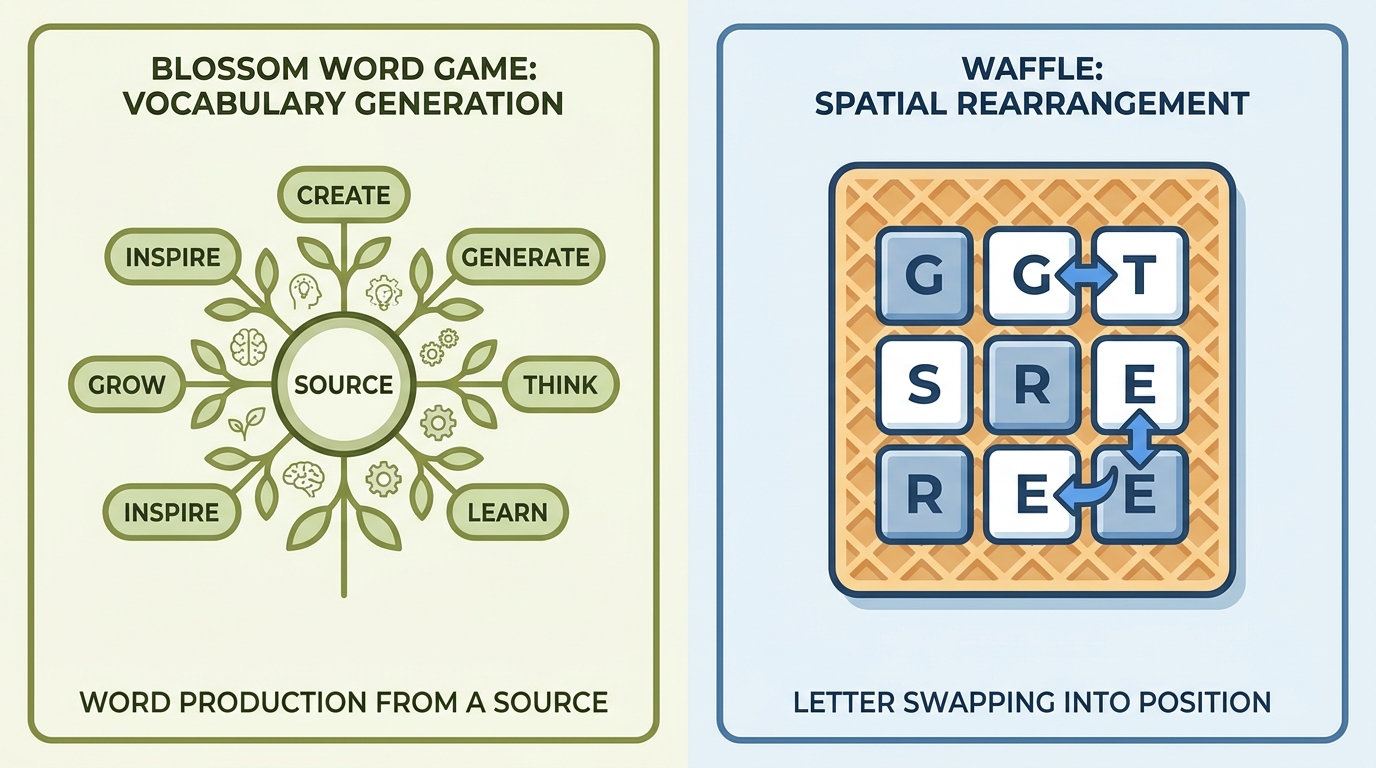
Blossom Word Game vs Waffle Game — one generates words from constraint, the other rearranges given letters into correct positions. Full comparison of mechanics, difficulty, and who each game serves best.
Blossom and Waffle share more surface-level similarities than most daily word game comparisons: both present letters in a visual spatial arrangement, both involve some constraint on how those letters can be used, and both produce a satisfying daily puzzle experience in under 20 minutes.
But the cognitive mechanics couldn’t be more different. Blossom asks you to generate valid words from your own vocabulary under a letter constraint — nothing is given to you, and the word list is open-ended. Waffle gives you all the letters and all the words; your job is to move the pieces into the correct positions through spatial rearrangement.
One is a vocabulary generation task. The other is a spatial optimization task. Both are excellent daily puzzles — but they exercise genuinely different skills, and understanding the difference tells you whether one, both, or neither fits what you’re looking for.
How Waffle Game Works — A Complete Overview
For readers unfamiliar with Waffle, here’s the complete mechanic.
The setup: Six five-letter words arranged in a waffle-shaped grid — three horizontal words and three vertical words, sharing letters at their intersections. Think of it as three stacked Wordle rows with three vertical columns crossing through them.
The key difference from Wordle: In Waffle, all the letters are already in the grid. They’re just in the wrong positions. Your job isn’t to guess what the words are — it’s to rearrange the given letters into their correct positions.
The mechanic: You swap two letters at a time. Click one letter and then another, and they exchange positions. You have 15 swaps to achieve a “perfect solve” where every letter is in its correct position. Using fewer swaps produces a higher star rating — a perfect solve in 10 swaps is better than one requiring all 15.
The feedback system: Color-coded tiles show progress as you swap:
- Green: This letter is in the correct position
- Yellow: This letter belongs in this word but not this position
- White/Gray: This letter is misplaced elsewhere in the grid
The goal: Get all tiles to green using as few swaps as possible.
The Core Difference: Generation vs. Spatial Rearrangement
This is the fundamental distinction that separates Blossom and Waffle as cognitive experiences.
Blossom — vocabulary generation:
You’re starting from nothing except seven letters and your own vocabulary. The valid words aren’t shown to you; you must produce them from memory. Your active vocabulary is the primary resource, and the constraint (center letter must appear, 12-slot budget, Merriam-Webster standard) shapes what you can submit. There’s no predetermined answer you’re working toward — the puzzle is open-ended.
Waffle — spatial rearrangement:
You’re starting with complete information — all letters are visible, the word count is fixed (six words, all five letters), and the general structure of valid words is implied by the grid positions. Your job is a spatial optimization problem: figure out where each letter belongs through the swap mechanic. Vocabulary knowledge helps you recognize valid word configurations, but you’re not generating from scratch.
The analogy: Blossom is like writing — you produce from a blank page using what you know. Waffle is like editing — you rearrange given material into its correct form.
The Spatial vs. Verbal Cognitive Distinction
This is the most important difference for players choosing between the two games.
Waffle’s primary cognitive demand: spatial reasoning
Figuring out how to rearrange letters efficiently — understanding that swapping letter A into position X forces letter B out, which then requires another swap, creating a cascade — is genuinely spatial reasoning. You’re tracking multiple positions simultaneously, predicting how one change affects adjacent positions, and optimizing a sequence of moves toward a target configuration.
This is meaningfully similar to the cognitive task in sliding-tile puzzles or Rubik’s cube optimization — spatial, positional, sequential thinking where each action has downstream consequences.
Blossom’s primary cognitive demand: lexical retrieval
Finding words from a letter constraint is fundamentally a vocabulary retrieval task — scanning your mental lexicon for words that satisfy the constraint, with secondary strategic demands around slot management and length prioritization. The spatial element (the flower grid layout) is secondary; what matters is what words you know.
Why this distinction matters:
Players with strong spatial reasoning often find Waffle’s swap-optimization mechanic particularly satisfying — the puzzle rewards the specific skill they’re good at. Players with strong verbal/vocabulary skills often find Blossom more natural — it rewards what they bring to the puzzle.
If you’re someone who’s always been good at puzzles involving piece rearrangement, spatial planning, and sequence optimization, Waffle will likely feel natural from the start. If you’re someone whose strength is vocabulary knowledge and word pattern recognition, Blossom will feel more natural.
These aren’t exclusive — many players are strong at both. But the games don’t exercise the same cognitive faculties, which is why playing both provides broader cognitive coverage than either alone. This point connects to the brain region analysis in our How Word Games Help Your Brain guide.
Difficulty Comparison: Where Each Game Is Hard
Where Blossom is hard:
Blossom’s difficulty lives entirely in your vocabulary — what words you know, how many you can actively retrieve under constraint, and how effectively you apply suffix/prefix patterns and letter-combination strategies. Players with deep vocabulary and strong word-pattern intuition find Blossom consistently productive. Players with limited vocabulary find it frustrating regardless of strategy.
The difficulty also scales with the letter set: rare center letters (X, Z, Q) or unusual letter combinations produce genuinely harder puzzles independent of player skill.
Where Waffle is hard:
Waffle’s difficulty is primarily spatial and sequential: identifying the correct target configuration for all six words simultaneously, then planning the minimum swap sequence to reach that configuration. The hardest Waffle sessions are those where multiple valid-looking configurations exist (could this word be STARE or RATES or TEARS with these letters?) and where figuring out which configuration is correct requires inference from intersecting word constraints.
Waffle’s difficulty also scales with the specific arrangement — some starting configurations require intricate swap sequences; others can be solved straightforwardly.
The comparison:
Blossom rewards vocabulary depth. Waffle rewards spatial sequence planning. Players often find they’re dramatically better at one than the other based on their cognitive strengths — which is exactly why these games don’t feel interchangeable.
Scoring and Completion Philosophy
Waffle’s star rating system:
Waffle tracks how many swaps you used relative to the 15-swap maximum. Perfect solve in 10 or fewer swaps = maximum star rating. More swaps = fewer stars. The scoring creates a specific optimization goal: not just completing the puzzle, but completing it efficiently.
This efficiency framing produces a different psychological relationship with the puzzle than Blossom — you’re not just finishing, you’re trying to finish optimally.
Blossom’s cumulative score system:
Blossom tracks total points across all words found, with no penalty for “inefficient” word selection. Finding a 4-letter word doesn’t cost you points; it’s just a lower-value contribution than a 7-letter word. The cumulative, non-penalizing score creates a different experience — you’re always building, never losing ground.
The felt difference:
Waffle players often feel the “puzzle” quality of the game more acutely — there’s a single correct target configuration and an optimal path to it. Blossom players often feel the “exploration” quality — there’s no single right answer, just more or fewer words found. Both are satisfying, but differently.
Vocabulary Requirement Comparison
Blossom’s vocabulary requirement:
Substantial. The game’s entire challenge is vocabulary retrieval — you need active knowledge of a large English word set to perform well. The Merriam-Webster standard means the full breadth of English vocabulary is fair game, including less common but legitimate words. Vocabulary directly determines performance ceiling.
Waffle’s vocabulary requirement:
Moderate. You need enough vocabulary knowledge to recognize valid five-letter word configurations when you see them — but you don’t need to generate those words from nothing. The letters are already in the grid; vocabulary is used as a validation tool (“does RATES make a valid word?”) rather than as a generation source (“what words can I make from these letters?”).
This difference is meaningful for ESL learners, younger players, and players with smaller active vocabularies: Waffle is generally more accessible at lower vocabulary levels than Blossom, because recognition is easier than generation.
Time Commitment
Waffle: Most sessions complete in 5-10 minutes. The 15-swap limit creates a natural endpoint. Even challenging configurations rarely require extended sessions.
Blossom: Typical sessions run 10-20 minutes for intermediate players, longer for comprehensive coverage. The 12-slot format creates a different endpoint — you stop when slots are filled or when you’ve exhausted productive search.
The time comparison:
Waffle is the faster game — well-suited for a quick daily puzzle in a constrained time window. Blossom is the deeper game — better suited for a sustained morning session where you want genuine cognitive engagement. Many players use Waffle as a quick daily addition that complements Blossom’s longer session rather than replacing it.
Side-by-Side Comparison Table
| Feature | Blossom Word Game | Waffle Game |
|---|---|---|
| Core mechanic | Generate words from 7 letters | Rearrange given letters into correct positions |
| Cognitive type | Lexical retrieval / vocabulary generation | Spatial reasoning / sequence optimization |
| Letters given | 7 constrained letters | All letters given (in wrong positions) |
| Words to find | Open-ended (up to 12 slots) | Fixed (6 five-letter words) |
| Scoring | Cumulative points by word length | Star rating by swap efficiency |
| Vocabulary requirement | High (generation) | Moderate (recognition) |
| Spatial reasoning requirement | Low | High |
| Typical session length | 10-20 minutes | 5-10 minutes |
| Difficulty curve | Long (deepens over months) | Medium (plateaus after swap-optimization mastery) |
| Center letter rule | Yes | No |
| Cost | Free — BlossomSpellingGame.com | Free — wafflegame.net |
| Best for | Vocabulary builders | Spatial puzzle enthusiasts |
Who Each Game Is Built For
Choose Blossom if you: Have strong vocabulary, enjoy open-ended word generation, want a game with a long-term learning curve, prefer cumulative scoring over efficiency optimization, and can dedicate 15-20 minutes.
Choose Waffle if you: Enjoy spatial rearrangement puzzles, prefer a quick focused session with a clear endpoint, like optimization challenges (minimize swaps, maximize stars), and want a game that feels like a spatial puzzle rather than a vocabulary test.
Play both if you: Want cognitive variety in your daily routine — verbal generation (Blossom) and spatial optimization (Waffle) exercise genuinely different cognitive systems. The combined session takes 20-30 minutes and covers meaningfully more cognitive territory than either game alone.
The Case for Playing Both
The argument for adding Waffle to a Blossom routine is the same cognitive-variety argument covered in our How Word Games Help Your Brain guide: different games engage different brain systems, and genuine variety across those systems produces broader cognitive benefit than repetition within one system.
Blossom engages language production systems primarily (Broca’s area, prefrontal cortex for strategic slot management). Waffle engages spatial reasoning systems primarily (parietal lobe for positional tracking, visual processing for grid state monitoring).
Together, they cover the verbal-spatial dimension that no single game covers alone — a 5-10 minute Waffle session following a 15-minute Blossom session provides a genuine cognitive variety break that a second 15-minute Blossom session wouldn’t.
FAQ
What is Waffle Game?
Waffle is a free daily word puzzle at wafflegame.net where six five-letter words are arranged in a waffle-shaped grid (three horizontal, three vertical, sharing intersection letters). All the letters are present but in wrong positions — you swap letters into their correct positions using a maximum of 15 swaps, with a higher star rating for using fewer swaps.
Is Waffle harder than Blossom?
They’re hard in different ways. Blossom’s difficulty is vocabulary-based — you need deep active vocabulary to find many words. Waffle’s difficulty is spatial-reasoning-based — you need to plan efficient swap sequences. Players often find one significantly easier than the other based on their cognitive strengths.
Is Waffle Word Game free?
Yes — wafflegame.net is free to play with no subscription required, similar to Blossom at BlossomSpellingGame.com.
What’s the main difference between Blossom and Waffle?
Blossom requires generating words from your own vocabulary under a letter constraint — nothing is given to you. Waffle gives you all the letters and words; you just need to rearrange them into correct positions. Generation vs. rearrangement is the fundamental distinction.
Can playing Waffle improve your Blossom performance?
Limited direct transfer. Waffle improves spatial letter-position reasoning; Blossom improves vocabulary retrieval. These are different skills with minimal overlap. Playing both exercises more total cognitive territory than playing either alone, but improvement in one doesn’t directly translate to improvement in the other.
Final Thoughts
Blossom and Waffle are better understood as complements than competitors. They share the “daily word puzzle” category label while exercising genuinely different cognitive skills — vocabulary generation vs. spatial rearrangement — that make them feel like entirely different activities despite their surface similarity.
If you’re a Blossom player who hasn’t tried Waffle, the 5-10 minute Waffle session makes a natural daily companion — quick enough to add without significant time cost, different enough to provide genuine cognitive variety rather than redundancy.
Play today’s Blossom puzzle at BlossomSpellingGame.com, then head to wafflegame.net for the day’s Waffle. The combined 25-minute routine covers more cognitive territory than either game alone.