
How Blossom Word Game Improves vocabulary? The honest answer covers passive-to-active conversion, word families, morphological awareness, and where the game reaches its limits.
Players who’ve been doing the daily Blossom puzzle for a few months start noticing something. Words come more readily in conversation. The vocabulary they reach for in writing is wider. Specific words they used to forget — the right word for something specific that always seemed just out of reach — come to them more reliably.
This isn’t wishful thinking or confirmation bias. There’s a real mechanism behind it. But understanding how Blossom actually improves vocabulary — rather than how it’s marketed to do so — requires being more precise than “it’s a word game, word games are educational.”
This article covers the specific vocabulary changes that daily Blossom play produces, the mechanisms behind each, where the benefits are strongest, where they plateau, and what the game genuinely can’t do that players sometimes expect it to. The honest account is both more interesting and more useful than the cheerful overview.
The Most Important Vocabulary Distinction: Passive vs. Active
Before examining how Blossom improves vocabulary, it’s worth being precise about what kind of vocabulary it primarily affects — because the distinction matters enormously for setting realistic expectations.
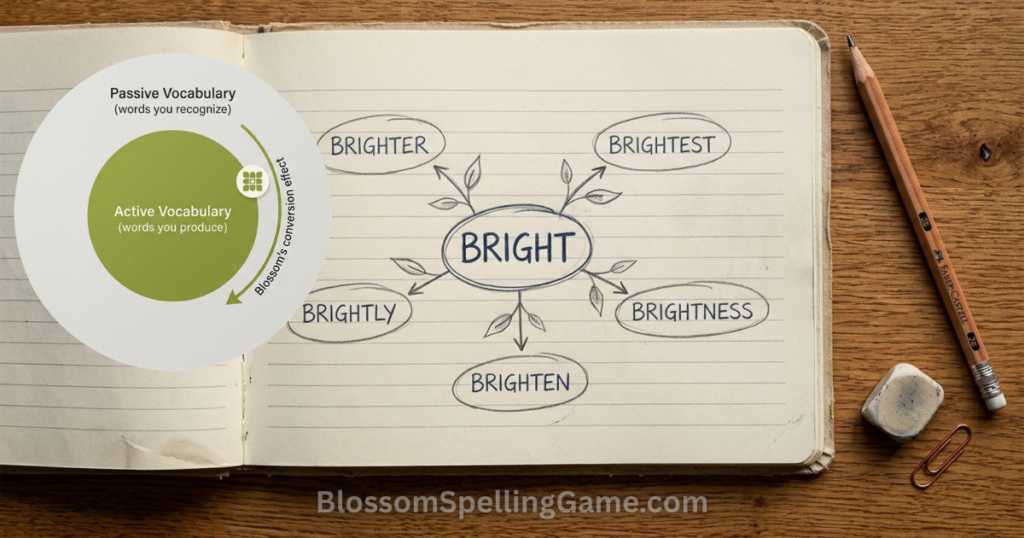
Passive vocabulary is the set of words you recognize — words you’ve encountered enough times to understand their meaning when you read or hear them, but that you don’t reliably produce spontaneously in your own speaking or writing.
Active vocabulary is the set of words you produce — words you reach for naturally when you write or speak, without effort or delay.
For most adults, passive vocabulary is dramatically larger than active vocabulary. Research estimates suggest that the average college-educated adult has a passive vocabulary of 50,000–100,000 words and an active vocabulary of roughly half that size. The gap between what you know passively and what you use actively is where most vocabulary improvement potential lives.
Where Blossom operates:
Blossom Word Game operates primarily on the passive-to-active conversion boundary. The game’s letter constraint mechanic forces you to produce words spontaneously from memory — which is exactly the condition that activates passive vocabulary and begins converting it toward active vocabulary.
Words in your passive vocabulary that you’ve never had reason to produce under constraint may surface for the first time in Blossom when the letters happen to make them possible. The act of producing them — even in a game context — begins the conversion process.
This is the most significant vocabulary impact of daily Blossom play: not learning new words (though that happens too), but converting known-but-unused vocabulary into regularly accessible vocabulary.
How Blossom Converts Passive Vocabulary to Active
The conversion process from passive to active vocabulary happens through a specific mechanism that Blossom’s design activates particularly well.
The production requirement:
Unlike reading (which exercises passive vocabulary) or vocabulary quizzes (which exercise recognition), Blossom requires generation — you must produce a word from raw letter material with no external prompt showing you the word first. This production requirement is the key difference.
When you generate a word you know passively, you’re performing what linguists call productive retrieval — accessing a word for output rather than just for comprehension. Productive retrieval, when practiced repeatedly under varying conditions (different letter sets, different time pressures, different word combinations), strengthens the neural connections that make a word actively available.
The repetition across contexts:
A word that appears in your vocabulary across multiple Blossom sessions — because its letters happen to be available on multiple occasions — is activated in multiple distinct contexts. REGAL, for example, might appear in sessions with different surrounding letters, different center letter configurations, and different strategic contexts. Each new context activation strengthens the word’s accessibility.
This is meaningfully different from the repetition in a flashcard system, where the word appears in the same format every time. Blossom’s letter constraint variation creates contextual variety that flash-card repetition doesn’t — and varied-context retrieval produces more robust word accessibility than same-context repetition.
The emotional encoding boost:
Words that emerge from productive effort — particularly words you almost didn’t find, words that turned out to be the pangram, words that produced an unexpected score boost — carry emotional encoding that purely cognitive processing doesn’t generate. The mild positive affect of a surprising accepted word strengthens memory consolidation through the amygdala’s role in emotionally significant memory formation.
This emotional encoding effect is why the words you find through genuine struggle in Blossom tend to become permanently accessible in a way that words you encounter on a word list rarely do.
The “Unexpected Acceptance” Learning Event
This is one of the most specific and powerful vocabulary learning moments in Blossom — and it happens more often than most players realize.
What it is:
You type a word you’re not fully sure about. Maybe it’s a word you vaguely remember from a novel, or a word you’ve used once in conversation but weren’t certain was really a word, or a variant form of a common word that you thought might be too unusual. You submit it half-expecting a rejection.
It gets accepted.
That moment — the surprise of unexpected acceptance — is a particularly potent vocabulary learning event. Here’s why.
The mechanism:
Standard vocabulary instruction tells you a word’s definition, perhaps shows it in context, and expects you to remember it through repetition or elaboration. The “unexpected acceptance” event works differently: it starts from a hypothesis (this might be a word) and delivers a confirmatory answer (yes, it’s valid, it has a score, it counts). This hypothesis-and-confirmation structure activates what psychologists call surprise-enhanced learning — the discovery that something you were uncertain about is actually true produces stronger memory encoding than learning something you expected.
The unexpectedness creates a prediction error signal in the brain’s learning systems. Prediction errors — gaps between what you expected and what happened — are one of the most powerful triggers for updating long-term memory. A word you were surprised to find accepted gets encoded as “I wasn’t sure about this, but it turned out to be real and valid” — a much stronger memory trace than “I was told this word exists.”
Examples of typical unexpected acceptances:
- Unusual plural forms (CACTI, FUNGI, PHENOMENA — confirmed as valid)
- Less common past tense forms (BESPOKE, WROUGHT, CLEFT — discovered to be valid)
- Adjective-derived nouns (WARMTH, BREADTH, LENGTH — confirmed)
- Verbs from nouns (GIFTED, PAPERED, FLOORED — discovered to be valid as past tenses)
- Rare but standard vocabulary (ABLUTION, FELICITY, LUCENT — confirmed as in the dictionary)
Each of these unexpected acceptances is a permanent vocabulary upgrade — not just the word itself, but the confirmation that it’s real, valid, and in the standard American English dictionary.
The “Wrong Form Rejection” as a Spelling Lesson
The flip side of unexpected acceptance is equally educational: the wrong-form rejection.
What it is:
You submit a word you’re confident exists, but in an incorrect form. RUNNED instead of RAN. BADDER instead of WORSE. GOODER instead of BETTER. MOUSES instead of MICE. The game rejects it.
This rejection is a morphological lesson: the specific form you used doesn’t match the dictionary’s validated form. You’ve discovered something concrete about how the word actually works in English — something passive vocabulary knowledge (knowing the word’s meaning) doesn’t guarantee you know.
Why this is valuable:
Spelling and morphological correctness (using the right word form) are separate skills from semantic vocabulary knowledge (knowing what a word means). Many adults have wide passive semantic vocabularies but significant gaps in their morphological knowledge — they know what BESPEAK means but don’t know that BESPOKE is its past tense. They know what SLAY means but aren’t sure whether the past tense is SLAYED or SLEW.
Blossom’s immediate, consequence-free rejection feedback provides rapid morphological correction. You try SLAYED, it gets rejected, you try SLEW, it gets accepted — and you’ve just updated your morphological knowledge of that verb permanently. No explanation needed, no embarrassment, no consequence beyond a moment of recalibration.
The learning advantage of no consequences:
The no-penalty nature of Blossom’s rejection feedback is pedagogically important. In formal educational settings, spelling or grammar errors carry social and graded consequences that create anxiety. Anxiety impairs learning. Blossom’s consequence-free feedback allows you to test and be corrected without any of the anxiety that impairs retention. The correction sticks because the encounter was low-stakes, not because it was formally instructed.
Word Family Awareness — Understanding Derivational Relationships
One of the most transferable vocabulary skills that Blossom builds — and one that goes largely unnoticed until you look for it — is word family awareness: the intuitive understanding of how words relate to each other through derivational morphology.
What word family awareness is:
Knowing that GOVERN, GOVERNOR, GOVERNMENT, GOVERNABLE, GOVERNING, GOVERNANCE, UNGOVERNABLE are all related and share a root is word family awareness. It’s the understanding of how English words are built from roots, suffixes, and prefixes — and how that building process generates predictable patterns across large clusters of related vocabulary.
How Blossom builds it:
Blossom’s letter constraint mechanic directly incentivizes word family exploration. When you find GOVERN and submit it, the next natural move is to test GOVERNING, GOVERNED, GOVERNOR, GOVERNANCE — because the same letters that produced GOVERN may also produce its relatives. Players who actively mine word families score more per session and learn faster than players who move between unrelated roots.
This active family exploration teaches the derivational relationships between words implicitly — you don’t learn “GOVERN + ANCE = GOVERNANCE” as an explicit rule; you discover it through production and feedback. This implicit learning of derivational patterns is deeply useful because it generalizes: a player who has learned the GOVERN family pattern has also strengthened their intuition for how -ANCE works in general, which helps them access GUIDANCE, DISTANCE, UTTERANCE, and any other -ANCE word they know passively.
The compounding effect:
After months of systematic word family exploration in Blossom, players often report a qualitative shift in how they encounter unfamiliar words outside the game. When they meet an unknown word in reading, they now more naturally analyze it morphologically — breaking it into root, prefix, and suffix — rather than experiencing it as an opaque unit. This morphological analysis skill dramatically accelerates vocabulary acquisition from reading, because it lets you infer meanings of unknown words from their components.
For a systematic approach to word family exploration specifically, see our Blossom Suffix Guide and Prefix Guide.
Morphological Awareness: Seeing Word Boundaries
Closely related to word family awareness but distinct enough to merit its own discussion: morphological awareness is the ability to perceive the internal structure of words — where roots end and affixes begin.
Why morphological awareness matters:
A reader with strong morphological awareness sees UNBREAKABLE and immediately parses it as UN (negative prefix) + BREAK (root) + ABLE (adjective suffix) = “not capable of being broken.” This parsing happens automatically, without effort, and it dramatically speeds up the comprehension of new words.
A reader without strong morphological awareness encounters UNBREAKABLE as a whole unit — a word they either know or don’t know — and has no way to infer meaning from structure.
How Blossom builds morphological awareness:
Blossom’s suffix and prefix hunting mechanic forces repeated morphological analysis. When you’re asking “what words can I form with these letters?” you’re implicitly asking “what root + affix combinations are possible?” The game trains morphological parsing through production: you build words from components, which means you must identify the components first.
Players who apply systematic suffix and prefix strategies (as detailed in the Suffix Guide and Prefix Guide) are explicitly doing morphological analysis — identifying which affixes are available in the letter set and which roots can combine with them. This explicit morphological processing, practiced daily, builds the automatic parsing skill over time.
Transfer to reading:
The most meaningful real-world outcome of morphological awareness built through Blossom is more efficient vocabulary acquisition from reading. When you encounter an unfamiliar word in a book or article, morphological awareness lets you derive a working definition from the word’s structure — even for words you’ve never seen before. This is a vocabulary expansion multiplier: each new root you learn through Blossom, combined with the affix patterns you’ve internalized, potentially generates dozens of words you can now parse if you encounter them.
Context-Free Vocabulary Acquisition — Strength and Limitation
Every vocabulary acquisition method has both strengths and limitations — and Blossom’s characteristic method (context-free letter constraint production) has specific ones worth understanding.
The strength:
Context-free production — finding words without the semantic scaffolding of a sentence or passage — builds form access: the ability to retrieve a word’s letters and spelling when you have a semantic need for it. This is the specific ability that supports writing fluency (finding the right word) and reduces tip-of-tongue experiences (words that feel familiar but won’t come to mind).
Because you find words without context in Blossom, the form (spelling and sound) becomes the primary representation strengthened. You know what the word looks like, how it’s spelled, which letters it contains — independently of any particular usage context.
The limitation:
Context-free acquisition doesn’t build semantic depth. When LUCENT appears in your letter set and you find it, you may not know what lucent means — you know only that it’s a valid word with these letters. The game tells you it’s valid; it doesn’t tell you it means “glowing with light.”
This creates a specific type of vocabulary that Blossom builds: formal knowledge (correct spelling, morphological form, dictionary validity) without necessarily semantic richness (nuanced meaning, typical usage contexts, connotation).
Addressing the limitation:
The most effective Blossom players who want vocabulary depth combine game play with brief definition lookup. When you find an accepted word you’re not sure about, pause to look it up — thirty seconds on Merriam-Webster’s definition builds the semantic layer that the game’s production context doesn’t provide. The archive review approach is another opportunity: review missed words, look up definitions, add to a personal vocabulary note.
The game handles form and production; you handle meaning through brief supplementary lookup.
Vocabulary Tiers: Which Level Does Blossom Target Most?
Vocabulary researchers commonly organize English words into three tiers based on frequency and academic utility.
Tier 1 — Basic everyday words: CAT, RUN, HOUSE, BEAUTIFUL. Words known by virtually all native English speakers from early childhood. Extremely high frequency in speech and writing.
Tier 2 — Academic vocabulary: ANALYZE, PRECISE, EVALUATE, SIGNIFICANT, CONCEPT. Words that appear across multiple subject areas in academic and professional contexts. Less common in informal speech but central to academic and formal writing.
Tier 3 — Technical vocabulary: PHOTOSYNTHESIS, QUATERNARY, AMORTIZATION, MORPHEME. Words specific to particular disciplines or technical fields. Low general frequency but critical within their domains.
Which tier Blossom targets:
Blossom operates most productively in Tier 2 — academic vocabulary that educated adults recognize but don’t always produce fluently. The Merriam-Webster standard means the game accepts words at the academic vocabulary level that don’t appear in everyday casual conversation but appear consistently in formal writing, serious reading, and professional contexts.
Tier 1 words are typically too common to produce notable vocabulary improvement — most adult players already have all Tier 1 words in their active vocabulary. Tier 3 words are typically too specialized to appear regularly in Blossom’s letter sets (highly technical terms often have unusual letter distributions or aren’t in the standard dictionary).
Tier 2 is the sweet spot: words like LUCENT, RANCOR, ELEGY, FALLOW, ARDENT, ABLAZE, FERVENT, PORTENT — words that educated adults have encountered in reading but may not reliably produce from memory. Blossom’s letter constraints and acceptance standards are naturally calibrated toward exactly this vocabulary tier.
The practical implication:
If your vocabulary goals are primarily professional writing, academic work, or articulate formal communication — Blossom targets exactly the right tier. If you’re primarily interested in casual everyday vocabulary, you’ve likely already mastered most of what Blossom offers at Tier 1. If you’re interested in specialized technical vocabulary for a specific field, Blossom’s general dictionary standard won’t cover much of that Tier 3 content.
The Tip-of-Tongue Resolution Effect
This is one of the most personally reported vocabulary improvements from regular Blossom play — and it has a specific neurological explanation.
What tip-of-tongue experiences are:
The tip-of-tongue (TOT) phenomenon is the frustrating experience of knowing that you know a word — you know its meaning, you can almost feel the word — but you can’t produce it. It’s a failure of lexical access: the semantic representation of the word is accessible, but the phonological and orthographic form isn’t.
TOT experiences increase with age and fatigue and decrease with vocabulary practice. They’re a measurable indicator of lexical access efficiency.
How Blossom addresses TOT:
Blossom’s production mechanic directly exercises the phonological and orthographic access route to words — the pathway that TOT experiences represent a failure in. When you’re searching for a word in Blossom and “almost have it” — when a word seems like it should be formable but you can’t quite construct it — you’re experiencing the linguistic equivalent of TOT in a training context.
Working through that near-TOT experience in Blossom (thinking around the word, trying different letter combinations, eventually either finding it or not) exercises exactly the retrieval pathway that TOT experiences reveal as weak. Over time, this repeated exercise of the phonological/orthographic access route reduces the frequency of TOT experiences for words in your daily vocabulary.
Players who’ve been doing daily Blossom for 3–6 months consistently report that specific words they used to lose — finding themselves saying “I know this word, what is it?” — have become reliably accessible. The game doesn’t teach the word; it strengthens the retrieval pathway to words already known.
Orthographic Vocabulary: Learning Correct Spelling
There’s a specific vocabulary dimension that Blossom builds more effectively than most other informal vocabulary tools: orthographic vocabulary — knowledge of correct spelling.
What orthographic vocabulary is:
Many adults have broad semantic vocabulary (they know what thousands of words mean) but relatively weak orthographic vocabulary (they’re uncertain how to spell many of those words). The semantic and orthographic knowledge of a word are separate representations in memory — knowing a word’s meaning doesn’t guarantee knowing its spelling.
Why Blossom builds orthographic vocabulary:
Blossom requires letter-by-letter word construction. When you form LUMINOUS in Blossom, you’re selecting L, U, M, I, N, O, U, S in sequence — which is a form of spelling practice. Each successful submission in Blossom is a confirmation that your orthographic representation of that word is correct.
More importantly, Blossom penalizes orthographic errors immediately. If you think RECIEVE is spelled with IE before E, the rejection tells you instantly (the correctly spelled RECEIVE would be accepted if the letters were available). This instant feedback loop on spelling — without any social embarrassment or graded consequence — is a particularly effective orthographic correction mechanism.
Over months of daily play, players who pay attention to their rejection feedback develop noticeably more reliable spelling intuitions for the specific words that appear in Blossom’s letter sets — words they previously misspelled or were uncertain about.
The Vocabulary Plateau — When Blossom Stops Teaching New Words
Honest vocabulary improvement articles don’t stop at the benefits — they tell you when the benefits plateau and why. For Blossom, this plateau is real and predictable.
The plateau mechanism:
As you play Blossom daily over months, your vocabulary at the Tier 2 level fills in. The words that once appeared unexpectedly — that you accepted with a mix of “is that a word?” uncertainty — become reliably known words. Fewer unexpected acceptances occur because fewer words remain in that uncertain “passive but not active” zone.
When to expect it:
For most players, the vocabulary growth phase of Blossom runs approximately 3–12 months of daily play. By the end of this period, most of the Tier 2 vocabulary that Blossom regularly surfaces has been encountered enough times to become active vocabulary. Beyond this point, Blossom continues to be cognitively valuable (the spacing effect, retrieval practice, flow state engagement all continue) but the raw vocabulary expansion rate slows significantly.
Signs you’ve hit the plateau:
- Few or no unexpected word acceptances per session (almost everything you submit, you knew with confidence)
- Archive reviews consistently show only a handful of missed words, all of which are obscure
- Your post-session review rarely surfaces genuinely new vocabulary
- Your improvement in session word count has leveled off despite continued play
What to do at the plateau:
The plateau isn’t a reason to stop — the cognitive maintenance benefits continue indefinitely. But for vocabulary growth specifically, the plateau means Blossom should be supplemented with other vocabulary sources: reading in new genres, formal vocabulary study, learning a second language, or deliberately exposing yourself to Tier 3 vocabulary in your professional field.
What Blossom Doesn’t Build: Vocabulary Depth
This is the most important limitation to understand — and the one most marketers of “educational” word games gloss over.
What vocabulary depth means:
Vocabulary depth refers to the richness of your knowledge about a word — not just that it exists and how to spell it, but its full range of meanings, its typical contexts, its connotations, its register (formal vs. informal), its collocations (words it typically appears with), and its etymology.
A person with deep knowledge of LUMINOUS knows not just the word but that it typically describes gentle, glowing light (not harsh brightness), that it appears in literary and poetic contexts, that LUMINESCENT is related but implies chemical rather than reflected light, and that the Latin root LUMEN (light) also appears in ILLUMIN ATE, LUMINARY, and TRANSLUCENT.
What Blossom builds:
Blossom builds vocabulary breadth (knowing many words) and form access (being able to produce words) but not vocabulary depth (rich, contextualized knowledge of word meaning and usage).
This is a real limitation. A player who finds LUCENT in Blossom but never looks up its meaning has added a word to their active orthographic vocabulary without adding it to their active semantic vocabulary. They can spell it and recognize it as valid; they can’t use it meaningfully in a sentence.
How to build vocabulary depth alongside Blossom:
- Read broadly in challenging genres. Literary fiction, quality journalism, and academic nonfiction are the primary sources of vocabulary depth. Encountering words in rich contextual usage builds the semantic, connotative, and collocational knowledge that games can’t provide.
- Follow up every new Blossom word. When a word appears in Blossom that you’re not confident about — look it up. Thirty seconds reading a Merriam-Webster definition and example sentence builds the semantic layer.
- Use new words in context. After finding an interesting word in Blossom, try using it in a sentence you write that day — in an email, a note, a text to a friend. Usage in context is the strongest depth-builder available.
How to Measure Your Vocabulary Improvement
Most players sense that their vocabulary is improving through Blossom without having a concrete way to measure it. Here are practical measurement approaches:
Method 1: Word count per session tracking
Track your average words found per session over time. Rising averages indicate improving vocabulary breadth — you’re finding more of the available words in each letter set. This is the most direct in-game vocabulary measurement available.
Method 2: Archive comparison (longitudinal)
Take a letter set from an archive puzzle from 60 days ago. Try the puzzle fresh (without looking at the answer). Compare your word count and score to what you would have found then (which you can estimate from your session records, if you have them). The gap represents your vocabulary growth over that period.
Method 3: The “unexpected acceptance” frequency tracker
Keep a simple count of how many unexpected acceptances you have per session — words you weren’t sure about that turned out to be valid. Early in your Blossom journey, this number is higher (more passive vocabulary getting confirmed). As you plateau, this number drops toward zero. Tracking this gives you a concrete signal of where you are in the vocabulary growth curve.
Method 4: Vocabulary size tests
Standardized vocabulary size tests are available free online (vocabulary.com’s vocabulary level estimator, testyourvocab.com, and others). Taking one of these tests when you start Blossom and repeating every three months gives you an independent, game-external measure of whether your general vocabulary is growing.
Method 5: Writing fluency self-assessment
If you write regularly, pay attention to whether your word choice feels more varied and precise over time. This is subjective but meaningful — writing fluency is one of the primary real-world outcomes of vocabulary improvement, and writers typically notice when it changes.
Complementary Tools: What to Add Alongside Blossom
Blossom covers vocabulary breadth and form access particularly well. Here’s what to add for the dimensions it doesn’t cover:
For vocabulary depth (semantic richness, context, connotation): Read challenging books. Literary fiction and quality nonfiction are the primary mechanisms for building deep, contextualized vocabulary knowledge. Blossom can’t replicate the richness of encountering a word in a novel’s contextually rich prose. Aim for at least 20 minutes of challenging reading daily alongside your Blossom session.
For Tier 3 technical vocabulary: Field-specific reading and study. If your vocabulary goals include medical, legal, scientific, or other technical terminology, Blossom won’t cover it effectively. Purpose-built vocabulary study in your field is the appropriate tool for Tier 3 vocabulary.
For explicit definition learning: The archive review habit. After each session, spend 5 minutes in the archive identifying missed words you didn’t know and looking up their definitions. This is covered in detail in our Archive Guide.
For pronunciation (often overlooked): Listening to challenging audio content. Blossom works only with written/spelled words — it doesn’t build your ability to recognize words in spoken form. For spoken vocabulary, podcasts, audiobooks, and lectures in challenging subject areas are the appropriate complement.
For second-language learners: Blossom helps reinforce English vocabulary breadth and form knowledge but doesn’t provide the contextual, grammar-linked vocabulary instruction that non-native speakers often need. Language learning apps (Duolingo, Anki-based vocabulary decks) address grammar-context dimensions that Blossom doesn’t cover.
FAQ
Does Blossom Word Game actually improve vocabulary?
Yes — specifically vocabulary breadth and form access (the ability to produce words, not just recognize them). The game’s production mechanic converts passive vocabulary (words you recognize) to active vocabulary (words you produce), builds word family awareness and morphological knowledge, and provides orthographic practice. It’s less effective for building vocabulary depth (nuanced semantic knowledge, contextual usage).
How long does it take to see vocabulary improvement from Blossom?
Most players notice changes in word retrieval speed and availability within 4–8 weeks of daily play. More substantial vocabulary growth — larger active vocabulary, fewer tip-of-tongue experiences for specific words — typically becomes noticeable after 3–6 months of consistent daily play.
What kind of vocabulary does Blossom build?
Primarily Tier 2 vocabulary — academic and formal words that educated adults recognize but don’t always produce fluently. Words like ARDENT, FELICITY, PORTENT, ABLAZE — words that appear in formal writing but not casual speech. The game doesn’t build Tier 1 (basic everyday words most adults already have actively) or Tier 3 (specialized technical vocabulary).
Does Blossom teach you the meanings of new words?
Not directly — the game accepts or rejects words but doesn’t define them. When Blossom accepts a word you’re uncertain about, it confirms the word exists and is spelled correctly, but you’ll need to look up its definition separately. The most effective Blossom vocabulary practice combines game play with brief definition lookup for uncertain words.
When does Blossom stop being a vocabulary-building tool?
For most players, active vocabulary growth from Blossom plateaus after approximately 6–12 months of daily play, when most of the Tier 2 vocabulary the game surfaces has become reliably active. After the plateau, Blossom remains cognitively valuable for maintenance and engagement, but the vocabulary expansion rate slows significantly. Supplementing with challenging reading at this point maintains vocabulary growth.
Is Blossom better for vocabulary than flashcard apps?
For different things, yes and no. Blossom is better for building production fluency and word family awareness through contextual generation. Flashcard apps are better for building deep semantic knowledge (definitions, contexts, examples) for specific target words. The most effective vocabulary building combines both: Blossom for broad production fluency, targeted flashcard study for depth in specific vocabulary areas.
Does playing Blossom improve writing ability?
Yes, as a downstream effect of expanded active vocabulary. Players consistently report that a broader active vocabulary results in more natural and varied word choice in writing — reaching for precise words rather than general ones, with less hesitation. This writing fluency improvement is one of the most practically valuable outcomes of regular Blossom play.
Does Blossom help with spelling?
Yes — through orthographic vocabulary building. The letter-construction mechanic and immediate rejection feedback on misspellings build more reliable spelling intuitions for the words that appear in Blossom’s letter sets. Players who pay attention to rejection feedback update their orthographic knowledge for specific words they previously misspelled or were uncertain about.
Final Thoughts
The vocabulary improvement case for Blossom is real — but it’s specific. The game excels at the passive-to-active conversion that most adults need most: bringing known-but-unused vocabulary into reliably accessible territory. It builds word family awareness, morphological parsing skills, and orthographic confidence in ways that make the game genuinely educational rather than just entertaining.
Where it falls short — vocabulary depth, specialized technical vocabulary, meaning-rich contextual knowledge — it falls short in ways that other activities (challenging reading, definition lookup, purposeful writing) cover naturally. The most effective vocabulary-building routine treats Blossom as one component of a broader engagement with language, not as a complete solution.
Use the game well: find words with genuine effort, look up the uncertain ones, mine every word family systematically, and do the post-session archive review that converts the session’s vocabulary encounters into lasting memory. The difference between a player who plays Blossom and learns vocabulary and a player who plays Blossom and just has fun is mostly in those five minutes after the session.
Play today’s puzzle at BlossomSpellingGame.com — and after you finish, spend five minutes with the archive. That’s where the vocabulary work actually happens.