
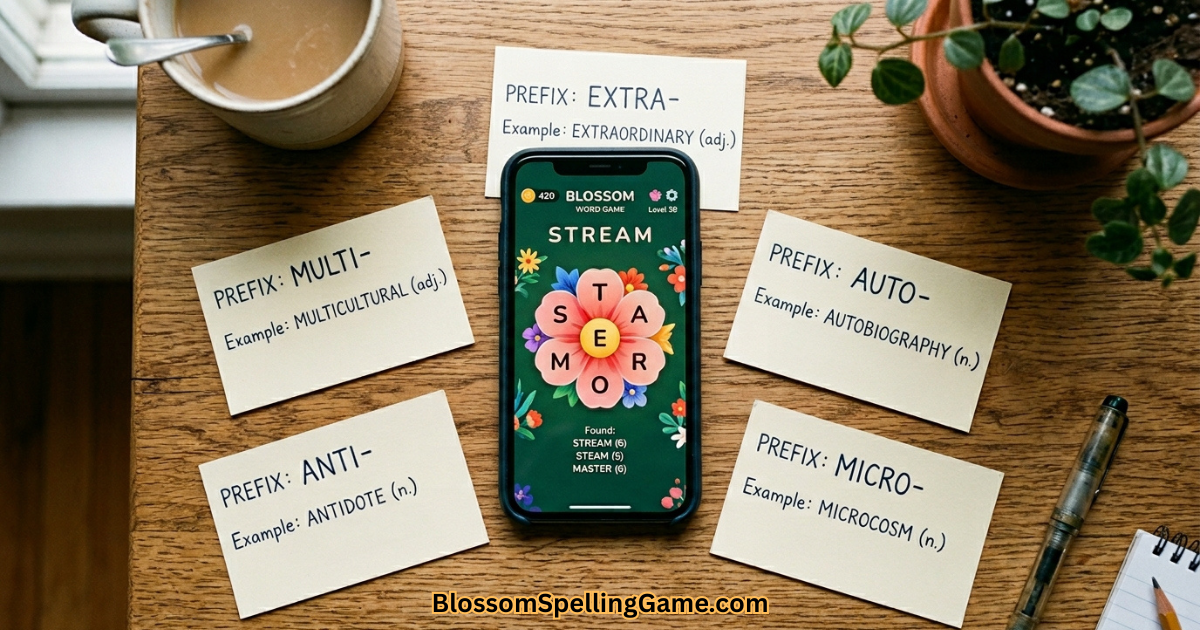
Learn how to use prefixes in Blossom Word Game to find more words every session — complete prefix taxonomy, letter screens, productivity rankings, and the workflow that works.
Every Blossom guide mentions prefixes. “Try RE-, UN-, PRE-, OUT-, OVER-.” Five prefixes listed, no further explanation. Then the guide moves on.
That’s not a prefix strategy. That’s a reminder that prefixes exist.
The gap between “I know prefixes help” and “I’m systematically using prefixes to find words” is wider than most players realize — and it’s a different gap from the one with suffixes. Suffixes attach to the end of roots, which means you find a root, then test every suffix your letters allow. Prefixes work differently. You can’t find the root first and then add RE- to the front — not reliably, because not every root takes every prefix. The productive prefix strategy runs in the opposite direction: start from the prefix and generate root candidates that pair with it.
This guide builds the complete prefix toolkit for Blossom: a full taxonomy organized by meaning and function, a letter availability screen, a productivity ranking that tells you which prefixes are actually worth hunting, the specific workflow for prefix-first word finding, how prefixes interact uniquely with the center letter rule, and the rare prefixes that almost no player uses but that consistently surface high-scoring words.
If you’ve read the Blossom Suffix Guide, you’ll find that prefixes require a meaningfully different approach — same principle, different execution. This article covers what that difference is and how to use it.
Why Prefix Strategy Is Different From Suffix Strategy
If you’ve worked through the suffix approach, your natural instinct might be to apply the same workflow here: find a root word, then test every available prefix against it. That instinct works for suffixes because suffixes are grammatically predictable — any verb can take -ING, any adjective can take -NESS, the attachment rules are consistent.
Prefixes don’t work that way. Prefix attachment is lexically determined rather than grammatically determined. That means which prefix attaches to which root is a property of the specific word, not a rule about word classes. You can’t reliably predict that a specific root will take RE- just because it’s a verb. RERUN works; REWALK doesn’t (even though WALK is a perfectly good verb). UNHAPPY works; UNSAD doesn’t (even though HAPPY and SAD are both adjectives meaning the same thing).
This lexical unpredictability means the suffix workflow — find root, test all suffixes — produces too many dead ends when applied to prefixes. You’d spend most of your time testing prefix+root combinations that don’t produce real words.
The productive prefix workflow runs the other direction:
- Identify which prefixes your letter set makes available
- For each available prefix, mentally generate the roots that commonly attach to that specific prefix
- Check whether those roots can be formed from your remaining letters
- Test the full word
This is prefix-first, root-second — the reverse of how most players instinctively approach it. It’s more efficient because you’re searching from a curated list of known prefix-root pairs rather than testing random combinations.
The second key difference: Suffixes often contain common letters (E, R, S, T, N) that frequently appear as center letters. When your center letter is E, almost every suffix naturally includes it. Prefixes work differently — most common prefixes don’t contain vowels that commonly serve as center letters, which means the center letter burden falls entirely on the root word. This changes the center letter analysis significantly.
How Prefixes Interact With the Center Letter Rule
This is the most important technical point about prefixes in Blossom — and it’s never discussed in general strategy guides.
Every valid Blossom submission must contain the center letter. When you add a prefix to a root word, the prefix letters are at the front of the word. The center letter must appear somewhere in the complete word. That means either:
Option A: The prefix itself contains the center letter. RE- contains R and E. If R or E is your center letter, any RE- word automatically satisfies the center letter requirement, regardless of the root.
Option B: The root contains the center letter. If the prefix doesn’t contain the center letter, then every single root you test against that prefix must contain the center letter.
Why this matters in practice:
Consider a puzzle where your center letter is A. You have the letters for UN- (U, N). Most UN- words have roots that don’t contain A: UNKIND, UNLIKE, UNTIE, UNTIL, UNWRAP. You need roots containing A: UNABLE (UN + ABLE), UNAWARE (UN + AWARE), UNAFRAID (UN + AFRAID), UNNATURAL (UN + NATURAL), UNPACK (UN + PACK — A in PACK).
This center letter filter applied to prefix roots significantly narrows your search — but it also makes it more efficient. Instead of generating all possible roots for UN-, you’re only generating roots that contain A. That’s a much smaller list.
The practical rule: Before generating roots for any prefix, ask: does this prefix contain my center letter? If yes, any valid root works. If no, only roots containing the center letter are viable — filter your root generation accordingly.
Which common prefixes contain vowels (and thus may contain common center letters):
- RE- contains E — if E is center, any RE- root works
- OVER- contains O and E — if O or E is center, OVER- words are fertile territory
- UNDER- contains E — if E is center, very productive
- INTER- contains E and I — if E or I is center, productive
- ANTI- contains A and I — if A or I is center, productive
- SEMI- contains E and I — if E or I is center, productive
- ULTRA- contains A — if A is center, productive
- EXTRA- contains E and A — if E or A is center, productive
- HYPER- contains E — if E is center, productive
- SUPER- contains E — if E is center, productive
Which common prefixes contain NO vowels (root must carry the center letter):
- UN- (U and N — U is less common as center)
- PRE- contains E — useful when E is center
- DIS- contains I — useful when I is center
- MIS- contains I — useful when I is center
- SUB- contains U — less common as center
- NON- contains O and N — useful when O is center
- OUT- contains O and U — useful when O is center
- FOR- contains O — useful when O is center
- PRO- contains O — useful when O is center
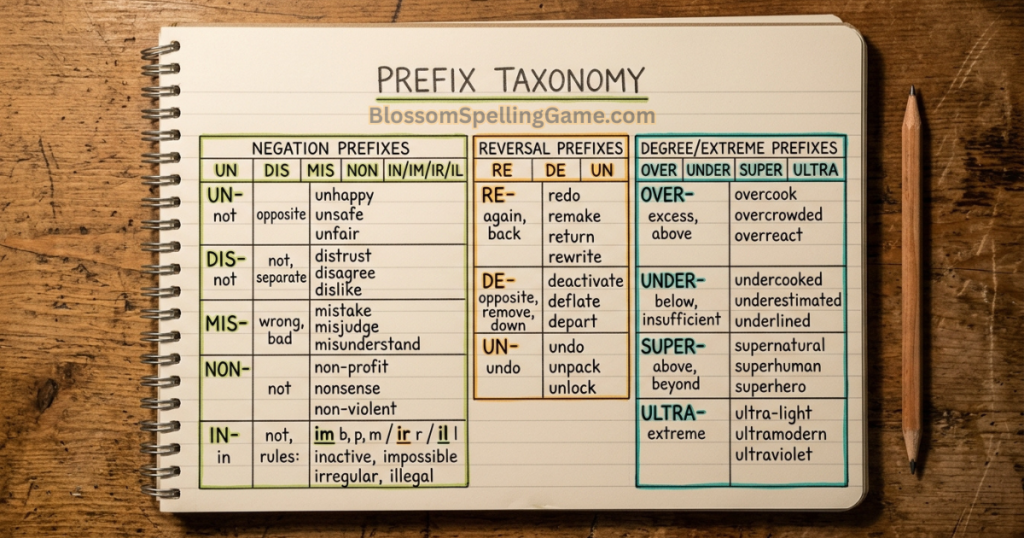
The Complete Blossom Prefix Taxonomy
Negation Prefixes — The Most Common Family
These prefixes create the negative or opposite meaning of a root word. They’re the most reliably productive prefix family in Blossom because they attach to large numbers of common adjectives, verbs, and nouns.
UN- Letters required: U, N Meaning: Not; reversal of action Attaches primarily to: adjectives (UNHAPPY, UNCLEAR, UNFAIR, UNSAFE, UNKIND), past participles (UNDONE, UNTIED, UNWRAPPED), and verbs of fastening (UNLOCK, UNPACK, UNBIND) Point addition: +2 letters High-value UN- words for Blossom: UNABLE (6 letters), UNAFRAID (8 letters), UNAWARE (7 letters), UNCERTAIN (9 letters), UNCLEAN (7 letters), UNFAIR (6 letters), UNHAPPY (7 letters), UNLIKELY (8 letters), UNNATURAL (9 letters), UNPACK (6 letters), UNSAFE (6 letters), UNUSUAL (7 letters), UNWRAP (6 letters) Center letter note: If U is center (uncommon), every UN- word works. If N is center, every UN- root must contain N — many do (UNNATURAL, UNNERVE). Otherwise, root must carry center letter.
IN- / IM- / IL- / IR- Letters required: I, N (for IN-); I, M (for IM-); I, L (for IL-); I, R (for IR-) Meaning: Not (attaches to adjectives of Latin/French origin) This prefix family morphs based on what follows it: IN- before most consonants and vowels; IM- before B, P, M; IL- before L; IR- before R. High-value IN- words: INACTIVE, INDIRECT, INFORMAL, INHUMAN, INJURE, INLAND, INNER (though these need full letter availability) High-value IM- words: IMMENSE, IMPACT, IMPORT (many IM- words aren’t strictly negative prefix — they’re from Latin IM- meaning “into”) Center letter note: IN- contains I and N. If I or N is your center letter, IN- words are highly productive.
DIS- Letters required: D, I, S Meaning: Not; reversal; removal Attaches to: verbs (DISAGREE, DISCOVER, DISCUSS, DISMISS), adjectives (DISHONEST, DISLOYAL), nouns (DISCOMFORT, DISORDER) High-value DIS- words: DISASTER (8 letters, 15 pts), DISCOUNT (8 letters), DISORDER (8 letters), DISPLAY (7 letters), DISTANT (7 letters), DISTINCT (8 letters), DISTURB (7 letters) Center letter note: DIS- contains D, I, S. If I or S is center, DIS- words are particularly productive.
MIS- Letters required: M, I, S Meaning: Wrongly; badly Attaches to: verbs (MISREAD, MISTAKE, MISLEAD, MISUSE) and nouns (MISFORTUNE, MISPRINT) High-value MIS- words: MISLEAD (7 letters), MISTAKE (7 letters), MISPLACE (8 letters), MISPRINT (8 letters), MISREAD (7 letters), MISUSE (6 letters) Center letter note: MIS- contains M, I, S. If I or S is center, productive.
NON- Letters required: N, O, N — but in practice N, O (the second N can be the first N reused if N is center or petal) Meaning: Not; absence of Attaches to: nouns and adjectives (NONFICTION, NONPROFIT, NONSENSE, NONSTANDARD) High-value NON- words: NONSENSE (8 letters), NONSTOP (7 letters), NONFICTION (10 letters when letters allow) Center letter note: NON- contains N and O. If N is center, very productive — the center N appears in the prefix itself.
Reversal and Opposition Prefixes
RE- Letters required: R, E Meaning: Again; back Attaches to: almost any verb (REREAD, REBUILD, RECLAIM, RECONNECT, RECOVER, REENTER) Point addition: +2 letters This is the single most productive prefix in Blossom — it attaches to more verb roots than any other prefix, the letters R and E are common, and RE- words tend to be long because the root verbs they attach to are often multi-syllable. High-value RE- words: REBUILD (7 letters), RECALL (6 letters), RECLAIM (7 letters), RECOVER (7 letters), REFORM (6 letters), RELEASE (7 letters), REMAIN (6 letters), REMIND (6 letters), REPLACE (7 letters), RESTORE (7 letters), RETURN (6 letters), REVEAL (6 letters) Pangram potential: RE- adds 2 letters to any verb root. A 5-letter root verb + RE- = 7-letter word. If your 5-letter root uses all 5 remaining letters (plus both R and E from your set), that’s your pangram. Center letter note: RE- contains R and E. If E is center (extremely common), every RE- word automatically satisfies the rule — any RE- root is valid regardless of whether the root itself contains E.
DE- Letters required: D, E Meaning: Remove; reduce; reverse Attaches to: verbs (DECODE, DEFROST, DELIGHT, DEMAND, DEPEND, DESIGN, DESTROY, DETACH) Point addition: +2 letters High-value DE- words: DEBATE (6 letters), DECADE (6 letters), DECODE (6 letters), DEFEAT (6 letters), DEFEND (6 letters), DEMAND (6 letters), DESIGN (6 letters), DETAIL (6 letters), DESTROY (7 letters) Center letter note: DE- contains D and E. If E is center, every DE- root works.
COUNTER- Letters required: C, O, U, N, T, E, R Meaning: Against; in opposition Point addition: +7 letters — this is both its power and its limitation High-value COUNTER- words: COUNTERACT (10 letters = 17 pts), COUNTERFEIT (11 letters), COUNTERPART (11 letters) Center letter note: COUNTER- requires 7 specific letters. When those letters are available, the words are extremely long and high-scoring. The prefix itself contains E — center E words qualify. Viability: Low overall — requires many specific letters — but when available, produces the highest-scoring prefix words in Blossom.
Degree and Intensity Prefixes
OVER- Letters required: O, V, E, R Meaning: Too much; above; across Attaches to: verbs (OVERCOME, OVERDO, OVERLAP, OVERSEE, OVERTURN) and adjectives (OVERDUE, OVERJOYED) Point addition: +4 letters High-value OVER- words: OVERCOME (8 letters, 15 pts), OVERFLOW (8 letters), OVERLAP (7 letters), OVERLOOK (8 letters), OVERRULE (8 letters), OVERTURN (8 letters), OVERUSE (7 letters) Center letter note: OVER- contains O, V, E, R. If E is center, every OVER- root works. V is not a common center letter but when it appears, OVER- words become very valuable. Note on V: V is an uncommon petal letter. When V appears in your set alongside O, E, R, systematically hunt OVER- words — they’re high-scoring and easily overlooked by other players.
UNDER- Letters required: U, N, D, E, R Meaning: Too little; below; beneath Attaches to: verbs (UNDERMINE, UNDERSCORE, UNDERSTAND, UNDERTAKE) and adjectives (UNDERAGE, UNDERDONE) Point addition: +5 letters High-value UNDER- words: UNDERLINE (9 letters, 16 pts), UNDERMINE (9 letters), UNDERTAKE (9 letters), UNDERSTAND (10 letters), UNDERGO (7 letters), UNDERSCORE (10 letters) Center letter note: UNDER- contains U, N, D, E, R. If E is center (or N), every UNDER- root works. When to look: When U, N, D, E, R are all present simultaneously, UNDER- words are among the highest-scoring opportunities in any Blossom session.
SUPER- Letters required: S, U, P, E, R Meaning: Above; greater Point addition: +5 letters High-value SUPER- words: SUPERHERO (9 letters), SUPERIOR (8 letters), SUPERMAN (8 letters), SUPERSTAR (9 letters), SUPERVISE (9 letters) Center letter note: SUPER- contains S, U, P, E, R. If E is center, productive.
ULTRA- Letters required: U, L, T, R, A Meaning: Extremely; beyond Point addition: +5 letters High-value ULTRA- words: ULTRALIGHT (10 letters), ULTRAVIOLET (11 letters — when V and I available), ULTRASOUND (10 letters) Center letter note: ULTRA- contains A. If A is center, productive.
HYPER- Letters required: H, Y, P, E, R Meaning: Excessive; beyond normal Point addition: +5 letters High-value HYPER- words: HYPERLINK (9 letters), HYPERSONIC (10 letters), HYPERACTIVE (11 letters when all letters available) Center letter note: HYPER- contains E and Y. If E is center, productive. Y is uncommon as center.
SEMI- Letters required: S, E, M, I Meaning: Half; partially Point addition: +4 letters High-value SEMI- words: SEMIFINAL (9 letters), SEMICIRCLE (10 letters), SEMITONE (8 letters) Center letter note: SEMI- contains E and I. If E or I is center, productive.
Location and Direction Prefixes
OUT- Letters required: O, U, T Meaning: Surpassing; external; beyond Attaches to: verbs (OUTRUN, OUTLAST, OUTSMART, OUTPERFORM) and nouns/adjectives (OUTDOOR, OUTRIGHT, OUTSIDE) Point addition: +3 letters High-value OUT- words: OUTCOME (7 letters), OUTDOOR (7 letters), OUTGROW (7 letters), OUTLINE (7 letters), OUTSIDE (7 letters), OUTRIGHT (8 letters), OUTSTANDING (11 letters when all letters available) Center letter note: OUT- contains O, U, T. If O or T is center, productive.
IN- (location sense) Letters required: I, N Meaning: Into; within (distinct from negating IN-) Words: INDOOR, INLAND, INWARD, INFLOW, INBORN, INSIDE, INTAKE, INWARD Center letter note: IN- contains I and N. If I or N is center, productive.
SUB- Letters required: S, U, B Meaning: Under; below; subordinate Attaches to: nouns (SUBWAY, SUBTITLE, SUBURB) and verbs (SUBMIT, SUBSCRIBE, SUBTRACT) Point addition: +3 letters High-value SUB- words: SUBJECT (7 letters), SUBMIT (6 letters), SUBURB (6 letters), SUBTLE (6 letters), SUBTRACT (8 letters), SUBWAY (6 letters) Center letter note: SUB- contains S, U, B. None of these are among the most common center letters, but B is a valid center letter in some puzzles.
FORE- Letters required: F, O, R, E Meaning: Before; in front of Attaches to: nouns (FOREFRONT, FORESIGHT, FORETHOUGHT) and verbs (FORESEE, FORECLOSE, FORETELL) Point addition: +4 letters High-value FORE- words: FORECAST (8 letters), FOREGROUND (10 letters), FORESEE (7 letters), FORESIGHT (9 letters), FORETHOUGHT (11 letters) Center letter note: FORE- contains F, O, R, E. If E is center, productive. F as a center letter is uncommon but when it appears, FORE- words are valuable.
INTER- Letters required: I, N, T, E, R Meaning: Between; among; mutually Point addition: +5 letters High-value INTER- words: INTERACT (8 letters), INTEREST (8 letters), INTERIM (7 letters), INTERNAL (8 letters), INTERNET (8 letters) Center letter note: INTER- contains I, N, T, E, R. If E is center (or I or N), highly productive given how many common words begin with INTER-.
TRANS- Letters required: T, R, A, N, S Meaning: Across; beyond; through Point addition: +5 letters High-value TRANS- words: TRANSFER (8 letters), TRANSFORM (9 letters), TRANSIT (7 letters), TRANSPARENT (11 letters) Center letter note: TRANS- contains T, R, A, N, S. If A is center, productive.
Time Prefixes
PRE- Letters required: P, R, E Meaning: Before Attaches to: verbs (PREPARE, PREVENT, PREDICT), nouns (PREFIX, PREFACE, PREVIEW), adjectives (PREMATURE, PREHISTORIC) Point addition: +3 letters High-value PRE- words: PREPARE (7 letters), PRESENT (7 letters), PREVENT (7 letters), PREVIEW (7 letters), PREVIOUS (8 letters), PROVIDE (7 letters — actually PRO- not PRE-) Center letter note: PRE- contains P, R, E. If E is center, any PRE- root works.
POST- Letters required: P, O, S, T Meaning: After; following Attaches to: nouns (POSTCARD, POSTWAR, POSTSCRIPT) and verbs (POSTPONE, POSTDATE) Point addition: +4 letters High-value POST- words: POSTCARD (8 letters), POSTPONE (8 letters), POSTSCRIPT (10 letters) Center letter note: POST- contains P, O, S, T. If O or S is center, productive.
AFTER- Letters required: A, F, T, E, R Meaning: Following in time Point addition: +5 letters High-value AFTER- words: AFTERTHOUGHT (11 letters), AFTERNOON (9 letters), AFTERWARD (9 letters) Center letter note: AFTER- contains A, F, T, E, R. If E or A is center, productive.
Rare and High-Value Prefixes Most Players Miss
These prefixes are almost never mentioned in word game guides — which means they’re a consistent source of words other players overlook.
MULTI- Letters required: M, U, L, T, I Meaning: Many Point addition: +5 letters Words: MULTIPLY (8 letters), MULTIPLE (8 letters), MULTITASK (9 letters), MULTITUDE (9 letters) Center letter note: MULTI- contains M, U, L, T, I. If I is center, productive.
ANTI- Letters required: A, N, T, I Meaning: Against; opposing Point addition: +4 letters Words: ANTIDOTE (8 letters), ANTISOCIAL (10 letters), ANTIQUE (7 letters — actually from Latin, not ANTI- prefix), ANTIFREEZE (10 letters) Center letter note: ANTI- contains A, N, T, I. If A, N, T, or I is center, productive.
PRO- Letters required: P, R, O Meaning: For; forward; in favor of Point addition: +3 letters Words: PRODUCE (7 letters), PROGRESS (8 letters), PROMOTE (7 letters), PROTECT (7 letters), PROVIDE (7 letters), PROUD (5 letters) Center letter note: PRO- contains P, R, O. If O is center, productive.
EXTRA- Letters required: E, X, T, R, A Meaning: Outside; beyond; additionally Point addition: +5 letters Words: EXTRAORDINARY (13 letters — when all letters available), EXTRACT (7 letters), EXTREME (7 letters — actually EX- not EXTRA-) Center letter note: EXTRA- contains E, X, T, R, A. X as a center letter is uncommon but when it appears alongside these letters, EXTRA- words are very high-scoring.
AUTO- Letters required: A, U, T, O Meaning: Self; independently Point addition: +4 letters Words: AUTOMATIC (9 letters), AUTOMOBILE (10 letters), AUTOPILOT (9 letters), AUTOGRAPH (9 letters) Center letter note: AUTO- contains A, U, T, O. If A or O is center, productive.
MICRO- Letters required: M, I, C, R, O Meaning: Small; one millionth Point addition: +5 letters Words: MICROCHIP (9 letters), MICROPHONE (10 letters), MICROSCOPE (10 letters) Center letter note: MICRO- contains M, I, C, R, O. If I or O is center, check for MICRO- words when all required letters are present.
PHOTO- Letters required: P, H, O, T, O — needs O twice, limiting availability Words: PHOTOGRAPH (10 letters), PHOTON (6 letters) Center letter note: Requires O twice — limited by this constraint.
The Prefix Letter Availability Screen
At the start of every Blossom session, run this screen to identify which prefixes your letter set supports. This takes ten to fifteen seconds and sets up your prefix strategy for the entire session.
Quick reference — prefix letter requirements:
RE-      → R, E
UN-      → U, N
DIS-     → D, I, S
MIS-     → M, I, S
IN-      → I, N
DE-      → D, E
PRE-     → P, R, E
OUT-     → O, U, T
OVER-    → O, V, E, R
UNDER-   → U, N, D, E, R
INTER-   → I, N, T, E, R
TRANS-   → T, R, A, N, S
FORE-    → F, O, R, E
PRO-     → P, R, O
POST-    → P, O, S, T
SUB-     → S, U, B
NON-     → N, O, N (needs N + O)
SUPER-   → S, U, P, E, R
SEMI-    → S, E, M, I
ANTI-    → A, N, T, I
MULTI-   → M, U, L, T, I
AUTO-    → A, U, T, O
AFTER-   → A, F, T, E, R
ULTRA-   → U, L, T, R, A
COUNTER- → C, O, U, N, T, E, R
Apply the center letter filter immediately: Once you’ve identified available prefixes, cross-check each against your center letter. For each prefix, ask: does this prefix contain my center letter? If yes, mark it as “open” — any root works. If no, mark it as “filtered” — only roots containing the center letter apply.
Build your active prefix list: Available prefixes that pass both the letter screen and center letter filter constitute your active prefix list for this session.
Prefix Productivity Rankings — Which Are Worth Hunting?
Not all prefixes are equally worth your time. Here’s a practical productivity ranking based on three factors: how many English roots each prefix attaches to (breadth), how often those roots can be formed from a typical 7-letter Blossom set (availability), and how long the resulting words tend to be (scoring value).
| Prefix | Breadth | Availability | Avg Word Length | Productivity Score |
|---|---|---|---|---|
| RE- | Very High | High (R, E common) | 6–9 letters | ⭐⭐⭐⭐⭐ |
| UN- | High | Moderate (U less common) | 6–8 letters | ⭐⭐⭐⭐ |
| DIS- | High | Moderate (D, I, S needed) | 7–9 letters | ⭐⭐⭐⭐ |
| OUT- | High | Moderate (O, U, T needed) | 6–9 letters | ⭐⭐⭐⭐ |
| IN- | High | High (I, N very common) | 6–8 letters | ⭐⭐⭐⭐ |
| OVER- | High | Low-Moderate (V uncommon) | 7–9 letters | ⭐⭐⭐ |
| PRE- | Moderate | Moderate (P, R, E needed) | 6–9 letters | ⭐⭐⭐ |
| DE- | Moderate | Moderate (D, E needed) | 6–8 letters | ⭐⭐⭐ |
| MIS- | Moderate | Moderate (M, I, S needed) | 6–8 letters | ⭐⭐⭐ |
| UNDER- | Moderate | Low (U, N, D, E, R needed) | 8–11 letters | ⭐⭐⭐ |
| INTER- | Moderate | Low (I, N, T, E, R needed) | 8–10 letters | ⭐⭐⭐ |
| FORE- | Low-Moderate | Low-Moderate | 7–10 letters | ⭐⭐ |
| SUB- | Low-Moderate | Low (B uncommon) | 6–8 letters | ⭐⭐ |
| ANTI- | Low | Moderate | 7–10 letters | ⭐⭐ |
| TRANS- | Low | Low | 7–10 letters | ⭐⭐ |
| COUNTER- | Low | Very Low | 10–13 letters | ⭐ (but enormous when available) |
The key insight from this ranking: RE- is the highest-productivity prefix by a significant margin. In any session where R and E are both in your letter set, hunting RE- words should be an explicit early-session strategy. The combination of breadth (it attaches to almost any verb), availability (R and E are common letters), and scoring length (RE- words are typically 6–9 letters) makes it the prefix equivalent of -ING in the suffix toolkit.
The Scoring Math: What Prefixes Add
Unlike suffix scoring (where the suffix adds letters to the end of a root, making the total word longer), prefix scoring works the same way mathematically — but the psychological difference is that prefix words tend to have longer root words than suffix words, producing inherently longer final words.
| Prefix | Letters Added | 4-Letter Root → Extended Word | Points Added |
|---|---|---|---|
| COUNTER- | +7 | 1 pt (4L) → 18 pts (11L) | +17 pts |
| UNDER- | +5 | 1 pt (4L) → 16 pts (9L) | +15 pts |
| INTER- | +5 | 1 pt (4L) → 16 pts (9L) | +15 pts |
| SUPER- | +5 | 1 pt (4L) → 16 pts (9L) | +15 pts |
| ULTRA- | +5 | 1 pt (4L) → 16 pts (9L) | +15 pts |
| TRANS- | +5 | 1 pt (4L) → 16 pts (9L) | +15 pts |
| AFTER- | +5 | 1 pt (4L) → 16 pts (9L) | +15 pts |
| OVER- | +4 | 1 pt (4L) → 15 pts (8L) | +14 pts |
| FORE- | +4 | 1 pt (4L) → 15 pts (8L) | +14 pts |
| SEMI- | +4 | 1 pt (4L) → 15 pts (8L) | +14 pts |
| ANTI- | +4 | 1 pt (4L) → 15 pts (8L) | +14 pts |
| AUTO- | +4 | 1 pt (4L) → 15 pts (8L) | +14 pts |
| POST- | +4 | 1 pt (4L) → 15 pts (8L) | +14 pts |
| OUT- | +3 | 1 pt (4L) → 12 pts (7L) | +11 pts |
| PRE- | +3 | 1 pt (4L) → 12 pts (7L) | +11 pts |
| PRO- | +3 | 1 pt (4L) → 12 pts (7L) | +11 pts |
| DIS- | +3 | 1 pt (4L) → 12 pts (7L) | +11 pts |
| MIS- | +3 | 1 pt (4L) → 12 pts (7L) | +11 pts |
| SUB- | +3 | 1 pt (4L) → 12 pts (7L) | +11 pts |
| RE- | +2 | 1 pt (4L) → 6 pts (6L) | +5 pts |
| UN- | +2 | 1 pt (4L) → 6 pts (6L) | +5 pts |
| DE- | +2 | 1 pt (4L) → 6 pts (6L) | +5 pts |
| IN- | +2 | 1 pt (4L) → 6 pts (6L) | +5 pts |
The paradox of short vs. long prefixes: RE- and UN- rank among the most productive prefixes (high breadth, high availability) but add the fewest letters (+2). COUNTER- and UNDER- are rare but add enormous point value when available. The optimal strategy: hunt RE- and UN- first for reliable word count, then hunt UNDER-/OVER-/INTER- when those letters are present for the massive point additions.
The Correct Workflow: Prefix-First vs. Root-First
As established earlier, prefix strategy runs in the opposite direction from suffix strategy. Here’s the complete workflow:
Suffix workflow (root-first): Find a root → test every available suffix against it → submit valid combinations
Prefix workflow (prefix-first): Identify available prefixes → for each prefix, generate known root words that commonly attach to it → check whether those roots can be formed from remaining letters → test and submit
The prefix-first workflow in detail:
Step 1: Identify your active prefix list Run the letter availability screen. Apply the center letter filter. What remains is your active prefix list.
Step 2: For each active prefix, generate its most common root words This is the vocabulary knowledge step. For RE-, your mental list might include: CALL, TURN, BUILD, COVER, PLACE, MIND, STORE, LEASE, VIEW, MAIN, NEW, LATE, PLAY. For UN-, your list might include: HAPPY, FAIR, KIND, PACK, LOCK, TIE, WRAP, CLEAR, SAFE, USUAL, KNOWN, LIKELY.
Step 3: Check root availability For each root candidate, check whether all its letters are present in your 7-letter set (center letter plus petals). Cross off roots whose letters you don’t have.
Step 4: Verify center letter If your prefix doesn’t contain the center letter, confirm the root contains it. If the prefix does contain the center letter, skip this step.
Step 5: Test and submit Submit the surviving candidates. Rejected submissions cost nothing — test freely.
Parallel processing: Once you’ve identified 3–4 promising prefix-root combinations, submit your first few shorter words from other sources while these candidates load in your mind. Then return to test the prefix words with fresh eyes.
Prefix-Root Compatibility — Not Every Prefix Attaches to Every Root
This is the critical knowledge that separates productive prefix use from wasted attempts. Prefix attachment in English is partly predictable (RE- attaches to verbs, UN- attaches to adjectives and past participles) and partly lexical (RERUN works, REWALK doesn’t).
Reliable attachment patterns:
RE- attaches to most verbs, especially those with Latin/French roots: REBUILD, RECLAIM, RECONNECT, RECOVER, REFORM, RELEASE, REMAIN, REPLACE, RESTORE. But not most Germanic-root verbs: REWALK, RETHROW, RESWIM are not standard words.
UN- attaches to adjectives ending in suffixes like -ED, -FUL, -ABLE, -WORTHY, -KNOWN: UNDAMAGED, UNHELPFUL, UNABLE, UNTRUSTWORTHY, UNKNOWN. Also to past participles of verbs of fastening: UNLOCK, UNTIE, UNPACK, UNWRAP.
DIS- attaches to verbs where the prefix creates a clear opposite: DISASSEMBLE, DISBELIEVE, DISCONNECT, DISCOVER, DISLIKE, DISMISS, DISPLACE, DISPROVE, DISREGARD.
OUT- attaches to verbs to mean “surpass” or “beyond”: OUTRUN, OUTLAST, OUTPERFORM, OUTSMART — and to nouns for location: OUTDOOR, OUTLINE, OUTSIDE.
Common false combinations to avoid submitting:
UNHUNGRY (not standard — use SATIATED) REASK (not standard — use ASK AGAIN) DISEAT (not a word) UNHAVE (not a word) PRETHINK (not standard) MISLOVE (not standard)
The test: if you wouldn’t see the word in a published book or serious article, it probably won’t be in Merriam-Webster. Stick to prefix-root pairs you’ve encountered in actual written English.
The Doubling Phenomenon — When Prefixes Create Double Letters
When a prefix ends in the same letter that the root begins with, the resulting word has a double letter. This is completely valid — and these words often surprise players who assume double letters can’t appear because each letter is “used up.”
Common Blossom-valid double-letter prefix words:
RE- + words beginning with R: REREAD (R,E,R,E,A,D — 6 letters, 6 pts) — needs R twice; R is petal, can be reused REROUTE (R,E,R,O,U,T,E — 7 letters, 12 pts) RERUN (R,E,R,U,N — 5 letters, 5 pts)
UN- + words beginning with N: UNNATURAL (U,N,N,A,T,U,R,A,L — 9 letters — needs N twice and other letters) UNNECESSARY (U,N,N,E,C,E,S,S,A,R,Y — needs many letters) UNNAMED (U,N,N,A,M,E,D — 7 letters)
IN- + words beginning with N: INNOCENT (I,N,N,O,C,E,N,T — needs N three times — very letter-heavy)
DIS- + words beginning with S: DISSOLVE (D,I,S,S,O,L,V,E — needs S twice) DISSERVICE (D,I,S,S,E,R,V,I,C,E)
The letter reuse reminder: In Blossom, you can use any letter from your 7-letter set multiple times in a single word. A word requiring N twice is valid as long as N appears in your set — it just appears in the word twice. This is not a violation; it’s a feature. See our Blossom Rules Guide for the complete letter reuse explanation.
Double-letter prefix words tend to be longer and therefore score more points. REREAD earns 6 points; READ earns 4. UNNATURAL earns 9 base points; NATURAL earns 7. The doubling adds value.
Prefix Chains and Multi-Prefix Words
A small but valuable category: words that appear to use two prefixes, or that chain a prefix onto an already-prefixed root.
Examples of chain-prefix words valid in Blossom:
MISUNDERSTAND — MIS- + UNDERSTAND (where UNDER is itself a prefix) MISREPRESENT — MIS- + REPRESENT (where RE is a prefix) OVERREACT — OVER- + REACT (where RE could be seen as part of REACT’s root) UNDERPREPARE — UNDER- + PREPARE (where PRE is a prefix) OUTPERFORM — OUT- + PERFORM
These words are typically 9–12 letters and score accordingly. They’re hard to find because they require recognizing the double structure — but when the letter set contains the right combination, they can be the highest-scoring word in your entire session.
How to find them: When you’ve already found a prefixed word (say, REFORM), ask: can another prefix attach to the front? REFORM → can I put something before it? PREREFORM? Not standard. ANTI-REFORM? Too letter-heavy. But OVERREFORM? Not standard. The specific word that works has to be a real dictionary entry — you can’t construct them arbitrarily.
More productively: start from known multi-prefix words and check if your letter set supports them. MISUNDERSTAND, OVERREACT, UNDERPREPARE, OUTPERFORM — if your letters allow any of these, they’re worth testing.
Common Prefix Mistakes in Blossom
Mistake 1: Applying prefixes to incompatible roots RESWIM, REWALK, UNFAST (not standard) — these feel right but aren’t in the dictionary. Stick to prefix-root pairs you’ve actually encountered in English texts.
Mistake 2: Forgetting the center letter requirement A beautiful prefix word that doesn’t contain the center letter is useless. Always verify the center letter appears somewhere in the complete prefixed word before spending time building root candidates for a prefix.
Mistake 3: Only testing RE- and UN- These two dominate strategy guides because they’re the most mentioned. But OUT-, OVER-, DIS-, MIS-, INTER-, FORE-, and DE- are equally productive in the right letter sets. Expand beyond the two most obvious options.
Mistake 4: Running prefix strategy before root strategy In most Blossom sessions, pure root words (without prefix or suffix) should be found first. Prefixes add to roots — so finding roots first means you always have material to apply prefixes to. Run prefix strategy in the second half of your session, after you’ve established your root word inventory.
Mistake 5: Ignoring the prefix word as a pangram candidate A prefix + root often uses many letters. RE- takes 2 letters; a 5-letter root uses 5 more. If those 5 root letters are the remaining 5 of your 7-letter set (after using R and E), REFORM or REPAIR or RETURN might be your pangram. Always check prefix words against the pangram criterion.
The 60-Second Prefix Screen for Every Session
This is the prefix equivalent of the suffix drill from the Blossom Suffix Guide. Run both drills at the start of each session for maximum word coverage.
Step 1: Check center letter (5 seconds) Note which common prefixes contain your center letter. These are immediately “open” — any root works.
Step 2: Run the letter availability screen (20 seconds) Check your 7 letters against the prefix requirement list above. Mark available prefixes.
Step 3: Apply center letter filter to non-containing prefixes (10 seconds) For each available prefix that doesn’t contain your center letter, note that only roots with the center letter apply.
Step 4: Priority order (5 seconds) Rank your active prefixes by productivity: RE- and IN- first, then UN-, OUT-, DIS-, MIS-, then longer prefixes if available.
Step 5: Generate roots for top 3 prefixes (20 seconds) For your three highest-priority active prefixes, quickly generate 3–4 root candidates each. Note which ones seem most likely given your letter set.
Step 6: Test during session (ongoing) Test prefix candidates throughout your session — particularly in the second half, once you’ve identified your root word inventory.
FAQ
What prefixes work best in Blossom Word Game?
RE- is the highest-productivity prefix by a significant margin — it attaches to more verb roots than any other prefix, requires only R and E (common letters), and produces words of 6–9 letters. UN-, DIS-, OUT-, and IN- rank second tier. For maximum point-adding, UNDER-, INTER-, OVER-, and COUNTER- produce the longest words when their letter requirements are met.
How is prefix strategy different from suffix strategy in Blossom?
Suffix strategy runs root-first: find a root, test every available suffix against it. Prefix strategy runs prefix-first: identify available prefixes, then generate known roots that commonly attach to each prefix, then check root availability. This difference exists because suffix attachment is grammatically predictable (any verb takes -ING) while prefix attachment is lexically determined (not every verb takes RE-).
Does adding a prefix always make a word valid in Blossom?
No — only known dictionary words are accepted. RERUN is valid; REWALK is not, even though both add RE- to a verb. The prefix-root combination must be an established Merriam-Webster entry. Testing uncertain combinations costs nothing (no slot used on rejection) — submit freely and let the dictionary decide.
How does the center letter rule interact with prefixes?
Every word must contain the center letter, including prefixed words. If your prefix contains the center letter (RE- when E is center), any root works. If your prefix doesn’t contain the center letter, your root must contain it — this filters your root candidates significantly and makes your search more efficient.
Can I use prefix and suffix on the same word?
Yes — and you should actively look for this. A word like REBUILDING uses RE- prefix and -ING suffix on the root BUILD. UNHELPFUL uses UN- prefix and -FUL suffix on HELP. MISUNDERSTANDING uses MIS- prefix and -ING suffix on UNDERSTAND. These words are very long and score very high. After finding a root, test both prefix and suffix additions before moving on.
What rare prefixes should I remember for Blossom?
FORE- (FORESIGHT, FORECAST), AUTO- (AUTOMATIC, AUTOGRAPH), SEMI- (SEMIFINAL, SEMICIRCLE), ANTI- (ANTIDOTE, ANTIFREEZE), MULTI- (MULTIPLY, MULTIPLE), and AFTER- (AFTERNOON, AFTERWARD) are consistently overlooked. When the required letters are present, these produce long, high-scoring words that other players miss entirely.
How do double-letter prefix words work in Blossom?
When a prefix ends in a letter that the root begins with (RE- + RUN = RERUN, UN- + NATURAL = UNNATURAL), the resulting word has a double letter. This is completely valid — Blossom allows letter reuse within words. These double-letter words are often longer and higher-scoring than their single-letter equivalents.
Should I look for prefixes before or after finding base words?
Root words first, then prefixes. Establishing your root word inventory first gives you material to test prefixes against — and many prefixes are discovered naturally as you find roots (finding RUN makes you think of RERUN). Reserve dedicated prefix strategy for the second half of your session, when you’ve found your obvious root words and need to extract more from the letter set.
Final Thoughts
Prefixes and suffixes are complementary tools — and the players who use both systematically are the ones who consistently pull 8–10 words per session from letter sets that average players get 5–6 from.
The key insight from this guide: prefix strategy requires different execution from suffix strategy. The prefix-first workflow (identify prefix → generate known roots → check availability → verify center letter → test) is more efficient than trying to add prefixes to roots after the fact, because prefix attachment is lexically constrained in ways that suffix attachment isn’t.
Start with RE-. It’s the most productive, most reliably available, and easiest to execute. For any session where R and E are both present, build a mental list of RE- verb roots your other letters can form and test them early. Then work through UN-, DIS-, OUT-, and IN- based on letter availability.
For long sessions and high scores, keep the rare prefixes in mind: FORE-, INTER-, UNDER-, AUTO-, SEMI-. When the letters line up, these produce the longest and highest-scoring words in any given session.
Combine both guides — this one and the Suffix Guide — into your pre-session drill. Together, they cover every major word-extension strategy available in Blossom and give you a systematic approach to finding words that reactive, intuition-based play consistently misses.
Play today’s puzzle at BlossomSpellingGame.com. The letters are fresh. Your active prefix list is one screen away.