
What are the real Cognitive benefits of playing daily word games? The science behind spacing effects, retrieval practice, flow states, cognitive reserve, and brain health — explained.?
You’ve probably read something like this before: “word games are good for your brain.” Maybe you’ve seen it mentioned in an app description, a wellness article, or a passing comment from someone who plays the daily puzzle to “keep sharp.”
The claim is accurate. The explanation is almost always too shallow to be useful.
“Good for your brain” doesn’t tell you which cognitive functions are affected, through which mechanisms, at what frequency of practice, and whether the benefits are temporary engagement effects or lasting structural changes. Those details matter — both for knowing what you’re actually getting from a daily word game habit and for understanding how to structure that habit to extract maximum benefit.
This article covers the cognitive science of daily word games in the depth it deserves. Not the two studies cited in every “word games are good for you” article — those are already covered in our How to Play guide. Instead, this article covers the mechanisms: spacing effects, retrieval practice theory, flow state psychology, cognitive reserve, inhibitory function, attention restoration, and what the evidence actually says about transfer to real-world language performance.
By the end, you’ll understand not just that daily word games are cognitively beneficial — but precisely why, which benefits are strongest, and how to structure your playing habits to maximize those benefits.
The Cognitive Functions That Daily Word Games Exercise
Before getting into mechanisms, it helps to map exactly which cognitive systems are engaged during a daily word game session. Different game types engage different systems — and understanding the map clarifies which benefits to expect from which games.
Playing Blossom Word Game specifically engages:
Phonological working memory: Holding letter patterns in mind while searching for words that match them. You’re simultaneously maintaining the letter set and running it against your vocabulary — a sustained dual-task for phonological working memory.
Lexical access: The speed and ease with which words are retrieved from long-term memory. Each Blossom session is a repeated lexical access exercise — dozens of retrieval attempts in a single 15-minute session.
Orthographic processing: Recognizing and manipulating written letter patterns. The letter-scanning component of Blossom is specifically orthographic — you’re working with letters as visual symbols, not sounds.
Semantic memory: Your stored knowledge of word meanings and word relationships. Finding words like GARDEN or NATURE requires activating semantic memory (the meaning categories that contain those words) alongside orthographic memory (their spelling).
Executive function: Planning, prioritization, and cognitive control. Blossom’s 12-slot budget mechanic specifically exercises executive function — you’re managing resources, making strategic decisions, and inhibiting premature submissions.
Inhibitory control: The ability to suppress inappropriate responses. Every time you consider a word that doesn’t contain the center letter and discard it, you’re exercising inhibitory control — selecting appropriate responses from a pool of candidates.
Playing daily word games in general additionally engages:
Spatial memory (grid-based games like Strands): The visuospatial sketchpad, path tracing, spatial working memory.
Categorical classification (Connections-style games): Semantic categorization, conceptual grouping, inhibitory control against misdirection.
Deductive reasoning (Wordle-style games): Logical elimination, hypothesis testing, systematic reduction of possibility space.
The Spacing Effect: Why Daily Play Beats Weekly Marathons
The spacing effect is one of the most robustly demonstrated phenomena in learning science — and it’s directly relevant to how you structure a word game habit.
What the spacing effect is:
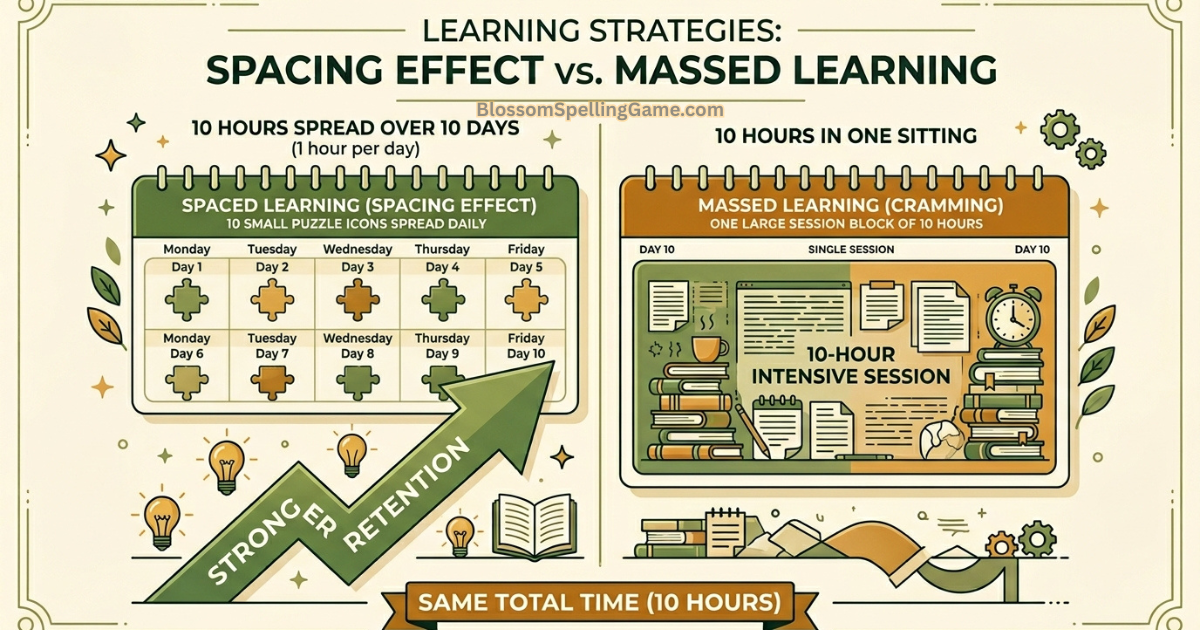
When you practice a skill, the timing of practice sessions dramatically affects how well the learning sticks. Specifically: distributed practice (short sessions spread across many days) produces significantly stronger long-term retention than massed practice (long sessions concentrated in fewer days).
The classic finding: studying vocabulary for 30 minutes per day for 10 days produces much stronger retention than studying for 300 minutes in a single session. The total time is identical. The outcome is radically different.
Why this happens:
The mechanism involves how memories are consolidated in the brain. Each time you retrieve information after a gap, the act of retrieval strengthens the memory trace — and the greater the gap, the stronger the strengthening effect. When you practice in massed sessions, you’re retrieving information from recent short-term memory (which is already active), so the retrieval is easy but the strengthening effect is minimal. When you practice after a day’s gap, retrieval requires genuine effort against some forgetting — and that effortful retrieval produces much stronger encoding.
Applied to daily word games:
A daily Blossom session is a near-perfect implementation of the spacing effect for vocabulary. Each day’s session requires you to retrieve words you encountered in previous sessions — but with a gap (usually 24 hours) that produces genuine retrieval effort. Words that appeared in yesterday’s puzzle that you didn’t find, words you discovered a week ago in the archive review, letter patterns you’ve encountered dozens of times — all of these are re-activated and strengthened with each daily session.
Players who play every day for a month will show much stronger vocabulary retention than players who play the equivalent total time in weekend marathons. This isn’t intuition — it’s the predictable consequence of the spacing effect applied to word game practice.
The practical implication:
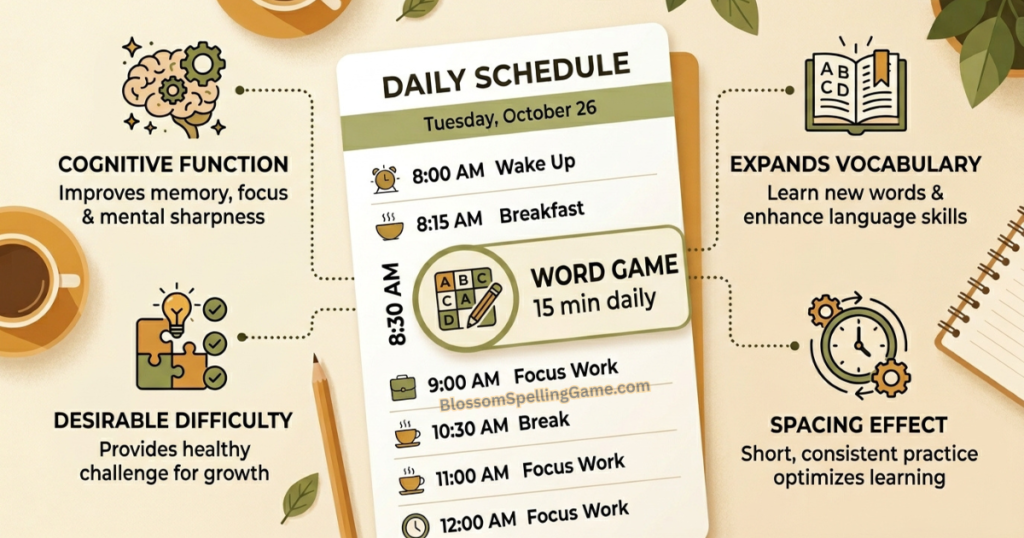
The daily reset that daily word games use isn’t just a business model — it’s cognitively optimal for learning. The 24-hour gap between sessions is close to the sweet spot for spacing effects for most vocabulary items. Playing at approximately the same time each day (as recommended for optimal cognitive performance) produces even more consistent spacing intervals and therefore stronger consolidation effects.
Retrieval Practice and the Testing Effect
The retrieval practice effect (sometimes called the “testing effect”) is closely related to the spacing effect but distinct enough to deserve its own treatment — because it explains one of the most important cognitive mechanisms behind word games specifically.
What retrieval practice is:
Learning research distinguishes between encoding (getting information into memory) and retrieval (getting it back out). The intuitive model of learning focuses on encoding — reading something, listening to it, studying it. The retrieval practice effect reveals that the most powerful method for strengthening memory is not better encoding but better retrieval: actively pulling information from memory, rather than passively re-exposing yourself to it.
The core finding:
When students study material by re-reading it, retention at a later test is moderate. When students study by attempting to recall the material from memory (even with errors, even unsuccessfully), retention is dramatically higher — often two to three times higher than re-reading alone, even when the total study time is identical.
This is one of the most counter-intuitive findings in learning science. Failed retrieval attempts — where you try to recall something and can’t — are often more effective at strengthening memory than successful passive review.
Applied to word games:
Every word you search for but don’t find in Blossom is a failed retrieval attempt. You know the word exists (because the archive confirms it later), you tried to retrieve it, and you couldn’t. According to retrieval practice theory, this failed attempt actually strengthens your subsequent ability to access that word — more than simply seeing it on a word list would.
This is the cognitive mechanism behind post-session archive review. Looking at words you missed isn’t just informational (“I didn’t know that word”) — it’s closing the retrieval loop on failed attempts that occurred during play. The combination of failed retrieval during play + successful recognition during archive review produces exactly the kind of retrieval practice cycle that memory research predicts will produce the strongest long-term retention.
The active vs. passive distinction:
In your Blossom Rules guide, we’ve covered that generating words from letters (active production) is more cognitively demanding than recognizing words from a list (passive recognition). The retrieval practice effect explains precisely why: active generation requires effortful retrieval from long-term memory, which triggers the strengthening mechanisms. Passive recognition doesn’t.
This is why word production games like Blossom are more effective vocabulary builders than word recognition games (multiple choice vocabulary tests, matching exercises) despite often being harder. The difficulty is the feature.
Desirable Difficulties: Why Struggling Is Better Than Easy Wins
Closely related to retrieval practice is the broader concept of “desirable difficulties” in learning science — a framework developed by cognitive psychologist Robert Bjork that explains why some forms of difficulty improve learning while others impede it.
What desirable difficulties are:
Desirable difficulties are conditions that slow down or complicate the learning process in the short term but enhance long-term retention and transfer. They’re “desirable” because they produce better outcomes despite feeling harder. Undesirable difficulties are conditions that slow learning without enhancing outcomes — confusion, unclear instructions, irrelevant obstacles.
Examples of desirable difficulties:
- Testing yourself on material before you’ve studied it (generation effect)
- Introducing variation in practice conditions rather than practicing the same way every time
- Spacing practice out over time rather than massing it
- Requiring active generation of responses rather than recognition
Blossom is a desirable difficulty machine:
Every difficult element of Blossom is a desirable difficulty. The center letter constraint makes word finding harder — and produces stronger orthographic learning than an unconstrained word game. The 12-slot budget makes session management harder — and produces stronger executive function engagement than an unlimited submission game. The fact that the pangram is genuinely hard to find — and that you often fail to find it — produces stronger learning through the retrieval practice mechanism than a game where the hardest word was easy.
The games that feel most satisfying to play aren’t the ones where you win easily. They’re the ones where you struggle, partially succeed, and feel like you earned what you found. That feeling is correlated with, not opposed to, cognitive benefit.
The “easy version” fallacy:
Players sometimes wish for an easier version of Blossom — more common letters, simpler pangrams, lower word length requirements. The learning science perspective suggests this would be a mistake. The difficulty is what produces the benefit. Making the game easier would make it more immediately satisfying but less cognitively valuable over time.
Flow State Theory Applied to Daily Word Games
The concept of flow, introduced by psychologist Mihaly Csikszentmihalyi, describes a state of deep, effortless engagement where a person is fully immersed in an activity — the “in the zone” feeling that makes time seem to pass differently.
The conditions for flow:
Csikszentmihalyi identified specific structural conditions that produce flow states: the challenge of the activity must be appropriately matched to the skill of the person doing it. Too easy → boredom. Too hard → anxiety. The sweet spot — where challenge slightly exceeds current skill — produces flow.
Why well-designed daily word games reliably hit the flow zone:
Blossom is specifically engineered (whether intentionally or emergently) to maintain flow conditions across a wide range of player skill levels. The scoring structure rewards players at all levels: beginners find short words and score points; advanced players find the same short words but also find longer words and the pangram. The puzzle’s total difficulty is calibrated so that any player can find some words (preventing complete failure/anxiety) while also being unable to find all words easily (preventing boredom).
As a player’s skill increases, their subjective experience of the puzzle’s difficulty remains roughly constant — because increasing skill means they’re finding more and harder words, not that the puzzle becomes trivial. This self-calibrating difficulty maintenance is a core feature of well-designed daily puzzles.
Cognitive benefits of flow specifically:
Flow states have been associated with heightened concentration, reduced self-consciousness, and enhanced intrinsic motivation. From a cognitive benefit perspective, the most important consequence is engagement depth: people in flow states are more deeply focused than in ordinary engagement, which produces more thorough cognitive processing and stronger memory encoding for the material being processed.
A Blossom player in a flow state isn’t just finding words — they’re experiencing deep orthographic and semantic processing of every letter combination they consider. That depth of processing translates to stronger vocabulary memory encoding, even for words they don’t successfully submit.
Cognitive Reserve: The Long Game
Cognitive reserve is one of the most clinically meaningful concepts in cognitive aging research — and one that directly argues for the long-term value of daily word game habits.
What cognitive reserve is:
Cognitive reserve refers to the brain’s resilience against age-related decline and pathological damage. People with higher cognitive reserve can sustain normal cognitive function with more underlying neural damage than people with lower reserve — in effect, the brain has built-in redundancy that compensates for damage.
How cognitive reserve is built:
Research across multiple cohort studies has identified several lifestyle factors that build cognitive reserve over time: formal education, cognitively demanding occupations, bilingualism, and — most relevant here — sustained mentally stimulating leisure activities across the adult lifespan. Word games, reading, learning new languages, playing musical instruments — activities that require continuous active engagement with complex information — are consistently associated with higher cognitive reserve.
The mechanism:
The leading theory is that cognitively stimulating activities promote synaptic density and neural efficiency — effectively strengthening the neural networks that support cognitive function. The more varied and sustained the stimulation, the more robust the neural network that results.
The daily word game contribution:
A daily Blossom habit, maintained consistently over years, contributes to cognitive reserve through multiple pathways simultaneously: vocabulary network strengthening (builds denser connections among word-related neural nodes), executive function exercise (maintains prefrontal cortex engagement), working memory workouts (sustained maintenance of multiple items under constraint), and the formation of new associations between words and letter patterns (ongoing network expansion).
This is the long-game benefit of daily word play — not a measurable IQ increase after three weeks, but a gradual building of neural resilience that compounds over years and decades of consistent engagement.
A note on realistic expectations:
Cognitive reserve research shows associations between stimulating activities and cognitive resilience — it doesn’t show that word games prevent dementia or reverse cognitive decline. The evidence supports daily word games as one component of a cognitively active lifestyle that appears to reduce risk and build resilience. They’re valuable — not magical.
Attention Restoration and Stress Relief
One of the most underappreciated cognitive benefits of daily word games has nothing to do with vocabulary — it’s about attention itself.
Attention Restoration Theory (ART):
Psychologists Rachel and Stephen Kaplan developed Attention Restoration Theory to explain why certain environments and activities restore depleted attention resources. The theory distinguishes between directed attention (effortful, voluntary attention used for tasks requiring focused concentration) and involuntary attention (effortless, automatic attention captured by inherently interesting stimuli).
Directed attention — the type used for work tasks, professional reading, complex decisions — is a finite resource that becomes fatigued with sustained use. The “mental fog” of a long work day is partly directed attention fatigue.
Activities that engage involuntary attention (fascinating, inherently interesting activities that hold attention without requiring effort) allow directed attention resources to recover. ART research shows that this recovery is measurable — performance on directed attention tasks improves after time spent in restorative activities.
Where word games fit:
Blossom engages an interesting middle ground: it requires enough cognitive effort to be genuinely engaging (not passive entertainment) but it operates in a domain (language play) that many players find inherently fascinating rather than effortful. The puzzle is interesting enough to hold attention without the grinding effort of professional cognitive work.
This positions daily word games as potential attention restoration tools — not rest in the sense of zero cognitive activity, but rest from the specific type of directed attention that work exhausts. A 15-minute Blossom session mid-afternoon may restore more directed attention capacity than a 15-minute social media scroll, which engages neither active cognition nor genuine restoration.
The stress dimension:
Cortisol (the primary stress hormone) has direct negative effects on working memory performance and cognitive flexibility — both key functions for word game performance and for daily cognitive function generally. Activities that produce moderate, positive engagement (flow-state word puzzles) are associated with cortisol regulation. Players often describe word games as “calming” despite being cognitively active — this may reflect genuine cortisol modulation from the combination of focused engagement and successful task completion.
Inhibitory Control: The Underrated Cognitive Skill
Inhibitory control — the ability to suppress inappropriate responses, resist distractions, and override automatic reactions — is one of the executive functions most clearly exercised by word games, and one of the most important for daily cognitive performance.
What inhibitory control does:
In daily life, inhibitory control is what lets you:
- Stop yourself from saying the first thing that comes to mind when you should think first
- Resist the impulse to check your phone during focused work
- Override a habitual response when the situation calls for something different
- Suppress knowledge from one context that’s irrelevant in another
Research consistently links strong inhibitory control to better academic performance, better professional outcomes, better social relationships, and even better physical health (through resisting impulsive behaviors).
How word games exercise inhibitory control:
In Blossom, inhibitory control operates at multiple levels:
Suppressing invalid candidates: Every time your brain generates a word that doesn’t contain the center letter, you discard it without submitting. If center letter is A and your brain suggests “STERLING” (which doesn’t contain A), you suppress that candidate. Across a 20-minute session with dozens of candidate words considered and discarded, this is a sustained inhibitory control workout.
Resisting premature submissions: The 12-slot budget requires inhibiting the impulse to submit any valid word you find and instead waiting to see if a better word (longer, containing the bonus petal letter, potentially the pangram) is available. This is pure impulse control applied to a resource management problem.
Overriding spatial anchoring in pangram hunting: Once you’ve mentally “placed” a word that isn’t the pangram, overriding that spatial anchoring to continue searching requires active inhibition of the completed-solution feeling.
NYT Connections specifically: The categorical misdirection mechanic in Connections requires suppressing the first, obvious grouping to find the correct, less obvious one — a direct inhibitory control exercise against overlearned pattern completion.
Transfer of Training: Which Word Game Skills Transfer to Real Life?
The “transfer of training” question asks: does getting better at a specific skill in one context produce improvement in related skills in other contexts? This is one of the most contested questions in cognitive training research.
The honest assessment:
The cognitive training research literature has seen significant controversy over claims of broad transfer — the idea that training on one cognitive task produces general cognitive improvement. The evidence for broad transfer is much weaker than marketing for “brain training” apps typically suggests.
However, narrow transfer — improvement in tasks closely related to the trained task — is well-supported. The question is what specific real-world tasks are closely related to daily word game play.
Skills that research supports transferring from daily word game play:
Writing fluency: Active vocabulary production in word games is directly related to writing fluency — the ease and speed with which words come to mind during composition. Players who practice daily word generation consistently report improvements in writing speed and in the variety of vocabulary they reach for naturally.
Reading vocabulary breadth: Words encountered and produced in word games that a player previously knew passively (recognized but didn’t use) become active vocabulary through the production practice. This active vocabulary enrichment transfers directly to reading comprehension of texts that use those words.
Spelling confidence: The orthographic processing in word games — building and evaluating letter combinations — reinforces spelling patterns. Players consistently report improved spelling confidence for words they’ve encountered and worked with in puzzle contexts.
Verbal communication: The speed of lexical access built through word game practice (how quickly words come to mind under constraint) transfers to verbal communication — particularly the ease of finding specific words in conversation and the reduction of tip-of-tongue experiences for familiar vocabulary.
What doesn’t strongly transfer:
General “intelligence” or IQ. The transfer is narrow and vocabulary-domain-specific. Word games make you better at vocabulary tasks and related language activities — not at mathematics, spatial reasoning, or unrelated cognitive domains. The claims that word games make you “smarter” in a general sense are significantly overstated by most popular coverage.
Sleep and Memory Consolidation
This is a cognitive benefit mechanism that most word game guides never mention — and it potentially affects when and how you play.
How sleep consolidates memories:
Memory consolidation — the process of converting fragile short-term memories into stable long-term storage — is heavily dependent on sleep. Specifically, slow-wave sleep (deep sleep, typically in the first half of the night) consolidates declarative memories (facts, vocabulary, semantic knowledge), while REM sleep consolidates procedural and associative memories (patterns, skills, context-dependent knowledge).
Vocabulary specifically is a declarative memory domain — words, their spellings, and their meanings are stored as factual knowledge that undergoes consolidation during slow-wave sleep.
The timing implication for word games:
Research on sleep-dependent memory consolidation suggests that newly encoded memories are most efficiently consolidated when sleep follows learning relatively quickly. Playing a word game in the evening, encountering new vocabulary through the puzzle and archive review, and then sleeping within 2–3 hours may produce stronger consolidation of those new word encounters than playing in the morning, where the new learning must wait through an entire day of other cognitive activity before reaching the consolidation window.
The practical application:
For players primarily interested in vocabulary building, evening play (followed by sleep within a few hours) may produce slightly stronger vocabulary retention than morning play, all else being equal. For players primarily interested in cognitive engagement and flow state enjoyment, morning play (when directed attention is freshest) may produce a better qualitative experience even if the consolidation window is longer.
Most players choose their play time based on schedule and habit rather than consolidation theory — which is perfectly valid. But the timing consideration is worth knowing.
Metacognition: Knowing What You Know
Metacognition — thinking about your own thinking — is a cognitive skill that daily word games develop in a specific and underappreciated way.
What metacognition involves:
Metacognition includes:
- Metacognitive knowledge: knowing what you know and don’t know
- Metacognitive monitoring: tracking how your current cognitive performance is going
- Metacognitive regulation: adjusting your approach based on monitoring
Strong metacognition is associated with better academic performance, better professional decision-making, and more effective learning across all domains.
How word games build metacognition:
Blossom constantly exercises metacognitive monitoring — you’re continuously tracking which letter combinations you’ve tried, which regions of vocabulary you’ve searched, and which strategies are working. The gap between “words I know” and “words I found” (revealed by archive review) is direct metacognitive feedback about the boundaries of your vocabulary access.
Over time, consistent word game players develop a specific kind of metacognitive vocabulary awareness: they get better at knowing what they know. They develop more accurate predictions about which words will be in a letter set (based on letter frequency and pattern recognition), which of their vocabulary areas are strong, and which word types they consistently miss. This metacognitive accuracy is itself a cognitive skill that transfers beyond word games.
Social Cognition: The Bonus Layer
Daily word games have an often-overlooked social dimension that adds a layer of cognitive benefit beyond solo play.
Discussing results with others:
When word game players discuss their sessions — “I found the pangram in the first five minutes” or “I completely missed all the -NESS words” — they’re engaging in social cognition: representing their own mental states to others and interpreting others’ descriptions of their mental processes.
This social articulation of cognitive experiences is itself cognitively beneficial. Explaining your word-finding strategy to someone else requires you to model your own thinking explicitly — a metacognitive exercise that deepens your understanding of your own approach.
The social sharing culture:
The share-your-score features in daily word games aren’t just social media mechanics — they create a social context around solo cognitive activities that has real engagement and motivational benefits. Players who participate in a word game community (however informally — a group chat, a family tradition, an office conversation) maintain habits longer and engage more deeply than purely solo players.
Comparison and calibration:
Seeing that someone you know scored higher than you provides motivational calibration — a benchmark that shows improvement is possible and creates a mild competitive incentive. This social comparison operates constructively in a non-punishing context (no one loses points for scoring lower than a friend) while providing the motivational benefits of external benchmarks.
How Much Playing Time Is Actually Needed?
The practical question: how much daily word game time is required to produce meaningful cognitive benefits?
The frequency vs. duration trade-off:
The spacing effect research is clear that frequency matters more than duration. Ten minutes every day will produce stronger cognitive benefits than 70 minutes once per week. This is genuinely good news for most players — the optimal cognitive investment in word games is modest.
Evidence-based time recommendations:
Based on the spacing effect research and general findings on cognitive engagement, approximately 10–20 minutes of daily focused word game engagement appears to produce meaningful benefits. The key qualifier: “focused” — passive, distracted, or highly rushed sessions produce fewer benefits than engaged sessions.
For vocabulary specifically, even 10 minutes of genuine active engagement (trying to find words, experiencing the productive struggle of searching for longer words) triggers the retrieval practice mechanisms that produce vocabulary learning.
The benefit of multiple games:
As covered in our Best Daily Word Games 2026 guide, different daily word games exercise different cognitive functions. A 30-minute routine that covers Blossom (verbal generation), a short deduction game like Wordle (logical elimination), and a categorical game like Connections (semantic classification) exercises more cognitive territory than 30 minutes on any single game. The diversity of cognitive engagement may produce broader benefits than depth in a single domain.
The consistency premium:
Across all the mechanisms discussed, the single most important variable is consistency. A player who plays for 10 focused minutes every day for six months will show more robust cognitive benefits than a player who plays for 30 minutes every two or three days for the same total time. The daily spacing is what activates the consolidation, spacing effect, and retrieval practice benefits.
FAQ
What are the cognitive benefits of playing daily word games?
Daily word games exercise multiple cognitive functions simultaneously: phonological working memory, lexical access speed, orthographic processing, semantic memory, executive function, and inhibitory control. The daily format specifically activates the spacing effect and retrieval practice mechanisms, which produce stronger long-term vocabulary retention than massed or passive learning. Long-term, consistent daily play builds cognitive reserve — neural resilience against age-related cognitive decline.
Do word games actually improve memory?
Yes, but in specific ways. Daily word games improve verbal working memory (the ability to hold word-related information in mind while processing) and lexical access speed (how quickly words come to mind). They don’t improve general memory for unrelated content. The improvement is domain-specific — vocabulary and language tasks — but within that domain, the effects are well-supported by research.
Why is daily play better than playing occasionally for longer sessions?
The spacing effect: distributed practice across many days produces significantly stronger long-term retention than equivalent time spent in fewer, longer sessions. Each daily session requires retrieval across a 24-hour gap, which produces effortful retrieval — the exact mechanism that strengthens memory encoding. Playing for 3 hours on Sunday produces weaker retention than playing for 15 minutes every day of the week for the same total time.
What makes word generation games like Blossom better than word recognition games for vocabulary?
Retrieval practice and the testing effect: generating words from memory (active production) produces stronger memory encoding than recognizing words from a list (passive recognition). When you pull a word from memory under constraint (specific letters, center letter requirement), you’re performing effortful retrieval — the mechanism most strongly associated with long-term retention. Recognition tasks are easier but produce weaker encoding.
Can word games help with cognitive aging?
Yes, as part of a cognitively active lifestyle. Research consistently associates sustained engagement in mentally stimulating leisure activities (including word games, reading, and learning new skills) with higher cognitive reserve — the brain’s resilience against age-related decline. This doesn’t mean word games prevent dementia, but they’re one component of the lifestyle factors associated with lower risk and better cognitive outcomes in aging.
How much time should I spend on word games daily for cognitive benefits?
Approximately 10–20 minutes of focused daily engagement appears sufficient for meaningful benefits. The key variables are consistency (every day is more effective than occasionally) and engagement quality (genuinely trying to find words, experiencing productive struggle, reviewing missed words). Distracted or rushed sessions produce fewer benefits. Multiple different games in a 30-minute routine may exercise more cognitive territory than 30 minutes on one game.
Do word games reduce stress?
There’s evidence that focused cognitive engagement in intrinsically interesting activities (which word games typically produce via flow states) is associated with cortisol regulation. The combination of active engagement and successful task completion that characterizes a satisfying word game session may contribute to stress modulation. Word games aren’t a stress treatment, but the “calming” quality many players report may have genuine physiological correlates.
Is there a best time of day to play word games for maximum cognitive benefit?
Two considerations pull in opposite directions: directed attention is freshest in late morning for most adults (favoring morning play for quality of engagement), but sleep-dependent memory consolidation is optimized when learning is followed by sleep relatively quickly (favoring evening play for vocabulary retention). In practice, playing consistently at a time that fits your schedule produces more benefit through consistency than trying to optimize timing.
Do word games transfer to better reading or writing?
Yes — narrow transfer to related language tasks is well-supported. Players consistently report improvements in writing fluency (vocabulary comes to mind more easily), reading comprehension (previously passive vocabulary becomes active), spelling confidence (orthographic pattern knowledge from word games), and verbal communication (faster lexical access reduces tip-of-tongue experiences). Transfer to unrelated domains (math, spatial reasoning, general intelligence) is not supported.
Final Thoughts
The cognitive case for daily word games is stronger and more specific than “they’re good for your brain.” The spacing effect, retrieval practice theory, desirable difficulties, flow state engagement, cognitive reserve building, attention restoration, inhibitory control exercise — these are well-characterized mechanisms with substantial research support.
What makes daily word games genuinely effective isn’t the activity itself but the structure it imposes: daily frequency that activates spacing effects, productive struggle that triggers desirable difficulties, active generation that produces retrieval practice, and consistent engagement that builds cognitive reserve over time.
The practical implication: the value isn’t in playing any word game occasionally — it’s in showing up daily with genuine engagement. The ten to twenty minutes you invest in a Blossom session every morning aren’t just entertainment. They’re a spacing effect session, a retrieval practice workout, a flow state engagement, and a cognitive reserve contribution — all at once.
The mechanisms are working whether or not you think about them. But understanding them might be the motivation you need to keep the habit going on the days when it feels optional.
Play today’s puzzle at BlossomSpellingGame.com — free, no download, and cognitively beneficial in more specific ways than most people know.