
Do you know Why Does Blossom Reject Real Words? Here’s every reason why with examples.
You type a word you’ve used in conversation a hundred times. The grid flashes. Rejected.
You try again with something from a crossword puzzle last week. Rejected.
Then, completely by accident, you submit a word you weren’t even sure existed — and it works.
If this experience sounds familiar, you’re in excellent company. The Blossom Word Game rejection system confuses experienced players just as often as beginners, and for a reason that isn’t immediately obvious: the game isn’t rejecting words it thinks are wrong. It’s rejecting words that don’t meet a specific set of dictionary and gameplay criteria — and those criteria are more nuanced than “is this a real word?”
Understanding exactly why Blossom rejects words doesn’t just reduce frustration. It changes how you play. Once you know the precise rules the game is applying, you stop wasting submissions on words that will never work and start targeting the vocabulary territory that the game actually rewards.
This guide covers every rejection reason — common and obscure — with real examples, the psychology of why certain rejections feel so unfair, and a practical pre-submission checklist you can use in any puzzle.
The Two Types of Rejection: They’re Not the Same
Before getting into specific reasons, it’s worth understanding that Blossom’s rejection feedback doesn’t always tell you why a word failed. The game typically shows one of two responses to an invalid submission: a visual shake or flash indicating rejection, sometimes paired with a message like “not in word list” or “word must include center letter.”
These are two completely different problems, and conflating them is the source of a lot of player confusion.
Type 1 — Rule violation: The word fails a gameplay rule before it even reaches the dictionary. It doesn’t contain the center letter. It’s too short. These rejections happen regardless of whether the word is in any dictionary.
Type 2 — Dictionary miss: The word passes all gameplay rules but isn’t in Merriam-Webster’s accepted word list for the game. This is the trickier category — and the one that generates the most genuine frustration — because the word might be completely real and valid in everyday English, but still fail for reasons that have nothing to do with whether you “made it up.”
Knowing which type of rejection you’re dealing with changes your response. A Type 1 rejection means adjust your word. A Type 2 rejection means the game’s dictionary standard is the issue — which tells you something useful about the territory you’re working in.
Reason 1: The Word Doesn’t Contain the Center Letter
This is the most common rejection in the game, and it catches players at every level — not just beginners.
Every valid submission in Blossom must include the center letter at least once. No exceptions. It doesn’t matter how legitimate the word is, how long it is, or how cleverly you constructed it. If the center letter isn’t somewhere in that word, the game rejects it before even consulting the dictionary.
The particularly sneaky version of this problem: you’re typing fast, you’ve found a great word, you submit it — and the rejection feels inexplicable until you look again and realize the center letter never made it in. The word was valid. The submission wasn’t.
Why this feels unfair: You didn’t make a vocabulary mistake. You made a process mistake. The word was fine. The mechanics caught you.
The fix: Before typing any word, identify the center letter first. Make it a reflex — center letter, then build around it. See our full Blossom Center Letter Guide for the strategy behind making this instinctive.
Reason 2: The Word Is Too Short
Blossom requires every valid submission to be at least four letters long. Three-letter words — even extremely common ones like “the,” “run,” “cat,” “big” — are always rejected, regardless of whether they contain the center letter or appear in any dictionary.
This trips up players in two specific scenarios:
Scenario A: You spot a three-letter combination and your brain autocompletes it into a word before you check the length. You submit “ATE” or “RAN” or “OAK” and get rejected. The word is real. It’s just too short.
Scenario B: You find a word root and start testing truncated forms — “SING,” “SUNG,” “SIN” — not realizing that the shorter inflected or base form falls under the four-letter minimum.
One edge case worth knowing: Some third-party Blossom versions and certain platform variants allow three-letter words. The core Merriam-Webster version and BlossomSpellingGame.com both require four letters minimum. If you’re playing on a different platform and experiencing unexpected three-letter rejections, check which version you’re on.
Reason 3: It’s a Proper Noun
Blossom only accepts common dictionary words — words that are lowercase in standard usage. Proper nouns are always rejected, regardless of how famous, obvious, or universally known they are.
This category is broader than most players initially assume. It includes:
Personal names: ALAN, DIANA, MARIO, CLARA — rejected even when all the letters fit perfectly.
Place names: PARIS, TEXAS, CHINA, AMAZON — completely off the table.
Brand names and trademarks: GOOGLE, NIKE, LEGO, UBER — also rejected.
Days and months: MONDAY, APRIL, OCTOBER — all proper nouns, all rejected.
Nationalities used as nouns: FRENCH, ITALIAN, AMERICAN when used as standalone nouns referring to people — rejected. (Note the nuance: “french” as in “french fries” is sometimes acceptable as an adjective, but this gets into the proper/common gray zone covered in Reason 9.)
The frustration pattern: You see the letters C-H-I-N-A arranged in your flower and submit it confidently. Rejected. “But china is a real word!” — and it is. Lowercase china (the porcelain) is in the dictionary. But when most people think of the word CHINA, their brain serves up the capitalized country name first. This exact scenario is covered more deeply in Reason 9.
Reason 4: It’s Not in Merriam-Webster’s Active Dictionary
This is the most complex rejection reason and the one that generates the most legitimate player frustration. The word is real. You’ve seen it in print. You’ve used it yourself. And Blossom still rejects it.
Here’s why this happens: Merriam-Webster’s dictionary — which powers Blossom’s word validation — is comprehensive, but it isn’t infinite. Several categories of real, legitimate English words don’t appear in it, or appear in a form the game doesn’t recognize:
Highly informal or slang terms: Words like “selfie,” “adulting,” “salty” (in the modern sense), or “lowkey” may or may not be in the dictionary depending on when they were formally added. Merriam-Webster does add new words periodically, but the integration into Blossom’s word list may lag. More on this in Reason 8.
Extremely technical or specialized vocabulary: Highly specialized scientific, medical, legal, or technical terms that appear in field-specific glossaries but not in a general dictionary won’t be accepted. The genus name of a plant you read about in a biology paper almost certainly isn’t in there.
Regional or dialectal terms: Words used primarily in one geographic area of the US (or from other English-speaking countries) may not have achieved the status of a formal dictionary entry. Regional vocabulary that’s widely understood locally but hasn’t been absorbed into the national standard dictionary is out.
Very archaic words: Some pre-modern English words fell out of use before Merriam-Webster’s modern dictionary era and aren’t in the active database, even if you found them in a historical text.
The counter-intuitive reality: Blossom often accepts words that feel obscure — unusual botanical terms, old-fashioned but still-active vocabulary, words that appear in Scrabble dictionaries — because Merriam-Webster’s general dictionary is broader than most players expect. The game’s word list regularly surprises players in both directions: rejecting things that feel common, accepting things that feel esoteric.
Reason 5: You’re Using the Wrong Word Form
This is the rejection reason that most surprises experienced players — and it’s subtler than anything covered so far.
English words exist in multiple forms: singular and plural, past and present tense, base form and inflected form, comparative and superlative. Merriam-Webster lists words under their headword (the main dictionary entry form), and not every inflected form is separately validated in Blossom’s word list.
Here’s where this gets genuinely interesting:
The plural problem: Most standard plurals work fine — CATS, DOGS, TABLES. But irregular plurals, foreign-derived plurals, and plurals of uncountable nouns sometimes don’t. “INFORMATIONS” (not standard in American English), “FURNITURES” (furniture is typically uncountable), or “RESEARCHES” (uncommon plural form) may be rejected even though the base word is obviously valid.
The comparative adjective trap: “GOOD,” “BETTER,” “BEST” — these exist as separate dictionary entries and work fine. But what about less common comparative forms? “FUNNER” (comparative of “fun” as an adjective) has actually been added to Merriam-Webster, but players often assume it won’t work. Test these — don’t assume.
The gerund nuance: Most -ING forms of verbs work when they’re genuinely a gerund or present participle. But some unusual -ING constructions — particularly ones derived from nouns used as verbs — may not be validated as separate entries. “GIFTING” works. More unusual coinages like “ADULTING” might not, depending on dictionary inclusion.
The -ED form question: Past tense forms of common verbs (WALKED, TALKED, PAINTED) are fine. But irregular past tense forms and past participles of less common verbs can be tricky. “DOVE” as the past tense of “dive” is a legitimate American English form that works. Less standard past tense forms of rare verbs may not.
The practical rule: When a word form gets rejected, try the base form. Try the plural. Try the past tense. One of the family members is usually accepted even when another isn’t.
Reason 6: It’s a Hyphenated or Multi-Word Compound
Blossom doesn’t accept hyphenated words or multi-word phrases, even when they appear exactly that way in the dictionary.
Hyphenated examples that won’t work: WELL-KNOWN, FINE-TUNE, SELF-AWARE, STEP-BY-STEP, HARD-BOILED. These are legitimate English compounds with dictionary entries — but the hyphen makes them invalid in Blossom.
What’s interesting about this rule is the gray zone around compound words that have evolved over time. English has a well-documented tendency for hyphenated compounds to gradually close up into single words: “e-mail” became “email,” “web-site” became “website,” “data-base” became “database.” Words in transition — currently listed with a hyphen in some dictionaries but as a closed compound in others — may or may not work in Blossom depending on which form Merriam-Webster is currently listing as primary.
The practical tip: If you think of a hyphenated word, try the closed compound version first. “HARDBOILED” (no hyphen) is worth testing if the letters are there. Sometimes the closed form has made it into the dictionary even when the hyphenated form hasn’t.
Reason 7: British Spelling vs. American Spelling
Blossom runs on Merriam-Webster’s American English dictionary. This means American spellings are the standard — and British variant spellings are rejected.
Common British spellings that will fail in Blossom:
| British | American (works in Blossom) |
|---|---|
| COLOUR | COLOR |
| FLAVOUR | FLAVOR |
| CENTRE | CENTER |
| GREY | GRAY |
| TRAVELLING | TRAVELING |
| ORGANISE | ORGANIZE |
| CATALOGUE | CATALOG |
| JUDGEMENT | JUDGMENT |
| THEATRE | THEATER |
| PROGRAMME | PROGRAM |
This catches players who grew up with British English spellings, learned spelling in another country, or who simply have both spellings in their mental vocabulary and reach for the wrong one.
The nuance: Some British spellings have been formally accepted into American dictionaries as variant spellings. “GREY” is sometimes listed as a variant of “GRAY” in Merriam-Webster — but its status in Blossom’s specific word list can vary. When in doubt, try the American spelling first. If it works, great. Then try the British variant — occasionally it does too.
Reason 8: It’s Too New — The Dictionary Update Lag
Merriam-Webster updates its dictionary periodically — adding new words that have achieved sufficient mainstream usage and stability to merit formal inclusion. But there’s always a lag between when a word enters common usage and when it appears in the dictionary, and a further lag between when it enters the dictionary and when it’s integrated into Blossom’s validation database.
Words in this gray zone (status varies by update cycle):
- Relatively new slang that’s been mainstream for several years (SELFIE was added in 2014; words added more recently may not be in Blossom’s version of the list yet)
- Portmanteaus that have achieved widespread use (BRUNCH, SMOG, BLOG — these are fine; newer coinages may not be)
- Words that existed informally for decades before being formally added to the dictionary
- Technology and internet vocabulary that’s become standard English but hasn’t completed the formal dictionary acceptance process
The honest answer about any specific recent word is: try it. The worst outcome is a rejection, which tells you something useful. And since Blossom’s word list updates alongside Merriam-Webster’s, a word that didn’t work six months ago might work today.
Reason 9: Words That Are Both Proper and Common
This is the most linguistically fascinating rejection category — and the one that generates the most heated player debates.
Some English words function as both proper nouns (capitalized) and common nouns or adjectives (lowercase), with different meanings in each role. Whether Blossom accepts these depends on whether the common-noun or adjective meaning has an independent dictionary entry under the lowercase form.
Examples of words that exist in both registers:
CHINA / china: China (proper) = the country. china (common) = porcelain, ceramic tableware. The lowercase common noun meaning is in the dictionary and may be accepted by Blossom.
TURKEY / turkey: Turkey (proper) = the country. turkey (common) = the bird, or an unsuccessful person/thing. The lowercase form absolutely has a dictionary entry and should work.
ROMAN / roman: Roman (proper) = relating to Rome. roman (common) = a style of typeface (as opposed to italic). The common noun meaning exists but is less well-known — its Blossom acceptance depends on whether the dictionary entry is in the game’s validated list.
FRENCH / french: French (proper) = the nationality or language. french (common) = as in “to french” (a cooking technique — trimming a bone), or “french kiss” as a verb. The common verb form is in some dictionaries but is rarely the first meaning anyone thinks of.
AMAZON / amazon: Amazon (proper) = the company or river. amazon (common) = a large, strong woman (from mythology). The common noun form has a dictionary entry and may be accepted.
The pattern: These words work in Blossom only when the game’s validation system recognizes the lowercase common-noun or common-verb meaning. There’s no guaranteed rule — you have to test them. But knowing this category exists means you’ll try “china” instead of assuming it’ll be rejected because you thought “China.”
Reason 10: Abbreviations, Acronyms, and Initialisms
Any word that functions primarily as an abbreviation or acronym is rejected — even when it’s so common that most people don’t think of it as an abbreviation anymore.
Examples:
- GOVT (government) — rejected
- DEPT (department) — rejected
- PROF (professor, when used as a standalone abbreviation) — may vary
- AIDS (when used as the medical acronym) — rejected as an acronym, though “aids” as a common verb is valid
- ASAP — rejected
- DIY — rejected
The tricky edge: some words started as abbreviations but have evolved into standalone common nouns or adjectives with their own dictionary entries. “RADAR” (originally an acronym: Radio Detection And Ranging) is now a fully standard English word with its own entry — it works in Blossom. “LASER” similarly (Light Amplification by Stimulated Emission of Radiation) — valid. The test is whether Merriam-Webster lists it as a standard word with its own entry, independent of its acronym origin.
The Flip Side: Words Blossom Accepts That Surprise Players
Understanding rejections is only half the picture. Blossom’s dictionary standard also produces surprising acceptances — words that players assume won’t work but do.
Words that regularly surprise new players by being accepted:
Unusual plurals: Some rare but valid plural forms — FUNGI, CACTI, PHENOMENA, CRITERIA — work because they have their own dictionary entries alongside the more common anglicized plurals.
Archaic but active vocabulary: Words that feel old-fashioned — SMITE, WRATH, BEQUEATH, MIRTH — are alive and well in Merriam-Webster and typically accepted.
Technical vocabulary that made it mainstream: GENOME, PIXEL, ALGORITHM, INTERFACE — these are fully standard dictionary entries now and accepted without issue.
Botanical and biological terms: Some nature vocabulary — FROND, CALYX, STAMEN, COROLLA — appears in standard dictionaries and works when the letters fit.
Less common but valid verb forms: BESPOKE (past tense of “bespeak”), WROUGHT (past tense/participle of “work” in certain uses), CLEFT (past tense of “cleave”) — these archaic-feeling forms are real dictionary entries.
The practical takeaway: Don’t assume a word is too unusual to try. Blossom rewards exploratory play. Every submission costs you nothing except a slot — and slots are only spent when the word is accepted. You can test freely.
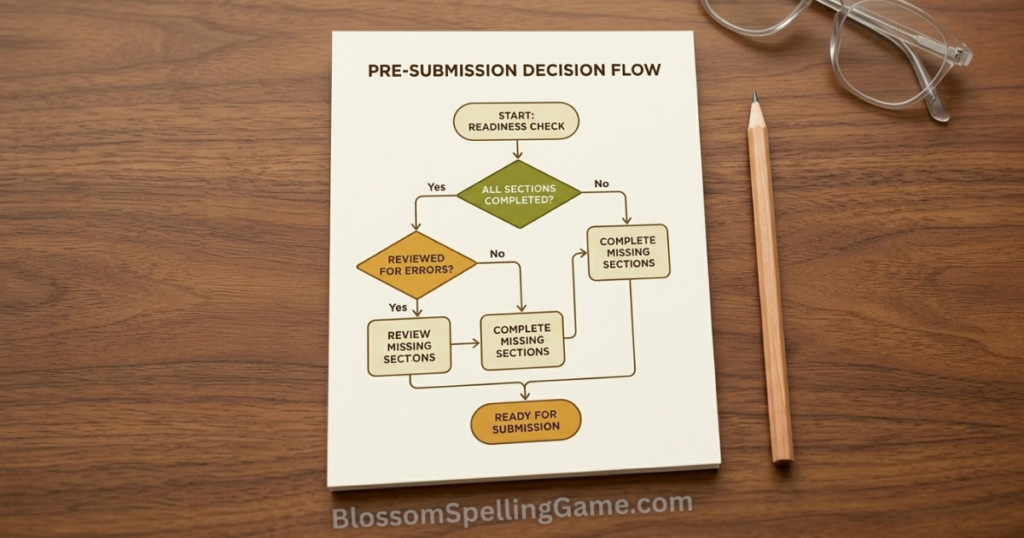
The Pre-Submission Checklist
Here’s the decision framework to run through before submitting any word — particularly when you’re not confident it will be accepted.
Step 1: Does it contain the center letter? If no → discard immediately, don’t submit. If yes → proceed to Step 2.
Step 2: Is it at least four letters long? If no → discard immediately. If yes → proceed to Step 3.
Step 3: Is it a proper noun? Starts with a capital letter in standard use? No place names, personal names, brand names, months, or days. If yes → discard. Exception: Does it have a common-noun lowercase meaning? If so, proceed — it may still work.
Step 4: Is it hyphenated in standard usage? If yes → try the closed compound version first. If letters allow.
Step 5: Is it American English spelling? If you’re thinking of a British spelling → switch to American before submitting.
Step 6: Is it a standard dictionary form? Not an abbreviation, acronym, or initialism? A complete word rather than a truncated form?
Step 7: When in doubt — submit. If it passes steps 1–6 but you’re still unsure, submit it. The game accepts no-penalty exploratory submissions. You lose nothing by trying. The word list is broader than intuition suggests.
The Psychology of Rejection: Why It Feels Unfair
This section exists because the emotional experience of word rejection is real — and understanding it makes you a calmer, better player.
There’s a specific frustration pattern that word game researchers and players both recognize: the “I know that word” rejection is more upsetting than “I don’t know that word.” When Blossom rejects a word you’re confident is valid, the game feels broken. When it rejects something you weren’t sure about, you accept it calmly.
The gap between those two experiences is usually explained by one of the reasons in this article — wrong word form, British spelling, proper noun in disguise, or dictionary version lag. The word isn’t wrong. The form or context is what the game’s validation system is responding to.
What helps: Treat every unexpected rejection as a data point rather than an insult. The game isn’t wrong about your vocabulary. It’s applying a consistent standard (Merriam-Webster’s dictionary) that is occasionally more restrictive than your personal word knowledge — and occasionally less restrictive, accepting words you didn’t expect.
The deeper lesson: The gap between “words I know” and “words the game accepts” is actually valuable information. It tells you something about the formal status of words you’ve been using casually — and occasionally teaches you that a word you thought was informal has made it into the standard dictionary.
One thing that shifts the psychology completely: understanding that no submission costs you a slot unless it’s accepted. You can test freely. The rejection isn’t a penalty — it’s feedback. Use it that way.
FAQ
Why does Blossom reject words I know are real?
Blossom uses Merriam-Webster’s dictionary as its word validation standard. A word can be rejected for several reasons even if it’s genuinely real: it might be a proper noun, a British spelling, a word form not separately listed in the dictionary, a hyphenated compound, or simply a word that hasn’t been formally added to the dictionary yet. The word isn’t “wrong” — it’s failing a specific technical criterion.
Why did Blossom reject a word I submitted but accept it from a friend?
This typically happens with words in transition — words that were recently added to Merriam-Webster’s dictionary and may or may not be in the version of the word list Blossom is currently using. Dictionary updates are incorporated periodically, so the game’s acceptance of newer words can vary. If the letters, center letter, and length are all correct, try it — it may have been added in a recent update.
Does Blossom accept all Merriam-Webster words?
Not every single entry. Blossom uses a validated subset of Merriam-Webster’s dictionary that excludes proper nouns, abbreviations, hyphenated words, and words under four letters. Within standard common-noun vocabulary, the coverage is broad — but individual word forms (specific plurals, comparative forms, rare inflections) may not all be independently validated.
Why does Blossom accept some obscure words but reject common ones?
The game’s validation is based on dictionary entries, not word frequency. A relatively rare but dictionary-standard word (like a botanical term or an unusual past tense) may be accepted, while a very common informal word that hasn’t been formally added to the dictionary may not be. Frequency of use in everyday speech and formal dictionary inclusion are two different things.
Will British spellings ever work in Blossom?
The game primarily validates American English spellings. Some British variants that are also listed as acceptable variants in American English dictionaries may occasionally work, but the American spelling is always the safer submission. When in doubt, use the American spelling first.
Why is a word rejected when it doesn’t have the center letter, even if it’s valid?
This is a gameplay rule, not a dictionary question. Every word must contain the center letter — this requirement applies before the dictionary is even consulted. If your word doesn’t include the center letter, it will always be rejected regardless of how valid the word is. See our Center Letter Guide for the full strategy around this rule.
Can a word be accepted in one Blossom puzzle and rejected in another?
The word list is consistent across daily puzzles — the same words are valid every day. What changes is the letter set. If a word was accepted yesterday, it will be accepted again whenever the same letters (including the center letter) are available. The rejection isn’t the word — it’s usually that today’s letters can’t form it.
Why did Blossom reject a plural form when it accepted the singular?
Some nouns have irregular plurals or are uncountable in American English usage, meaning the plural form either doesn’t exist in the dictionary or isn’t separately validated. Standard plurals (-S, -ES) almost always work. Unusual plurals, foreign-origin plurals, or plurals of uncountable nouns are less reliable. Try the base form when a plural fails.
Does Blossom accept new words as Merriam-Webster updates the dictionary?
Yes, periodically. Merriam-Webster formally adds new words to its dictionary several times a year, and Blossom’s word list is updated to reflect these additions over time. There may be a lag between a word’s formal dictionary inclusion and its appearance in Blossom’s validated list — but recent additions do eventually make it in.
What’s the fastest way to figure out if a word will be accepted?
Submit it. There’s no penalty for a rejected submission — you lose nothing by testing a word, and your 12 slots are only consumed when a word is accepted. The fastest learning method is exploratory submission: try anything that passes the basic checklist (has center letter, 4+ letters, not a proper noun, not hyphenated), and let the game tell you what it knows.
Final Thoughts
Every Blossom rejection that used to frustrate you makes more sense now. The game isn’t broken. It isn’t inconsistent. It’s applying a specific, principled standard — Merriam-Webster’s American English dictionary, filtered through a set of gameplay rules — and every rejection falls cleanly into one of the categories above.
The most useful shift this knowledge creates: you stop second-guessing valid-feeling words and start thinking more precisely about which form of a word to try, whether the spelling is American, and whether the word has achieved formal dictionary status regardless of how common it feels in speech.
And when in doubt — always submit. The game’s rejection is free information. Your 12 slots are only spent on successes. Test freely, learn from what comes back, and let the dictionary surprise you in both directions.
Play today’s puzzle at BlossomSpellingGame.com — and next time a word gets rejected, you’ll know exactly why.