
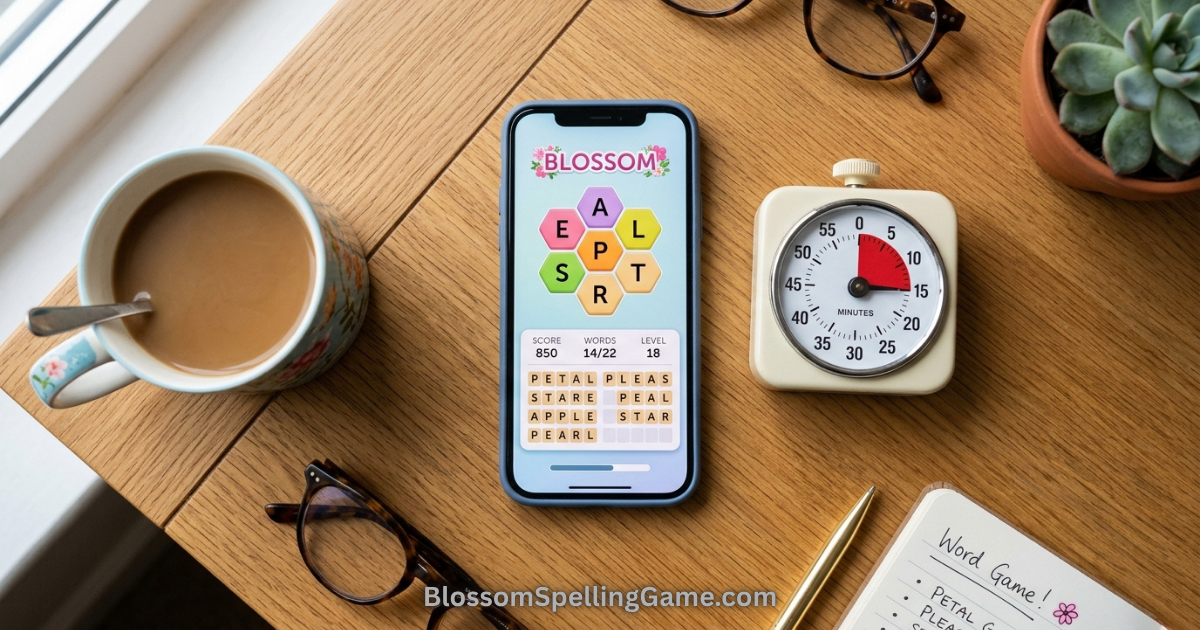
Want tips to score higher in Blossom Word Game? These 10 practical tips go beyond the basics — each one targets a specific scoring gap most players never close.
You’ve been playing Blossom for a while. You know the rules. You know the center letter goes in every word. You know long words beat short ones. You know the pangram is worth hunting.
And yet — your score keeps landing in the same range. Same rank, same rough point total, same frustrating feeling that the puzzle had more to offer than you pulled out of it.
Here’s what’s actually happening: the basics get you so far, and then they stop working. The tips you already know — start from the center letter, use suffixes, find the pangram — are good advice. They’re also the same advice you’ll find in every Blossom guide written in the last two years. Most players have internalized them. Most players still plateau.
What moves the needle past the plateau is a different kind of strategy — techniques that operate at a more granular level, targeting the specific gaps between “decent player” and “consistently high scorer” that generic advice never quite addresses.
These ten tips are built around those gaps. Each one is practical, specific, and genuinely different from the standard advice. Some will feel immediately obvious in hindsight. A few will change how you think about the puzzle from the first session you apply them.
Let’s get into it.
1st Tips to Score Higher in Blossom Word Game: Work Backward From Rare Letters First
Here’s a technique most players never formalize, even when they’re doing a version of it instinctively.
When your seven-letter set includes an uncommon letter — an X, Z, Q, W, or even a V or J — that letter should be the first thing you solve for, not the last. Rare letters are high-constraint: relatively few English words contain them, which means the rare letter isn’t a limitation to work around — it’s actually your fastest path to a short list of candidates.
How to apply it: The moment you see your seven letters, identify any rare or low-frequency letters. Then mentally ask: what common English words contain this letter? Don’t think about all seven letters yet. Just that one.
An X center letter? Think BOX, WAX, TAXI, AXLE, EXACT, OXIDE, RELAX, EXPAND. Which of those can be built from your remaining six petals? You’ve just narrowed your search space from potentially hundreds of word candidates to a manageable handful.
A Z in the petal letters? HAZE, MAZE, ZONE, ZERO, PRIZE, FREEZE, BRONZE. Run through these against your letter set.
Why this works: Common letters like E, A, R, S, T appear in thousands of words — searching for them first gives you too many options to process efficiently. Rare letters appear in hundreds, sometimes dozens. Solving from scarcity first is the same logic a good cryptic crossword solver uses: start with the most constrained clue.
The scoring payoff: Rare-letter words that use long combinations tend to be longer words — which means more base points. And because rare letters force you to think in less obvious vocabulary territory, you’re more likely to stumble onto the pangram or a long word you’d never have found through conventional searching.
Tip 2: Use Digraphs as Word Scaffolding
A digraph is a pair of letters that consistently appear together and make a single sound in English: TH, CH, SH, ST, NG, PH, WH, TR, DR, CR, BR, FL, GL, SP, SK, and so on.
Most players scan their seven letters looking for complete words. A faster and more productive approach is to scan for digraph pairs first — these two-letter combinations are essentially guaranteed to appear in many English words, and spotting them gives you a structural scaffold to build longer words around.
How to apply it: Look at your seven letters and ask: which digraphs can I form? If you have T and H, immediately think of words built around TH: THEN, THESE, THERE, THOUGH, THINK, THROW, THREE, NORTH, SOUTH, TEETH, CLOTH, BIRTH. Now check which of those can be formed from your remaining letters.
If you spot ST: STAR, STORE, STONE, STING, STREET, STRONG, STREAM, STRICT, STRANGE. Check against your set.
If you see NG: RING, SONG, LONG, THING, SPRING, STRONG, BLING, FLUNG — but also endings like -ING on almost any verb in the puzzle.
The strategic depth here: Digraphs do double duty. They work at the beginning of words (TR- in TRAIL, TRADE, TRAVEL), in the middle (STRANGE, INSTRUCT), and at the end (-NG, -TH, -SH). Spotting a digraph pair in your letters essentially gives you a scanning filter that cuts across all word positions — much more efficient than letter-by-letter combinations.
One specific digraph to always check first: If your letters include N and G together, immediately scan for -ING endings on any verb roots your other five letters can form. The -ING suffix is one of the most productive length-adders in English — it turns a 4-letter root into a 7-letter word in one move.
Tip 3: Run the Category Sweep Before Your First Submission
This tip operates before you submit a single word — and it’s one of the highest-leverage things you can do in the first two minutes of any puzzle.
The category sweep works like this: before typing anything, mentally run through semantic categories and test each one against your letter set. Not random words — organized categories. Move through them quickly, like a mental checklist:
- Animals: Can I make any animal names? CRANE, RAVEN, EAGLE, TIGER, MOUSE — which letters are present?
- Plants / nature: FERN, GROVE, BLOOM, FLORA, PETAL, GRAIN, GRASS
- Foods: GRAIN, BRINE, OLIVE, CREAM, LEMON, CAROM, GRAPE
- Body parts: ELBOW, ANKLE, SPINE, THUMB, LIVER, COLON
- Actions / verbs: CLIMB, REACH, GRASP, TWIST, BLEND
- Emotions / states: ANGER, GRIEF, ELATE, TENSE, BRAVE
The point isn’t to find all your words in the first two minutes. The point is to prime your semantic memory across multiple word categories before you start the reactive scanning process. This warm-up activates vocabulary networks that might otherwise stay dormant during the session.
Why this works psychologically: Our vocabulary isn’t stored alphabetically in our minds — it’s organized semantically, by meaning and category. When you’re staring at seven letters and trying to “think of words,” you’re often stuck in one category without realizing it. The sweep forces you to move between categories deliberately, which unblocks vocabulary you weren’t accessing.
One practical rule: Spend no more than 90 seconds on the category sweep. It’s a warm-up, not the main strategy. Its value is priming, not exhausting your word options before you’ve properly analyzed the letter set.
Tip 4: Sequence Your Bonus Petal Submissions Deliberately
This is one of the most underexploited scoring mechanics in Blossom — and the gap between players who use it well and those who ignore it can be 30–50 points per session.
The bonus petal letter — the highlighted outer petal that adds +5 points to every word containing it — doesn’t need to appear in every word you submit. But here’s what most players miss: you should actively sequence your submissions to maximize how often the bonus letter appears.
Before you submit any word, check: does this word contain the current bonus petal letter? If yes, submit it. If no, and if you have another word available that does contain the bonus letter — submit the bonus letter word first.
The deeper strategy: Think of your 12-slot budget as 12 opportunities to earn the +5 bonus. If you can get the bonus letter into 10 of your 12 submissions, that’s 50 extra points on top of your base word scores — often the difference between Amazing and Genius rank.
How to apply this systematically:
- Identify the bonus petal letter before you start
- While building your word list mentally, tag every word that contains the bonus letter
- When you have a choice between two similarly-valued words, always submit the one with the bonus letter first
- When hunting for additional words late in your session, specifically look for new words that include the bonus letter
What most players do instead: Find words in whatever order they come to mind, submit them immediately, and only notice the bonus letter when they happen to spot it. This leaves +5 bonuses on the table for every submission that could have contained the bonus letter but didn’t.
The math on why this matters: A 12-word session where 10 words contain the bonus letter earns 50 extra points. A 12-word session where only 5 words contain it earns 25. Same words, same base scores — 25-point gap just from sequencing.
Tip 5: Reverse-Engineer From Suffixes, Not Just Forward From the Center
Every Blossom guide tells you to start from the center letter and build forward. That’s genuinely good advice. But there’s a complementary technique that unlocks a completely different set of words: building backward from the end of a word.
Here’s how it works. Instead of asking “what word can I build that starts with or contains [center letter]?” ask instead: “what common suffixes can my letters form — and what words end in those suffixes?”
Run through high-frequency endings against your letter set:
- -TION / -SION: Can my letters form TION? If yes, what words end in -ATION, -ESTION, -ITION?
- -NESS: What adjectives in my letter set can take -NESS? DARK + NESS = DARKNESS. GREAT + NESS?
- -MENT: What verbs can take -MENT? MOVE + MENT. JUDGE + MENT. TREAT + MENT.
- -ABLE / -IBLE: BREAK + ABLE. READ + ABLE. FLEX + IBLE.
- -FUL / -LESS: CARE + FUL. GRACE + FUL. CARE + LESS. HOPE + LESS.
- -LY: Almost any adjective becomes an adverb. BRIGHT + LY. CLEAR + LY. FIRM + LY.
- -AGE: DRAIN + AGE. STOR + AGE. PASS + AGE. PACK + AGE.
The key difference from standard suffix hunting: you’re working from the suffix backward to the root, not forward from the root to the suffix. This reverse scan often surfaces longer, higher-scoring words that the forward approach misses — because when you’re building forward, your brain gravitates toward roots it knows, which are often short. When you build backward, you’re forced to consider longer, complete word structures.
Practical example: Suppose your center letter is A and your petals include T, R, N, E, G, L. Forward thinking gives you RANT, LANE, GRATE, TANGLE. Reverse thinking from -ATION gives you: what ends in -ATION with these letters? NARRATE → no R appears twice… ALTERATION? Not quite the letters. But the exercise forces you through longer word candidates you wouldn’t naturally reach forward-scanning from A.
Tip 6: Read the Negative Space — Track What You Haven’t Used
This technique becomes most valuable in the second half of your session, once you’ve found six or seven words and you’re starting to feel the familiar “I’ve run out of ideas” sensation.
The negative space technique works like this: instead of staring at all seven letters trying to think of new words, look at which letters you haven’t used much yet across your submitted words. Those underused letters are clues pointing toward words you haven’t found.
How to apply it: After submitting six or seven words, mentally or physically note which petal letters have appeared frequently in your submissions and which ones have appeared rarely or not at all. If you’ve barely used the Q, or the W has only appeared once, that’s your signal — there are words hiding in the puzzle that use those letters heavily.
Then pivot your search specifically toward words containing those underused letters. Ask: what words do I know that feature this letter prominently? What common English words have W near the beginning, middle, or end?
Why this works: The words you’ve found so far tend to cluster around the letters your brain finds easiest to use — common vowels, high-frequency consonants. The words you haven’t found tend to cluster around the letters that are harder to incorporate. Explicitly tracking unused letters forces you into the harder vocabulary territory where your remaining points are hiding.
An added benefit: This technique naturally guides you toward the pangram. The pangram requires all seven letters — which means if you’ve barely used a particular petal letter, the pangram almost certainly includes it prominently. Tracking negative space is indirect pangram-hunting.
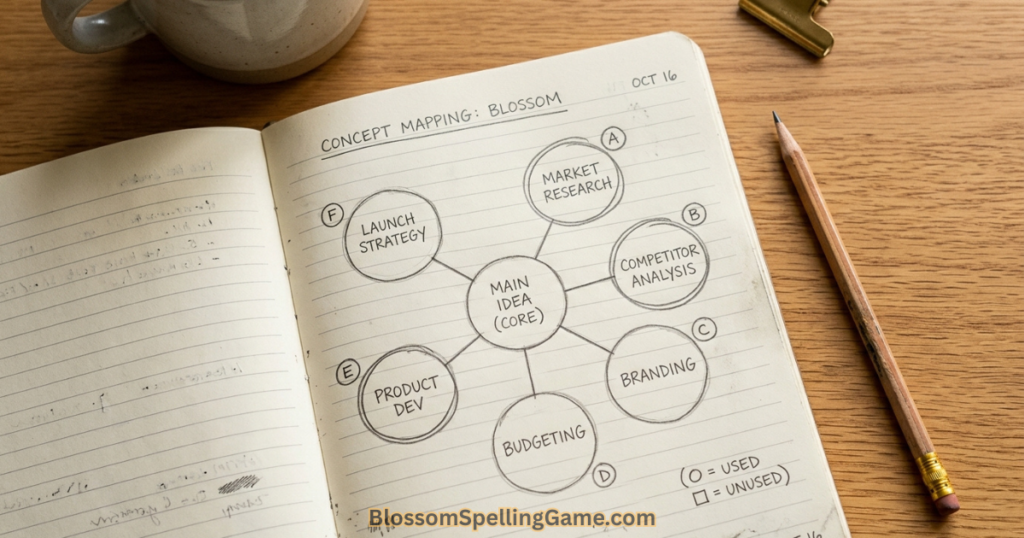
Tip 7: Know When to Be Greedy vs. Patient With Your Slots
The standard advice is: don’t submit short words early, save your slots for longer words. That’s correct as a general rule. But “never submit short words early” is too absolute — and misapplying it actually costs players points.
Here’s the more nuanced version:
Be patient (hold short words) when:
- You’re in the first four or five slots and you haven’t attempted a pangram hunt yet
- You have a clear intuition that a long word exists but you haven’t found it yet
- The letter set includes unusual combinations that suggest a non-obvious pangram
- You’ve found a 4-letter word but its 6- or 7-letter extension is clearly possible with your letters
Be greedy (submit shorter words) when:
- You’re past slot eight and you genuinely can’t find longer options
- You’ve already found the pangram and your remaining letters don’t obviously form long words
- The short word contains the bonus petal letter AND a longer equivalent isn’t readily available
- You have multiple 4-letter words available and holding them all is causing you to over-complicate your slot management
The critical insight most players miss: Holding a short word has a cost. While you’re waiting for a better alternative, you’re burning cognitive energy managing the mental list of “words I’m holding back.” That mental overhead can actually suppress your ability to find the longer words you’re waiting for. Sometimes submitting a 4-letter word clears the cognitive clutter and immediately makes room for new combinations to surface.
A rule of thumb that works: In slots 1–6, be patient. In slots 7–10, be situationally greedy (submit if the alternative is extended stuck-ness). In slots 11–12, always submit the best available word — you can’t afford to wait.
Tip 8: Vocalize Letter Combinations to Unlock Auditory Memory
This tip sounds too simple to make a meaningful difference. It makes a meaningful difference.
When you’re stuck — really stuck, staring at the same seven letters for the third minute in a row — try saying the letters out loud in different combinations. Not typing them, not thinking them. Actually vocalizing them.
Here’s the cognitive reason this works: your brain stores and retrieves vocabulary through multiple parallel systems. The visual system (recognizing letter patterns on the grid) is the one you use most in word games. But you also have an auditory-phonological system — the mental representation of how words sound — that’s accessed differently, through hearing and speech production.
When you’re visually stuck, your visual word-retrieval system has essentially run out of immediately accessible candidates. Vocalizing letter combinations bypasses that system and routes through the phonological system instead. You’re literally asking a different part of your brain to search the vocabulary database.
How to apply it: Take your center letter and two or three petal letters and say them in different orders out loud. “TRA… TRA… TRAIN? TRAIT? TRAIL?” Or: “ENT… ENT… ENTER? ENTIRE? ENTANGLE?” The moment a sound pattern triggers a word recognition, you’ll feel it immediately — the phonological system “knows” words as sound patterns, and the matching happens very fast once you’re accessing it.
When this is most useful: In the final three or four slots, when you’ve exhausted your visual scanning. Also useful early in a session when the letter set is unusual and visual pattern-matching isn’t surfacing obvious candidates.
A variation: If you’re in a context where speaking aloud isn’t practical, try mouthing the combinations silently. Even subvocalization activates the phonological system partially — it’s less effective than full vocalization, but meaningfully better than purely visual scanning.
Tip 9: Build a Personal Weakness Database From Post-Game Reviews
This is the only tip on this list that doesn’t apply during the puzzle. It applies after — and it’s the one that has the most impact on your score trajectory over a month of daily play.
Most platforms, including BlossomSpellingGame.com, show you the complete word list for the day’s puzzle after your session ends (or after the puzzle resets at midnight Eastern Time). Most players glance at this list, feel mild regret about the words they missed, and close the browser.
That’s a missed training opportunity.
The high-scorer’s approach: After each session, spend two minutes with the missed word list and do the following:
- Identify words you “should have known” — common words that were absolutely in your vocabulary but you didn’t produce. These point to retrieval gaps, not knowledge gaps.
- Identify words you genuinely didn’t know — vocabulary you need to learn. Look these up. Understand their meaning and how they’re used.
- Note the pattern of your misses. Are you consistently missing -TION words? Consistently overlooking words that start with a specific letter? Missing compound words?
Over time — even two weeks of this — you’ll identify specific vocabulary categories where your word generation consistently underperforms. Those are your weaknesses. And knowing your weaknesses is the fastest path to eliminating them.
The practical tool: Keep a simple note on your phone. After each session, add 2–3 words you missed that you now know. Review the list occasionally — not obsessively, just a quick scroll every few days. Words you encounter this way tend to stick better than words you encounter passively, because the regret of having missed them creates a stronger memory encoding.
What to expect: Players who do this consistently for three to four weeks typically report noticeable score improvements without feeling like they “studied.” The improvement comes from plugging specific vocabulary gaps rather than general improvement, which is faster and more satisfying.
Tip 10: Apply a Time Constraint to Sharpen Your Word-Finding Instinct
This one’s counterintuitive — Blossom has no timer, which is one of the things that makes it relaxing. So why would you voluntarily add one?
Because gentle time pressure produces a specific cognitive state that improves word-finding performance — and recreating that state as a training tool, without the punishing consequences of a real timer, is one of the most effective ways to push past a score plateau.
Here’s the mechanism: when you have unlimited time, your brain optimizes for certainty — you only submit words you’re confident will be accepted, and you spend extra mental energy evaluating borderline candidates. This cautious, deliberate mode is comfortable, but it also suppresses the kind of rapid associative thinking that surfaces surprising, high-value words.
When you apply mild time pressure, your brain shifts into a more generative, less filtered mode. You try more things. You submit words you’re less sure about. You move between ideas faster. And in that faster, less filtered mode, you tend to find words you’d never have reached through the careful, methodical approach.
How to apply this as a training technique:
- Set a soft 15-minute timer at the start of your session (not a hard cutoff — this is a training target, not a rule)
- Try to fill all 12 slots before the timer expires
- Notice which words you find under this pressure that you typically miss during leisurely play
What you’re training: The faster, more intuitive mode of word association that your brain can access but doesn’t use when there’s no urgency. Over time, playing with the soft timer trains this mode to be more available — so that even in your regular untimed sessions, your word-finding instincts are sharper.
Important caveat: This is a training technique, not a performance technique. Don’t apply it on days when you’re genuinely chasing a high score — take your time. Apply it on days when you want to improve your underlying speed and vocabulary access.
Putting It All Together: The High-Score Session Framework
Here’s how to apply these ten tips within a single Blossom session — organized by phase.
Phase 1: Setup (first 60–90 seconds, before any submissions)
- Identify rare letters → solve those first (Tip 1)
- Scan for digraph pairs → note your scaffolding candidates (Tip 2)
- Run the category sweep → prime semantic memory across 5–6 categories (Tip 3)
- Identify the bonus petal letter → tag every word that contains it (Tip 4)
Phase 2: Main hunt (slots 1–8)
- Work both forward from the center letter AND backward from suffixes (Tip 5)
- Use the reverse-engineering method to find longer words
- Sequence submissions to include the bonus petal letter as often as possible (Tip 4)
- Apply the greedy/patient framework: hold short words in slots 1–6, be situational in 7–8 (Tip 7)
Phase 3: Push past the plateau (slots 9–12)
- Read the negative space — which letters haven’t appeared much in your submissions? Hunt those (Tip 6)
- If visually stuck, vocalize combinations out loud (Tip 8)
- Apply time pressure if you’re stuck — set 5 minutes on your phone and see what surfaces under urgency (Tip 10 variant)
- Submit the best available word in each remaining slot
Phase 4: Post-game (2 minutes after your session)
- Review missed words
- Note 2–3 new vocabulary items or patterns in your weakness database (Tip 9)
Total time investment: 20–30 minutes of play, 2 minutes of post-game review. Over a month of this, the improvement is measurable.
FAQ
What is the fastest way to improve your Blossom Word Game score?
The highest-leverage single change most players can make is deliberate bonus petal letter sequencing (Tip 4) — ensuring as many of your 12 submissions as possible contain the highlighted bonus petal letter. This alone can add 25–50 points to a session without finding any new words. After that, post-game vocabulary review (Tip 9) produces the fastest multi-session improvement.
Why do I keep getting stuck around the same score in Blossom?
Score plateaus almost always stem from one of three causes: submitting short words too early (burning slot budget on low-value words), not tracking which letters are underused in your session (missing words in the negative space), or a specific vocabulary category weakness that keeps recurring. Post-game review (Tip 9) identifies which of these is your primary blocker.
Does the time I play Blossom affect my score?
Yes — but not directly through the game mechanics. Playing when you’re genuinely mentally fresh (typically late morning for most people) produces better word-finding performance than playing when tired or distracted. The game has no timer, but your cognitive state affects how much vocabulary you can access. See our Blossom reset time guide for timing considerations by timezone.
How much does the bonus petal letter actually matter?
Significantly. A 12-word session where the bonus letter appears in 10 submissions earns 50 extra points over base word scores. Over a week of daily play, that’s potentially 350 points of difference between a player who sequences the bonus letter deliberately and one who includes it only by chance.
Is it worth submitting a word I’m not confident about?
Yes — always. Rejected submissions cost you nothing. Your 12-word slot budget is only spent when a word is accepted. Testing uncertain words is free information. See our guide on why Blossom rejects real words for the full breakdown of what the game’s dictionary standard accepts.
How do I find words I keep missing in Blossom?
The most reliable method is combining the negative space technique (Tip 6) with vocalizing letter combinations (Tip 8). When you’ve exhausted visual scanning, track which letters are underused in your submissions, then say those letters in different combinations out loud. The phonological memory system often surfaces words the visual system missed.
Can improving my general vocabulary actually help my Blossom score?
Yes — but targeted improvement is faster than general vocabulary expansion. Identifying your specific category weaknesses through post-game review (Tip 9) and addressing those gaps directly produces score improvement much faster than broad vocabulary study.
What’s the single biggest mistake that keeps players at average scores?
Submitting low-value short words in the first four or five slots before attempting a serious pangram hunt. This burns your slot budget on 1-point words while leaving the highest-value words undiscovered. The greedy/patient framework in Tip 7 addresses this directly.
Conclusion
Every tip in this article targets a specific, identifiable gap — not a general “play better” suggestion. The rare letter technique gives you a faster search entry point. The digraph scaffolding gives you word structure to build around. The category sweep primes vocabulary networks you weren’t accessing. The bonus petal sequencing turns a passive mechanic into an active scoring opportunity. The negative space technique guides you toward the exact words still hiding in the puzzle.
None of these require you to know more words. They require you to access the vocabulary you already have more effectively — and to make smarter decisions about how you use your 12 slots.
Apply two or three of these in your next session. See what changes. The plateau isn’t permanent — it’s just evidence that the strategies that got you this far have reached their ceiling.
The next level requires different thinking. Now you have it.
Play today’s puzzle at BlossomSpellingGame.com and put at least one of these into practice. The puzzle resets tonight at midnight Eastern Time — which means you have today’s session to experiment, and a fresh start tomorrow to apply what you learned.