
How to play NYT Connections — complete beginner’s guide covering rules, the four color categories, strategy tips, and everything you need to start solving daily puzzles.
NYT Connections is deceptively simple to describe and genuinely challenging to master. Sixteen words appear in a grid. Your job is to group them into four sets of four, where each set shares a hidden connection. You have four attempts before the puzzle locks. That’s the entire game.
The difficulty lives in the connections themselves — which range from obvious to fiendishly misdirecting — and in the puzzle’s deliberate use of words that seem to belong to multiple categories simultaneously. A word that looks like it fits with three others may actually belong to a completely different group.
If you’ve seen the colorful result grids on social media or heard colleagues talking about “getting the purple” and weren’t sure what any of it meant, this guide covers everything from the basic rules to the strategy that separates consistent solvers from frustrated ones.
What Is NYT Connections?
NYT Connections is a daily word puzzle published by The New York Times and created by puzzle editor Wyna Liu. It launched publicly in 2023 and quickly became one of the most popular daily word games in the NYT Games suite.
The premise: sixteen words are arranged in a 4×4 grid. All sixteen words can be grouped into four sets of four, where each set shares a specific hidden connection — a category that links exactly those four words and no others. Your job is to identify the four groups correctly using four total attempts.
The puzzle resets daily at midnight Eastern Time, and all players worldwide see the same puzzle on any given day.
The Basic Rules
Rule 1 — Find four groups of four: The sixteen words divide into exactly four groups of four. Each word belongs to exactly one group — no word fits into two correct answers simultaneously (though the puzzle is designed to make you think some do).
Rule 2 — Four attempts total: You have four guesses. Each incorrect guess (selecting four words that don’t form a correct category) costs you one attempt. Use all four attempts incorrectly and the puzzle reveals all the answers.
Rule 3 — Select and submit: Tap or click four words to select them, then tap the Submit button. If your selection is correct, those four words form a colored row and leave the grid. If incorrect, the tiles shake and you lose one attempt.
Rule 4 — “One Away” hint: If you submit a group of four that’s almost correct — three words belong to the same category plus one interloper — the game tells you “One Away.” This is a useful signal: you’ve identified the right category but included one wrong word.
Rule 5 — Order within a category doesn’t matter: Once you’ve identified the correct four words for a category, submit them in any order. The game recognizes the correct group regardless of the sequence.
The Four Color Categories Explained
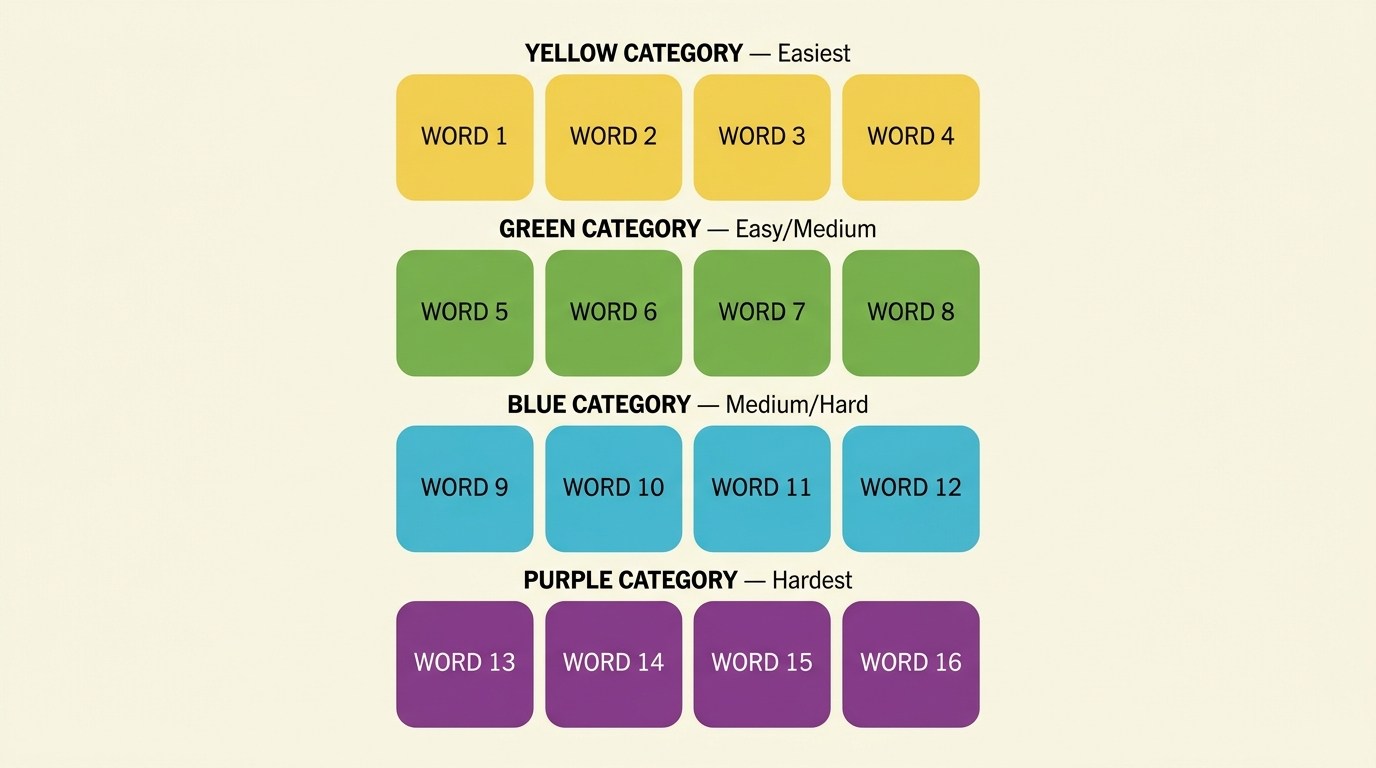
Every Connections puzzle has exactly four categories, each assigned a color that indicates difficulty level. The colors are revealed as you solve each group.
Yellow — Easiest The yellow category typically has the most straightforward connection — something relatively obvious once you see it. Examples: “Types of pasta,” “Words meaning ‘fast,'” “Animals that live underground.” Most players aim to solve yellow first to build confidence and reduce the grid.
Green — Medium Slightly trickier than yellow, requiring a bit more lateral thinking. The connection might involve wordplay, require broader knowledge, or include words that initially look like they belong to other categories.
Blue — Hard The blue category requires genuine knowledge or clever pattern recognition. Connections here are often less obvious, and the words chosen frequently seem to belong to easier categories.
Purple — Hardest The purple category is deliberately constructed to mislead. Purple connections often involve wordplay (all four words can follow “FIRE”), hidden patterns (all four are types of something unexpected), or cultural references that aren’t universally known. Many players find purple impossible without the “One Away” hint narrowing their options.
Important: The colors are revealed as you solve. You don’t know in advance which group is yellow and which is purple — part of the skill is identifying which category you’re most confident about.
How a Typical Game Plays Out
Here’s what a Connections session feels like from start to finish:
Opening: Sixteen words appear in a randomized grid. You read through all sixteen before selecting anything — this initial scan is crucial. Some connections will jump out immediately; others will become clear only after eliminating the obvious ones.
First selection: Most players identify the category they’re most confident about first (usually the one that will be revealed as yellow). Select those four words and submit.
Building momentum: Each correctly solved category removes four words from the grid, making the remaining categories easier to see. With twelve words, then eight, then four remaining, the options narrow considerably.
The hard part: At some point — usually blue or purple — you’ll hit a group where you’re not sure which four words belong together. This is where the “One Away” feedback becomes valuable: if you’re close, the game tells you.
Resolution: Either all four groups are solved (satisfying, shareable) or you exhaust your four attempts (the answers are revealed, useful for learning).
The Misdirection Mechanic — Why It’s Harder Than It Looks
This is the most important thing to understand about Connections before you start playing.
The NYT puzzle team deliberately designs each puzzle so that words fit multiple plausible categories. A word like “PITCH” could belong to a music category (musical pitch), a sports category (pitching a ball), a sales category (sales pitch), or a landscape category (a patch of ground). The word that seems to obviously belong to one category may actually be the key to a completely different one.
The dual-membership trap: The most frustrating Connections experience is confidently submitting four words that seem obviously connected, only to find that one of them actually belongs to a different group. The puzzle is specifically designed to create these false-confidence moments.
The practical implication: Never submit your most “obvious” group first without second-guessing it. Ask yourself: could any of these four words plausibly fit a different category? If yes, hold that group and look for something with less ambiguity.
The purple category’s role: Purple typically contains the words most likely to trick you into misassigning them. A word in purple often looks like it belongs to yellow — the puzzle uses this misdirection intentionally.
Strategy Tips for Beginners
Scan all sixteen words before selecting anything. The initial overview often reveals patterns invisible when you’re rushing to select. Look for themes across the whole grid before committing to any group.
Start with your most confident group, not the most obvious. “Most obvious” and “most confident” aren’t the same thing in Connections. The most obvious grouping is often a trap. Your most confident group is the one where you can explain exactly why those four words connect AND why no other word in the grid fits that connection.
Think about what the category could be, not just which words seem similar. Connections categories have specific, articulable connections — not just vague similarity. “These four words all feel kind of similar” isn’t a Connections category. “These four words are all types of knots” is.
Use elimination. If you’re confident about three categories, the fourth group is whatever words remain — regardless of whether you understand their connection. Solving the easier groups first often reveals the purple category by elimination.
Take the “One Away” feedback seriously. If you get “One Away,” you’ve correctly identified the category but included one wrong word. Systematically test which of your four words doesn’t belong — swap each one out for the remaining words in the grid until you find the correct version.
Don’t spend your attempts on guesses. Four attempts sounds like enough, but it goes fast. Only submit when you’re genuinely confident. A wrong guess both costs an attempt and reveals no useful new information.
Understanding the Results Grid
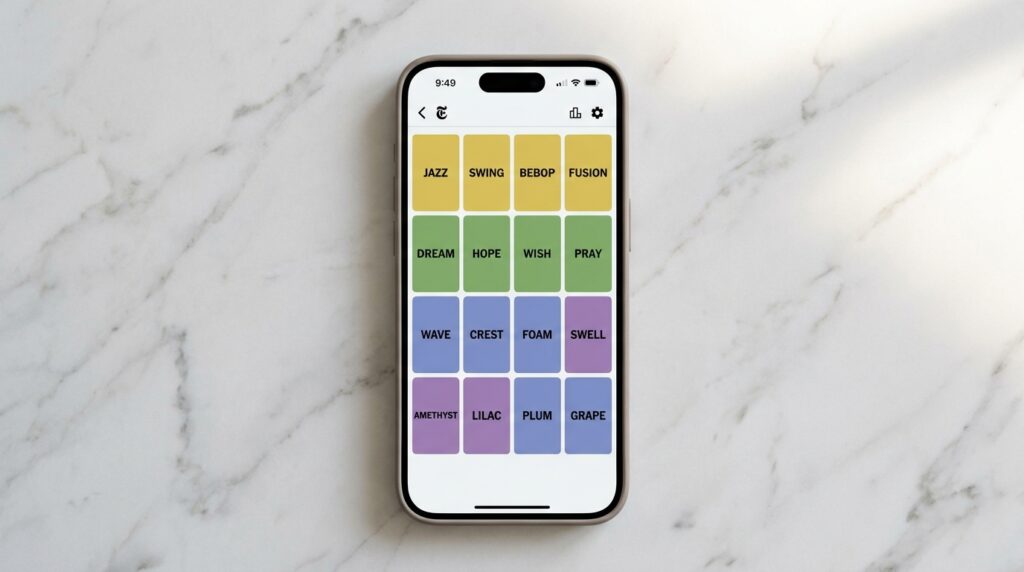
After completing a Connections puzzle (win or lose), you can share a results grid — a pattern of colored squares showing which categories you solved in which order, how many mistakes you made, and whether you completed the puzzle.
A perfect solve (four categories solved in order from easiest to hardest, no mistakes) produces a clean rainbow pattern: yellow, green, blue, purple in sequential rows.
A more typical solve includes some reshuffled rows (if you solved purple before blue, for example) and possibly some mixed-color indicators showing where mistakes occurred.
The format is designed for social sharing — it shows your performance without revealing the actual words or category contents, so it doesn’t spoil the puzzle for friends who haven’t played yet.
Is NYT Connections Free?
Connections has a limited free tier with basic NYT registration, similar to Wordle. Full unrestricted access is part of the NYT Games subscription.
The free experience: Basic NYT registration (free, email and password only) provides access to Connections with some limitations. Full stats tracking, unlimited access, and bundled access to other NYT games (Spelling Bee, Crossword, Strands) require a subscription.
The free alternative for categorization puzzle fans: If you enjoy the category-grouping cognitive challenge and want a related game that’s completely free, Blossom Word Game at BlossomSpellingGame.com exercises a complementary skill set — vocabulary generation rather than category classification. Many players run both games daily for cognitive variety. See our Blossom vs. Connections comparison for the full breakdown.
How to Access Connections
Desktop/laptop:
- Go to nytimes.com/games/connections
- Register for a free NYT account or sign in
- The daily puzzle loads immediately — no download required
Mobile:
- Download the NYT Games app (iOS App Store or Google Play)
- Sign in with your NYT account
- Access Connections from the games menu
The puzzle resets at midnight Eastern Time daily. Your progress and stats are saved with a registered account.
How Connections Compares to Similar Games
vs. Blossom Word Game: Connections groups given words into categories (classification). Blossom generates words from a letter constraint (production). Connections tests cultural knowledge and pattern recognition; Blossom tests vocabulary depth and strategic word finding. Both are around 5-15 minutes. Blossom is completely free (BlossomSpellingGame.com); Connections has a free tier but benefits from subscription. For a full comparison, see our Blossom vs. Connections guide.
vs. Wordle: Both are daily NYT word games, but Wordle is a deduction game (guess the hidden five-letter word) while Connections is a categorization game (group the sixteen words). Wordle is fully free with basic registration; Connections has a tiered access model.
vs. NYT Spelling Bee: Both require NYT subscription for full access, but they exercise completely different skills. Spelling Bee is open-ended word generation; Connections is bounded categorical grouping. Players who enjoy both often cite them as complementary cognitive workouts.
vs. NYT Strands: Both launched in 2023-2024 and require subscription access. Strands is a spatial word-search game with a theme; Connections is a grid-based categorization game. Both challenge thematic/cultural knowledge in different formats.
FAQ
How do you play NYT Connections?
Find four groups of four words from a 16-word grid, where each group shares a hidden connection. You have four attempts — each incorrect guess costs one. Submit four words, and if correct, they form a colored row. The categories range from easy (yellow) to hardest (purple).
What do the colors mean in NYT Connections?
Yellow is the easiest category, green is medium difficulty, blue is hard, and purple is the hardest — typically the most misdirecting category with the least obvious connection. The colors are revealed as you solve each group.
What is “One Away” in Connections?
“One Away” appears when you submit four words where three belong to the same correct category but one is wrong. It’s a helpful hint — you’ve identified the right category but included one incorrect word.
Is NYT Connections free?
Basic access is available with free NYT registration. Full unrestricted access and stats tracking require an NYT Games subscription.
What time does Connections reset?
Midnight Eastern Time daily, the same as Wordle and other NYT Games.
How is Connections different from Wordle?
Wordle is a deduction game — you guess a hidden five-letter word using color-coded feedback. Connections is a categorization game — you group sixteen given words into four correct categories. Different cognitive skills, different time commitments, different difficulty structures.
What’s the hardest part of Connections?
The purple category and the misdirection mechanic. Words are deliberately placed to look like they belong to easier categories when they actually belong to harder ones. The most common failure is confidently submitting a “yellow-looking” group that actually contains a purple-category word.
Final Thoughts
Connections occupies a genuinely unique cognitive space in the daily puzzle landscape — it’s not about vocabulary generation, deduction from feedback, or spatial search. It’s about pattern recognition across categories, cultural knowledge breadth, and the ability to resist the puzzle’s deliberate misdirection.
The learning curve is steeper than Wordle but the ceiling is also higher — after months of daily play, experienced Connections players develop a reliable intuition for the puzzle’s misdirection patterns that beginners simply don’t have yet.
Start with yellow, second-guess your most obvious grouping, never waste attempts on guesses, and accept that purple will beat you sometimes. That’s Connections at its most honest.
And if you want a free game that exercises a completely different but equally satisfying cognitive skill — vocabulary generation from a constrained letter set — Blossom Word Game at BlossomSpellingGame.com is there whenever you’ve finished today’s puzzle.