
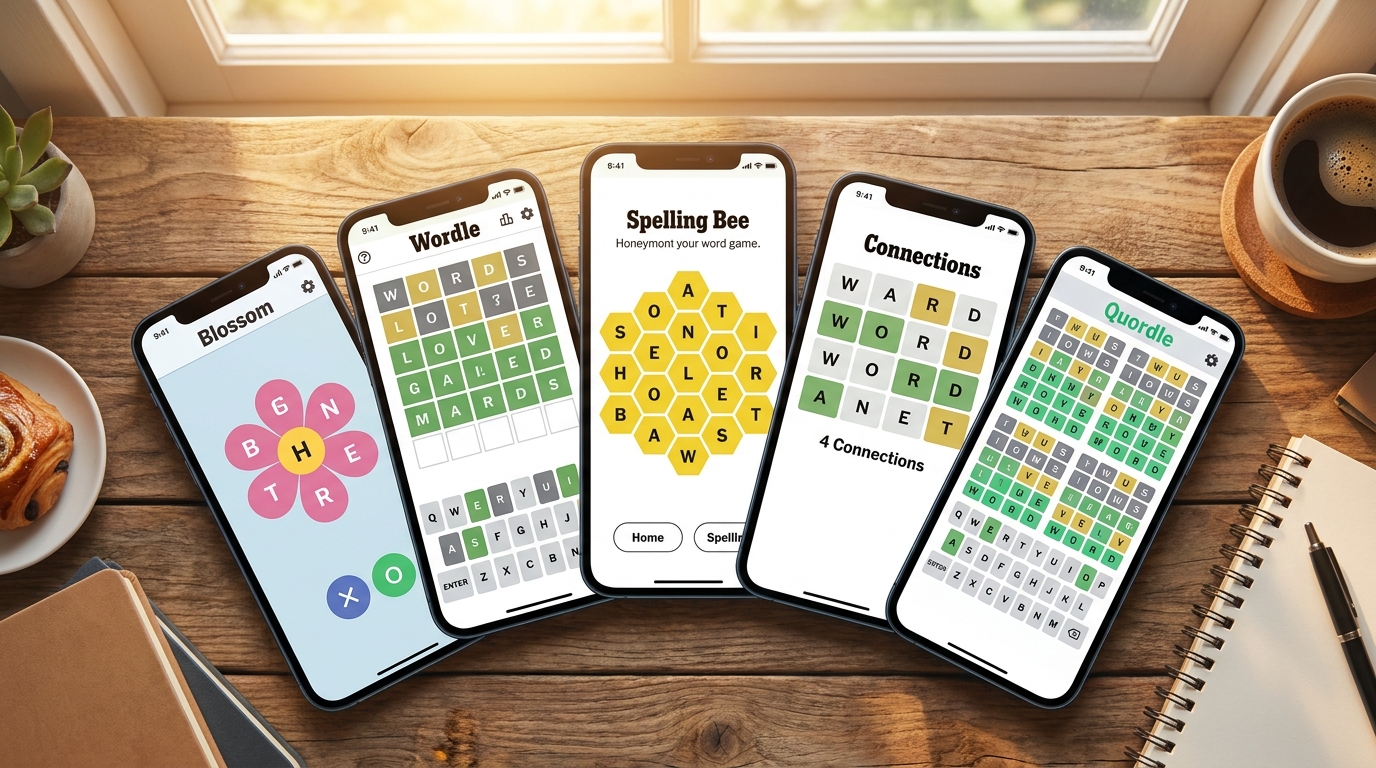
The best daily word games for adults in 2026 — matched to your specific play style, time budget, and what you actually want from a word game. Not another generic ranked list.
Most “best word games” lists are useless for actually choosing what to play. They rank games without asking what you want from a game — whether you’re chasing vocabulary growth, a quick competitive fix, something to do for ten minutes before bed, or a habit that actually sticks over months.
This guide works differently. Instead of ranking ten games against each other, it matches ten of the best adult word games to the specific motivations and play styles they serve best. Find your type, find your game.
The Adult Word Game Landscape in 2026
Daily word games have become one of the defining casual habits of adult leisure time — and the landscape has expanded dramatically since Wordle’s 2021 viral moment. There are now dozens of credible daily word games, each with a distinct cognitive profile, time commitment, and community.
The challenge isn’t finding a good word game. It’s finding the right one for you — or the right combination of two or three games that together cover the cognitive territory you actually want to exercise, in the time you actually have available.
What follows is a persona-matched guide to ten of the strongest daily word games for adults in 2026.
For the Vocabulary Builder: Blossom Word Game
Best for: Adults who want to genuinely expand their active vocabulary, not just exercise what they already know.
What it is: Seven letters in a flower grid. One mandatory center letter. Find as many valid words as possible within a 12-slot budget. Scoring rewards length and strategic play.
Why it fits this persona: Blossom’s generative format — producing words from your own vocabulary store rather than recognizing or guessing presented words — directly exercises active vocabulary production. The Merriam-Webster dictionary standard regularly surfaces words at the edges of a player’s vocabulary, creating learning events that recognition-based games don’t produce. For adults who want to write and speak with greater vocabulary confidence, daily Blossom play specifically targets the passive-to-active vocabulary conversion that matters most.
Time commitment: 10-20 minutes Cost: Free — BlossomSpellingGame.com Difficulty curve: Long — deepens over months and years of play
The bonus: Blossom is the only major daily word game that’s both completely free AND uses a comprehensive standard dictionary (Merriam-Webster) rather than a curated/restricted word list. This matters for vocabulary building — you encounter a broader range of legitimate vocabulary than games with editorially restricted word lists.
For the Competitive Deductor: Wordle
Best for: Adults who want a quick, shareable daily puzzle with clear win/lose stakes and a strong social dimension.
What it is: Guess the hidden five-letter word in six attempts. Green, yellow, and gray tile feedback narrows the possibility space with each guess.
Why it fits this persona: Wordle’s binary structure — you either solve it or you don’t, and your guess count is a public performance metric — appeals directly to competitive adults who want a clear daily benchmark. The shared worldwide puzzle means your result is directly comparable to every other player’s result, making social comparison natural and low-stakes. The emoji share format lets you broadcast performance without revealing the answer.
Time commitment: 2-5 minutes Cost: Free (basic NYT registration) Difficulty curve: Short — plateaus within weeks for most systematic thinkers
The honest caveat: Wordle’s difficulty ceiling is relatively low. Players who internalize good opening word strategy and systematic elimination will solve it consistently in 3-4 guesses within a month. If you find yourself always solving it easily, Quordle (see below) provides the same format with much higher challenge.
For the Depth Seeker: NYT Spelling Bee
Best for: Adults who want an open-ended daily puzzle with no artificial completion limit and a genuine depth challenge.
What it is: Seven letters in a honeycomb. Find as many words as possible, with the center letter required in every word. No word limit — the goal is reaching Genius (70% of total possible score) or Queen Bee (100%).
Why it fits this persona: Unlike most daily word games, Spelling Bee has no ceiling — you can always find more words. Players who want to push beyond “good enough” find infinite depth here. The Queen Bee pursuit — finding every valid word in the puzzle — creates a long-term challenge that no other daily word game in this list replicates.
Time commitment: 15 minutes (to Genius) to hours (Queen Bee pursuit) Cost: Requires NYT Games subscription Difficulty curve: Very long — Queen Bee is challenging even for experienced players
The honest caveat: The NYT’s curated word list excludes many legitimate dictionary words, which frustrates players who expect consistent dictionary-standard validity. If this bothers you, Blossom’s Merriam-Webster standard produces fewer “that’s a real word!” rejection moments.
For the Pattern Recognizer: NYT Connections
Best for: Adults who enjoy finding hidden categories and patterns, and who have broad general knowledge and cultural awareness.
What it is: Sixteen words in a grid. Group them into four sets of four, each sharing a hidden connection. Four attempts total. Yellow = easiest, purple = hardest and most misdirecting.
Why it fits this persona: Connections is fundamentally a pattern recognition and categorical thinking game, not a vocabulary game. Adults with broad general knowledge — who enjoy crossword clues, trivia, lateral thinking — find Connections particularly satisfying because it rewards exactly the kind of associative, cross-domain thinking that vocabulary-focused games don’t exercise.
Time commitment: 5-10 minutes Cost: Basic access with free NYT registration; full access with subscription Difficulty curve: Medium — consistent solvers develop purple-category intuition over months
The honest caveat: Connections is heavily culturally dependent. Players with specifically American cultural references will find it more natural than those with different cultural backgrounds. Some purple categories require knowledge of specific idioms, pop culture, or US-specific references that not all adult players share equally.
For the Pressure Seeker: Quordle
Best for: Adults who’ve mastered Wordle and want the same deductive format with genuinely higher stakes and more sustained cognitive pressure.
What it is: Four Wordles simultaneously. Nine total guesses shared across all four boards. Every guess lands on all four grids at once.
Why it fits this persona: The parallel attention-splitting demand of Quordle — tracking four sets of constraints simultaneously under a shared guess budget — provides the cognitive intensity that Wordle’s single-board format can’t match once you’ve internalized good strategy. Adults who want their daily puzzle to still feel genuinely hard after months of practice find Quordle sustains challenge in a way Wordle doesn’t.
Time commitment: 5-15 minutes Cost: Free — quordle.com Difficulty curve: Medium-long — harder than Wordle but plateaus faster than Spelling Bee or Blossom
For the Spatial Thinker: NYT Strands
Best for: Adults who enjoy word searches and spatial pattern recognition, and who want a word game that exercises visuospatial processing alongside language.
What it is: A letter grid where words are hidden in any direction — horizontally, vertically, diagonally, and curved. Each day has a theme, and a special “spangram” word spans the entire board.
Why it fits this persona: Strands is the only major daily word game that genuinely exercises spatial processing alongside language skills — tracing word paths through a multi-directional grid engages parietal brain regions that purely verbal games like Blossom or Spelling Bee don’t reach. Adults who find purely verbal games too narrow, or who have naturally strong spatial processing, often find Strands occupies a uniquely satisfying cognitive niche.
Time commitment: 10-20 minutes Cost: Requires NYT Games subscription Difficulty curve: Medium — theme recognition improves significantly with practice
For the Wordsmith Who Wants More: Knotwords
Best for: Adults who enjoy crosswords but want a purer word-construction challenge without trivia or clue-based knowledge requirements.
What it is: A crossword-style grid where you fill in letters to satisfy both across and down constraints simultaneously. No clues — just letter placement puzzles based on which letters can validly appear at each intersection.
Why it fits this persona: Knotwords is genuinely novel in the daily puzzle landscape — it’s not a vocabulary game or a deduction game but a constraint satisfaction puzzle. Adults who enjoy the logic puzzle dimension of word games, without the cultural knowledge requirements of crosswords or the open-ended generation of Spelling Bee, find Knotwords hits a specific sweet spot.
Time commitment: 5-15 minutes Cost: Free daily puzzle; premium for expanded content Difficulty curve: Medium — puzzle variety keeps difficulty engaging over time
For the Social Player: Words With Friends 2
Best for: Adults who want a word game structured around ongoing social competition with specific people, not anonymous daily puzzle comparison.
What it is: A Scrabble-variant mobile game where you form words on a crossword-style board, placing tiles to maximize letter-value scores. Asynchronous — you play your turn whenever, opponents respond when they can.
Why it fits this persona: Words With Friends is the only game in this list designed fundamentally around persistent one-on-one or small-group social relationships. Adults who want their word game to be a vehicle for ongoing connection with specific friends, family members, or colleagues — rather than a solo daily ritual — find Words With Friends fills a social need that solo puzzle games don’t address.
Time commitment: 2-5 minutes per turn, multiple turns across a day Cost: Free with ads; premium to remove ads Difficulty curve: Ongoing — improves continuously with Scrabble vocabulary knowledge
For the Meaning Hunter: Contexto
Best for: Adults who enjoy semantic thinking and want a word game built around meaning rather than spelling or letter manipulation.
What it is: Guess a secret word based on semantic similarity. Each guess is ranked by how semantically close it is to the hidden word — no letter feedback, only meaning-based proximity scores. Unlimited guesses.
Why it fits this persona: Contexto exercises semantic memory and conceptual categorization in a way that letter-based word games don’t. Adults who are fascinated by how words relate to each other in meaning — not just in spelling — find Contexto uniquely engaging. It’s also genuinely replayable for the same puzzle, since you can approach the same hidden word from different conceptual directions.
Time commitment: 5-20 minutes (unlimited guesses, so fully self-paced) Cost: Free — contexto.me Difficulty curve: Long — semantic intuition develops significantly over months
For the Variety Seeker: Letter Boxed
Best for: Adults who want a daily word game with a completely different structural mechanic — one that feels like neither Wordle, Spelling Bee, nor any crossword-variant.
What it is: Letters are arranged on the four sides of a square box. Form words by connecting letters, but consecutive letters must come from different sides of the square. Chain words together — each new word must start with the last letter of the previous word — using all letters in as few words as possible.
Why it fits this persona: Letter Boxed’s chaining mechanic — where words must connect to each other sequentially, not just use the available letters independently — creates a genuinely different cognitive experience from any other game in this list. Adults who feel like they’ve tried every major word game format and want something structurally novel often find Letter Boxed fills that gap.
Time commitment: 5-15 minutes Cost: Free (NYT basic registration); full access with subscription Difficulty curve: Medium — optimization (fewest words to solve) creates long-term challenge
Building Your Ideal Daily Combination
The most effective daily word game routine for adults isn’t one game — it’s two or three that cover different cognitive territory without significant overlap.
The quick + deep combination: Wordle (5 minutes, deductive) + Blossom (15-20 minutes, generative vocabulary). Covers both deduction and production skills efficiently. Total time: 20-25 minutes. Both free.
The verbal + spatial combination: Blossom (generative production) + Strands (spatial word finding). Covers language production and visuospatial processing. Different enough cognitively to feel like genuine variety. Total time: 25-35 minutes.
The solo + social combination: Blossom (solo daily ritual) + Words With Friends (ongoing social competition). One game for personal skill building; one for relationship maintenance through play.
The maximalist routine: Wordle (5 min) + Blossom (15 min) + Connections (10 min). Different cognitive demands in each — deduction, production, categorization. Total time: 30 minutes. Covers the broadest range of language-adjacent cognitive skills of any three-game combination.
FAQ
What’s the best daily word game for adults?
There’s no single best — it depends on what you want from a game. For vocabulary building and long-term skill development, Blossom Word Game (free at BlossomSpellingGame.com) is unmatched. For quick competitive satisfaction, Wordle. For depth and community, NYT Spelling Bee. For pattern recognition, Connections. The right answer is whichever game matches your specific motivation for playing.
Which word games for adults are completely free?
Blossom Word Game (BlossomSpellingGame.com), Wordle (basic NYT registration), Quordle, Contexto, and Letter Boxed (basic NYT registration) are all free or functionally free. NYT Spelling Bee, Strands, and the full Connections experience require an NYT Games subscription.
How many daily word games should I play?
Two to three complementary games covering different cognitive territory is the sweet spot for most adults. More than three often becomes a chore rather than a pleasure. The key is ensuring your chosen games exercise different skills — combining deduction + generation + categorization covers broad cognitive territory without redundancy.
What word game is best for improving vocabulary?
Blossom Word Game, specifically because its generative format (producing words from constraint) exercises active vocabulary production rather than recognition or guessing. The Merriam-Webster standard also means broader vocabulary exposure than games with curated word lists. Our Vocabulary Improvement guide covers the specific techniques for maximizing Blossom’s vocabulary benefit.
Final Thoughts
The best word game for you is the one that matches what you actually want — not what’s most popular or most highly rated in the abstract. A vocabulary builder and a competitive deductor should be playing different games, even if both call themselves “word game fans.”
Use this guide as a starting point: identify the one or two motivations that most describe why you play word games, find the matching games, and build from there. Two well-chosen complementary games played daily outperform five games played sporadically every time.
Start with Blossom Word Game at BlossomSpellingGame.com — it’s free, it requires no account, and you can play today’s puzzle in the next five minutes to see if it resonates. Add a second game from this list once the first is a stable daily habit.