

Word games to play when you’re bored — matched to your exact situation, from a 3-minute wait to a 45-minute flight. Find the right game for the time you actually have.
Boredom comes in different sizes. There’s the 3-minute wait for your coffee. The 20-minute commute with no good podcasts. The 45-minute flight with no Wi-Fi. The hour between meetings that’s too short for real work and too long to just sit there.
Each of these needs a different kind of game. A 3-minute session needs something with an immediate entry point and a natural stopping place. A 45-minute flight needs something with enough depth to stay interesting without Wi-Fi. A lunch break needs something that feels complete in 15 minutes rather than leaving you hanging.
This guide matches the best word games to the specific boredom situations they serve best — not a generic ranking, but a situational guide organized by the time you have and the context you’re in.
The 3-Minute Boredom Window
The situation: Your food is in the microwave. You’re standing in line. You’re waiting for a meeting to start. You have exactly one to three minutes and you don’t want to spiral into social media.
The problem with most word games: Most require at least 5-10 minutes to get a satisfying experience. Starting a game you can’t finish in 3 minutes is worse than not starting — you’ve broken your concentration without completing anything.
The right game: Wordle
Wordle’s entire session — first guess through final solution — often takes under three minutes for practiced players. It has a clear endpoint (solving the word or using all six guesses), produces immediate shareable satisfaction, and doesn’t leave you hanging with an incomplete experience. The puzzle has been loaded in your brain all morning; three minutes is enough to complete it.
Runner-up: Blossom Word Game minimum viable session (one word submitted — streak protected, session complete). Not satisfying as a full play experience, but a legitimate streak-maintenance option in under 60 seconds.
The 10-Minute Break (Coffee, Quick Pause)
The situation: You have a proper break — coffee, a few minutes outside, a genuine pause — and want something that fills it completely without running over.
The right game: NYT Connections or Wordle + Mini Crossword
Connections consistently runs 5-10 minutes for most players, has a clear endpoint (all four categories solved or four attempts used), and produces satisfying shareable results. It’s precisely calibrated for this time window.
Alternatively: Wordle (3 minutes) + NYT Mini Crossword (5 minutes) = a 8-minute two-game routine that fills the break cleanly with two different cognitive experiences.
What to avoid: Don’t start Blossom or Spelling Bee in a 10-minute window. Both are better suited to longer, uninterrupted sessions where you can develop search momentum. Starting either with 10 minutes and then stopping mid-session is more frustrating than satisfying.
The 20-Minute Commute
The situation: Train, bus, subway, or passenger seat in a carpool. Twenty minutes of potentially uninterrupted time, probably with Wi-Fi or data, possibly standing or moving.
The right game: Blossom Word Game
Blossom’s 10-20 minute typical session length is built for exactly this window. It doesn’t require typing on a tiny keyboard — letter tapping on mobile is comfortable. It doesn’t require constant attention to external feedback (unlike Wordle’s sequential guess-and-read cycle); you can think, tap a word, think some more, tap another. The game accommodates the naturally interrupted attention of a commute better than fast-paced competitive games.
Secondary pick: NYT Spelling Bee for commuters who prefer Spelling Bee’s open-ended format. The no-deadline, no-timer nature of both games makes them ideal for commute environments where you might need to stop suddenly.
What to avoid in a commute context: Quordle’s four-board simultaneous scanning requires more sustained visual attention than a moving, potentially crowded commute environment comfortably provides. Better saved for stationary sessions.
The Lunch Break (15-20 Minutes)
The situation: A proper lunch break — you’ve eaten, you have 15-20 minutes before you need to be back, you want something that feels like a complete daily accomplishment.
The right game: Blossom Word Game (primary) + Wordle (if you haven’t played yet)
The lunch break is the ideal Blossom window for players who can’t do mornings. Fifteen to twenty minutes is enough for a full, satisfying session — finding the pangram, filling most or all of the 12 word slots, having a definitive score to look at. The game resets at midnight, so a lunch session is always today’s fresh puzzle.
If you played Wordle in the morning, Blossom is the complete lunch break. If you haven’t played Wordle yet, a combined Wordle (3 minutes) + Blossom (15 minutes) routine fits comfortably.
The social variant: If you’re eating with colleagues who also play daily word games, a shared Connections session — discussing the categories, working through the groups together — turns a solo game into a social lunch activity. Connections’ shared worldwide puzzle means any two players who haven’t completed it yet can work through it together in real time.
The 45-Minute Flight or Long Wait
The situation: A short domestic flight, a long airport wait, an extended queue, or any situation with 45+ minutes of potential engagement time — with the likely complication of no internet connection.
The Wi-Fi complication: Most games in this guide require internet connectivity to load the daily puzzle. See our Offline Guide for full details on which games work without connectivity and how to prepare.
For prepared offline play:
- Blossom app (puzzle pre-loaded while on Wi-Fi): Full session available, no connection needed mid-play
- Words With Friends app: Can take and respond to turns offline; syncs when connection returns
- Knotwords app: Full offline functionality in the app version
For connected long waits: NYT Spelling Bee is the ideal long-wait game — its open-ended format fills exactly as much time as you have available. Fifteen minutes to Genius; another thirty hunting Queen Bee. It expands naturally to fill the available time without the artificial constraint of a slot budget or guess limit.
Runner-up for long waits: Wordle + Connections + Blossom as a combined daily routine. For players who do all three games daily, a 45-minute wait is the perfect window to complete all three without feeling rushed.
The Bored-at-Desk Situation
The situation: You’re at work or at a desk, in between tasks, procrastinating on something you should be doing, or in a legitimate mental-rest period between focused work sessions.
The honest caveat: The best word game for the bored-at-desk situation is one that has a clear endpoint so you can actually stop when it’s done. Open-ended games (Spelling Bee’s Queen Bee pursuit, Words With Friends) are risky in this context because they don’t have natural stopping points.
The right game: Wordle → then stop. Or Connections → then stop. Or Blossom → then stop at 12 words.
The key for desk boredom is choosing a game with a built-in stopping point rather than an infinite one. Wordle’s six-guess limit guarantees it ends. Connections’ four-attempt limit guarantees it ends. Blossom’s 12-word slot limit guarantees it ends. None of these can eat more than 20 minutes of your desk time even if you try.
What to avoid: Starting Spelling Bee at your desk. Its open-ended format has no built-in stopping mechanism, and “just one more word” is genuinely dangerous for productivity — it’s designed to keep you searching indefinitely.
The Late-Night Wind-Down
The situation: In bed, winding down before sleep, wanting something that engages your mind gently without the screen-time penalty of fast-paced or socially stimulating apps.
The right game: Blossom Word Game
Blossom’s deliberate pace — thinking, tapping, thinking — creates a gentle cognitive engagement that’s meaningfully different from the dopamine-loop stimulation of social media or fast-paced games. The absence of a timer means there’s no urgency, no pressure, no escalating tension. You can stop at any time without feeling like you’ve been interrupted.
The vocabulary-generation cognitive mode also happens to complement pre-sleep mental states well — soft, associative thinking rather than sharp analytical or reactive thinking.
Runner-up: Knotwords’ letter placement puzzles provide similarly calm cognitive engagement without competitive urgency.
What to avoid before sleep: Wordle’s win/lose stakes create a mild stress response (especially on hard days) that can interfere with sleep transition. Quordle’s parallel attention demand is significantly activating. The Social media notifications that come with Words With Friends are the opposite of wind-down.
The Waiting Room (Unpredictable Duration)
The situation: Doctor’s office, DMV, car repair shop — any waiting room where you don’t know if you’ll be called in 5 minutes or 45 minutes.
The unique requirement: The right game for an unpredictable wait is one that’s satisfying to play for any duration — from 5 minutes to 45 — and doesn’t punish you for stopping mid-session when your name is called.
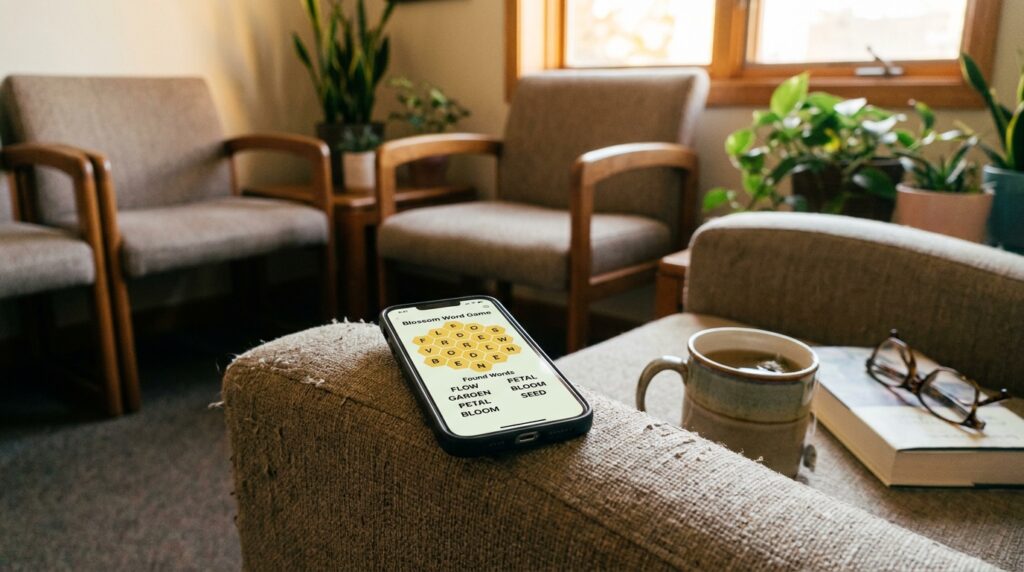
The right game: Blossom Word Game
Blossom’s session structure is uniquely suited to unpredictable waits because there’s no penalty for stopping mid-session. Found 4 words and got called in? Your session ends with 4 words and whatever score you’ve accumulated — no wasted effort, no corrupted game state. Called back in 2 minutes? Submit one word, streak protected, come back to the full session later if the puzzle hasn’t reset.
No other game in this guide handles interruption as gracefully as Blossom. Wordle interrupted mid-guess loses your current thinking. Connections interrupted mid-session is potentially frustrating. Blossom interrupted mid-session is just a partial session — which is fine.
The “I Have Wi-Fi” vs. “No Wi-Fi” Split
Many boredom situations are defined as much by connectivity as by time. Here’s a quick split:
With Wi-Fi or data — any game works: Full access to Blossom, Wordle, Connections, Spelling Bee, Quordle, Contexto, Letter Boxed, and all browser-based games. Situational matching above applies.
Without Wi-Fi — preparation matters:
- Best offline option: Blossom app (pre-loaded) or Knotwords app
- Decent offline option: Words With Friends (can queue moves offline)
- Not available offline: Browser-based games including Wordle, Connections, and the Blossom browser version without PWA setup
The pre-flight habit: Open and load the Blossom app before boarding. Thirty seconds on the ground guarantees a full offline session at 35,000 feet.
The Social Boredom Situation
The situation: You’re with someone — a friend, partner, sibling — and you’re both bored at the same time. You want something you can do together.
The right game: NYT Connections (collaborative) or Blossom Word Game (competitive comparison)
Connections collaborative play: Both of you look at the same grid and discuss which words belong together before submitting. The category-guessing dynamic creates natural conversation — “do you think PITCH goes with the music group or the sports group?” — that solo play doesn’t generate.
Blossom competitive comparison: Both of you play the same daily puzzle independently, then compare results — how many words each person found, who found the pangram, whose score was higher. The shared puzzle means comparison is meaningful even with different vocabulary strengths.
Words With Friends: Start a new game against each other right now. It fills not just the current boredom session but provides a persistent game to return to across days.
Quick Reference: Situation → Game Match Table
| Situation | Best Game | Time Needed | Connectivity |
|---|---|---|---|
| 3-minute wait | Wordle | 2-5 min | Needs internet |
| 10-minute break | Connections | 5-10 min | Needs internet |
| 20-minute commute | Blossom | 10-20 min | Needs internet (pre-load for offline) |
| Lunch break (15-20 min) | Blossom | 10-20 min | Needs internet |
| 45-min flight (offline) | Blossom app | 15-45 min | Works offline if pre-loaded |
| 45-min wait (online) | Spelling Bee | Unlimited | Needs internet |
| Bored at desk | Wordle or Connections | 5-15 min | Needs internet |
| Late-night wind-down | Blossom | 10-20 min | Needs internet |
| Unpredictable wait | Blossom | Any duration | Needs internet |
| Social boredom | Connections (co-op) | 10-15 min | Needs internet |
FAQ
What’s the best word game to play when you’re bored?
It depends on how much time you have. For under 5 minutes, Wordle. For 10 minutes, Connections. For 15-20 minutes, Blossom Word Game at BlossomSpellingGame.com. For unlimited time, NYT Spelling Bee. All of these are free or low-cost and require no download to start on a browser.
What word games work without Wi-Fi?
The Blossom mobile app works offline when the day’s puzzle has been pre-loaded while connected. The Knotwords app and Words With Friends also function offline. Most browser-based word games (Wordle, Connections, the browser version of Blossom) require an internet connection to load.
What’s a good quick word game for a 5-minute break?
Wordle is designed for exactly this — most games complete in 2-5 minutes and always have a definitive endpoint. NYT Connections also works for 5-10 minute breaks. Both are free with basic registration.
Can I play Blossom Word Game during a commute?
Yes — Blossom is one of the best commute word games because its pace accommodates naturally interrupted attention. You can think between taps, stop and restart without penalty, and complete a session in 10-20 minutes. Load the app before losing connectivity if you’re going underground.
Final Thoughts
The best word game for boredom isn’t the highest-rated one — it’s the right one for the specific shape of your boredom right now. Three minutes needs something that ends cleanly. A 45-minute flight needs something that works offline and fills time without a deadline. A desk break needs something with a built-in stopping point.
Blossom Word Game appears in more situations in this guide than any other game because its flexible structure — play for 5 minutes or 45, stop at any point without penalty, satisfying at any word count — genuinely adapts to more boredom contexts than any other daily word game.
If you haven’t tried it yet, BlossomSpellingGame.com requires no download and no account. Today’s puzzle is already loaded. Your commute, your break, your waiting room moment — any of them is the right time to start.