
How to play Wordle — complete beginner’s guide covering rules, the color tile system, strategy tips, hard mode, and everything you need to start solving daily puzzles.
Wordle is one of the simplest word games ever designed — and one of the most satisfying. One hidden five-letter word per day. Six guesses to find it. Color-coded feedback after each guess. The entire world plays the same puzzle simultaneously, shares results in emoji grids, and then it resets tomorrow.
If you’ve seen those black-and-yellow grids on social media and wondered what’s going on, this guide explains everything from the very beginning: how to play, how the color system works, what strategy actually helps, and where to find it today.
What Is Wordle?
Wordle is a daily word-guessing game originally created by software engineer Josh Wardle as a personal gift for his word-game-loving partner. It went viral in late 2021 after being shared publicly, and the New York Times purchased it in January 2022 for a reported price in the low seven figures. It’s been part of NYT Games ever since.
The premise: every day, a new five-letter word is chosen. Every player worldwide sees the same word. You have six attempts to guess it. After each guess, the game tells you how close you were using colored tiles. The puzzle resets at midnight, and the next day brings a fresh word.
That’s the entire game. No accounts required to play, no subscription needed (unlike most other NYT word games), just a five-letter word and six attempts.
The Basic Rules
Rule 1 — Five letters exactly: Every guess must be exactly five letters. No more, no fewer. The game won’t accept words of any other length.
Rule 2 — Real words only: You must guess a valid English word. Random letter strings like AAAAA or XZQJK are rejected. The word must be in the game’s dictionary.
Rule 3 — Six guesses maximum: You have six attempts to find the hidden word. If you don’t solve it in six guesses, the game ends and reveals the answer.
Rule 4 — Use the feedback: After each guess, the tiles change color to tell you how close you were. Using this feedback to narrow down possibilities is the entire skill of the game.
Rule 5 — One puzzle per day: One new word per day, shared by all players worldwide. The puzzle resets at midnight your local time (or midnight Eastern Time for the NYT version).
Understanding the Color Tile System
This is the heart of Wordle — the three-color feedback system that transforms each guess into useful information.
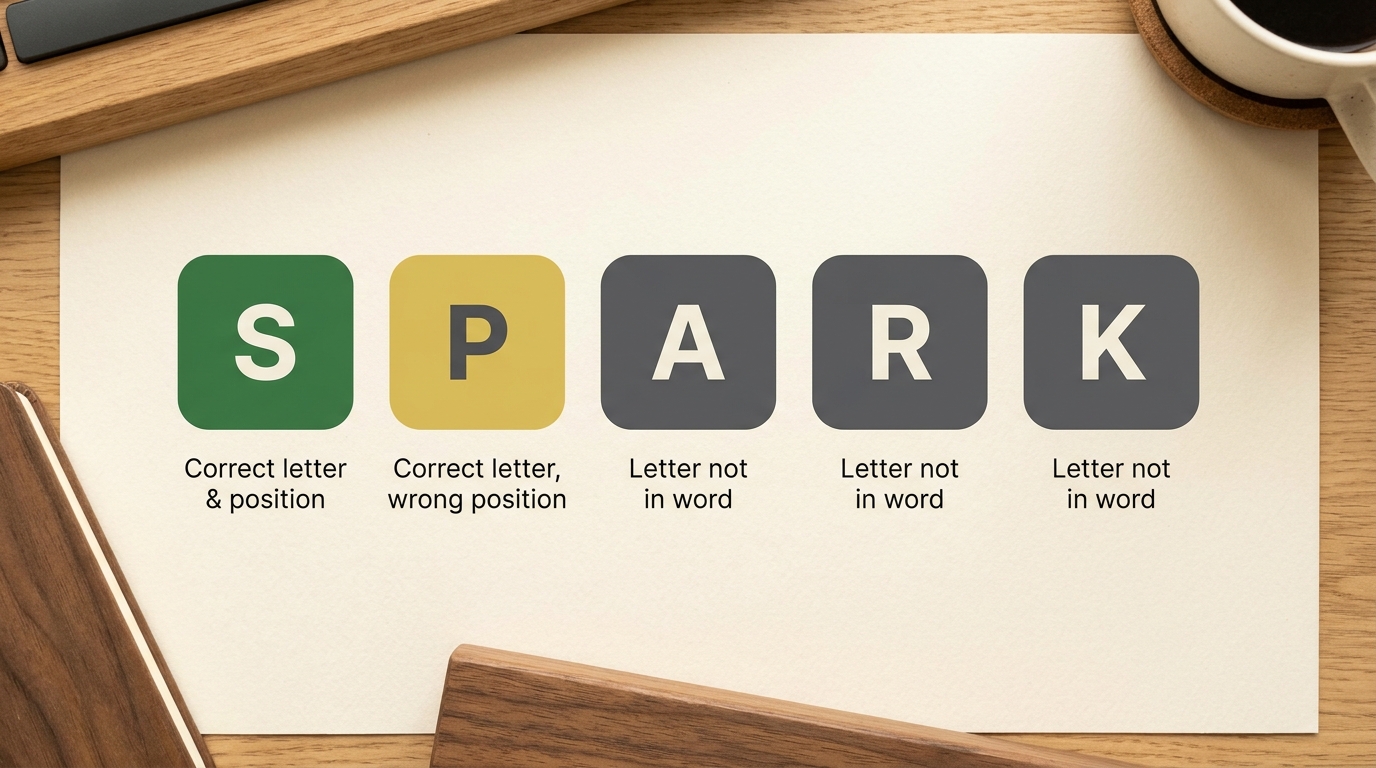
GREEN tile: The letter is correct and in the correct position. If the third letter of your guess turns green, the actual word has that letter in position 3.
YELLOW tile: The letter is in the word, but in the wrong position. The letter appears somewhere in the hidden word, just not where you placed it in this guess.
GRAY tile: The letter is not in the word at all. Eliminate it from all future guesses.
An example: Hidden word: CRANE Your guess: TRAIN
- T → Gray (T is not in CRANE)
- R → Yellow (R is in CRANE but not in position 2)
- A → Yellow (A is in CRANE but not in position 3)
- I → Gray (I is not in CRANE)
- N → Yellow (N is in CRANE but not in position 5)
From this one guess, you’ve learned: the word contains R, A, and N, but not in positions 2, 3, and 5 respectively. It contains no T or I. This dramatically narrows the possibility space for your next guess.
The repeated letter rule: If a letter appears twice in the hidden word and you’ve only included it once in your guess, the tile will show yellow or green depending on whether your single placement is correct. If you include a letter twice in a guess but it only appears once in the hidden word, one tile will color (green or yellow) and the other will show gray.
Step-by-Step: Your First Wordle Game
Step 1: Go to nytimes.com/games/wordle (free, no subscription required) or open the NYT app.
Step 2: Type any five-letter word using your keyboard (physical or on-screen) and press Enter. This is your first guess. It can be any valid word — most players start with a word that covers common letters.
Step 3: Watch the tiles change color. Use the feedback to understand which letters are correct, misplaced, or absent.
Step 4: Type your second guess. Use what you learned — include confirmed letters, reposition misplaced ones, avoid eliminated letters.
Step 5: Continue for up to six guesses, refining each guess using the accumulated feedback from all previous guesses.
Step 6: Either solve the word (all green tiles) or see the answer revealed after your sixth guess.
Wordle Strategy: How to Solve Faster
Start with a high-coverage opening word. Your first guess should include common letters in common positions, not just any valid word. Letters E, A, R, O, T, I, N, S appear in the largest proportion of English five-letter words. Opening with a word that covers 4-5 distinct common letters gives you maximum information on the first guess.
Eliminate, don’t just confirm. Each guess that includes gray letters (letters confirmed absent) is doing double duty — it confirms some letters while eliminating others. Guessing a word with five distinct, untested letters is generally more informative than guessing a word that reuses letters you’ve already tested.
Reposition yellow letters. Yellow letters must be used in subsequent guesses — but not in the same position. If R is yellow in position 3, your next guess must include R in any position other than 3.
Green letters are fixed. Once a letter shows green, keep it in that position for all future guesses. It’s confirmed correct.
Don’t forget about double letters. Some Wordle words contain repeated letters (SKILL has double L, ABBEY has double B). If you’ve tested all five positions and can’t find a solution, consider whether the word might contain a repeated letter.
Work backward from the letter count. By guess 3 or 4, you typically know most of the letters in the word. The remaining challenge is arrangement — which combination of your known letters forms a valid word.
The Best Starting Words
No single starting word is definitively optimal, but high-coverage words used by experienced players include:
CRANE — Contains C, R, A, N, E — five distinct, high-frequency letters covering different positions well.
SLATE — S, L, A, T, E — another strong distribution across positions.
ADIEU — Covers four vowels (A, I, E, U) in one guess, useful for understanding vowel distribution early.
RAISE — R, A, I, S, E — highly common letters, frequently recommended.
AUDIO — A, U, D, I, O — covers four vowels plus a common consonant.
The two-opener strategy: Some players use two preset opening words (like CRANE followed by LOUSY or STUMP) that together cover 10 distinct common letters before working from feedback. This sacrifices flexibility for comprehensive coverage.
The truth about starting words: The difference between opening words is smaller than enthusiasts sometimes claim. Any word with five distinct, common letters is a reasonable opener. Avoid words with repeated letters or uncommon letters (X, Z, Q, J) as your opener.
Hard Mode: What It Is and Whether to Use It
What it is: Hard Mode is an optional Wordle setting that requires you to use all confirmed information in subsequent guesses. Specifically:
- Any confirmed green letter must stay in that position in all future guesses
- Any yellow letter must be included in all future guesses
The effect: Hard Mode prevents the common strategy of “information guesses” — guesses you make primarily to learn information rather than to solve the word, even when you already know some confirmed letters. In Normal Mode, a player who gets G-R-A-?-E confirmed might guess a word with completely different letters to narrow down position 4. Hard Mode requires them to use G, R, A, E in their next guess.
Is it more fun? For many players, yes — Hard Mode creates more tension and feels more authentic as a puzzle. The risk: you can paint yourself into a corner where a word like CATCH (with double T) is the answer and you’ve committed too early.
Is it harder? Counterintuitively, Hard Mode can increase the chance of failing (using all 6 guesses without solving) because it removes the strategic flexibility of pure information guesses.
Recommendation: Try Normal Mode first. Once you’re consistently solving in 3-4 guesses, switch to Hard Mode for an additional challenge.
What Happens When You Win or Lose
When you solve the puzzle: All tiles in your winning row turn green, a brief celebration animation plays, and a results screen appears showing your guess distribution — how many guesses you’ve needed across all your Wordle sessions.
When you use all six guesses without solving: The game ends and the correct answer is revealed. Your streak resets to zero. The experience is genuinely frustrating (as designed) — but the next day’s puzzle is always a fresh start.
The share button: After any completed game (win or lose), a share button lets you copy an emoji grid representing your session — green, yellow, and gray squares in the pattern of your guesses, without revealing the actual letters. This is the iconic format people post to social media.
Streaks: Wordle tracks your current winning streak (consecutive days solved) and your maximum streak ever. Unlike some word games, the Wordle streak requires actually solving the puzzle — a failed game breaks the streak regardless of how close you came.
The Emoji Share Format Explained
The Wordle share format — rows of colored squares — has become one of the most recognizable social media formats in word gaming.
Each row represents one guess. Each square represents one letter tile:
- 🟩 = Green (correct letter, correct position)
- 🟨 = Yellow (correct letter, wrong position)
- ⬛ or ⬜ = Gray (letter not in word)
A perfect solve in two guesses might look like: ⬛🟨🟩⬛🟨 🟩🟩🟩🟩🟩
The header typically shows “Wordle X Y/6” where X is the puzzle number and Y is how many guesses it took. The format is designed to show your performance without revealing the actual word or letters — so anyone sharing hasn’t spoiled the puzzle for people who haven’t played yet.
Is Wordle Free?
Yes — Wordle is free to play with basic NYT registration (email and password, no payment). Unlike most other NYT Games (Spelling Bee, Connections, Strands, Crossword), Wordle does not require a paid subscription.
Where to play:
- nytimes.com/games/wordle (desktop/mobile browser)
- The NYT Games app (iOS and Android)
Wordle Variations Worth Trying
If you enjoy Wordle’s format and want more:
Wordle Unlimited (wordleunlimited.com): The same format with unlimited daily games — no waiting until tomorrow.
Dordle: Two Wordles simultaneously, seven guesses shared between both boards.
Quordle: Four Wordles simultaneously, nine shared guesses. Significantly harder than standard Wordle.
Octordle: Eight simultaneous Wordles for the most committed multi-board solvers.
Nerdle: The same format but with equations instead of words — for math enthusiasts.
How Wordle Compares to Similar Daily Word Games
vs. Blossom Word Game: Wordle is deduction — you guess to narrow down one hidden word. Blossom is generation — you produce words from a constrained letter set. Wordle takes 2-5 minutes; Blossom takes 10-20 minutes. Both are free (Blossom at BlossomSpellingGame.com). For players who enjoy both, they’re complementary rather than competing. See our full Blossom vs. Wordle comparison for the complete breakdown.
vs. NYT Spelling Bee: Both are NYT word games, but Spelling Bee requires a subscription and is open-ended (find all words), while Wordle is free and binary (solve the word in six guesses or lose). Spelling Bee sessions typically run much longer.
vs. NYT Connections: Both are free NYT games (with basic registration). Connections groups 16 words into categories rather than guessing a hidden word. Both take roughly 5 minutes and share the daily puzzle social culture.
FAQ
How do I play Wordle?
Go to nytimes.com/games/wordle and type any five-letter word as your first guess. After each guess, green tiles confirm correct letters in correct positions, yellow tiles indicate correct letters in wrong positions, and gray tiles eliminate letters. You have six guesses to find the hidden word.
What do the colors mean in Wordle?
Green means the letter is in the word and in the correct position. Yellow means the letter is in the word but in a different position. Gray means the letter is not in the word.
Is Wordle free?
Yes — Wordle is free to play with basic NYT registration (no paid subscription required).
What is the best starting word for Wordle?
There’s no single definitively best starting word, but high-frequency letter words like CRANE, SLATE, RAISE, or ADIEU are popular choices. Any word containing five distinct, common letters (E, A, R, O, T, I, N, S) is a reasonable opener.
How often does Wordle reset?
Once per day, at midnight Eastern Time. The same word is shared by all players worldwide on any given day.
What is Hard Mode in Wordle?
Hard Mode requires you to use all confirmed information (green and yellow letters) in every subsequent guess. It prevents “information guesses” where you might test completely new letters even after confirming some. It’s more challenging but preferred by many experienced players.
What happens if I don’t solve Wordle?
The game ends after your sixth guess and reveals the correct answer. Your streak resets to zero. The next day’s puzzle is a completely fresh start with a new word.
Final Thoughts
Wordle is about as elegant as word games get: one word, six guesses, perfect information at every step. It takes two minutes to play and precisely calibrates its difficulty to keep most players winning most days without making any day feel trivial.
If you’ve been meaning to try it and haven’t yet, the barrier is as low as it gets: free, no account needed, browser-based, and the entire world’s playing the same puzzle you’d be playing today.
And if you want a longer, deeper word game to go alongside it — one that exercises a completely different vocabulary skill set — Blossom Word Game at BlossomSpellingGame.com pairs naturally with Wordle. Wordle for the quick deductive five minutes; Blossom for the sustained generative twenty. Many players run both in the same morning routine.