
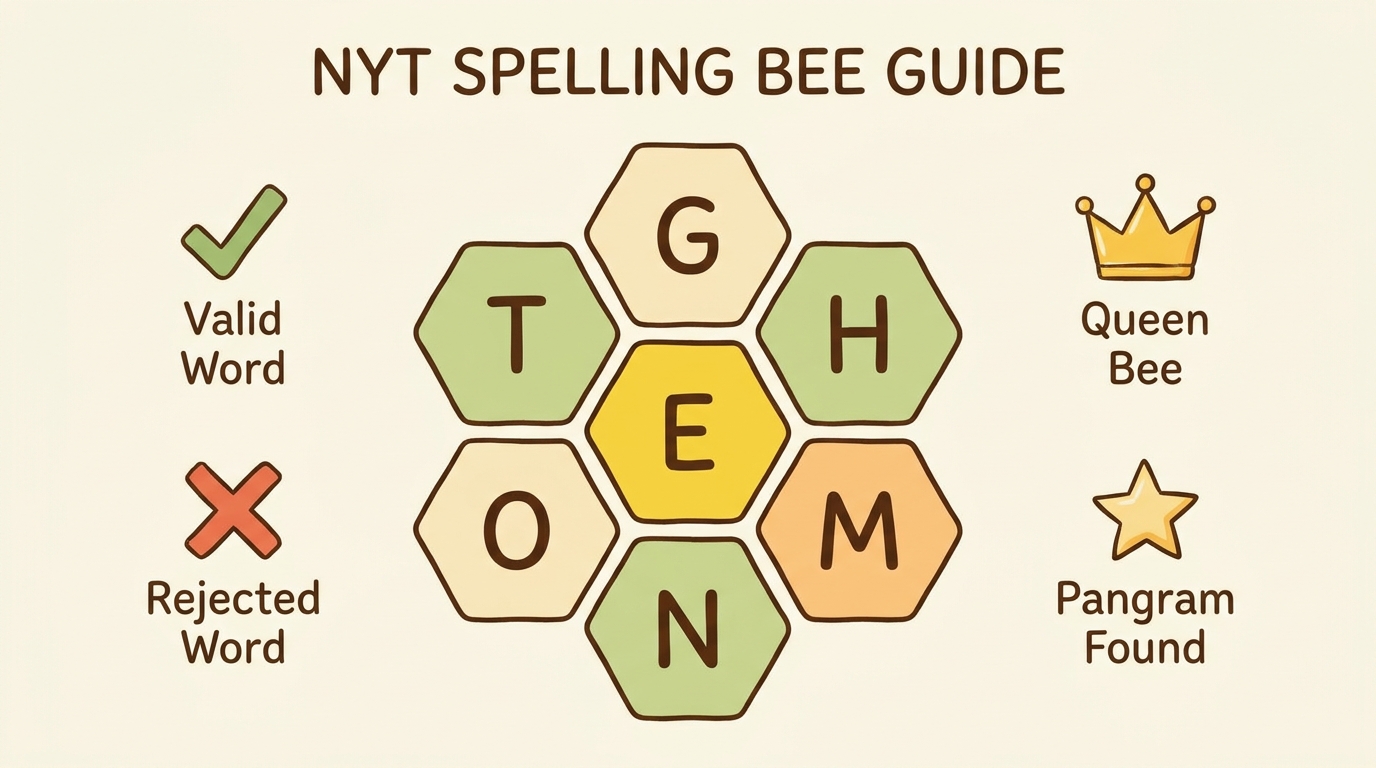
What is the NYT Spelling Bee word game? Here’s the complete beginner’s guide — how it works, how to score, what Genius and Queen Bee mean, and how to get started.
The NYT Spelling Bee is one of the most popular daily word games in the world — and one of the most deceptively simple to explain but genuinely difficult to master. The concept fits in a single sentence: find as many words as possible using seven letters, where one center letter must appear in every word. The execution can occupy anywhere from fifteen minutes to several hours depending on how deep you want to go.
If you’ve heard people talking about “Genius” or “Queen Bee” and weren’t sure what they meant, or if you’ve seen the honeycomb hexagon and wondered how to play, this guide covers everything — from the basic rules to the tier system to what separates a casual player from a dedicated one.
What Is the NYT Spelling Bee?
The NYT Spelling Bee is a daily word puzzle published by The New York Times as part of its Games subscription. It was created by puzzle constructor Sam Ezersky and launched in its current digital form in 2018, though the concept dates back to a print version in the NYT Magazine.
Every day, a new puzzle appears with seven letters arranged in a honeycomb pattern — six outer hexagons surrounding one center hexagon. Your job is to find as many valid words as possible using those seven letters, with the rule that the center letter must appear in every word you find. Words must be at least four letters long.
There’s no timer. No penalty for incorrect guesses. No hard cap on the number of words you can submit (unlike Blossom’s 12-slot limit). You can play for five minutes or five hours — the puzzle stays open until you close it or the next day’s puzzle replaces it at midnight Eastern Time.
The Basic Rules
Rule 1 — Use the seven letters: Every word must be formed using only the seven letters displayed in the honeycomb. Letters can be reused as many times as needed within a single word.
Rule 2 — Include the center letter: This is the defining constraint. Every valid submission must contain the center letter at least once. Words that use only the outer letters and ignore the center letter are rejected.
Rule 3 — Minimum four letters: Words shorter than four letters are not accepted, regardless of how valid they are as English words.
Rule 4 — No proper nouns: Names of people, places, or brands are not accepted.
Rule 5 — No hyphenated words: Words requiring hyphens are excluded.
Rule 6 — The word must be in the NYT’s curated list: This is where Spelling Bee differs from games using a standard dictionary — the NYT editorial team curates which words are accepted, which means some legitimate dictionary words are excluded if the editors consider them too obscure, offensive, or otherwise inappropriate for the puzzle.
The Scoring System
Points in Spelling Bee are assigned based on word length:
- 4-letter words: 1 point each (the minimum valid submission)
- 5-letter words: 5 points
- 6-letter words: 6 points
- 7-letter words: 7 points
- 8-letter words: 8 points
- And so on — one point per letter for words five letters or longer
The Pangram bonus: Every puzzle contains at least one “pangram” — a word that uses all seven of the available letters. Finding the pangram earns a 7-point bonus on top of the word’s normal length score. If the pangram is a 7-letter word, it earns 7 (length) + 7 (pangram bonus) = 14 points. Longer pangrams score even more.
The total possible score for any given day’s puzzle varies based on how many valid words the letter set allows and how many of those are long words or pangrams.
The Tier System: From Beginner to Genius
Spelling Bee doesn’t just show you a raw score — it maps your progress through a series of tiers based on what percentage of the day’s total possible points you’ve accumulated. These tiers are displayed on a progress bar at the top of the game.
The tiers, from lowest to highest:
- Beginner
- Good Start
- Moving Up
- Good
- Solid
- Nice
- Great
- Amazing
- Genius
Genius is reached when you’ve found words totaling approximately 70% of the day’s maximum possible score. This is most players’ primary daily goal — getting to Genius means you’ve found the majority of the puzzle’s vocabulary, including the pangram, while not necessarily finding every valid word.
The tiers scale with the day’s total possible score, so reaching Genius requires a different raw point count each day depending on how word-rich that day’s letter set is.
What Is Queen Bee?
Queen Bee is Spelling Bee’s ultimate achievement — finding every single valid word in the puzzle. Not 70%, not 90%, but every word the NYT’s curated list recognizes for that day’s letter set.
Queen Bee status is indicated by a special visual achievement in the game interface and is the badge that the most dedicated Spelling Bee players chase daily. On a typical puzzle, the complete word list might contain anywhere from 30 to 100+ valid words — finding all of them requires both deep vocabulary and systematic searching.
Most players reach Genius on many days but achieve Queen Bee much less frequently. A small community of dedicated players tracks their Queen Bee streaks and discusses daily puzzles in active online communities where hints are shared for players who get stuck.
The Queen Bee community: The NYT Spelling Bee has one of the strongest community cultures in daily word games. Daily discussion threads, hint systems (where community members give clues rather than answers), and collective celebration of Queen Bee finds are central to the experience for regular players.
What the Pangram Is (And Why It Matters)
Every Spelling Bee puzzle contains at least one pangram — a word that uses all seven of the available letters at least once. Some puzzles contain two pangrams; very occasionally more.
Finding the pangram is considered the central achievement of any Spelling Bee session — more so than reaching Genius in some player communities. The pangram often unlocks the path to Genius because it’s typically a longer, higher-scoring word, and finding it usually signals that your vocabulary search has covered the most challenging territory.
Why it’s often hard to find: The pangram is frequently a word that uses uncommon or less obvious letter combinations from the day’s set — a compound word, an unusual word form, or vocabulary from a specific domain that not everyone knows. This is also why the pangram hunt is such a celebrated moment when it succeeds: it required genuine vocabulary effort.
What Words the Bee Accepts (And Rejects)
This is one of the most common sources of frustration for new players, and it’s worth understanding clearly.
Why some real words get rejected:
The NYT Spelling Bee uses an editorially curated word list rather than a complete dictionary. The NYT puzzle team chooses which words to include and exclude based on editorial criteria — words they consider too obscure, too offensive, too archaic, or otherwise inappropriate are excluded even if they appear in Merriam-Webster.
This means TEMPS, FRAT, ALOUD, and many other completely standard words have been famously rejected by Spelling Bee at various times — not because they’re not real words, but because an NYT editor decided not to include them.
The practical implication: You can’t predict with certainty whether a word is in the Spelling Bee list by checking the dictionary. A word being in Merriam-Webster doesn’t guarantee it’s in the Bee; a word being rejected by the Bee doesn’t mean it’s not a real word. This editorial opacity is the most common source of Spelling Bee player frustration.
What’s always rejected:
- Proper nouns (always)
- Hyphenated words (always)
- Words under four letters (always)
- Words not using the center letter (always)
- Words using letters not in the day’s set (always)
Cost: Is Spelling Bee Free?
NYT Spelling Bee requires a NYT Games subscription for full access. As of 2026, the subscription bundles Spelling Bee with the NYT Crossword, Connections, Strands, Wordle, and Mini Crossword.
The free tier: A limited free version allows you to play a portion of the puzzle before hitting a paywall — typically the first few words or a limited number of submissions before being prompted to subscribe.
Pricing: NYT Games subscription pricing varies and changes periodically. Check nytimes.com/games for current pricing.
The free alternative: If you want a similar daily word game experience without a subscription, Blossom Word Game at BlossomSpellingGame.com is completely free — no account required, no paywall, no subscription. Blossom uses a seven-letter flower grid with a mandatory center letter and shares significant structural similarities with Spelling Bee while being a distinct game with its own mechanics (12-word slot limit, scoring by length, bonus petal letter). See our full comparison in the Blossom vs. Spelling Bee guide.
How to Access Spelling Bee
On desktop/laptop:
- Go to nytimes.com/games/spelling-bee
- Sign in or subscribe to access the full puzzle
- The puzzle loads in your browser — no download required
On mobile:
- Download the NYT Games app (iOS App Store or Google Play)
- Sign in with your NYT account
- Access Spelling Bee from the games menu
The puzzle resets at midnight Eastern Time each day. Your progress on the current day’s puzzle is saved if you don’t finish in one sitting.
Tips for Beginners
Find the pangram early. The pangram uses all seven letters — hunting for it specifically early in your session often unlocks the most challenging vocabulary territory and earns bonus points.
Include the center letter in every attempt. This is the rule new players most often forget. Before typing any word, confirm it contains the center letter at least once.
Try all common suffixes. -ING, -ED, -ER, -NESS, -TION, -ABLE all produce many valid words when the letter set allows. A single root word often generates three or four valid submissions through suffix variations.
Don’t give up after Genius. Genius at 70% means there’s still 30% of the puzzle undiscovered. Many players stop at Genius; pushing further is where the most interesting vocabulary territory lies.
Use the shuffle button. Rearranging the outer letters frequently helps you see new word possibilities your brain was missing in the familiar arrangement.
Accept that some real words won’t work. The NYT’s curated list excludes many legitimate words. When something gets rejected that you’re sure is a word, it may simply have been excluded editorially. Try a different form of the same root.
How Spelling Bee Compares to Similar Games
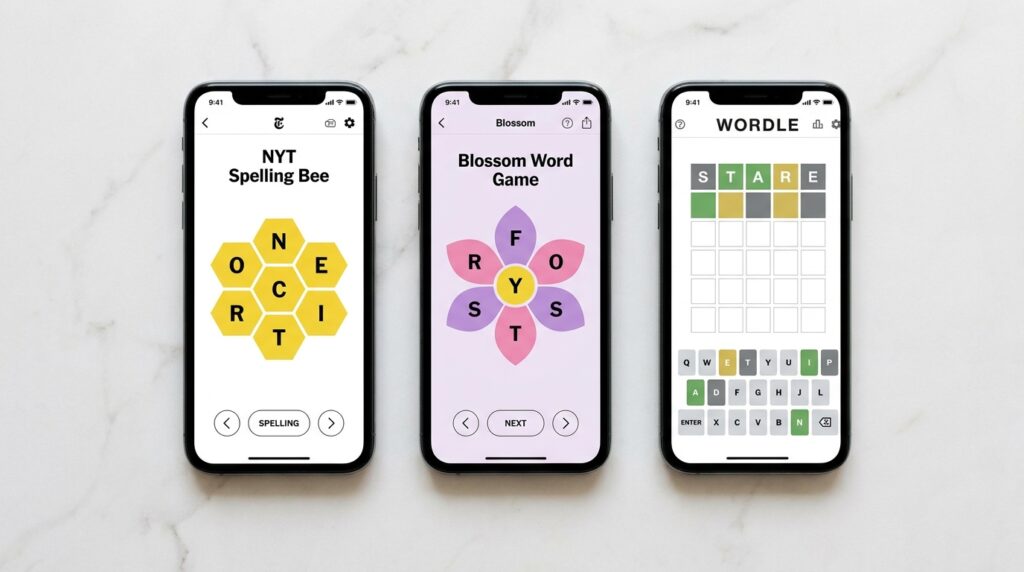
vs. Blossom Word Game: Both use seven letters with a mandatory center letter, but they differ significantly. Blossom has a 12-word slot limit (you choose which words to submit); Spelling Bee is open-ended (find everything). Blossom uses the complete Merriam-Webster dictionary; Spelling Bee uses a curated NYT editorial list. Blossom is completely free; Spelling Bee requires a subscription. For a full head-to-head comparison, see our Blossom vs. Spelling Bee guide.
vs. Wordle: Both are daily NYT word games, but Wordle is a deduction game (guess the hidden word) while Spelling Bee is a generation game (find as many words as you can). Wordle is free; Spelling Bee requires a subscription.
vs. NYT Connections: Both are daily NYT games requiring subscription access, but Connections is a categorical grouping game rather than a word-finding game. They’re frequently played together as part of a daily NYT Games routine.
FAQ
What is the NYT Spelling Bee?
The NYT Spelling Bee is a daily word game published by The New York Times in which players find as many valid words as possible using seven letters arranged in a honeycomb, where the center letter must appear in every word. It resets daily at midnight ET and is accessible through a NYT Games subscription.
How do you play the NYT Spelling Bee?
Find words of four or more letters using the seven available letters, always including the center letter. Submit each word to earn points based on its length. The goal is to reach “Genius” (approximately 70% of the day’s total possible points) or, for the most dedicated players, “Queen Bee” (every valid word found).
What is Queen Bee in Spelling Bee?
Queen Bee is the achievement for finding every single valid word in the day’s puzzle — 100% of the total possible score. It’s the game’s ultimate daily achievement, pursued by the most dedicated players and celebrated in the active Spelling Bee community.
What is the pangram in Spelling Bee?
The pangram is a word that uses all seven of the day’s available letters at least once. Every puzzle contains at least one pangram, which earns a 7-point bonus in addition to its normal length score. Finding the pangram is considered the central achievement of most daily sessions.
Is the NYT Spelling Bee free?
No — full access to NYT Spelling Bee requires a NYT Games subscription. A limited free preview is available. For a completely free alternative with similar gameplay, Blossom Word Game at BlossomSpellingGame.com is free with no account required.
Why does Spelling Bee reject real words?
Spelling Bee uses an editorially curated word list rather than a complete dictionary. NYT editors choose which words to include and exclude, meaning some legitimate dictionary words are not accepted. This is intentional editorial curation, not a bug — but it’s a common source of player frustration.
How is Spelling Bee different from Blossom Word Game?
Both use seven letters with a required center letter, but key differences include: Blossom has a 12-word slot limit while Spelling Bee is open-ended; Blossom uses Merriam-Webster dictionary while Spelling Bee uses a curated NYT list; Blossom is completely free while Spelling Bee requires a subscription. See our full comparison guide for the complete breakdown.
What time does the NYT Spelling Bee reset?
The Spelling Bee resets daily at midnight Eastern Time, the same as most other NYT daily games.
Final Thoughts
The NYT Spelling Bee is genuinely excellent — a well-designed, endlessly deep daily word game with one of the strongest player communities in the genre. If you’re looking for an open-ended vocabulary challenge and are comfortable with a subscription cost, it’s worth trying.
If you want a similar experience that’s completely free — seven letters, a mandatory center letter, daily reset, vocabulary generation — Blossom Word Game at BlossomSpellingGame.com covers much of the same cognitive territory with some meaningfully different mechanics (the 12-slot limit adds a strategic dimension Spelling Bee doesn’t have, and the Merriam-Webster dictionary standard means fewer frustrating “that’s a real word!” rejections).
Many players find they enjoy both: Blossom for its strategic slot management and free access, Spelling Bee for its open-ended depth and community culture. They’re complementary rather than competing — and both are worth a daily session.