
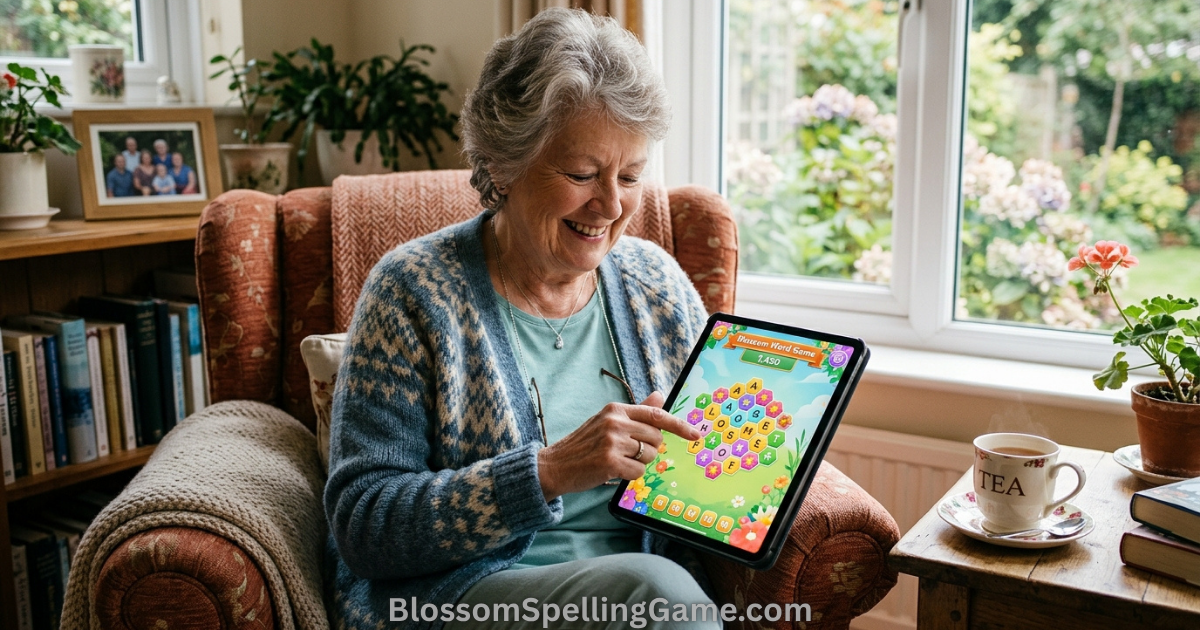
Is Blossom Word Game good for seniors? Here’s the honest answer — the real benefits, accessibility tips, and why older players often have a built-in advantage.
There’s a common but slightly condescending way that “brain games for seniors” get marketed — as remedial tools, as compensations for decline, as things you do because aging is taking something away from you. That framing misses something important about how vocabulary and word knowledge actually work across the lifespan, and it misses what makes Blossom Word Game specifically well-suited to older players for reasons that have nothing to do with deficit.
The honest starting point: vocabulary knowledge — the specific cognitive resource Blossom Word Game exercises — doesn’t decline with age the way processing speed and certain memory functions do. It typically grows. Many older adults have larger working vocabularies than they did at 30, built from decades of reading, conversation, and life experience. Blossom Word Game is one of the few “brain game” categories where older players often have a genuine structural advantage over younger ones.
This guide covers the honest, specific picture: which benefits are real and which are oversold, what accessibility considerations matter for comfortable play, how Blossom compares to other senior-recommended puzzle activities, and practical tips for getting the most out of daily play — whether you’re playing solo, with a spouse, or staying connected with grandchildren through a shared puzzle habit.
The Vocabulary Advantage: Why Older Players Often Have an Edge
Most discussions of brain games for older adults assume an implicit deficit model: you’re playing to compensate for what’s declining. For Blossom Word Game specifically, this framing is backward.
Vocabulary knowledge is one of the few cognitive resources that reliably increases across most of adulthood, often continuing to grow into the 60s and 70s for people who remain intellectually engaged. The accumulated decades of reading, conversation, professional vocabulary, and lived experience build a vocabulary depth that’s genuinely difficult for a 25-year-old to match, regardless of their raw processing speed.
This means a 70-year-old playing Blossom isn’t necessarily playing from a position of disadvantage compared to a 30-year-old. In fact, many older players outperform younger ones on raw word count and vocabulary depth — they simply have more words available in long-term memory to draw from.
What does shift with age:
Where age-related changes do affect Blossom performance is in processing speed (how quickly you scan the letters and generate candidate words) and certain aspects of working memory (holding the letter set actively in mind while searching). These are real changes — but they affect speed of play, not the underlying vocabulary resource that determines how many words you ultimately find.
The practical reframe:
For an older player, Blossom isn’t a tool to slow decline in a domain where you’re weak — it’s a tool that plays directly to a domain where you’re likely already strong. The daily session becomes less about “keeping up” and more about exercising a genuine strength. This reframe matters because activities approached as strength-building tend to be more enjoyable and more sustainable than activities approached as remedial compensation.
Crystallized vs. Fluid Intelligence — What Actually Changes With Age
Understanding the distinction between two types of intelligence — crystallized and fluid — clarifies exactly what changes with age and why Blossom specifically aligns well with the type that doesn’t decline.
Fluid intelligence is the capacity for abstract reasoning, novel problem-solving, and processing speed — your ability to work with information you haven’t encountered before, in real time, without relying on prior knowledge. Fluid intelligence tends to peak in early adulthood and gradually decline from middle age onward. Tasks requiring rapid novel pattern recognition, quick mental math, or fast-paced multitasking draw heavily on fluid intelligence.
Crystallized intelligence is accumulated knowledge and skill — vocabulary, factual knowledge, accumulated expertise, learned patterns. Crystallized intelligence tends to remain stable or even continue growing well into older age, particularly for people who remain cognitively engaged. Tasks requiring vocabulary recall, accumulated knowledge, and pattern recognition based on extensive experience draw heavily on crystallized intelligence.
Where Blossom sits:
Blossom Word Game is predominantly a crystallized intelligence task. The core challenge — generating valid words from a letter constraint — draws on accumulated vocabulary knowledge far more than it draws on novel abstract reasoning or rapid processing speed. This is meaningfully different from games that are predominantly fluid intelligence tasks: rapid logical deduction games, fast-paced reaction games, or novel pattern-matching puzzles with no prior-knowledge advantage.
Why this distinction matters practically:
Games that rely heavily on fluid intelligence (timed deduction, rapid pattern matching) tend to become relatively harder with age as processing speed slows. Games that rely heavily on crystallized intelligence (vocabulary generation, factual knowledge games) tend to remain stable or even become relatively easier with age as accumulated knowledge grows.
This is part of why Blossom specifically — as opposed to faster-paced or more fluid-intelligence-dependent word games — tends to be particularly well-suited to older players. There’s no timer pressuring rapid processing. The 12-slot budget rewards thoughtful, deliberate word selection rather than speed. The core skill being exercised is exactly the one that tends to be strongest in this age group.
What the “Use It or Lose It” Research Actually Shows for Older Adults
The popular framing — “use it or lose it” for cognitive function — deserves more nuance than the slogan suggests, particularly for older adults specifically, where the research is more developed than the general cognitive benefits picture covered in our Cognitive Benefits guide.
What’s well-supported:
Longitudinal studies of older adults consistently find associations between sustained engagement in cognitively stimulating activities and better-maintained cognitive function over time, compared to populations with less cognitive engagement. This holds across multiple activity types: reading, word puzzles, learning new skills, and social engagement that requires cognitive effort.
The mechanism most strongly supported is cognitive reserve — covered in depth in our Cognitive Benefits guide — where sustained mental engagement appears to build structural and functional resilience that compensates for age-related changes.
What’s overstated in popular coverage:
The claim that specific brain games “reverse” cognitive decline or function as a treatment for cognitive impairment is not well-supported by current evidence. Cognitive training research has generally found that improvement on a specific trained task (getting better at Blossom specifically) doesn’t reliably transfer to broad, general cognitive improvement or to clinically meaningful outcomes for conditions like dementia.
The honest middle ground:
Daily engagement with a cognitively demanding, intrinsically enjoyable activity like Blossom appears to be one component of a cognitively active lifestyle associated with better long-term outcomes. It is not a clinical intervention, not a substitute for medical care, and not a guarantee against decline. For older adults specifically, the most defensible framing is: daily word game engagement is a reasonable, low-risk, genuinely enjoyable component of staying cognitively active — most valuable as part of a broader pattern that includes physical activity, social engagement, and varied intellectual stimulation, not as a standalone solution.
Why this matters for sustainable engagement:
Older adults who approach Blossom with realistic, non-clinical expectations — playing because it’s genuinely enjoyable and intellectually satisfying, not because they’re anxious about decline — tend to maintain the habit longer and experience it more positively than those approaching it as an anxious compensatory measure. The activity should feel like a pleasure, not a prescription.
Combating Social Isolation Through Word Games
This is one of the most clinically significant — and least discussed — benefits of daily word games for older adults specifically, since social isolation is a well-documented health risk for this population in a way it isn’t typically framed for younger players.
The isolation risk:
Social isolation among older adults, particularly those who live alone, are retired, or have experienced the loss of a spouse or close friends, is associated with significant negative health outcomes — comparable in magnitude to well-established risk factors like smoking, according to multiple large-scale public health analyses. Combating isolation is a genuine health priority, not just a quality-of-life nicety.
How shared word game habits address this:
Daily word games create a structured, low-effort social touchpoint that doesn’t require the planning or energy that in-person social activities sometimes demand. A daily text exchange with an adult child — “found the pangram today!” — or a shared puzzle conversation with a spouse over breakfast creates a consistent, reliable social interaction built into the day’s structure.
Specific social use cases for older players:
The spousal ritual: Couples who both play Blossom — even on separate devices — often develop a daily conversation ritual comparing results. This creates a small daily point of connection that persists even in long marriages where conversation topics can feel repetitive.
The long-distance family connection: Adult children who’ve moved away often struggle to find low-effort, regular conversation topics with aging parents. A shared daily word game creates exactly this: a built-in, pressure-free conversation starter that doesn’t require either party to initiate something more demanding.
The senior community connection: In retirement communities, assisted living facilities, or senior centers, shared daily puzzle discussion has become a genuine social activity — comparing scores, discussing tricky letter combinations, and celebrating pangram discoveries together.
The widowed or solo-living player: For older adults living alone, particularly after the loss of a spouse, a daily structured activity that engages the mind and can be shared (even asynchronously, via text or phone call) provides both cognitive engagement and a meaningful social touchpoint.
Why this benefit deserves emphasis:
Most discussions of “brain games for seniors” focus exclusively on the cognitive dimension. The social dimension — the conversations, shared rituals, and connection points that a daily puzzle habit creates — may be equally or more valuable for overall wellbeing, particularly for older adults at elevated risk of isolation.
Blossom and the Retirement Transition
The transition out of structured work life is a significant life adjustment that affects daily routine, sense of purpose, and cognitive engagement patterns — and it’s a context where a daily Blossom habit can serve a specific, valuable function.
The structure vacuum:
Decades of working life provide structure: a schedule, tasks, deadlines, problems to solve, a sense of productive engagement. Retirement removes this structure all at once, and many retirees report missing not the work itself but the rhythm and structure it provided.
How a daily puzzle habit fills part of this gap:
A consistent daily Blossom session — ideally tied to a specific time, as covered in our Daily Habit Guide — provides a small, reliable structural anchor in a day that otherwise lacks the imposed structure of work. It’s not a replacement for the broader sense of purpose that meaningful retirement activities provide, but it’s a consistent, low-stakes daily task with a clear beginning, middle, and satisfying end.
The problem-solving continuity:
For retirees from professions that involved significant problem-solving, analysis, or verbal/written work, Blossom provides a specific continuity: the experience of engaging a problem, applying systematic thinking, and reaching a satisfying resolution — at a smaller scale than professional work, but recognizably similar in structure.
The “productive feeling” without productivity pressure:
Blossom delivers something psychologically similar to professional accomplishment — finding words, building a score, occasionally hitting an excellent session — without any of the pressure, deadlines, or stakes of actual work. For retirees adjusting to life without daily professional accomplishment, this can fill a specific psychological need during the transition period.
Accessibility Considerations: Vision, Touch, and Setup
Practical accessibility matters for comfortable, sustainable play — and a few specific adjustments make a meaningful difference for many older players.
Vision considerations:
Font and letter size: Most browsers and devices allow zoom adjustment. On desktop browsers, Ctrl/Cmd + “+” increases page zoom, making the letter grid larger and more legible. On mobile devices, accessibility settings allow system-wide text size increases that affect how Blossom’s interface renders.
Contrast sensitivity: Age-related changes in contrast sensitivity (distinguishing similar shades, particularly in lower light) are common. If the default color scheme feels difficult to read, check whether your device or browser has a high-contrast mode, and consider playing in well-lit conditions rather than dim evening lighting if visual clarity matters.
Screen glare: Tablets and phones with glossy screens can create glare issues, particularly for players with cataracts or other age-related vision changes. A matte screen protector or playing in indirect light reduces this friction.
Touch and motor considerations:
Touchscreen target size: For players with reduced fine motor precision (common with arthritis or age-related dexterity changes), larger touchscreen devices (tablets rather than phones) provide bigger letter targets that are easier to tap accurately. A larger tablet screen reduces mis-taps significantly compared to a small phone screen.
Physical keyboard alternative: Players who find touchscreen typing or tapping uncomfortable can use Blossom on a desktop or laptop with a physical keyboard, typing words directly rather than tapping letter tiles — generally more comfortable for players with reduced fine motor control in the fingers.
Stylus options: Some tablet users find a stylus more precise and comfortable than direct finger tapping, particularly for smaller touch targets.
Setup simplification:
No account complexity: Playing at BlossomSpellingGame.com requires no account creation for basic play — removing a common friction point for players less comfortable with creating logins and remembering passwords. An account adds streak tracking benefits but isn’t required to enjoy the daily puzzle.
Bookmark or home screen shortcut: Setting up a single-tap shortcut (covered in our Daily Habit Guide) removes the need to remember a URL or navigate through search results daily — a meaningful simplification for players less comfortable with general web navigation.
Blossom vs. Other Senior-Recommended Puzzles
Older adults are frequently steered toward specific puzzle types — crosswords, sudoku, jigsaw puzzles, bridge. Here’s how Blossom genuinely compares.
Blossom vs. traditional crossword puzzles:
Crosswords primarily test factual knowledge recall (trivia, cultural references, specific terminology) cued by definitional clues. Blossom tests generative vocabulary production from letter constraints without definitional cuing. Crosswords have a fixed, single correct answer per clue; Blossom has an open-ended search space with many valid answers. Crosswords appeal to players who enjoy clue-solving and trivia; Blossom appeals to players who enjoy open-ended verbal generation. Many players who enjoy one enjoy both — they exercise related but distinct vocabulary skills.
Blossom vs. Sudoku:
Sudoku is a pure logic and numerical pattern puzzle with no vocabulary or language component. It exercises different cognitive territory entirely — primarily fluid intelligence (logical deduction, spatial pattern recognition) rather than crystallized intelligence (vocabulary). For players who want specifically verbal/vocabulary engagement (as opposed to numerical/logical), Blossom is the more appropriate choice. Many senior puzzle enthusiasts alternate between both types for cognitive variety.
Blossom vs. jigsaw puzzles:
Jigsaw puzzles primarily exercise visuospatial processing and pattern matching with no vocabulary component. They’re excellent for fine motor practice and visual-spatial skills but don’t provide the language-specific cognitive engagement that Blossom does. The two are complementary rather than competing — many players enjoy both for different reasons.
Blossom vs. bridge or other card games:
Bridge and similar strategic card games exercise working memory, strategic planning, and (in bridge specifically) significant social interaction as a core game mechanic. They’re excellent for combining cognitive engagement with social connection but require a partner or group, unlike Blossom’s solo-friendly format. For players wanting a daily solo activity that doesn’t require coordinating with others, Blossom fills a gap that bridge can’t.
The complementary recommendation:
Rather than choosing one puzzle type, the strongest cognitive engagement approach for older adults typically involves variety: a vocabulary-based game like Blossom, a logic-based game like Sudoku, and ideally a social activity like bridge or a card game group. Each exercises different cognitive territory, and the variety itself appears to be more valuable than depth in any single activity type.
Tips for Comfortable, Sustainable Daily Play
Practical recommendations specifically calibrated for older players building a sustainable habit.
Play at a consistent, comfortable time: Many older players report strongest cognitive engagement in mid-morning, after the early morning grogginess has passed but before any afternoon energy dip. Experiment to find your personal peak window rather than defaulting to “first thing in the morning.”
Don’t chase the pangram every session: The pangram hunt can be the most frustrating part of Blossom for any player. If a session isn’t yielding the pangram after reasonable effort, it’s entirely fine to submit the words you’ve found and move on. The habit and enjoyment matter more than completionism.
Use the shuffle button freely: Rearranging the visual layout of the petal letters genuinely helps some players see new word combinations. There’s no penalty for shuffling — use it whenever you feel stuck.
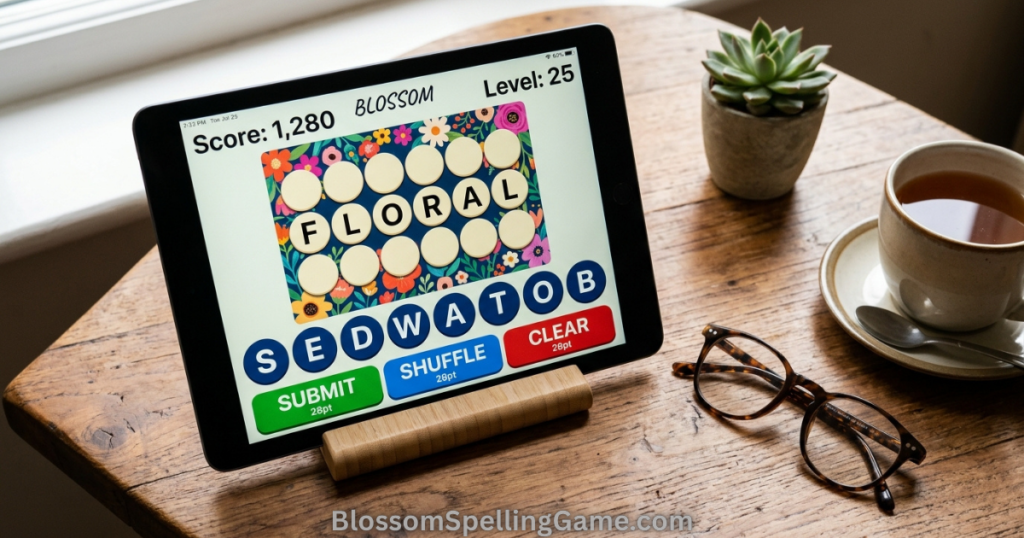
Play with a larger screen if available: A tablet or desktop monitor, rather than a phone, reduces visual strain and touch-target frustration for most older players. If you primarily use a phone for other tasks, consider keeping Blossom specifically for a tablet or computer session.
Take breaks within a session if needed: There’s no timer in Blossom — you can step away mid-puzzle and return later in the same session. Players managing fatigue or needing to pace cognitive effort across the day can split a session into two shorter sittings without any game penalty.
Pair play with a comfortable routine: Morning coffee, afternoon tea, or an evening wind-down moment — anchoring the Blossom session to an existing comfortable daily ritual (as detailed in our Daily Habit Guide) makes the habit easier to sustain than treating it as a separate task to remember.
Celebrate the vocabulary you already have: Many older players are surprised by how much vocabulary they retrieve once they start playing regularly — words from decades of reading and conversation that haven’t been actively used in a while. This is a genuine asset, not a coincidence. Trust your vocabulary instincts; they’re often more reliable than you’d expect.
Intergenerational Play: Connecting With Grandchildren
A specific and consistently rewarding use case for older players: playing Blossom together with grandchildren as a shared activity that bridges generational and skill differences naturally.
Why it works well across generations:
Blossom’s scoring structure rewards different things for different players simultaneously — a grandchild might find more short words quickly; a grandparent might find the longer, more obscure words that come from decades of accumulated vocabulary. Both contributions matter to a shared session, and the collaboration feels genuinely complementary rather than one person carrying the other.
Practical intergenerational play approaches:
The shared session: Sit together with one device, taking turns submitting words. The grandparent’s vocabulary often surfaces words the grandchild has never encountered, creating natural teaching moments without feeling like a lesson.
The parallel comparison: Play separately on different devices, then compare results — discussing which words each person found, learning unfamiliar words from each other’s lists.
The phone/video call ritual: For grandparents and grandchildren who live apart, a regular phone or video call centered on comparing the day’s Blossom results creates a built-in conversation topic that doesn’t require either party to manufacture small talk.
What grandparents often bring to shared play:
Decades of accumulated vocabulary, including words that have fallen out of common usage among younger generations — words from earlier reading, different professional contexts, and simply more total years of language exposure. This often surprises and delights grandchildren, turning the shared puzzle into an informal vocabulary-sharing experience across generations.
Realistic Expectations: What Blossom Can and Can’t Do
Honest expectation-setting matters for any wellness-adjacent recommendation, and it matters particularly here given how heavily “brain games” are sometimes marketed to older adults with overstated claims.
What Blossom can reasonably deliver:
A genuinely enjoyable daily activity that exercises vocabulary, provides cognitive engagement, creates structure, and can serve as a social connection point. These are real, meaningful benefits worth pursuing for their own sake.
What Blossom cannot deliver:
It is not a medical treatment, not a proven prevention for dementia or cognitive decline, and not a substitute for medical care, physical exercise, or social engagement beyond what the game itself provides. Any marketing language suggesting brain games “prevent” or “reverse” cognitive decline should be treated with significant skepticism — the research doesn’t support these specific claims, regardless of which game or app is being marketed.
The appropriate framing:
Treat Blossom Word Game as you would treat any genuinely enjoyable hobby with some additional cognitive engagement benefit — closer to “a hobby I enjoy that happens to be good for my mind” than “a medical intervention I’m relying on.” This framing produces more sustainable, more enjoyable engagement than an anxious, deficit-focused approach.
When to seek additional support:
If you or a family member are experiencing concerning changes in memory, language, or cognitive function — beyond normal age-related changes — a word game is not the appropriate response. Consult a physician. Word games are a complement to a cognitively engaged life, not a diagnostic tool or a treatment for genuine cognitive concerns.
Getting Started: A Simple Setup Guide
Step 1: Visit BlossomSpellingGame.com in any web browser — no download required.
Step 2: The day’s puzzle loads automatically — seven letters arranged in a flower, with one center letter.
Step 3: Tap or click letters in sequence to spell a word, or type directly if using a keyboard. The center letter must appear somewhere in every word.
Step 4: Submit each word. Valid words are accepted with a points display; invalid attempts simply don’t register — no penalty.
Step 5 (optional): Create a free account if you want streak tracking and stat history across devices. This isn’t required to enjoy daily play.
Step 6: Consider bookmarking the site or adding it to your device’s home screen for one-tap daily access — see our Daily Habit Guide for the specific steps.
There’s no time limit, no penalty for wrong guesses, and no pressure to finish quickly. Play at whatever pace feels comfortable.
FAQ
Is Blossom Word Game good for seniors?
Yes — for reasons that go beyond generic “brain games are good for you” framing. Blossom specifically exercises vocabulary knowledge (crystallized intelligence), which tends to remain stable or grow with age rather than decline. The lack of time pressure and the open-ended, deliberate nature of the gameplay suit a cognitive profile where processing speed may have slowed but accumulated vocabulary remains strong or has even grown.
Does Blossom Word Game prevent dementia or cognitive decline?
No — there’s no research support for this specific claim about Blossom or any similar word game. The honest picture is that sustained engagement in cognitively stimulating activities is associated with better-maintained cognitive function and “cognitive reserve” over time, but this is different from preventing or reversing specific conditions. Treat Blossom as a genuinely enjoyable cognitive activity, not a medical intervention.
Are older players at a disadvantage in Blossom compared to younger players?
Not necessarily, and often the opposite. Blossom relies heavily on vocabulary depth (crystallized intelligence), which tends to be stronger in older adults due to decades of accumulated reading and language exposure. While processing speed may be faster in younger players, the underlying vocabulary resource that determines how many words you ultimately find often favors older, more experienced players.
What accessibility features help older players use Blossom comfortably?
Browser/device zoom for larger text, playing on a tablet rather than a phone for bigger touch targets, using a physical keyboard instead of touchscreen tapping if preferred, ensuring good lighting to reduce glare and improve contrast visibility, and setting up a one-tap bookmark or home screen shortcut to simplify daily access.
Can Blossom Word Game help with loneliness or social isolation?
Indirectly, yes. While the game itself is solo, a shared daily puzzle habit — comparing results with a spouse, adult child, or grandchild — creates a built-in, low-effort social touchpoint. This can be particularly valuable for older adults living alone or experiencing reduced social contact, where social isolation itself is a significant health risk.
Is Blossom Word Game better than crossword puzzles for seniors?
They’re different rather than one being objectively better. Crosswords test factual/trivia recall through definitional clues; Blossom tests open-ended vocabulary generation from letter constraints. Many puzzle enthusiasts enjoy both for different reasons — crosswords for the satisfaction of clue-solving, Blossom for the open-ended verbal exploration. Neither replaces the other; they’re complementary.
Can grandparents and grandchildren play Blossom together?
Yes, and it’s a particularly rewarding shared activity. The game’s structure allows both a grandchild’s quick recognition of simple words and a grandparent’s deeper accumulated vocabulary to both contribute meaningfully to the same puzzle, creating natural teaching moments and shared discovery without either person feeling outmatched.
Does Blossom Word Game require good vision or fine motor skills?
Some visual clarity and basic touch/click precision are needed, but accessibility adjustments help significantly: increasing browser/device zoom, playing on a larger screen (tablet or desktop), using a keyboard instead of touchscreen tapping, and ensuring good lighting all reduce friction for players with age-related vision or dexterity changes.
What’s a realistic daily time commitment for Blossom as a senior?
Most players find 10-20 minutes per day comfortable and sufficient for a satisfying session. There’s no time pressure within a session — you can take breaks and return, play at whatever pace feels right, and there’s no requirement to complete all 12 word slots if that feels like enough for the day.
Final Thoughts
The most honest thing to say about Blossom Word Game for older adults is this: it’s a genuinely good fit, not because it compensates for decline, but because it plays to a strength that often grows stronger with age. The accumulated vocabulary built over decades of reading, conversation, and life experience is a real asset in this specific game — one that younger players, for all their faster processing speed, simply haven’t had time to build yet.
Beyond the cognitive dimension, the daily structure, the potential for social connection through shared play, and the simple, accessible format make Blossom a sustainable addition to daily life for older adults — not as a medical necessity, but as a genuinely enjoyable habit that happens to exercise a cognitive resource worth maintaining.
If you’re getting started, keep the framing simple: this is a hobby you might genuinely enjoy, one that rewards the vocabulary you’ve spent a lifetime building. Play today’s puzzle at BlossomSpellingGame.com — no download, no account required, just seven letters and however many words your decades of language experience can find.