
How college students and adult learners use Blossom Word Game to build academic vocabulary? if you are a student, you can read this post Blossom Word Game for Students.
You’re staring at a draft of your essay, and the word you want — the precise one, not the vague placeholder you typed instead — won’t come. You know there’s a better word than “important.” You know there’s something sharper than “shows.” But it’s 11 PM, the deadline is tomorrow, and the right word stays just out of reach.
This is one of the most common frustrations in academic writing, and it’s not a knowledge problem so much as a retrieval problem. You likely know more sophisticated vocabulary than you can access under writing pressure — the gap between what you know and what you can produce on demand is exactly the gap that determines whether your writing sounds confident or merely adequate.
This guide is specifically for college students, graduate students, and adult learners using Blossom Word Game as part of building genuine academic vocabulary fluency — not the K-12 education angle covered in our Is Blossom Good for Kids guide, but the specific challenges of college-level writing, standardized graduate test prep, ESL academic English, and the daily grind of building a vocabulary that sounds like you belong in the room.
The Specific Vocabulary Gap College Writing Exposes
High school writing and college writing demand fundamentally different vocabulary registers, and the transition exposes a gap that many students don’t expect.
High school writing often rewards clarity and correctness — saying things plainly and accurately. College writing, particularly in the humanities and social sciences, rewards precision and nuance — the ability to distinguish between words that are almost synonyms but carry different shades of meaning. The difference between IMPLY and INFER, between AFFECT and EFFECT used as nouns, between ARGUE and CONTEND and POSIT and ASSERT — these distinctions matter in academic writing in ways they rarely mattered before.
Why this gap catches students off guard:
Most students arrive at college with substantial passive vocabulary — they recognize sophisticated words when they read them in assigned texts — but limited active vocabulary at that same level. They can read a dense academic article and understand it, but when asked to write at that register themselves, the precise words don’t come. This is the passive-to-active vocabulary gap covered in depth in our Vocabulary Improvement guide — and it’s particularly pronounced for college students because the demand for active production (writing papers, participating in seminar discussions) suddenly outpaces what casual reading alone has built.
How Blossom specifically addresses this gap:
Blossom’s generative format — producing words from constraint rather than recognizing them on a page — directly exercises the exact skill that academic writing demands: pulling sophisticated vocabulary from memory under pressure, without a word bank or thesaurus to lean on. A student who’s been playing Blossom regularly has practiced exactly this retrieval thousands of times by the time they sit down to write a paper.
The specific vocabulary tier Blossom targets — covered as “Tier 2 academic vocabulary” in our broader vocabulary guide — is precisely the register that distinguishes competent college writing from merely correct college writing. Words like COGENT, SALIENT, NUANCED, TENUOUS, UNTENABLE, EQUIVOCAL — these aren’t rare or obscure, but they’re words that need active practice to produce fluently rather than just recognize.
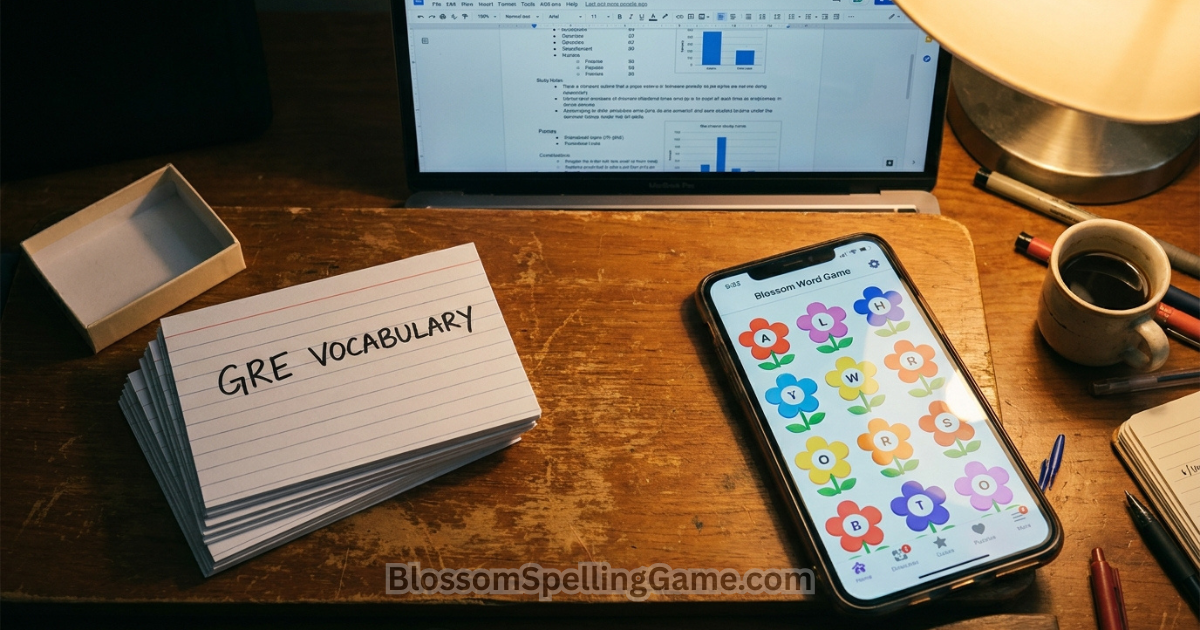
Blossom and Graduate Test Prep: GRE, GMAT, LSAT
While our kids-focused guide covers SAT/ACT preparation for high schoolers, graduate-level standardized tests present a different vocabulary challenge entirely — one where Blossom plays a genuinely useful supporting role.
The GRE verbal vocabulary challenge:
The GRE’s verbal reasoning section is notorious for testing vocabulary at a level well beyond typical college reading — words like PERSPICACIOUS, OBSEQUIOUS, RECALCITRANT, and PERFUNCTORY appear regularly. Traditional GRE vocabulary prep relies heavily on flashcard memorization of word lists, which builds recognition (you can match the word to its definition) but often fails to build the deeper morphological pattern recognition that helps with words you haven’t specifically memorized.
Blossom’s suffix and prefix systems — covered comprehensively in our Suffix Guide and Prefix Guide — build exactly this morphological pattern recognition. A student who’s internalized that -ACIOUS forms adjectives meaning “inclined to” (PERSPICACIOUS, VORACIOUS, TENACIOUS) or that -SCENT relates to gradual processes (OBSOLESCENT, CONVALESCENT) can make educated guesses about GRE words they’ve never specifically memorized — a skill flashcard memorization alone doesn’t build.
The GMAT and LSAT vocabulary dimension:
GMAT and LSAT verbal sections test vocabulary less directly than the GRE but still require precise reading comprehension of dense, formally written passages. The general academic vocabulary fluency that daily Blossom play builds — particularly the ability to quickly parse complex words through morphological analysis — supports faster, more confident reading of these passage types.
The honest limitation:
Blossom is not a substitute for dedicated test prep. It doesn’t teach GRE-specific vocabulary lists, doesn’t simulate test conditions, and doesn’t provide the targeted, high-frequency-word study that focused test prep delivers more efficiently for a specific exam date. The realistic role: Blossom is an excellent year-round vocabulary maintenance habit that makes dedicated test prep more effective when you start it, because your baseline vocabulary fluency and morphological analysis skills are already stronger than if you’d done no vocabulary work at all before beginning formal prep.
A practical sequencing recommendation: If you have a graduate test scheduled months out, maintain daily Blossom play as ongoing vocabulary conditioning. In the 6-8 weeks immediately before the test, shift to dedicated test-specific vocabulary study (official word lists, practice tests) while keeping Blossom as a lower-priority daily habit rather than your primary prep tool.
Building Academic Register: The Conversational-to-Formal Gap
One of the most practically useful things Blossom does for college writers is build awareness of register — the difference between how we speak casually and how academic writing expects us to write.
What register awareness means:
Every word has a register — a level of formality and a typical context of use. “Use” and “UTILIZE” mean nearly the same thing, but UTILIZE carries a formal academic register that “use” doesn’t. “Show” and “DEMONSTRATE” overlap in meaning but occupy different registers. Academic writing generally expects the more formal register member of these pairs, and students sometimes struggle to access the formal-register vocabulary even when they understand the concept perfectly well.
How Blossom builds register awareness:
Because Blossom’s word list draws from Merriam-Webster’s full dictionary rather than filtering for everyday conversational vocabulary, the game regularly surfaces formal-register words that don’t appear in casual speech: SUBSTANTIATE, MITIGATE, DELINEATE, CIRCUMSCRIBE, PRECLUDE. Repeated exposure to and production of these words in the game context builds familiarity that transfers to writing contexts where the formal register is expected.
The specific academic writing vocabulary categories Blossom helps with:
Hedging language: Academic writing often requires careful qualification — words like ARGUABLY, OSTENSIBLY, PRESUMABLY, PURPORTEDLY that signal appropriate epistemic caution. These words frequently appear in Blossom’s accepted word lists when letters allow.
Transition and logical connector vocabulary: Words like CONSEQUENTLY, NEVERTHELESS, CONVERSELY, SIMILARLY — the connective tissue of academic argumentation — are common Blossom finds that reinforce this specific vocabulary category through repeated production.
Analytical verb vocabulary: ANALYZE, EVALUATE, SYNTHESIZE, DELINEATE, SUBSTANTIATE, CORROBORATE — the verbs that drive academic analysis appear regularly in Blossom letter sets and benefit from the kind of active retrieval practice the game provides.
Practical application: After a Blossom session where you’ve encountered or produced a formal-register word you recognize as academically useful, make a small note. Over a semester, this builds a personal academic vocabulary bank specifically calibrated to your own writing needs — more useful than a generic vocabulary list because it’s built from words you’ve already demonstrated you can recognize and produce.
Blossom for ESL and International Students
For non-native English speakers in college and graduate programs, vocabulary building carries additional weight — academic success depends not just on understanding course content but on demonstrating that understanding in a second language, often under time pressure.
The specific challenge for ESL students:
Non-native speakers frequently report a particular frustration: they understand course material intellectually but struggle to express that understanding with the vocabulary precision that native-speaking peers seem to access effortlessly. This isn’t a knowledge gap — it’s a vocabulary production gap specifically in the target language, which is exactly the gap that generative word games address most directly.
Why Blossom’s format helps specifically:
Traditional ESL vocabulary instruction often emphasizes recognition (matching words to definitions, multiple choice exercises) because production is harder to teach and assess at scale. Blossom inverts this — every successful submission is a production event, which builds the specific skill (generating English words under constraint) that ESL students most need to strengthen for academic success.
The dictionary validation benefit:
For ESL students specifically, Blossom’s strict Merriam-Webster dictionary standard provides a confidence-building function beyond vocabulary growth: every accepted word is confirmed as standard, correctly spelled American English. This removes the uncertainty that non-native speakers often carry about whether a word they think they know is actually used correctly — confirmation from an authoritative dictionary source carries real reassurance value.
Building morphological awareness for ESL learners:
English’s complex prefix and suffix system — covered in our Common Prefixes and Common Suffixes reference guides — is often one of the harder aspects of English for speakers of languages with different morphological structures to internalize. Blossom’s suffix and prefix hunting mechanics provide repeated, low-stakes practice with exactly this system, building the pattern recognition that helps decode unfamiliar academic vocabulary encountered in coursework.
A realistic caveat:
Blossom builds written vocabulary specifically — spelling, word recognition, and production in written form. It doesn’t build pronunciation, listening comprehension, or conversational fluency. For ESL students, it’s most valuable as a complement to a broader English language learning approach that includes speaking and listening practice, not as a standalone solution.
The Study Break Use Case — Pomodoro and Productive Pauses
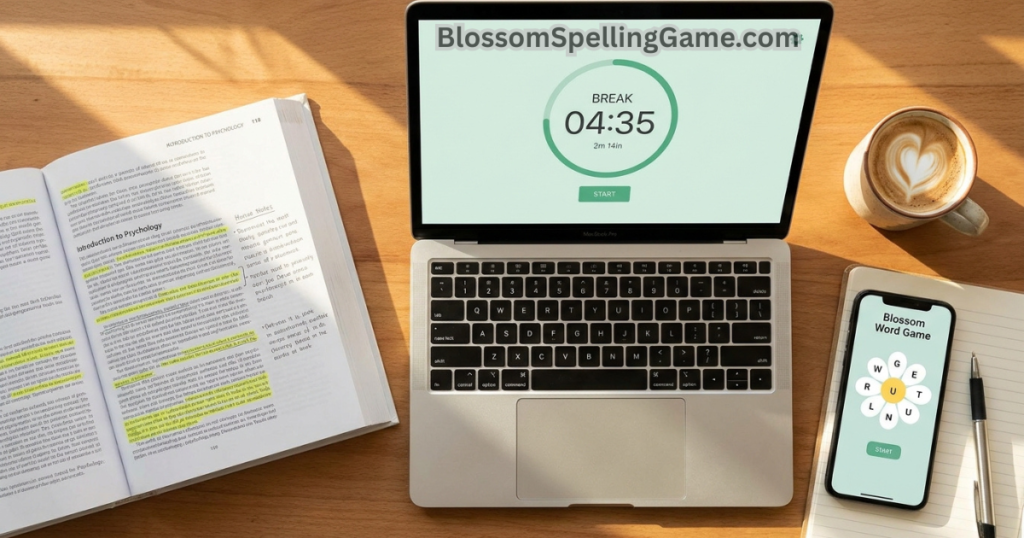
College students often structure study time using techniques like the Pomodoro method — focused work intervals (typically 25 minutes) followed by short breaks (5 minutes) — and Blossom fits naturally into this structure in a way that distinguishes it from passive break activities.
Why active breaks beat passive breaks:
Research on cognitive restoration generally favors breaks that involve a shift in activity type rather than complete disengagement. A five-minute scroll through social media is passive and can actually leave you more mentally fatigued than before the break (the endless-scroll format doesn’t provide closure or restoration). A five-minute Blossom session — bounded, engaging, with a natural stopping point — provides a genuine cognitive shift without the open-ended attention drain of social media.
The closure advantage:
Blossom sessions have natural completion points — you can stop after finding a satisfying handful of words, or push to complete all 12 slots if your break allows more time. This bounded structure is psychologically different from infinite-scroll platforms, which provide no natural stopping cue and frequently consume far more time than intended. A study break that has a clear beginning and end protects the next study interval better than one that bleeds into 20 minutes of unplanned scrolling.
Practical Pomodoro integration:
During a single 5-minute break, a quick partial Blossom session (finding 3-5 words without completing the full puzzle) provides cognitive variety without consuming the entire break. During longer breaks (15-30 minutes, typically scheduled after 3-4 Pomodoro cycles), a complete Blossom session fits comfortably and provides a more substantial mental reset before returning to focused study.
The switching cost consideration:
One genuine caution: switching from deep analytical study (math, dense reading) to Blossom’s vocabulary-generation mode and then back to the original study task does involve some cognitive switching cost. For very short breaks (under 5 minutes) during intensive deep-focus study sessions, a non-cognitive break (stretching, walking) may restore attention more efficiently than any word game. Blossom fits best in breaks of 5+ minutes, or as a transition activity between different types of study tasks (finishing reading, before starting problem sets).
Productive Use vs. Procrastination — An Honest Distinction
Any genuinely engaging activity carries procrastination risk for students with deadlines, and it’s worth being honest about where the line sits.
The procrastination risk pattern:
The specific risk with Blossom isn’t that it’s inherently distracting in the way social media or video content is — it’s bounded, finite, and doesn’t have the infinite-engagement design of platforms built for maximum time-on-app. But it can still become a procrastination tool when used as an avoidance mechanism: “I’ll just play one quick Blossom session before I start” becoming a repeated stalling pattern rather than a genuine break.
The diagnostic question:
The honest test for whether your Blossom session is a productive break or a procrastination episode: are you playing it AFTER defining what study task comes next, with a clear intention to return to that task? Or are you playing it INSTEAD of starting a task you’re avoiding, without having committed to when you’ll actually begin?
Productive break pattern: “I’ll finish this reading, then play one Blossom session, then start my problem set.” The game has a defined place in a sequence with clear before-and-after tasks.
Procrastination pattern: “I should start my essay but let me just play Blossom first” — repeated multiple times, with no specific commitment to when the essay writing actually begins. The game becomes the path of least resistance for avoiding a harder task.
Structural solutions:
If you notice the procrastination pattern emerging, the most effective intervention isn’t avoiding Blossom — it’s restructuring when you allow yourself to play it. Reserve Blossom specifically for the break slots in a Pomodoro structure or for after a defined task is complete, rather than leaving it available as an anytime option during study sessions. The bounded availability removes its function as an avoidance tool while preserving its function as a genuine break activity.
The honest acknowledgment:
For students who already struggle significantly with procrastination and task avoidance, any engaging activity — including Blossom — can become entangled in that broader pattern. If procrastination is a significant ongoing challenge, addressing the underlying pattern (often through structured study techniques, accountability systems, or in persistent cases, support from a campus academic resource center) matters more than any specific decision about word games.
The Imposter Syndrome Vocabulary Problem
This is a specific and underdiscussed dimension of college vocabulary anxiety — and one where regular Blossom play offers a quiet, genuine confidence benefit.
The pattern:
Many college students, particularly first-generation college students, students from under-resourced high schools, and ESL students, report a specific anxiety: the feeling that their vocabulary isn’t sophisticated enough to belong in academic discourse — that peers who grew up with more books, more educated family conversation, or more exposure to formal English have an unfair vocabulary head start that can’t be closed.
Why this matters beyond just vocabulary:
This anxiety isn’t just about words — it affects classroom participation (hesitating to speak up because the right vocabulary doesn’t come quickly enough), writing confidence (avoiding sophisticated constructions because of uncertainty about correct usage), and broader academic self-perception (interpreting vocabulary gaps as evidence of not belonging, rather than as a normal and addressable skill gap).
How regular Blossom play addresses this specifically:
The unexpected acceptance phenomenon — covered in depth in our Vocabulary Improvement guide — provides direct, repeated evidence that a student’s vocabulary is more extensive than they assumed. Discovering that you correctly produced LUCENT, or that FELICITY was accepted, or that you successfully constructed UNTENABLE from available letters — these are small but real confirmations that your vocabulary includes sophisticated words you weren’t confident about.
Over weeks and months of daily play, the accumulated evidence of “I know more sophisticated words than I gave myself credit for” can meaningfully shift the underlying belief that drives vocabulary-related imposter syndrome. This isn’t therapy and shouldn’t be mistaken for one, but the repeated, low-stakes confirmation of vocabulary competence is a genuine, measurable confidence input.
The complementary writing confidence effect:
Students who report reduced vocabulary anxiety after consistent Blossom play often describe a specific shift: more willingness to attempt sophisticated vocabulary in writing and discussion, because the daily game has provided repeated proof that they can access and correctly use words at that register. The risk of “using a word wrong” feels lower when daily practice has built genuine confidence in vocabulary accuracy.
Major-Specific Vocabulary Gaps: STEM, Humanities, and Cross-Training
College majors create specific vocabulary specializations — and students often have underdeveloped vocabulary outside their major’s domain in ways that affect general education requirements and interdisciplinary work.
The STEM student’s humanities vocabulary gap:
STEM majors often build deep technical vocabulary within their field (specific scientific and mathematical terminology) but may have less practiced exposure to the analytical, argumentative vocabulary that humanities and social science courses require — words related to interpretation, argumentation, and qualitative analysis: NUANCED, AMBIGUOUS, DIALECTIC, NORMATIVE, SUBJECTIVE.
Blossom’s general dictionary standard — rather than a technical or field-specific word list — naturally exposes STEM students to this broader humanities-adjacent vocabulary through regular play, providing low-stakes exposure to words they’ll need for required general education writing courses.
The humanities student’s STEM vocabulary gap:
Conversely, humanities-focused students often have less comfortable familiarity with the precise, often Latin/Greek-derived vocabulary that STEM general education requirements demand — terms like HYPOTHESIS, VARIABLE, CORRELATION (used precisely, not loosely), EMPIRICAL. While Blossom’s letter game format doesn’t teach the technical concepts behind these words, regular exposure to the general-vocabulary versions of scientific terminology (many science words have crossed fully into general dictionary use, as discussed in our Dictionary Guide) builds some familiarity.
The cross-training value:
Because Blossom draws from a comprehensive general dictionary rather than any field-specific word list, it naturally provides cross-disciplinary vocabulary exposure that a major-focused course load doesn’t always deliver. This is a genuine, if modest, benefit for students navigating general education requirements outside their primary field of study.
Fitting Daily Play Into a Chaotic Student Schedule
Our general Daily Habit Guide assumes a relatively stable daily routine — useful for most readers, but college schedules are notoriously irregular: different class times each day of the week, exam periods that override normal routines, and semester transitions that reset everything.
Why fixed-time anchors often fail for students:
The habit-stacking approach of “after my morning coffee” works well for people with consistent mornings. College students frequently have wildly different wake times, class schedules, and morning routines across different days of the week — Monday might start at 8 AM, Tuesday might start at 11 AM, weekend mornings might not exist in any consistent form.
Event-based anchors instead of time-based anchors:
For irregular schedules, anchor the Blossom habit to an event that occurs daily regardless of timing, rather than a specific clock time:
The “after my last class” anchor: Regardless of when your last class ends on a given day, playing Blossom immediately after creates a consistent daily trigger tied to event sequence rather than clock time.
The “before I start homework” anchor: Playing Blossom as the explicit transition ritual between class/social time and study time creates a consistent psychological marker for “now I’m switching into study mode” — useful both for the habit and for general study transition cueing.
The “in bed before sleep” anchor: Regardless of how variable your day is, the moment of getting into bed is relatively constant — even if the clock time varies by hours from day to day, the sequence (get in bed, then play before sleep) remains stable.
Exam period adaptations:
During exam periods, when normal routines are most disrupted, shift explicitly to the minimum viable session approach from our Daily Habit Guide — one valid word submission to maintain the habit and streak, without expecting a full session. Treat exam weeks as a “maintenance mode” period for the habit rather than abandoning it entirely, then return to fuller sessions once the period passes.
From Game to Cover Letter: Building Professional Writing Confidence
The vocabulary fluency built through Blossom has a specific downstream application that matters significantly during the college years: professional written communication — cover letters, graduate school application essays, and professional emails.
Why this transition matters:
Cover letters and application essays require a specific kind of vocabulary precision: confident, varied, professional language that doesn’t repeat the same three adjectives throughout a document. Students often struggle specifically with this task because they default to safe, simple vocabulary out of uncertainty about whether more sophisticated alternatives are being used correctly.
The vocabulary variety problem:
A common weakness in student professional writing is over-reliance on a small set of go-to descriptive words: “great,” “excellent,” “passionate,” “dedicated” appear repeatedly across drafts because they’re the words that come most readily to mind under writing pressure. Blossom’s daily practice in retrieving varied vocabulary under constraint directly addresses this — a student with more actively accessible vocabulary has more genuine alternatives available when drafting, rather than defaulting to the same overused descriptors.
Application essay and personal statement vocabulary:
Graduate school application essays specifically reward precise, vivid language that demonstrates genuine reflection rather than generic phrasing. The vocabulary retrieval speed that regular Blossom play builds — covered as the “tip-of-tongue resolution effect” in our Vocabulary Improvement guide — directly supports the drafting process for these high-stakes documents, where students often have limited time and significant motivation to find the right word rather than settling for an adequate one.
Social Use Cases: Roommates, Study Groups, and Dorm Culture
College living arrangements create natural opportunities for shared Blossom play that don’t exist in the same way for other age groups.
The roommate ritual:
Roommates who both play Blossom often develop a daily comparison ritual — sharing scores, discussing tricky letter combinations, celebrating each other’s pangram discoveries. This creates a low-effort daily social touchpoint that fits naturally into shared living space dynamics without requiring scheduled time.
The study group warm-up:
Some study groups use a shared Blossom session as a warm-up activity before diving into coursework — five minutes of light cognitive engagement together before shifting into focused study mode, similar to the classroom warm-up use case covered in our Kids guide but applied to a college study group context.
The dorm floor community:
In dorm settings where group chats and floor-wide communication channels are common, daily Blossom score sharing has become a genuine community-building activity on some campuses — creating light social connection among students who might not otherwise have a regular interaction point.
A Practical Weekly Plan for Student Vocabulary Building
Here’s a concrete weekly structure that combines Blossom with complementary practices for students serious about vocabulary development:
Monday-Friday (10-15 minutes daily): Standard Blossom session, ideally anchored to an event-based trigger (after last class, before homework) given the schedule variability discussed earlier.
One day per week (15 minutes): Post-session archive review — comparing your word list to the complete puzzle answer key, looking up any unfamiliar words, adding genuinely new vocabulary to a running note. Covered in depth in our Archive Guide.
One day per week (10 minutes): Review your personal vocabulary note from the week — words you discovered through Blossom or archive review that you want to actively incorporate into upcoming writing assignments.
Ongoing: When drafting papers or essays, deliberately attempt to use at least one or two words from your personal vocabulary note per assignment — converting passive game-vocabulary into actively deployed writing vocabulary.
Exam periods: Shift to minimum viable sessions (one word, streak maintained) and resume full sessions once the period passes.
This structure takes roughly 75-90 minutes total per week — a modest time investment that compounds meaningfully over a semester or academic year when combined with the deliberate writing-application step.
FAQ
Is Blossom Word Game good for college students specifically?
Yes, particularly for building the academic and formal vocabulary register that college writing demands. The game’s generative format builds active vocabulary production — the specific skill of retrieving sophisticated words under pressure, which is exactly what essay writing and class discussion require. It’s a genuine complement to (not a replacement for) structured writing instruction.
Can Blossom Word Game help with GRE vocabulary prep?
Indirectly and as a supplement, not a primary study tool. Blossom builds general morphological pattern recognition (prefix and suffix awareness) that helps with unfamiliar GRE vocabulary, and provides ongoing vocabulary maintenance. For the months immediately before a GRE test date, dedicated test-specific vocabulary study (official word lists, practice tests) should take priority, with Blossom continuing as a lower-priority daily habit.
Is playing Blossom during study time procrastination?
It depends on usage pattern, not the activity itself. If you play Blossom as a defined break within a study structure (like Pomodoro breaks) with a clear intention to return to a specific task, it’s a productive break. If you repeatedly play it as a way to avoid starting a task you’re dreading without committing to when you’ll actually begin, that’s a procrastination pattern — and the fix is restructuring when you allow yourself to play, not necessarily avoiding the game.
Does Blossom Word Game help non-native English speakers?
Yes, particularly for building active vocabulary production and morphological pattern recognition in English. The dictionary-validated format provides confidence-building confirmation that specific words are correctly spelled and standard American English. It doesn’t build pronunciation or conversational fluency — it’s most valuable as a complement to a broader English language learning approach that includes speaking practice.
How can Blossom help with college application essays or cover letters?
By building broader active vocabulary, regular Blossom play reduces reliance on the same handful of overused descriptive words (great, passionate, dedicated) that weaken professional writing. The vocabulary retrieval speed the game builds directly supports the drafting process for high-stakes documents where precise, varied language matters and time is often limited.
Should STEM students play Blossom even though it doesn’t teach technical vocabulary?
Yes — Blossom’s value for STEM students is specifically in building the general analytical and argumentative vocabulary (words like nuanced, nominal, qualitative) needed for required humanities and social science coursework, which complements rather than duplicates the technical vocabulary STEM coursework already builds.
How do I maintain a Blossom habit with an irregular college schedule?
Use event-based anchors instead of fixed-time anchors — “after my last class” or “before I start homework” rather than a specific clock time. These triggers remain consistent in sequence even when the actual time varies significantly day to day. During exam periods, shift to minimum viable sessions (one word) rather than abandoning the habit entirely.
Final Thoughts
The vocabulary gap that college exposes — between what you can recognize when reading and what you can produce when writing or speaking under pressure — is real, common, and addressable. It’s not a sign that you don’t belong in academic spaces; it’s a skill gap with a specific, practicable solution: deliberate practice in vocabulary production.
Blossom Word Game provides exactly that practice, in a low-stakes, genuinely engaging format that fits naturally into the irregular rhythms of student life — between classes, during study breaks, in the last few minutes before sleep. The daily habit compounds: each session is small, but the accumulated vocabulary fluency over a semester or academic year shows up in your writing confidence, your class participation, and the specific words available to you when you’re drafting something that matters.
Start today. Play one session at BlossomSpellingGame.com, and the next time you’re searching for the right word in a paper at 11 PM, there’s a better chance it’ll be there.