
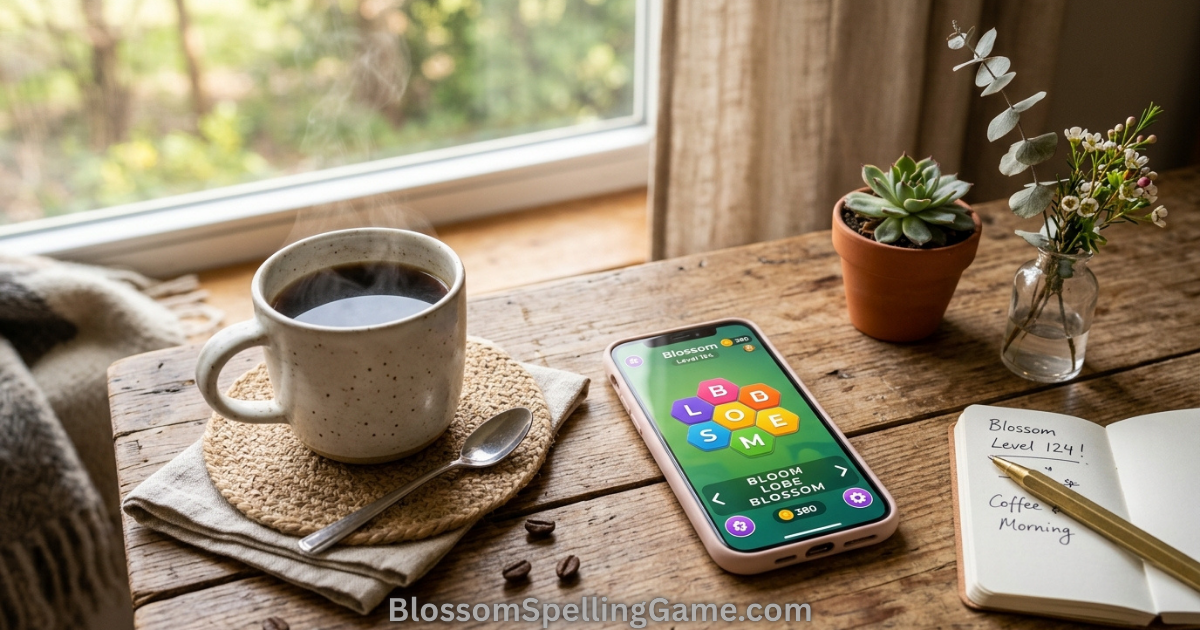
How to build a lasting Daily Habit With Blossom Word Game — habit stacking, implementation intentions, environment design, identity framing, and the never-miss-twice rule.
You’ve started the Blossom habit before. Maybe several times. The first week is easy — the game is new, the novelty carries you. Then life gets busy, you miss a day, you miss another, and suddenly you haven’t played in two weeks.
This isn’t a willpower problem. It’s a habit design problem.
The difference between people who maintain a daily Blossom habit for years and people who repeatedly start and stop isn’t self-discipline — it’s architecture. The consistent players have built their Blossom session into the structure of their day in ways that make playing the default rather than the decision. The inconsistent players rely on motivation and intention, which are finite resources that run out.
This guide covers the behavioral science of building a lasting Blossom habit: habit stacking, implementation intentions, environment design, identity framing, and the specific recovery protocols that keep a habit alive after the inevitable missed days. None of this is willpower-dependent. It’s structural — and structure outlasts motivation every time.
Why Motivation Fails and Structure Works
Here’s the most important thing to understand before building any habit: motivation is a feeling, not a system. Feelings fluctuate. Systems don’t.
On the days when you want to play Blossom — when you’re curious, rested, and feeling good — you don’t need a habit system. The desire itself is enough. The habit system is for every other day: the tired Tuesdays, the overloaded Thursdays, the days when every minute is spoken for and playing a word game feels like a luxury you can’t afford.
Most people build habits backward. They rely on motivation when it’s available and skip when it isn’t. The result is inconsistency that feels like a character flaw (“I just can’t stick with things”) when it’s actually just a design flaw (“I haven’t structured the habit to survive low-motivation days”).
The behavioral science on habit formation is unambiguous: habits that survive belong to people who’ve reduced the friction of doing them, attached them to reliable anchors, and pre-made the decision about when and where before motivation is required. The content of the habit (Blossom, running, meditation) matters less than the structural engineering around it.
The four components of a durable habit:
- A reliable cue (what triggers it)
- A friction-reduced path (how easy is it to start)
- A satisfying reward (what makes it worth returning to)
- An identity that supports it (who you believe yourself to be)
Each section of this article addresses one or more of these components. The most durable Blossom habits engage all four.
Habit Stacking: Attaching Blossom to What You Already Do
Habit stacking is one of the most reliably effective habit-formation techniques identified by behavioral researchers — and it’s the single most practical starting point for building a Blossom habit.
What habit stacking is:
Coined by BJ Fogg and popularized through James Clear’s work on habit formation, habit stacking means linking a new habit to an existing, automatic behavior. The existing habit serves as the cue — when it happens, the new habit follows.
The formula: After [CURRENT HABIT], I will [NEW HABIT].
Why it works:
Existing habits are deeply encoded neural pathways. They don’t require decisions or motivation — they just happen. By attaching a new behavior to an existing automatic one, you borrow the reliability of the established pathway and gradually transfer some of that automaticity to the new behavior.
The best Blossom anchor habits:
Morning coffee: “After I pour my first cup of coffee, I will open Blossom.” Coffee is a near-universal daily anchor — consistent timing, consistent location, brief pause between action and consumption that creates a natural play window. Morning coffee is the most commonly reported successful anchor for daily word game habits.
Commute start: “After I sit down on the train/bus, I will open Blossom.” The transition moment of starting a commute is already a habitual cue for phone use — redirecting that phone-reach toward Blossom requires minimal friction.
Lunch break start: “After I sit down for lunch, I will play Blossom before eating.” The lunch anchor works well for players who prefer mid-day cognitive engagement and find morning play too rushed.
Pre-bed wind-down: “After I get into bed but before I turn off the light, I will play Blossom.” Evening play benefits from the sleep consolidation effect (see our Cognitive Benefits guide) and pairs well with existing bedtime phone habits.
Choosing your anchor:
Pick the existing habit that is:
- Most consistent (happens every day, not just weekdays)
- Most stable (the same time, same location)
- Naturally followed by a 10-20 minute window of availability
Start with ONE anchor. Don’t try to build multiple Blossom sessions into different anchors simultaneously — one reliable session beats three unreliable ones.
Implementation Intentions: The If-Then Framework
Habit stacking tells you WHAT to attach your habit to. Implementation intentions tell you HOW to specify that attachment so precisely that no decision is required when the moment arrives.
What implementation intentions are:
Research by psychologist Peter Gollwitzer found that people who form specific “if-then” plans for new behaviors are significantly more likely to follow through than people who set general intentions. The difference isn’t motivation — it’s specificity.
A general intention: “I want to play Blossom daily.” An implementation intention: “When I sit down at my desk with my morning coffee on weekdays, I will open BlossomSpellingGame.com before checking email.”
The implementation intention specifies WHEN (sit down at my desk), WHERE (with my morning coffee), and WHAT (open BlossomSpellingGame.com, before checking email). This specificity eliminates the decision point — when the conditions are met, the behavior follows automatically, without the cost of deliberation.
Building your Blossom implementation intention:
Complete this template with specifics that reflect your actual daily routine:
“When I [specific trigger action], in [specific location], I will [exact first action for Blossom].”
Examples:
- “When I sit down with my coffee in the kitchen each morning, I will tap the Blossom bookmark before opening any social media.”
- “When I sit on the subway heading to work, I will open the Blossom app after I put in my headphones.”
- “When I get into bed each night after brushing my teeth, I will open BlossomSpellingGame.com before any other phone activity.”
The specificity premium:
Every vague word in your implementation intention is a decision you’ll have to make when motivation is low. “When I have some free time in the morning” is a vague trigger — “free time” requires a judgment call each day. “When I sit down with my coffee” is automatic — sitting down with coffee is an observable, unambiguous event.
Write your implementation intention down. Say it aloud a few times. The act of explicit verbal commitment strengthens the neural pathway between cue and action before the behavior has even begun.
Environment Design: Making Blossom the Path of Least Resistance
Every second of friction between intention and action increases the probability of not following through. Environment design is the practice of eliminating that friction before it arises.
The friction principle:
Behavioral economists and habit researchers have documented that small increases in friction (an extra click, an extra step, having to remember a URL) produce disproportionate decreases in behavior. Conversely, small friction reductions produce disproportionate increases in behavior.
Applied to Blossom: if opening the game requires finding the website in your bookmarks, navigating there, loading the page, and then waiting for the puzzle to appear — that’s four friction points, each of which creates a small opportunity to get distracted. If opening the game requires tapping a home screen icon that loads directly into today’s puzzle — that’s one friction point.
Friction reduction techniques for Blossom:
Home screen icon (mobile): Add BlossomSpellingGame.com to your phone’s home screen as a web app shortcut. On iOS: open the site in Safari → Share → Add to Home Screen. On Android: open in Chrome → menu → Add to Home Screen. This creates a native-app-like experience with one tap to today’s puzzle.
Pinned browser tab (desktop): Pin the BlossomSpellingGame.com tab in your browser so it’s always open and first in your tab row. Playing from a pinned tab requires zero navigation — the puzzle is already there when you open the browser.
Browser bookmark in toolbar: If pinned tabs aren’t your preference, add BlossomSpellingGame.com as a one-click toolbar bookmark. One click from any browser state to today’s puzzle.
Pre-load before bed: If you play in the morning, load BlossomSpellingGame.com in a browser tab the night before. The puzzle will be there when you open your device in the morning — zero navigation required.
Notification setup: Enable streak reminder notifications if your platform supports them. The notification itself is a friction reducer — it brings the cue to you rather than requiring you to remember.
Increasing friction for competing behaviors:
Equally important to reducing Blossom’s friction is increasing the friction of the behaviors that compete with it. Social media scrolling in the morning is a common Blossom-competitor. Moving social media apps to a secondary screen (one swipe further), requiring a PIN to open them, or using a blocking app during your designated Blossom window all increase friction for the competition without requiring willpower.
The goal of environment design is a morning routine where opening Blossom is easier than any alternative — not because you’re disciplined, but because you’ve engineered the environment to make it so.
Identity-Based Habit Formation
This is the deepest habit formation lever available — and the one most people overlook entirely.
The identity vs. outcome distinction:
Most people approach habits from an outcome perspective: “I want to play Blossom daily” (the desired outcome). James Clear’s influential work on habit formation identifies a more durable foundation: identity. “I am someone who does a daily word puzzle” (the desired identity).
The difference sounds subtle but produces different behavior in friction moments. When you miss a day, the outcome-based framer thinks “I failed to play today.” The identity-based framer thinks “That’s not like me — I’m someone who plays daily.” The identity framing naturally generates recovery behavior; the outcome framing often generates the giving-up spiral.
Building a Blossom identity:
Identity is built through evidence — small actions that “vote” for the identity you want to hold. Each day you play Blossom is a vote for the identity “I am someone who maintains a daily word game habit.” Each completed post-session archive review is a vote for “I am someone who takes vocabulary seriously.” The identity emerges from the accumulated evidence of consistent small actions, not from a dramatic declaration.
The language shift:
Try shifting from “I’m trying to play Blossom daily” to “I’m a daily Blossom player.” The second phrasing describes an identity, not an aspiration. Notice how the second framing makes skipping feel inconsistent with who you are, rather than just inconsistent with what you want.
This isn’t self-deception — it’s self-construction. Identity isn’t fixed; it’s built through behavior. You become a daily Blossom player by playing daily, and you play daily more reliably when you consider yourself to already be that person.
Connecting Blossom to a broader identity:
The most durable habits connect to a broader identity that the person genuinely values. “I am someone who keeps their mind active.” “I am someone who takes language seriously.” “I am someone who maintains consistent daily practices.” Blossom becomes one expression of a broader identity — which means missing it feels like a violation of something larger than just today’s game.
The Two-Minute Rule Applied to Blossom
What it is:
When starting a new habit, make the first version of it take two minutes or less. Not because two minutes is the goal — but because starting is the hardest part, and making starting trivially easy removes the most significant barrier.
The two-minute version of Blossom: open the game, find one valid word, close it. Done.
This sounds absurdly minimal. It is. That’s the point.
Why it works:
The two-minute rule exploits a fundamental property of habit formation: getting started is far harder than continuing. Once you’ve opened Blossom and found one word, you’re already engaged. The psychological cost of finding a second word is near zero. The third word costs even less. Most “two-minute” Blossom sessions become full sessions — not because you forced yourself, but because starting broke the inertia.
On genuinely impossible days — when you truly have only two minutes — the two-minute version still counts. One word keeps your streak. One word counts as having played. One word is enough to maintain the habit chain.
Scaling up from two minutes:
Once the two-minute trigger is automatic (typically 2-4 weeks of daily execution), the habit naturally expands. You’re not deciding each day whether to play — you’re deciding how long to play. That’s a fundamentally easier decision, and it almost always resolves toward longer sessions than the minimum.
The “just start” protocol:
On any low-motivation day, commit only to opening the game. Not to finding words, not to scoring well, not to finding the pangram. Just to opening it. The two-minute rule in practice: lower the commitment threshold until it feels impossible to refuse. “I will just open Blossom” — that’s all. What happens after opening is rarely nothing.
Defining Your Minimum Viable Session
Related to the two-minute rule but distinct: defining exactly what counts as “completing” your daily Blossom habit prevents the all-or-nothing thinking that breaks habits.
The all-or-nothing trap:
Many players define their Blossom session mentally as “find the pangram” or “reach 100 points” or “play until the puzzle is solved.” When life prevents a full session, this definition means the habit is either perfectly executed or not done — and “not done” often becomes “not done again” the next day.
Defining minimum viable completion:
Set a clear, achievable minimum that counts as “I played today”:
- One valid word submitted (streak-protecting, two-minute tier)
- Five words submitted (brief session tier)
- Ten minutes played regardless of word count (time-based tier)
The minimum defines what “done” means on hard days. Above the minimum, everything is bonus — more words, more time, finding the pangram. But the habit is complete at the minimum, and tomorrow starts fresh.
The psychological benefit:
When your minimum viable session is “one valid word,” there are essentially no days when playing is impossible. Traveling without wifi? Most hotels have wifi. Working a 12-hour day? You can find 60 seconds. Sick with a fever? The two-minute version exists.
This doesn’t mean settling for one-word sessions most days. It means building a habit that has no legitimate excuse for failure on most days — and that distinction is what separates 30-day habits from 300-day habits.
Temptation Bundling: Pairing Blossom With Something You Love
What temptation bundling is:
Research by behavioral economist Katherine Milkman found that people maintain habits more reliably when they bundle them with immediately enjoyable activities — a concept she calls “temptation bundling.” The enjoyable activity (the temptation) is only permitted during the habit (the virtuous behavior).
Why it works for Blossom:
Blossom is already intrinsically enjoyable for most players — but adding an additional layer of immediate pleasure strengthens the habit’s reward signal and creates a positive association with the trigger context.
Blossom temptation bundle examples:
The coffee bundle: Blossom only during the first cup of coffee. The coffee ritual becomes the reward context for the word game habit. Neither happens without the other — which means when you want coffee in the morning, you’ve also created the Blossom occasion.
The music bundle: A specific playlist that only plays during Blossom sessions. The playlist becomes the Pavlovian trigger — hearing those songs creates an automatic Blossom state.
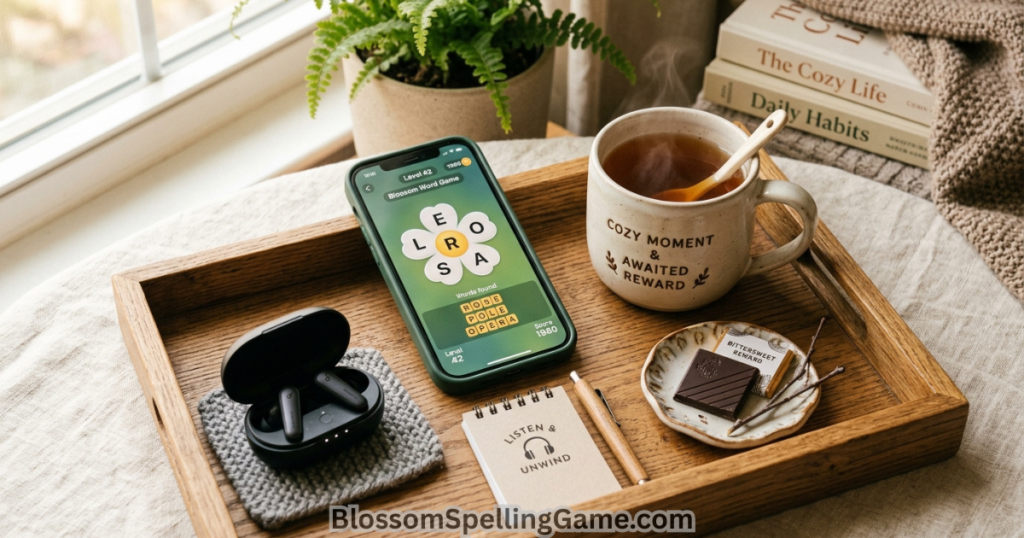
The treat bundle: A small daily treat (a particular tea, a piece of chocolate, a special snack) that’s only permitted during a Blossom session. The treat becomes the immediate reward for starting.
The podcast buffer bundle: Saving one episode of a favorite podcast for the commute immediately after the morning Blossom session. The anticipation of the podcast is the reward for completing the word game.
The key constraint:
For temptation bundling to work, the temptation must be genuinely restricted to the habit context. If you drink coffee and scroll Instagram anyway, the coffee-Blossom bundle loses its motivational force. The mild restriction is what creates the motivational pull.
The Never-Miss-Twice Rule
Missing a day is not a habit failure. Missing two days in a row is the beginning of a pattern. This distinction — captured in the “never miss twice” principle — is one of the most practically important habit maintenance tools available.
Why one miss doesn’t matter:
Habits are built through accumulated repetitions over time, not through perfect streaks. Habit research consistently shows that a single missed day has negligible impact on long-term habit strength when it’s followed immediately by resumption. The miss is noise; the response to the miss is the signal.
Why two consecutive misses create a new pattern:
Two consecutive misses begin to establish an alternative pattern: not playing. The neural pathways for “play Blossom today” weaken with each additional day of non-play, while the alternative pattern (“don’t play today”) begins to accumulate its own associative strength. Two misses starts a competing habit.
Applying never-miss-twice in practice:
The moment you recognize you missed yesterday, make tomorrow’s session non-negotiable — regardless of the circumstances. Not a full session necessarily, not a great score, not finding the pangram. Just resumption. The minimum viable session, done without negotiation.
This applies even when the reason for the miss was completely beyond your control. The cognitive mechanism that weakens habits doesn’t distinguish between “missed because of a genuine emergency” and “missed because of low motivation.” In both cases, consecutive non-play days weaken the habit pathway. In both cases, immediate resumption is the response.
The self-compassion component:
Never-miss-twice works best when the missed day is treated as genuinely neutral — not as evidence of character weakness, not as a reason for self-criticism. Self-criticism after a missed day often produces avoidance (not wanting to face the shame of returning) rather than resumption. Treat the miss as weather: it happened, now it’s passed, time to play.
Bright Spots Analysis: Learning From Your Best Days
Most habit-building advice focuses on failure analysis — why did you miss, what went wrong, how to prevent it. Bright spots analysis does the opposite: it examines your most successful days to identify what made showing up easy, and then replicates those conditions.
How bright spots analysis works:
Think back to the last 30 days of playing Blossom. Identify the 5-7 days when playing felt effortless — when you opened the game without any internal resistance, played a full session, and felt genuinely satisfied. Now ask: what was different about those days?
Common patterns from bright spots analysis:
Timing pattern: Maybe you consistently play well after an outdoor walk or immediately after eating breakfast, not before. The timing that feels effortless deserves to be your default, even if your implementation intention targets a different time.
Location pattern: Maybe you play best in a specific chair, at a specific table, in a specific room. Physical environment affects cognitive state in ways that are difficult to override — moving your Blossom habit to the location where it’s naturally strongest produces better results than willpower-forcing it in a suboptimal location.
Prior activity pattern: Maybe you play Blossom most readily after exercise, or after reading, or after a specific type of work. The cognitive state created by prior activities affects habit execution.
Device pattern: Some players find mobile play more natural; others find desktop play more engaged. If your bright spots cluster around one device, lean into that even if the other seems more convenient.
Using what you find:
Bright spots analysis produces individual insights that no general guide can anticipate. The conditions that make your Blossom habit effortless are personal. Once you identify them, restructure your implementation intention around those conditions rather than around what habit guides say should work.
Habit Tracking Systems That Actually Work
The act of tracking a habit produces a behavioral change beyond what the tracking itself achieves. This is documented consistently in habit research: measurement creates motivation.
Why tracking works:
When you mark a habit as completed on a tracker — whether that’s a calendar checkmark, an app notification, or a physical tally — you create a visual record of your consistency. That visual record becomes motivating in two ways: the streak of completed days creates momentum (“I don’t want to break the chain”), and the pattern of missed days creates diagnostic information (“I miss every Thursday — what happens on Thursdays?”).
Simple tracking systems for Blossom:
Paper calendar: Print a monthly calendar, hang it near your phone or desk, and mark each day you play with a checkmark or X. The physical act of marking is satisfying in itself — B.J. Fogg calls this “celebration,” and it’s an underappreciated component of habit formation.
Habit tracking app: Apps like Streaks (iOS), Loop Habit Tracker (Android), or Habitica allow you to log Blossom as a daily habit and track completion. Many players find the built-in streak counter sufficient once they have a BlossomSpellingGame.com account (which tracks playing streaks automatically).
The “don’t break the chain” method: Made famous by comedian Jerry Seinfeld’s practice of marking every day he wrote jokes with a red X on a wall calendar. The unbroken chain of X’s becomes a motivator in itself. The instruction is simply: “don’t break the chain.”
What to track:
At minimum: did you play today (yes/no). Optionally: score, words found, whether the pangram was found. More data gives you better bright spots analysis material, but more data also adds friction. Start with yes/no and add complexity only if it feels motivating rather than burdensome.
Social Commitment Devices
Social commitment — making your habit visible to others in a way that creates accountability — is one of the most potent habit reinforcement tools available. It’s also one of the most underused.
Why social commitment works:
Humans are deeply social creatures whose behavior is significantly influenced by how their actions appear to others. Making a private habit public creates a layer of accountability that purely internal motivation doesn’t generate. This isn’t weakness — it’s using social psychology as a structural tool.
Blossom-specific social commitment options:
The daily share: Use Blossom’s share score feature consistently and share your result to one or more social channels daily. The mild social expectation created by consistent sharing becomes motivating — you play partly because your network has come to expect the daily share.
The accountability partner: Identify one other person who plays (or might play) Blossom and establish a daily share ritual with them. Even a simple “played today, found the pangram” text to one friend creates the social accountability structure.
The group chat: Family groups, friend groups, or coworker groups where daily word game sharing is a norm create ambient social commitment. Multiple people playing the same puzzle creates comparison motivation and shared vocabulary experiences.
The public commitment: Announcing your Blossom habit publicly — “I’m starting a daily Blossom habit” — creates reputational commitment. The mild desire not to appear inconsistent in front of the people who heard your announcement drives consistency on low-motivation days.
The asymmetry of social commitment:
Social commitment works asymmetrically — the cost of breaking a public commitment is significantly higher than the cost of breaking a private one. This asymmetry is the source of its power. Use it deliberately rather than accidentally.
Building the Plateau-Proof Habit
One of the most common reasons daily Blossom habits collapse is the skill plateau: after 6-12 months of daily play, vocabulary growth slows, scores level off, and the game feels less rewarding because it feels less educational. If the habit’s primary motivation was improvement, plateau = reason to stop.
Designing beyond the plateau:
The most durable Blossom habits are built on motivations that don’t plateau:
Process enjoyment: The immediate pleasure of the flow state during a session doesn’t diminish with skill — if anything, it deepens as you get better at entering flow quickly. Players who enjoy the process of word-finding (independent of score outcomes) maintain habits much longer than players who are primarily score-motivated.
Daily ritual value: The value of the session as a morning ritual — a brief, focused mental engagement before the day’s demands begin — doesn’t diminish with skill level. The session’s role in your morning is independent of vocabulary improvement.
Social ritual value: If your Blossom habit is tied to a social ritual (comparing results with a partner or group), the social dimension maintains value even when personal skill growth has plateaued.
Expanding the scope: At the plateau, the habit can expand rather than stagnate. Archive review, post-session vocabulary study, trying new game types from our Best Daily Word Games guide alongside Blossom — all of these extend the value delivered by the daily session without requiring score improvement.
Designing for the plateau from the start:
The most durable habit designs anticipate the plateau and build in plateau-surviving value from day one. Don’t make score improvement the primary motivation for your habit — make it a secondary benefit. Primary motivations should be things that never plateau: the process, the ritual, the social dimension, the mental engagement.
The Blossom Habit Ecosystem
The most sophisticated habit design treats Blossom not as a standalone daily task but as the anchor of a small ecosystem of related habits — each of which supports the others and makes the whole more durable than any single habit would be alone.
The core Blossom habit: Daily play session (10-20 minutes).
Supporting habits that strengthen the core:
Post-session archive review (5 minutes): Reviewing missed words from yesterday’s puzzle via the archive builds vocabulary more effectively than play alone and creates a satisfying ritual endpoint for the session. Covered in our Archive Guide.
Word bank maintenance (2 minutes, weekly): Adding interesting words encountered in Blossom to a running personal vocabulary note. This small weekly habit creates tangible evidence of vocabulary growth and provides motivational reinforcement for the core habit.
Score journaling (1 minute): A simple daily log of score and whether the pangram was found. Provides the data for bright spots analysis and cross-session tracking. Thirty seconds of writing per day.
These supporting habits are optional but powerful because:
- They increase the total value delivered by each session (more vocabulary learning, more improvement)
- They create additional completion moments (each supporting habit is a small win that reinforces the overall ecosystem)
- They make the overall habit more valuable over time — the ecosystem compounds in ways the core habit alone doesn’t
The ecosystem design principle:
Build the core habit first. Stabilize it (2-4 weeks of consistent execution). Then add ONE supporting habit. Stabilize that. Then add another if it feels natural. An ecosystem that grew organically over months is far more stable than one designed from scratch and started all at once.
FAQ
How long does it take to build a Blossom daily habit?
Research on habit formation suggests that simple daily behaviors become automatic in roughly 21-66 days, with the median closer to 66 days for habits that require any cognitive engagement. For Blossom specifically — which involves active cognitive work — expect 4-8 weeks before playing feels genuinely automatic rather than deliberate. The first two weeks are the most fragile; design your environment and implementation intentions carefully for that period.
What’s the best time of day to play Blossom for habit formation?
The best time is the one that’s most consistent and connects to the most reliable anchor in your existing routine. For most people this is morning — specifically tied to the morning coffee or breakfast routine. Morning habits benefit from the cognitive freshness that supports word retrieval and from occurring before the day’s demands have depleted willpower and schedule flexibility. That said, a reliable evening habit beats an unreliable morning habit every time.
What should I do if I keep forgetting to play?
Forgetting is an environment design problem, not a motivation problem. Solutions: pin BlossomSpellingGame.com as a permanent browser tab, add it to your phone’s home screen, enable streak reminder notifications, and specify a more precise implementation intention (not “sometime in the morning” but “when I sit down with coffee in the kitchen”). Each of these reduces the cognitive demand of remembering to play.
How do I restart a Blossom habit after breaking it for several weeks?
Use a temporal landmark: start on a Monday, the first of the month, or a personally meaningful date. Research on the “fresh start effect” shows that temporal landmarks — moments that feel like new beginnings — increase the probability of habit initiation and reinstatement. Then apply the two-minute rule and never-miss-twice principle for the first two weeks to stabilize the restart.
Should I use the Blossom streak as my habit tracker?
The built-in streak is a useful tool but has a limitation: the streak requires an account and is binary (played/didn’t play). For deeper habit tracking — including time played, score trends, and the bright spots analysis data — maintain a separate simple log. The streak is a maintenance tool; a personal log is an improvement tool.
How do I keep Blossom interesting after months of daily play?
Several approaches: add the post-session archive review habit (creates a new learning loop), occasionally use a different device or location (breaks staleness through environmental novelty), add another daily word game from our Best Daily Word Games guide as a companion habit, or set a new skill-focused goal (find the pangram in the first 5 minutes for 30 days).
What if I don’t have 15-20 minutes daily?
Use the minimum viable session approach: define what counts as “played today” at the two-minute level (one valid word submitted) and commit only to that minimum on constrained days. The habit is maintained at minimum; the full session is the version you play when time allows. A 90-second minimum session every day beats a 20-minute session twice a week for habit formation purposes.
Final Thoughts
The daily Blossom habit you want isn’t built through motivation and discipline. It’s built through architecture.
A reliable anchor habit. A specific implementation intention. An environment designed to make starting effortless. An identity that treats playing as part of who you are. A minimum viable session that removes all legitimate excuses. A recovery protocol for missed days that prevents the two-miss spiral.
These are structural tools. They work on the days when you don’t feel like playing, when the puzzle looks hard before you’ve started, when fourteen other things are competing for the same ten minutes. Motivation runs out; structure doesn’t.
Build the structure this week. Write your implementation intention down — the specific if-then plan for when and where you’ll play. Add BlossomSpellingGame.com to your phone’s home screen or pin the tab in your browser. Identify your anchor habit. Define your minimum viable session.
You don’t need to start perfectly. You need to start, and then to keep starting — one day at a time, with a structure that makes starting the default.
Today’s puzzle at BlossomSpellingGame.com is already loaded. The seven letters are fresh. Your anchor habit is waiting.