
Learn exactly how to use suffixes in Blossom Word Game to find more words and score higher — complete suffix taxonomy, scoring math, and a 60-second drill framework.
You already know suffixes help in Blossom. Every guide mentions it. “Try -ING, -ED, -ER.” You’ve been doing this for weeks and it helps — but only so far.
Here’s the gap between knowing that suffixes work and actually using them systematically: most players apply suffix thinking reactively. They find a word, then ask “can I extend it?” They notice -ING in passing, try a couple of verb forms, move on.
Systematic suffix thinking works the other way. You assess your letter set’s suffix potential before you start finding words, map which suffix families are available, and then mine each one deliberately — turning a single root word into a cluster of three, four, sometimes five valid submissions.
The difference in word count is significant. Players who scan for suffixes reactively find one or two suffix extensions per session. Players who run a systematic suffix analysis at the start find four to eight. On a 12-slot budget, that gap is the entire difference between a good session and a great one.
This guide gives you the complete suffix toolkit for Blossom: the full taxonomy organized by type, the scoring math for each suffix category, a letter availability screening method, the rare suffixes most players ignore, and a 60-second suffix drill you can run at the start of every session.
Why Suffixes Matter More in Blossom Than Other Word Games
Suffixes are valuable in any word game — but Blossom’s specific mechanics make them disproportionately powerful in ways other games don’t reward equally.
The scoring cliff at 5 letters. Blossom’s scoring jumps dramatically at the 5-letter mark: 4-letter words earn 1 point, 5-letter words earn 5 — a 5x increase for one additional letter. Almost every common suffix adds at least one letter to a root word. -ED turns a 4-letter root into a 5-letter word and multiplies its point value by five in one move. -ING turns a 4-letter root into a 7-letter word worth 12 points. The suffix is doing the scoring work. For the full scoring breakdown, see our Blossom Scoring Guide.
The 12-slot budget. Because you have a fixed number of submissions, every word needs to earn its slot. A suffix-extended word earns more points per slot than its base form. Finding BRIGHT is worth 6 points. Finding BRIGHTER is worth 8, BRIGHTEST is worth 9, BRIGHTLY is worth 8. Four words, one root — and each one earns more than the base. Suffix awareness converts one discovery into four slot-worthy submissions.
The center letter constraint. Many suffixes contain letters that commonly serve as center letters in Blossom puzzles — E, R, S, T, N, L. When your center letter is one of the letters in a common suffix, that suffix becomes available across almost every root word in your vocabulary. An E center letter means -ER, -ED, -EST, -NESS, -MENT, -ABLE, -LESS, -FUL all become viable — not just for one root, but for any verb or adjective your other letters can form.
No penalty for exploration. In Blossom, you lose nothing by submitting a word that gets rejected — rejected submissions don’t cost a slot. This means testing suffix variants is essentially free. Every plausible suffix extension costs you nothing to try and potentially earns you points if it works.
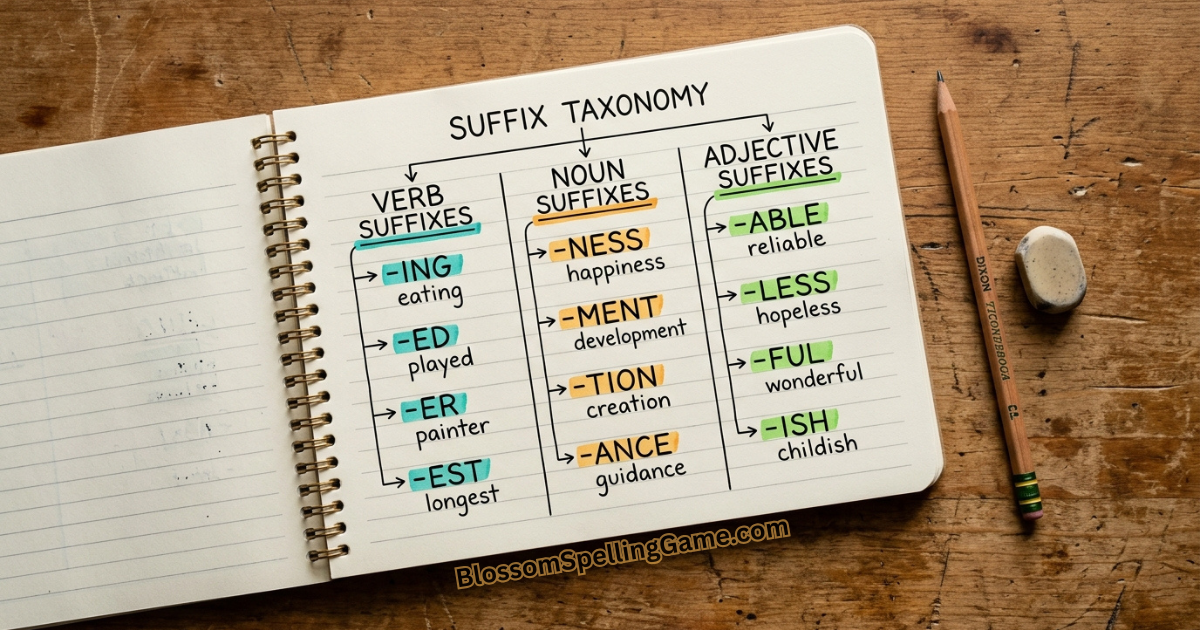
The Complete Blossom Suffix Taxonomy
Here’s the full working taxonomy of suffixes organized by what part of speech they create. Knowing the category matters because different root types take different suffixes.
Verb Suffixes — The Highest Yield Category
Verb suffixes are the most productive suffix category in Blossom because English has more verbs than any other word class, and verbs take more suffix forms than nouns or adjectives.
-ING (present participle / gerund) Letters required: I, N, G | Point addition: +3 letters minimum (PLAY to PLAYING: 4 to 7 letters, 1 to 12 pts) The single most valuable suffix in Blossom. Works on virtually every verb root. A 4-letter verb root + ING = a 7-letter word that may qualify as a pangram. Always check -ING on every verb you find.
-ED (simple past / past participle) Letters required: E, D | Point addition: +2 letters (PLANT to PLANTED: 5 to 7 letters, 5 to 12 pts) Works on most regular verbs. Irregular past tenses (RAN, SANG, SWAM) don’t use -ED. Watch for: verbs ending in -E take just -D: BAKE to BAKED, HIKE to HIKED.
-S / -ES (third person singular present) Letters required: S | Point addition: +1 letter Bridges the critical 4 to 5 letter scoring cliff. WALK to WALKS: 1 point becomes 5 points for the price of an S. If S is in your letter set, test it on every verb.
-ER (comparative / agent noun) Letters required: E, R | Point addition: +2 letters Doubles as both comparative adjective suffix (BRIGHT to BRIGHTER) and agent noun (TEACH to TEACHER). Both interpretations produce valid Blossom words.
-EST (superlative) Letters required: E, S, T | Point addition: +3 letters Always test when E, S, T are all present. BRIGHT to BRIGHTEST adds 3 letters and significant points.
-EN (causative verb form) Letters required: E, N | Point addition: +2 letters Creates verbs from adjectives: BRIGHT to BRIGHTEN, DARK to DARKEN, SOFT to SOFTEN, TIGHT to TIGHTEN. An often-forgotten suffix family that produces valid, scorable words from adjective roots.
Noun Suffixes — Length and Points
Noun suffixes tend to produce longer words, making them particularly valuable for points even though they apply to a smaller category of roots.
-NESS Letters required: N, E, S | Point addition: +4 letters (DARK to DARKNESS: 4 to 8 letters, 1 to 15 pts) One of the highest point-adders in the suffix toolkit. Turns almost any adjective into a noun: BRIGHT to BRIGHTNESS, CLEAR to CLEARNESS, DARK to DARKNESS, SOFT to SOFTNESS.
-MENT Letters required: M, E, N, T | Point addition: +4 letters (MOVE to MOVEMENT: 4 to 8 letters) When M is in your letter set alongside E, N, T, actively look for verb roots. GOVERN to GOVERNMENT, MOVE to MOVEMENT, TREAT to TREATMENT.
-TION / -SION Letters required: T, I, O, N (or S, I, O, N) | Point addition: +4 letters minimum When T, I, O, N are all present, test aggressively. DIRECT to DIRECTION (8 letters, 15 pts). The reverse approach — what words end in -TION given these letters? — is particularly productive here.
-ANCE / -ENCE Letters required: A or E, N, C, E | Point addition: +4 letters When C is in your set alongside vowels: ASSIST to ASSISTANCE, DIFFER to DIFFERENCE, IMPORT to IMPORTANCE.
-ITY Letters required: I, T, Y | Point addition: +3 letters Converts adjectives to abstract nouns: REAL to REALITY, ACTIVE to ACTIVITY. When I, T, Y are all present, scan your adjective candidates.
-SHIP Letters required: S, H, I, P | Point addition: +4 letters FRIEND to FRIENDSHIP, LEADER to LEADERSHIP, OWNER to OWNERSHIP.
-DOM Letters required: D, O, M | Point addition: +3 letters FREE to FREEDOM, BORE to BOREDOM, KING to KINGDOM, WISE to WISDOM.
Adjective Suffixes — The Underused Category
Adjective suffixes are systematically underused — players scan more naturally for nouns and verbs, making adjective suffix words a consistent source of overlooked submissions.
-ABLE / -IBLE Letters required: A, B, L, E or I, B, L, E | Point addition: +4 letters One of the most productive adjective suffixes. BREAK to BREAKABLE, READ to READABLE, FLEX to FLEXIBLE. When B and L are both present, test every verb root you’ve found.
-FUL Letters required: F, U, L | Point addition: +3 letters CARE to CAREFUL, GRACE to GRACEFUL, HELP to HELPFUL, POWER to POWERFUL.
-LESS Letters required: L, E, S | Point addition: +4 letters Pairs naturally with -FUL: CARE to CARELESS, HOPE to HOPELESS, HOME to HOMELESS, POWER to POWERLESS. After finding -FUL words, immediately check the -LESS partner.
-ISH Letters required: I, S, H | Point addition: +3 letters Underused but productive: CHILD to CHILDISH, FOOL to FOOLISH, GREEN to GREENISH, SELF to SELFISH. When I, S, H are present, specifically think about this suffix — it rarely comes to mind naturally.
-OUS / -IOUS / -EOUS Letters required: O, U, S | Point addition: +3 letters minimum FAME to FAMOUS, GLORY to GLORIOUS, GRACE to GRACIOUS.
-AL Letters required: A, L | Point addition: +2 letters High viability — A and L are common letters. MUSIC to MUSICAL, NATURE to NATURAL, LOGIC to LOGICAL, COAST to COASTAL.
Adverb Suffixes — Small but Stackable
-LY Letters required: L, Y | Point addition: +2 letters When L and Y are both present, every adjective in your vocabulary is potentially also an adverb: BRIGHT to BRIGHTLY, CLEAR to CLEARLY, FIRM to FIRMLY, SOFT to SOFTLY.
-WARD / -WARDS Letters required: W, A, R, D | Point addition: +4-5 letters When W is in your letter set — uncommon but worth flagging — look for directional words: NORTH to NORTHWARD, HOME to HOMEWARD.
Rare and Powerful Suffixes Most Players Miss
-SOME Letters required: S, O, M, E | Point addition: +4 letters AWE to AWESOME, TIRE to TIRESOME, HAND to HANDSOME, LONE to LONESOME, WHOLE to WHOLESOME. Players who remember this suffix are consistently finding words others miss.
-LING Letters required: L, I, N, G | Point addition: +4 letters Creates small-version or human nouns: DUCK to DUCKLING, STAR to STARLING, UNDER to UNDERLING, EARTH to EARTHLING.
-LET Letters required: L, E, T | Point addition: +3 letters Diminutive nouns: BOOK to BOOKLET, STAR to STARLET, PIG to PIGLET, DROP to DROPLET.
-FY / -IFY Letters required: F, Y or I, F, Y | Point addition: +2-3 letters SOLID to SOLIDIFY, SIMPLE to SIMPLIFY, GLORY to GLORIFY, TERROR to TERRIFY.
The Suffix Letter Availability Screen
Before hunting any suffix family, confirm all required letters are present in your 7-letter set. This screening takes ten seconds and prevents wasted effort.
Quick reference screen:
-ING: need I, N, G | -ED: need E, D | -ER: need E, R | -EST: need E, S, T -NESS: need N, E, S | -MENT: need M, E, N, T | -TION: need T, I, O, N -ABLE: need A, B, L, E | -FUL: need F, U, L | -LESS: need L, E, S -LY: need L, Y | -ISH: need I, S, H | -AL: need A, L -SOME: need S, O, M, E | -LING: need L, I, N, G
Cross off any suffix family whose letters aren’t fully present. What remains is your active suffix list.
Critical nuance: Your center letter counts. If E is your center letter and petals include I, N, G — -ING is available, because the E center can appear in the root of many -ING words. -ING words containing E in the root: SINGING, REELING, MEETING, FEELING.
Second nuance: Letters can be reused. If your center letter is N and petals include I and G, -ING is available — the N appears in the suffix AND potentially in the root (RUNNING uses N twice).
The Scoring Math: What Each Suffix Is Actually Worth
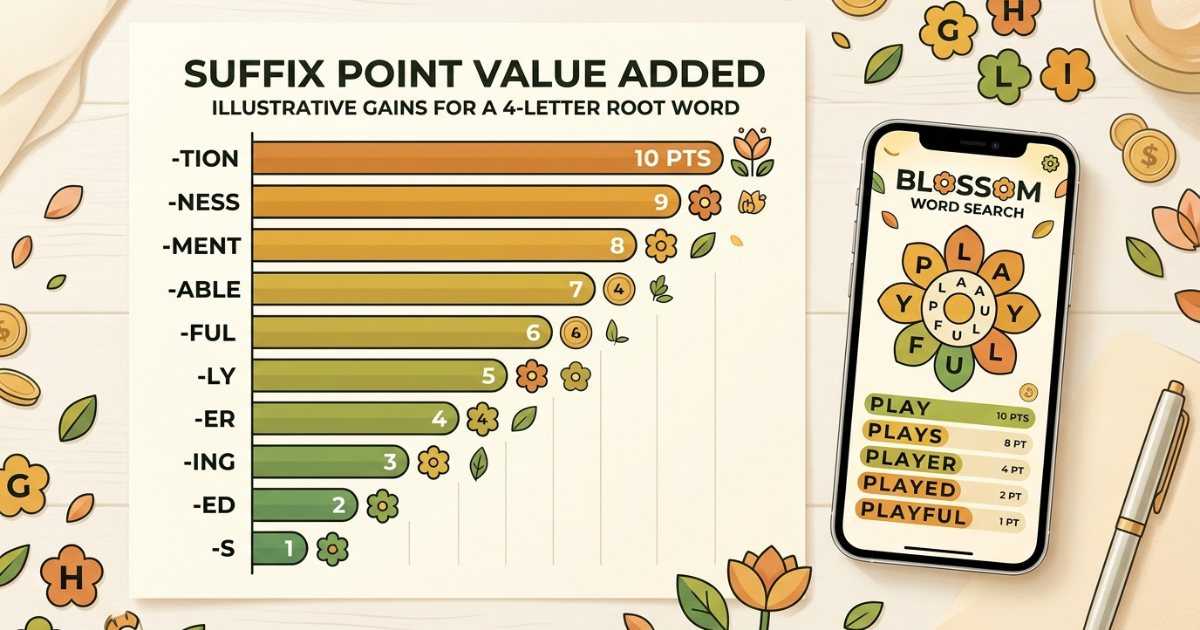
Here’s the quantified case for prioritizing specific suffixes — based on how many points each adds to its root word.
| Suffix | Letters Added | From 4-Letter Root | Extended Score | Points Added |
|---|---|---|---|---|
| -NESS | +4 | 1 pt (4 letters) | 15 pts (8 letters) | +14 pts |
| -MENT | +4 | 1 pt (4 letters) | 15 pts (8 letters) | +14 pts |
| -TION | +4 | 1 pt (4 letters) | 15 pts (8 letters) | +14 pts |
| -ABLE | +4 | 1 pt (4 letters) | 15 pts (8 letters) | +14 pts |
| -LESS | +4 | 1 pt (4 letters) | 15 pts (8 letters) | +14 pts |
| -SOME | +4 | 1 pt (4 letters) | 15 pts (8 letters) | +14 pts |
| -ING | +3 | 1 pt (4 letters) | 12 pts (7 letters) | +11 pts |
| -EST | +3 | 1 pt (4 letters) | 12 pts (7 letters) | +11 pts |
| -FUL | +3 | 1 pt (4 letters) | 12 pts (7 letters) | +11 pts |
| -ER | +2 | 1 pt (4 letters) | 6 pts (6 letters) | +5 pts |
| -ED | +2 | 1 pt (4 letters) | 6 pts (6 letters) | +5 pts |
| -AL | +2 | 1 pt (4 letters) | 6 pts (6 letters) | +5 pts |
| -S | +1 | 1 pt (4 letters) | 5 pts (5 letters) | +4 pts |
Key insight: -NESS, -MENT, -TION, -ABLE, -LESS, and -SOME all add 14 points to a 4-letter root word. These are the highest-yield suffixes in the game. When your letter set contains the letters for any of these, hunting them is the most efficient path to high-scoring words.
The -ING priority: Despite adding “only” 11 points, -ING has the highest viability rating of any suffix — it works on almost every verb. The combination of high point-add AND high applicability makes -ING the most productive suffix to hunt first in most sessions.
Suffix Stacking — Multiplying Your Output From One Root
Suffix stacking is applying multiple different suffixes to the same root word — turning one vocabulary discovery into a cluster of four, five, or six separate valid submissions.
Most players apply one suffix per root and move on. Systematic players apply every viable suffix before moving to a new root. The difference in word count from a single root is dramatic.
Example: ROOT = CARE, available suffixes include -ER, -ED, -LESS, -FUL, -ING, -S
CARES (5 pts), CARED (5 pts), CARER (5 pts), CARELESS (8 pts), CAREFUL (7 pts), CARING (6 pts) — six words, 36 combined points, from one root. CARE alone is worth 4 points.
The stacking rule: Never leave a root word after finding just one suffix form. Run the complete active suffix list before moving on.
Triple stacking — the compound suffix approach:
Some words accept two suffixes applied in sequence:
DARK to DARKEN (root + causative -EN) DARK to DARKENED (root + -EN + -ED) DARK to DARKENING (root + -EN + -ING) DARK to DARKER (root + comparative -ER) DARK to DARKEST (root + superlative -EST) DARK to DARKLY (root + adverb -LY, if L and Y available) DARK to DARKNESS (root + -NESS)
Seven words from DARK, if all letters are available. The compound suffix chain (DARKEN to DARKENED, DARKENING) is the most productive stacking technique and the one most players never think to apply.
Suffix Pairs: When Finding One Means Finding Another
Certain suffixes naturally travel together. When one produces a valid word, a partner suffix often does too.
The -FUL / -LESS pair: Almost every word that takes -FUL also takes -LESS. CARE to CAREFUL / CARELESS | HOPE to HOPEFUL / HOPELESS POWER to POWERFUL / POWERLESS | HELP to HELPFUL / HELPLESS
The -ER / -EST pair: Any adjective taking -ER comparative also takes -EST superlative. BRIGHT to BRIGHTER / BRIGHTEST | CLEAN to CLEANER / CLEANEST SHARP to SHARPER / SHARPEST | SMART to SMARTER / SMARTEST
The -ER / -ED / -ING verb trio: Regular verbs that accept one typically accept all three. WALK to WALKER / WALKED / WALKING PLAY to PLAYER / PLAYED / PLAYING
The -NESS / -LY pair: Many adjectives form both a -NESS noun and a -LY adverb. BRIGHT to BRIGHTNESS / BRIGHTLY | CLEAR to CLEARNESS / CLEARLY SOFT to SOFTNESS / SOFTLY | DARK to DARKNESS / DARKLY
The moment you successfully submit a suffix-extended word, immediately test its pair partner. This doubles your output with essentially zero additional cognitive effort.
The Irregular Suffix Trap — Forms That Break the Pattern
Suffix hunting has one consistent failure mode: applying regular patterns to irregular words.
The -ED irregular trap: RUN to RUNNED (wrong — correct form: RAN) SING to SINGED (wrong meaning — SINGED means slightly burned; SANG/SUNG are the past tenses) SWIM to SWIMMED (wrong — correct form: SWAM or SWUM)
The -E dropping rule: When a root ends in -E, drop the E before vowel-initial suffixes: BAKE to BAKING (not BAKEING) | HIKE to HIKED (not HIKEED) But retain E before consonant-initial suffixes: LOVE to LOVELY (not LOVLY)
The consonant doubling rule: Short vowel + single consonant roots double the consonant before vowel-initial suffixes: RUN to RUNNING (not RUNING) | STOP to STOPPING (not STOPING) SIT to SITTING (not SITING) | But SLEEP to SLEEPING (long vowel — no doubling)
The -Y to -I rule: Roots ending in -Y change to -I before most suffixes: HAPPY to HAPPIER (not HAPPYER) | CARRY to CARRIED (not CARRYED) HEAVY to HEAVINESS (not HEAVYNESS) Exception: -ING keeps -Y: CARRY to CARRYING (not CARRIING)
When a suffix extension gets rejected, immediately check whether you’re using the regularized form of an irregular word. Try the correct irregular form — it may be the valid submission.
Suffixes and the Bonus Petal Letter
Every submission containing the highlighted bonus petal letter earns +5 extra points. This creates a strategic suffix opportunity: when choosing which suffix-extended words to submit, prioritize ones containing the bonus letter.
Which suffixes contain common bonus petal letters:
E as bonus petal: -ED, -ER, -EST, -NESS, -LESS, -ABLE, -SOME, -MENT, -AL, -IBLE, -IVE all contain E — virtually every suffix extension earns the +5 bonus.
N as bonus petal: -ING, -EN, -NESS, -TION, -ANCE, -ENCE, -MENT all contain N.
S as bonus petal: -S, -EST, -NESS, -LESS, -ISH, -OUS all contain S.
L as bonus petal: -FUL, -LESS, -ABLE, -IBLE, -LING, -LY, -AL all contain L.
T as bonus petal: -EST, -MENT, -TION all contain T.
Strategic application: Before running your suffix drill, identify the bonus petal letter. Mark which active suffixes contain that letter — these get highest priority. When choosing between two equally valid suffix extensions, always submit the one containing the bonus petal letter first.
The 60-Second Suffix Drill for Every Session
Here’s the systematic suffix analysis framework to run at the start of every Blossom session — before submitting a single word. The entire drill takes under 60 seconds and typically surfaces 3–5 additional words.
Step 1: Identify your center letter (5 seconds) Fix it clearly in mind. It appears in every valid word — including every suffix-extended word.
Step 2: Run the letter availability screen (15 seconds) Check your seven letters against the suffix requirements. Mark every suffix family whose letters are fully present. This is your active suffix list.
Step 3: Identify high-priority suffix families (5 seconds) Flag the highest-scoring suffix families (those adding 4+ letters: -NESS, -MENT, -TION, -ABLE, -LESS, -SOME). Hunt these first.
Step 4: Check bonus petal letter (5 seconds) Identify the highlighted petal letter and mark which active suffixes contain it. These earn +5 per use — prioritize them.
Step 5: Generate root candidates (20 seconds) For each high-priority suffix, quickly generate 3–4 root word candidates from your letter set. Don’t evaluate yet — generate, then test.
Step 6: Apply to every root during play (ongoing) As you play, run each found word through the complete active suffix list before moving to the next root. Never leave a root after one suffix test.
Practical Examples: Suffix Thinking in Action
Example: Center = E, Petals = R, T, N, G, A, L
Letter availability screen: -ING: I missing — unavailable | -ED: D missing — unavailable -ER: E(center), R — AVAILABLE | -EST: S missing — unavailable -NESS: N, E(center), S missing — unavailable | -MENT: M missing — unavailable -TION: T, I missing — unavailable | -ABLE: B missing — unavailable -AL: A, L — AVAILABLE | -EN: E(center), N — AVAILABLE
Active suffix list: -ER, -AL, -EN (all add 2 letters)
Root candidates for -ER: RENT to RENTER, GRANT to GRANTER, LARGE to LARGER (needs R twice — R is in petals, can be reused; LARGER: L,A,R,G,E,R — valid if letters allow), GENTLE to GENTLER (G,E,N,T,L,E,R — needs E twice, R once; E is center, R is petal — GENTLER valid at 7 letters = 12 pts)
Root candidates for -AL: RENT to RENTAL (R,E,N,T,A,L — all present), NATURE to NATURAL (needs U — unavailable)
Root candidates for -EN: adjective roots — if LARGE is found, LARG+EN = LARGEN (not standard); TIGHT+EN = TIGHTEN (needs I — unavailable); FLAT+EN = FLATTEN (needs F — unavailable). Limited by the specific letter set.
Words found via suffix drill: RENTER, LARGER, GENTLER, RENTAL — four additional words from systematic suffix thinking before the session even began.
FAQ
What suffixes work best in Blossom Word Game?
-ING is the highest-yield suffix due to its extremely wide applicability across verb roots — it adds 3 letters and turns many 4-letter words into 7-letter high-scoring submissions. For raw point-adding, -NESS, -MENT, -TION, -ABLE, -LESS, and -SOME all add 4 letters and 14 points to a 4-letter root. The best suffix to hunt depends on which letters are available in your daily set.
How do I know which suffixes are available in today’s puzzle?
Run the letter availability screen: check whether all letters required for each suffix are present in your 7-letter set. For example, -ING requires I, N, G all present (or available via your center letter). Any suffix whose letter requirements can’t be met is unavailable that day.
Can I use the same suffix on multiple root words?
Yes — and you should. Apply your active suffix list to every root word you find. When -ER is available, test it on every verb and adjective root, not just the first one.
Why do some suffix-extended words get rejected?
Three common reasons: (1) The root + suffix combination doesn’t form a real word. (2) You’re using a regularized form of an irregular word (RUNNED instead of RAN). (3) The extended form isn’t in Merriam-Webster’s dictionary as a separate entry. For a complete guide to rejection reasons, see our Why Does Blossom Reject Real Words article.
Does adding -S to a word always make it valid?
For nouns (plurals) and verbs (third person singular), yes — if the plural is regular. For adjectives, -S typically doesn’t apply. Always test -S on nouns and verbs; skip it on pure adjectives.
How does suffix thinking help find the pangram?
Suffix extensions frequently push 6-letter words into 7-letter pangram territory. If a root word uses 4 of your 7 letters, adding a 3-letter suffix (-ING, -FUL, -EST) brings the total to 7 letters — potentially using all of them. After finding a 4-letter root, immediately check whether your remaining letters form a suffix that extends it to pangram length.
What is suffix stacking?
Suffix stacking is applying multiple different suffixes to the same root word — turning DARK into DARKER, DARKEST, DARKLY, DARKNESS, DARKEN, DARKENED, DARKENING. The compound suffix chain (applying two suffixes in sequence) is the most productive stacking technique.
Should I always prioritize the longest suffix available?
Not always. A longer suffix produces more points but requires more letters — limiting which roots it can apply to. A shorter suffix like -ER produces fewer points but applies to many more roots. Optimal strategy: hunt long-suffix extensions first on each root, then fall back to shorter extensions if the longer ones don’t produce valid words.
Final Thoughts
Suffixes aren’t a secret or an advanced technique. Every Blossom player knows they help. The difference between a player who occasionally benefits from suffix thinking and one who systematically extracts 4–8 additional words per session from suffixes is entirely in the methodology.
The taxonomy, the letter availability screen, the scoring math, the stacking approach, the suffix pairs — these aren’t new information about English grammar. They’re a structured workflow for applying what you already know systematically rather than reactively.
Run the 60-second drill at the start of your next session. Identify your active suffix list before you submit your first word. Apply the full list to every root you find before moving on. Track how many additional words you find compared to your previous sessions.
The word count difference will be immediately visible. The score difference follows directly from it.
Play today’s puzzle at BlossomSpellingGame.com and put the suffix drill into practice. Your active suffix list is waiting to be built from whatever seven letters appear in today’s flower.