
Blossom Word Game vs NYT Connections — two daily puzzles, two completely different brains. Here’s the honest comparison that actually tells you which one belongs in your routine.
Both games take about five minutes when you’re in the zone. Both reset every day. Both have that satisfying moment when the right answer suddenly snaps into place. And both will leave you genuinely stumped at least once a week in a way that Wordle, for all its charm, rarely does anymore.
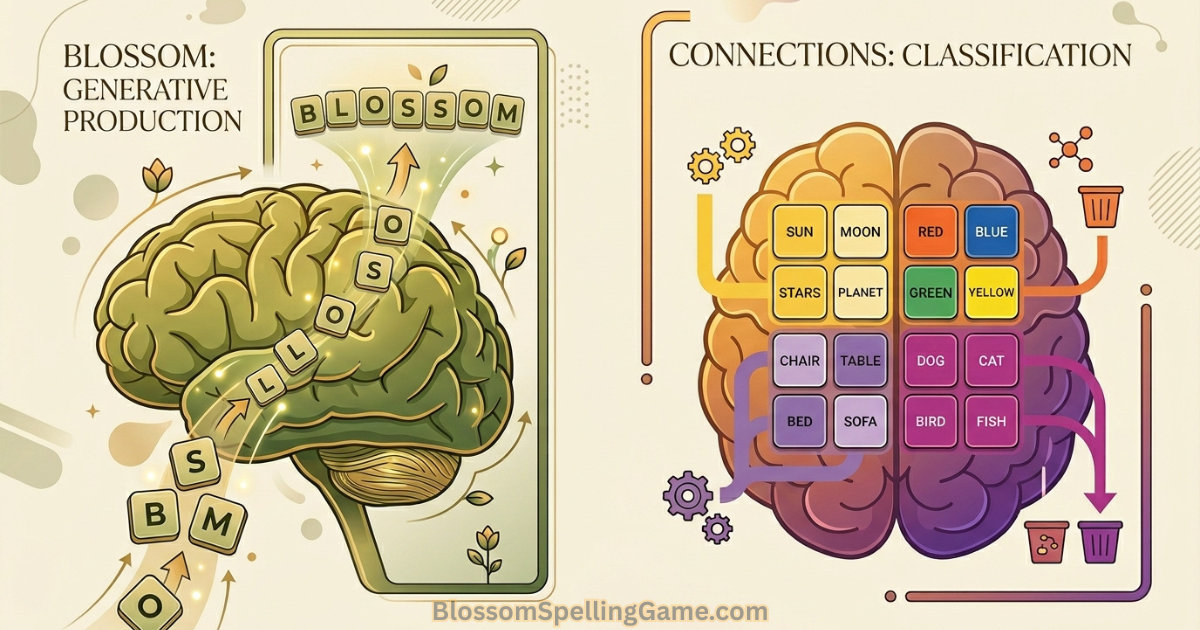
But here’s the thing: Blossom Word Game and NYT Connections are not solving the same puzzle. They’re not even exercising the same cognitive system. One asks your brain to produce — to generate words from raw material. The other asks your brain to classify — to find the hidden relationship between things that seem unrelated.
That distinction matters more than most comparison articles admit. Because the game you’ll stick with, the one that still feels fresh in week twelve, is almost always the one that matches how your particular brain enjoys thinking — not just the one everyone around you happens to be playing.
This guide goes deep on that distinction. Not just what each game is (you already know that), but what each game requires of you cognitively, where each one pushes your frustration tolerance, which one builds skills that transfer to real life, and — practically — how to decide which one belongs in your morning rotation, and whether you actually need to choose at all.
The Fundamental Difference: Production vs. Classification
⚡ Quick Answer: Blossom Word Game is a word production game — you generate valid words from seven constrained letters. NYT Connections is a word classification game — you group 16 given words into four hidden categories. Same daily puzzle format, same social-sharing culture, completely different cognitive operations. Which one you prefer usually comes down to whether you think more naturally in what can I make? or what do these have in common?
This production vs. classification distinction isn’t just an interesting observation — it predicts almost everything about how each game feels to play, which players stick with each one, and where each game’s frustrations come from.
In Blossom, you’re staring at letters and asking your vocabulary to surface words. The constraint is material: these specific letters, this specific center letter, maximum 12 submissions. The challenge is generative — pulling words from inside your own mental lexicon.
In Connections, you’re staring at 16 words that are all already there. Nothing is hidden at the letter level. The challenge is conceptual — finding the invisible thread that connects four of them while the other twelve are deliberately designed to confuse you about what that thread might be.
Same five minutes. Radically different demands on your brain.
How Connections Actually Works — The Mechanics That Matter
If you’ve been playing Blossom and haven’t tried Connections yet, here’s what’s waiting for you — and specifically, the mechanics that determine the game’s character.
Every day, 16 words appear in a 4×4 grid. Your job is to identify four groups of four — each group sharing a hidden connection. You select four words, submit, and the game tells you whether you got a category right. If you did, those four words animate into a colored row. If you didn’t, you use one of your four attempts.
The four difficulty tiers:
- Yellow (easiest) — the connection is usually straightforward: “types of pasta,” “words meaning fast,” “animals that live underground”
- Green (medium) — requires slightly more lateral thinking: “things that can follow ‘rock'” or “Olympic sports”
- Blue (hard) — the connection often requires cultural knowledge or wordplay awareness
- Purple (hardest) — deliberately constructed to mislead. The purple category is usually something unexpected: a hidden pattern in word structure, an obscure cultural reference, or a wordplay trap that makes obvious groupings look correct until they suddenly don’t
The four-mistake limit is the game’s primary pressure mechanic. Unlike Blossom — where rejected word submissions cost you nothing — Connections penalizes wrong category guesses. This changes the psychological texture of the game dramatically. In Blossom, exploration is free. In Connections, every uncertain guess has a cost.
The emoji share format — color-coded rows in the order you solved them — is Connections’ social currency. Solving all four in four perfect guesses (one per tier, in order from yellow to purple) produces a satisfying rainbow progression. Solving purple first — showing you identified the hardest category immediately — is the Connections equivalent of finding the pangram in your first three submissions.
What Blossom Requires That Connections Doesn’t
To understand what makes each game distinct, it helps to be precise about the cognitive demands each places on you.
Blossom specifically requires:
Active vocabulary generation. The words aren’t given to you — you have to pull them from your own lexicon. This is cognitively demanding in a way that classification tasks aren’t: you’re not recognizing patterns in given material, you’re accessing and retrieving from memory under constraint.
Letter pattern recognition. Your brain needs to scan a set of seven letters and simultaneously evaluate which combinations form valid English words. This involves orthographic processing — recognizing spelling patterns — at a rapid, fluid level.
Strategic resource allocation. The 12-slot budget means every submission decision has a cost-benefit dimension. Is this 5-letter word worth a slot, or should I keep hunting for the 8-letter pangram? This meta-level strategic thinking runs continuously beneath the vocabulary search.
Patience with ambiguity. There’s no narrowing feedback in Blossom — no color-coded hint system telling you whether you’re warmer or colder. You’re searching through an undifferentiated space with only accept/reject as your signal. That tolerating-ambiguity skill is genuinely difficult.
What Connections requires instead:
Associative pattern recognition. Given 16 words, find the four conceptual threads. This is pattern-matching at the semantic level — identifying categories from instances.
Cultural breadth. Many Connections categories reference pop culture, sports, TV shows, music, historical events, or idiomatic expressions. Knowing the word is easy; knowing what cultural category it belongs to is the challenge.
Resistance to misdirection. The game is explicitly designed to confuse you with words that fit multiple categories. Avoiding the trap requires holding multiple potential groupings in working memory simultaneously and testing which configuration is most internally consistent.
Comfort with the four-mistake limit. Unlike Blossom’s consequence-free exploration, Connections requires confidence calibration — knowing when you’re sure enough to submit vs. when to reconsider.
The Cognitive Science Behind Each Game
Here’s where it gets genuinely interesting — and where understanding the cognitive science actually changes how you approach each game.
What Blossom activates:
Blossom engages your phonological loop (the brain system that processes and holds language sounds in working memory), your orthographic lexicon (stored knowledge of how words are spelled), and your semantic memory (the conceptual meanings and relationships of words). The generative format — producing words rather than recognizing them — places higher demands on retrieval processes than recognition processes, which is why active vocabulary generation builds vocabulary more effectively than passive exposure.
There’s also a strategic executive function component in Blossom that pure vocabulary games don’t have: the 12-slot budget and bonus petal sequencing require the prefrontal cortex’s planning and prioritization systems to run alongside the language retrieval systems. This dual-system engagement is part of what makes Blossom cognitively richer than simpler word games.
What Connections activates:
Connections engages your semantic categorization system — the brain’s ability to identify what category an item belongs to — and your inhibitory control (resisting the first, obvious grouping in favor of a less obvious but correct one). The misdirection mechanic is explicitly designed to trigger and then require you to override your brain’s natural pattern-completion tendency.
It also engages cultural episodic memory heavily — knowledge that’s stored not as abstract vocabulary but as remembered cultural experiences. Knowing that “BLUE” can be a shade, a mood, a music genre, and a type of cheese requires retrieving knowledge from very different memory systems simultaneously.
The key insight: These two games are almost perfectly complementary at the cognitive level. Blossom builds generative vocabulary production from the bottom up — building word from letters. Connections builds top-down conceptual classification — organizing words into categories. Playing both daily exercises the full vocabulary-cognition stack in a way that neither game achieves alone.
The Hardest Moment in Each Game — And What It Reveals
Every daily puzzle has a signature hard moment — that specific point where the difficulty peaks and you feel genuinely stuck. Comparing these moments reveals something important about each game’s character.
Blossom’s hardest moment: the pangram hunt
You’ve found nine or ten words. Your slot budget is thinning. The pangram — the one word that uses all seven letters — is still missing. You’ve been hunting it for five minutes. You know it’s there (every Blossom puzzle guarantees at least one) but you can’t find it.
The pangram hunt is hard because there’s no feedback mechanism to guide you. Every test is binary: the word either exists in the letter set or it doesn’t. You’re searching through vocabulary space with no trail of breadcrumbs.
What this moment reveals: Blossom’s difficulty is internally structured. Your skill, vocabulary, and search methodology are the variables. The puzzle doesn’t change — your approach does. Getting better at Blossom means getting better at searching your own vocabulary more efficiently.
Connections’ hardest moment: the purple category
You’ve solved yellow, green, and blue. The four remaining words sit there. You look at them. You look harder. Two of them obviously go together — you just solved a blue category involving one of them. But somehow four unrelated-seeming words need to form a single group.
Then it clicks — or it doesn’t. The purple category is where Connections’ editorial misdirection reaches its peak. Sometimes it’s a wordplay trap: all four words can follow “FIRE” in a compound word. Sometimes it’s a cultural reference: all four are characters played by one specific actor. Sometimes it’s a structural pattern hidden in the words themselves.
What this moment reveals: Connections’ difficulty is externally structured. The puzzle is designed to mislead you in a specific direction — and the hardest moment is the one where you either see through the design or you don’t. Getting better at Connections means getting better at anticipating and resisting the game’s misdirection patterns — not deepening vocabulary per se, but developing pattern-resistance against deliberate editorial trickery.
Which is more satisfying to crack?
This is genuinely subjective — and it’s one of the best questions for figuring out which game suits you. If finding the pangram feels like your puzzle-solving skill was rewarded, you’re a Blossom player. If seeing through the purple category trap feels like outsmarting the puzzle designer, you’re a Connections player. Many people are both.
Cultural Knowledge vs. Linguistic Knowledge
This is one of the most practically important differences between the two games — and it’s almost never discussed.
Blossom tests linguistic knowledge — your knowledge of English words, their spellings, their valid forms, and the letter patterns that produce them. Your vocabulary as a dictionary user.
Connections tests cultural knowledge — your familiarity with pop culture, sports, entertainment, history, food, and idiomatic expressions. Your vocabulary as a participant in shared cultural experience.
These are meaningfully different knowledge domains, and your performance in each game often reflects which domain you’ve been more immersed in.
A player who reads voraciously, loves etymology, and plays Scrabble will probably be stronger at Blossom than at Connections. A player who watches a lot of television, follows sports closely, and listens to diverse music genres will probably be stronger at Connections — even if their formal vocabulary is narrower.
Practical examples of the difference:
In Blossom, knowing that ELATE is a valid 5-letter word helps you. In Connections, knowing that “ELATION” can be used to describe a particular Taylor Swift album era might be what you need.
In Blossom, knowing the word GRANGE scores you points. In Connections, knowing that “The Grange” is a historical American farming organization — and recognizing it as belonging to a category of “19th century US social organizations” — is what matters.
What this means for you: If you’ve been frustrated with Connections’ purple categories specifically, it’s worth asking whether the issue is general difficulty or cultural knowledge gaps. The game’s hardest categories often reference corners of culture that not everyone shares equally — TV shows from specific decades, sports records from before certain players’ fans were born, food categories specific to regional American cuisine.
Blossom’s Merriam-Webster dictionary standard creates a more level playing field across demographics. The knowledge required is shared English vocabulary rather than shared cultural experience.
Scoring Philosophy: Numbers vs. Completion
This difference is deceptively significant for long-term motivation.
Blossom has a numeric scoring system. Every word earns points. Points accumulate. Your total score maps to a rank (Beginner → Genius). The bonus petal letter adds +5 per word containing it. The pangram adds +7. At the end of your session, you have a number — a specific, comparable performance metric that varies based on your decisions throughout the puzzle.
This numeric system creates a skill-differentiated outcome. Two players who both find 12 words can have very different scores based on which 12 words they chose, how often they incorporated the bonus petal letter, and whether they found the pangram. The score is genuinely informative about the quality of your play, not just its quantity. For a full scoring breakdown, see our Blossom Scoring Guide.
Connections has a completion-based system. You either grouped the categories correctly or you used a mistake. At the end, you know how many mistakes you made (0–4) and whether you solved it at all. There’s no numeric score — just a result grid of colored rows in the order you solved them.
This binary-ish system creates a completion-differentiated outcome. The difference between a perfect solve and a one-mistake solve is meaningful. But the difference between a one-mistake solve achieved through brilliant deduction and one achieved through lucky guessing looks identical in the results.
What this means for motivation:
Numeric scoring in Blossom creates a feedback loop that directly rewards skill improvement. Your score goes up as your vocabulary and strategy improve — you can see it happening over time. This is deeply motivating for players who are internally driven by measurable progress.
Completion-based scoring in Connections creates a different motivation: the binary satisfaction of a clean solve, and the social currency of sharing a specific grid pattern. A perfect solve (no mistakes) has social meaning; the difference between 250 and 280 Blossom points doesn’t have the same immediate social readability.
Neither approach is objectively better — they appeal to different motivation profiles. Measurement-driven players tend to prefer Blossom’s numeric system. Completion-driven players tend to prefer Connections’ clean binary resolution.
Difficulty Consistency — Which Game Is Fairer?
This is one area where the games differ in a way that genuinely affects player satisfaction over time — and it’s worth being honest about.
Blossom’s difficulty varies based on letter set. Some days produce accessible pangrams in familiar vocabulary. Other days produce pangrams in less common words or with unusual letter combinations that extend the hunt significantly. This variance is real — some Blossom days feel significantly harder than others.
However, Blossom’s difficulty variability comes from the mechanics themselves — the inherent difficulty of different letter combinations. It’s not designed to be difficult; it’s just that some letter sets are more constrained than others. This feels less arbitrary because there’s a clear structural reason for the variability.
Connections’ difficulty varies based on editorial decisions. The NYT puzzle team chooses the categories, the words, and the misdirections. Some teams create fairer puzzles; others create genuinely unfair ones. Some days’ purple categories feel like elegant “aha” moments; other days feel like you needed specific pop culture knowledge that isn’t universally shared.
This editorial variability has been a sustained source of community frustration since Connections launched. Players regularly report days where the puzzle felt unfairly obscure — not because they lack vocabulary or cultural knowledge, but because the specific cultural reference required was too narrow.
Which feels fairer to most players?
The consistent community feedback is that Blossom’s difficulty variance feels more fair than Connections’. When Blossom is hard, there’s usually a structural reason (a rare center letter, an unusual vowel-consonant ratio). When Connections is hard, it sometimes feels like you needed to know a specific piece of trivia that not everyone can reasonably be expected to have.
That said: Connections’ best days — where the misdirection is elegant and the “aha” of the purple category is genuinely satisfying — produce a puzzle-solving pleasure that Blossom doesn’t quite replicate. The editorial construction, when done well, creates a different kind of delight.
The Misdirection Problem in Connections
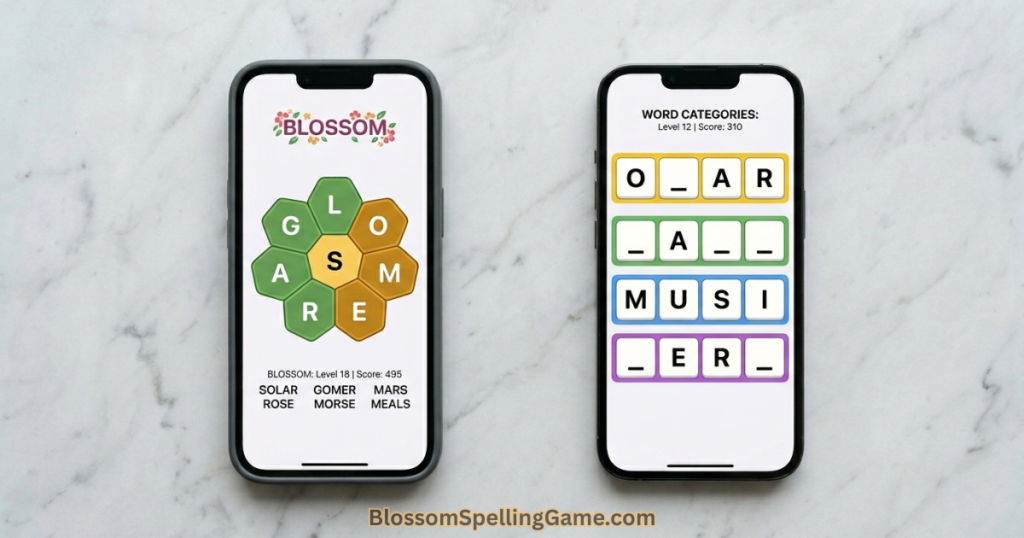
Connections’ most distinctive design feature — and its most controversial — is intentional misdirection. Understanding how it’s constructed makes you significantly better at the game.
How NYT editors construct Connections traps:
The “obvious first grouping” trap: Some words in the grid seem to obviously belong together — “FRENCH, ITALIAN, GREEK, ROMAN” might look like nationalities, but the actual category might be “types of salad dressing.” The most obvious grouping is often wrong.
The dual-membership word: Certain words legitimately fit two different categories. “BLUE” could belong to “shades of color,” “types of music,” “mood words,” or “words before ‘print.'” These words are placed deliberately — they’re designed to lead you to the wrong grouping first.
The compound word trap: Several words might all seem to go with a common compound word or phrase, but only four of them actually do. Knowing the category is “words that follow FIRE” is easy — knowing which four of the six plausible candidates are correct is harder.
The cultural register trap: The purple category often requires knowing that a set of words shares a cultural reference that isn’t primarily their dictionary meaning. Four words that are all “Emmy Award-winning TV shows from the 1990s” look completely unrelated if you’re not immersed in that specific cultural space.
How to get better at reading misdirection:
The most effective Connections strategy for experienced players is counterintuitive: start with the category you’re least confident about, not the most confident. The yellow category (easiest) is the one most likely to contain words that also fit other categories — which means committing to yellow early can accidentally use up a word you needed for the purple category later.
Experienced players often confirm their purple hypothesis first (without submitting it) — mentally locking in the four words they believe form the hardest category — and then solve the easier tiers in order. This avoids the trap of using a purple-category word to complete an easier tier.
The Blossom analogy: Connections misdirection is structurally similar to the pangram hunt problem in Blossom — you’re searching for a specific correct answer while the other options create noise. But in Connections, the noise is intentionally crafted by editors. In Blossom, the noise is just the rest of the dictionary.
How Skills Transfer Between the Two Games
This question matters if you’re considering adding both games to your daily routine: does getting better at one make you better at the other?
Skills that transfer FROM Blossom TO Connections:
Vocabulary depth. Knowing more words helps you recognize which Connections category a less-familiar word might belong to. A player with strong vocabulary will recognize that ELEGY belongs to a poetry-related category even if they haven’t seen that specific Connections puzzle before.
Pattern resistance. Blossom teaches you that the obvious word combination isn’t always right — sometimes the letters that look like they’ll form a common word actually form something unexpected. This training in checking your assumptions transfers to Connections’ misdirection resistance.
Comfort with ambiguity. Blossom’s no-feedback search environment builds tolerance for uncertainty. Connections players who’ve also played Blossom tend to be more comfortable sitting with an uncertain grouping hypothesis rather than submitting prematurely.
Skills that transfer FROM Connections TO Blossom:
Semantic category awareness. Connections explicitly trains you to think about what category words belong to — animal words, action words, food words. This categorical thinking helps in Blossom’s category sweep technique (mentally running through semantic categories to surface vocabulary you might not reach through letter scanning alone).
Cultural vocabulary breadth. Connections exposes you to words in cultural contexts that pure letter games don’t — slang, idiomatic expressions, cultural references. This exposure sometimes surfaces vocabulary that appears in Blossom puzzles.
Misdirection awareness. Paradoxically, Connections’ training in recognizing deliberate misleading patterns can help in Blossom — specifically in the pangram hunt, where common word patterns can draw your attention away from the less obvious full-letter solution.
The honest verdict on skill transfer:
The transfer is real but limited. They’re different enough that improving at one doesn’t dramatically accelerate improvement at the other. What they share is a general vocabulary engagement habit — the daily practice of actively thinking about words, their meanings, and their relationships — that benefits both games over time.
Who Each Game Is Really Built For
Choose Blossom Word Game if you:
- Find genuine satisfaction in producing words rather than categorizing them
- Are motivated by numeric scoring and measurable skill improvement over time
- Prefer puzzles where difficulty comes from mechanics, not editorial choices
- Want a game that keeps challenging you as your vocabulary grows
- Value consistency — same rules, different letter set, predictable structure
- Are building vocabulary as an explicit goal and want the generative format that research suggests works best
- Have 15–20 focused minutes and want to feel genuinely spent at the end
- Don’t have a strong pop culture or sports knowledge background that would give you a Connections advantage
- Want the cleanest possible free-to-play daily puzzle experience
Choose NYT Connections if you:
- Love the “aha” of seeing a hidden category after being misdirected
- Have broad cultural knowledge across TV, sports, music, food, and history
- Are motivated by clean completion rather than numeric scoring
- Enjoy puzzles that sometimes require specific cultural knowledge as much as vocabulary
- Want a 5-minute session with a clear binary result
- Are already in the NYT Games ecosystem
- Find group dynamics and shared puzzle discussion with others motivating
- Enjoy puzzles where the designer’s intent is to trick you, and you enjoy outsmarting that intent
Play both if you:
- Want to exercise both generative vocabulary production AND categorical classification daily
- Have 25 minutes total for word games
- Enjoy variety in the type of thinking your morning puzzle demands
- Are building a complete vocabulary-cognition daily workout
- Want complementary challenges that exercise different cognitive systems
Sequencing: Which to Play First in Your Morning Routine
If you’re playing both, the order matters more than most players realize.
The case for Blossom first:
Blossom’s generative format — pulling words from your own vocabulary under constraint — benefits from a rested, unprimed cognitive state. When your brain hasn’t been exposed to other words and categories yet, your vocabulary retrieval is cleaner and less biased by recently activated concepts.
Starting with Connections first can inadvertently prime certain word categories in your mind that then bias your Blossom search — you might be more likely to find words related to the categories you were just thinking about in Connections, while missing other vocabulary territory.
The case for Connections first:
Connections’ 5-minute session is shorter and less cognitively demanding. Using it as a mental warm-up — like a light stretching routine before a workout — activates your word-association networks and gets your brain into language mode before the more sustained Blossom session.
Players who feel sluggish at the start of Blossom sometimes find that a quick Connections session beforehand helps them enter word-finding mode faster.
The practical recommendation:
For most players, Blossom first produces better Blossom scores with no meaningful impact on Connections performance. The generative demands of Blossom benefit most from fresh cognitive access. Save Connections for after — it’s a satisfying 5-minute cooldown after the more intensive Blossom session.
One exception: if you’re playing Blossom at a point in the day when you’re already mentally warmed up (mid-morning rather than immediately on waking), the sequencing matters less. In that case, personal preference determines order.
Side-by-Side Comparison
| Feature | Blossom Word Game | NYT Connections |
|---|---|---|
| Core mechanic | Generate words from 7 letters | Group 16 words into 4 categories |
| Cognitive type | Generative production | Categorical classification |
| Knowledge domain | Linguistic / vocabulary | Cultural / associative |
| Session length | 10–20 minutes | 3–7 minutes |
| Scoring | Numeric points + rank | Completion (0–4 mistakes) |
| Penalty for errors | None (rejected words cost nothing) | Yes (4 mistakes = game over) |
| Difficulty source | Letter set mechanics | Editorial construction |
| Difficulty consistency | Varies by letter set (structural) | Varies by editorial quality |
| Misdirection | None — only accept/reject | Intentional and central |
| Skill ceiling | Very high — improves over months | Moderate — plateaus as you learn patterns |
| Social sharing | Score + rank | Color-coded grid emoji |
| Word list source | Merriam-Webster dictionary | NYT editorial team |
| Cost | Free (BlossomSpellingGame.com) | NYT Games subscription |
| Account required | No | Yes (basic registration) |
| Pangram equivalent | Pangram (all 7 letters) | Purple category (hardest tier) |
| Transfer skills | Builds vocabulary production | Builds cultural association |
| Best for | Vocabulary builders, strategists | Cultural knowledge players, completionists |
FAQ
What is the main difference between Blossom Word Game and NYT Connections?
Blossom is a word production game — you generate valid words from seven given letters. NYT Connections is a word classification game — you group 16 given words into four hidden categories. They share the daily puzzle format but exercise completely different cognitive systems: Blossom tests generative vocabulary recall, Connections tests categorical pattern recognition and cultural knowledge.
Which is harder, Blossom or NYT Connections?
They’re hard in fundamentally different ways. Blossom’s difficulty comes from the letter set’s mechanics and your vocabulary depth — it stays challenging as your skills grow. Connections’ difficulty comes from the NYT editorial team’s construction choices — specifically, how effectively they misdirect you toward wrong groupings. Blossom’s difficulty curve is longer; Connections’ purple category can be harder on any given day but doesn’t necessarily reflect your skill development.
Is NYT Connections free like Blossom?
Blossom Word Game at BlossomSpellingGame.com is completely free — no account, no subscription, no payment required. NYT Connections has a free tier with limited access, but full play typically requires a NYT Games subscription. For free daily word game alternatives, Blossom is the stronger no-cost option.
Can you play both Blossom and Connections in the same day?
Yes — they’re completely separate games that complement each other well. Playing both takes roughly 20–25 minutes total. Most players who enjoy both games recommend playing Blossom first (when your vocabulary retrieval is freshest) and Connections afterward as a shorter, culturally-focused cooldown.
Which game is better for improving vocabulary — Blossom or Connections?
Blossom is significantly better for vocabulary building. The generative format — producing words from letter constraints — creates stronger vocabulary encoding than classification tasks. Connections builds cultural vocabulary and associative thinking, which is a different (and complementary) skill. For traditional vocabulary expansion, Blossom is the more effective daily tool.
Does improving at Connections make you better at Blossom?
Partially. Connections builds semantic category awareness and cultural vocabulary breadth that can help you access different vocabulary territory in Blossom. But the core skills are different enough that direct transfer is limited. The most meaningful transfer goes the other direction — Blossom’s pattern-resistance training slightly improves your ability to see through Connections’ misdirection.
Why does Connections sometimes feel unfair?
The NYT editorial team constructs the categories and misdirections, which means difficulty varies based on editorial quality rather than purely structural mechanics. Purple categories that require very specific pop culture knowledge (a particular TV show, sports record, or regional food) can feel unfair to players who lack that specific background. This is a known, persistent community frustration with Connections that Blossom avoids by using the objective Merriam-Webster dictionary standard.
What’s the Connections equivalent of Blossom’s pangram?
The purple category is the structural equivalent of Blossom’s pangram hunt — it’s the single hardest element of the puzzle, requires the most sophisticated thinking to find, and delivers the biggest satisfaction when you crack it. Both represent the moment where the puzzle’s real difficulty lives.
Which game should I start with if I’m new to daily word puzzles?
Blossom Word Game is the gentler entry point for most new players. The rules are simpler, there’s no penalty for incorrect attempts, and the numeric scoring gives you immediate feedback on how well you’re doing. Connections’ four-mistake limit and cultural knowledge requirements can feel frustrating for players who are still developing their puzzle instincts. Start with Blossom, add Connections once the daily puzzle format feels natural.
Do Blossom and Connections reset at the same time?
Yes — both reset daily at midnight Eastern Time. A fresh Blossom puzzle and a fresh Connections puzzle are both available every day at 12:00 AM ET.
Final Thoughts
Here’s the clearest way to think about this: Blossom and Connections aren’t competing for the same cognitive territory. They’re more like cardio and strength training — related enough that you can do them in the same session, different enough that each one builds something the other doesn’t.
Blossom builds generative vocabulary — the ability to produce words fluidly from constraint. Connections builds categorical association — the ability to see hidden connections between things that seem unrelated. Both are genuine cognitive skills. Both transfer to real life in ways that matter (writing, conversation, problem-solving). And both deliver the specific daily satisfaction that comes from a well-designed puzzle.
If you’ve only been playing one: try the other for a week. The contrast will sharpen what you appreciate about each. Players who’ve played both consistently report that their Blossom vocabulary instincts feel richer after a month of also doing Connections — and their Connections pattern-resistance feels sharper after sustained Blossom play.
And if you need a starting point: open BlossomSpellingGame.com right now. Free, no download, no account, and today’s puzzle is already loaded. The seven letters in that flower grid are waiting — and the pangram is in there somewhere.