

How to Find the Pangram in Blossom Word Game? These advanced methods go beyond basic tips.
There’s a specific moment every serious Blossom player knows. You’ve found nine, ten, eleven words. Your score is decent. The puzzle feels almost finished. But the pangram is still there, somewhere, invisible — using all seven of your letters in a configuration you haven’t cracked yet.
You try combinations. Nothing. You shuffle the petals. Still nothing. You submit a few more short words to fill time, quietly frustrated. Then the session ends, you look at the answer, and think: how did I not see that?
Finding the pangram isn’t random luck. It isn’t just vocabulary breadth. It’s a learnable skill — one that operates on specific cognitive techniques that have nothing to do with how many words you know and everything to do with how you search through the letter set in front of you.
This article covers the advanced pangram-finding methods that no basic guide teaches: how to analyze your letter set before you start searching, how to use words you’ve already found as search scaffolds, how to hunt compound-word pangrams differently from standard ones, what to do when you’ve been searching for ten minutes and nothing is coming, and how to find a second pangram after you’ve found the first.
If you want the foundational approach — counting vowels, common suffixes, rare letters — our Blossom Pangram Guide covers that ground thoroughly. This article picks up where that one ends.
Why Pangram Hunting Fails (The Real Reason)
Before getting into the techniques, it’s worth understanding exactly why pangram hunting fails — because the failure mode is almost always the same, regardless of the player’s vocabulary level.
The problem isn’t that players don’t know the word. In most cases, they do know it. The pangram is often a perfectly ordinary word — SPLINTER, GRATEFUL, BLANKET, CHAPTER — that they’d recognize immediately if it appeared in a sentence.
The problem is search strategy. Specifically: most players approach pangram hunting the same way they approach regular word-finding — by scanning the letters visually and waiting for a word to appear. This passive recognition mode works fine for finding 4- and 5-letter words, because those words exist in enormous quantity and the letters almost inevitably form something familiar.
For pangrams, this approach fails because the solution space is much smaller. There might be only one or two words in the entire English language that use exactly your seven letters (at least once each). Passive visual scanning won’t land you there reliably, because your brain isn’t filtering for “uses all seven letters” — it’s filtering for “looks like a word I know,” which is a completely different criterion.
Effective pangram hunting requires active, constrained search — deliberately applying each letter as a filter and narrowing the space systematically until only viable candidates remain. The techniques below teach exactly that.
1st Step OF How to Find the Pangram: Run the Letter Inventory Before You Search
This is the first thing to do before you attempt any pangram hunt — and most players skip it entirely.
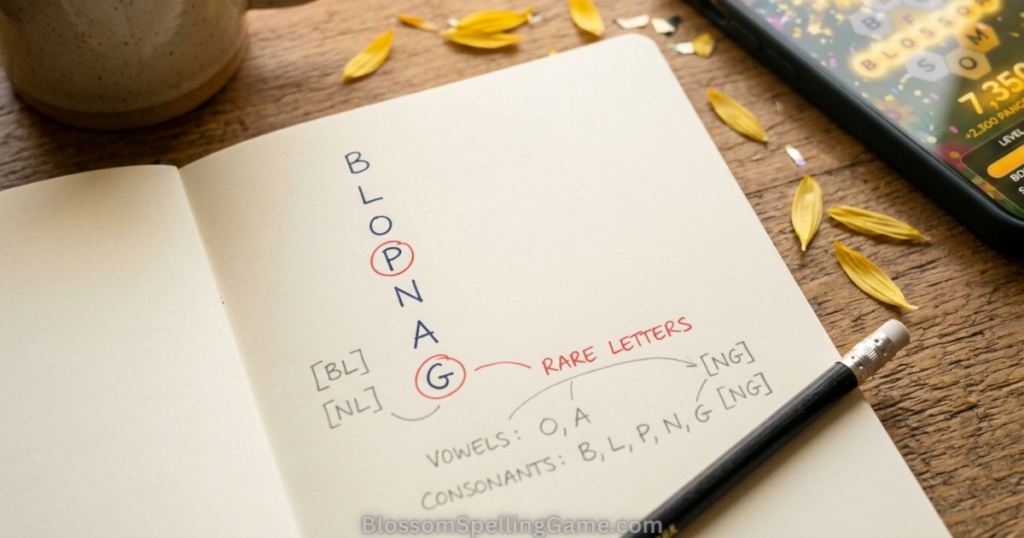
A letter inventory is simply writing down (mentally or on paper) exactly which seven letters you have and their basic linguistic properties. It takes thirty seconds and dramatically sharpens everything that follows.
What to note in your inventory:
Vowels vs. consonants: Count your vowels explicitly. How many do you have? Two? Three? Four? This determines what category of words you’re looking for. A pangram using three vowels and four consonants must contain at least one of each vowel — which immediately tells you which vowel patterns are possible and which aren’t.
Letter frequency class: Identify any rare letters (X, Z, Q, W, V, J, K) immediately. These are your highest-constraint letters — the ones with fewest possible word positions. Note which common letters you have (E, T, A, R, S, N, I) — these are flexible and can appear almost anywhere.
Letter pairs: Do any two of your seven letters frequently appear together in English? TH, ST, CR, BL, NG, PH — spotting these pair relationships tells you which two letters will likely travel together in the pangram.
Repeated letters: Does your set include any letter more than once? Wait — a pangram only needs each of the seven displayed letters to appear at least once. But some pangrams are longer than seven letters precisely because they repeat a letter. If your center letter is E, a nine-letter word with two E’s is valid. Your inventory should flag which letters could double.
Why this matters: The inventory converts seven abstract letters into a structured constraint profile. You’re not staring at random letters anymore — you’re looking at a set of specific linguistic facts that define exactly what kind of word you need to find.
Step 2: Identify Your “Must-Solve” Letters
After the inventory, identify the one or two letters in your set that are hardest to incorporate into a word. These are your must-solve letters — and they’re the most important clue you have.
Here’s the logic: in any valid pangram, every letter in the set appears at least once. That means your hardest-to-use letters must appear in the pangram. The pangram is built around the constraint of including every letter — which means it’s most efficiently found by starting from the letters that constrain it most severely.
How to identify must-solve letters:
A letter is a must-solve candidate if:
- It’s rare in English (X, Z, Q, W, V, J, K)
- It rarely appears at the beginning or end of common words
- It’s a consonant cluster breaker — a consonant that doesn’t naturally pair with the other consonants in your set
- It’s a vowel that appears alone (if your three vowels are A, O, U — and the pangram needs all three — U is the hardest to integrate into a word that also contains A and O)
How to use your must-solve letters:
Once identified, build your pangram search exclusively around them. Ask: what English words — ideally of 7 letters or more — contain this specific letter? Then filter that mental list against your remaining six letters to see which candidates survive.
Practical example: Suppose your seven letters are R, A, T, E, N, L, G — and your vowels are A and E. Your consonants are R, T, N, L, G. None of these are particularly rare, but G is your most constrained consonant — it appears in fewer word positions than R, T, N, or L. So G becomes your must-solve letter. What seven-letter words contain G and also use R, A, T, E, N, L? TANGLE (6 letters, uses T, A, N, G, L, E — but misses R), ENTANGLE (8 letters — uses E, N, T, A, N, G, L, E — still misses R), GRANTLE? No. LATERAL — uses L, A, T, E, R, A, L — misses G. Now GRANTEE? G, R, A, N, T, E, E — uses all your consonant set plus both vowels. That’s the kind of candidate the must-solve method surfaces.
Step 3: Map Valid Syllable Combinations From Your Letters
This technique operates at a different level from letter-by-letter searching — and it’s particularly powerful for finding pangrams that aren’t obvious English words.
Every English word is built from syllables following specific consonant-vowel patterns: CV (consonant-vowel, as in “be”), CVC (consonant-vowel-consonant, as in “cat”), VC (vowel-consonant, as in “at”), CCV (two consonants then vowel, as in “try”), and so on. Pangrams, being longer words, are typically built from two or more syllables.
How to apply syllable mapping:
- Take your vowels and assign each one to a potential syllable slot
- Group your consonants around those vowel slots based on natural English phonology
- Test whether the resulting syllable combinations form recognizable word components
Working example: Letters are B, R, A, N, C, H, E. Vowels: A, E. Consonants: B, R, N, C, H.
Syllable slot 1 around A: BRA, RAN, CAN, HAD — possible. BRAN works (CVC pattern). Syllable slot 2 around E: CHE, HEN, NEC — possible. What follows BRAN? BRANCH (6 letters — B, R, A, N, C, H — misses E). What about BRANCHÉ? No. BRANCHE? No. But wait: what 7-letter word uses B, R, A, N, C, H, E? DEBRANCHE? Not standard. But BLANCHER, BLENCHER — checking letters… Actually ENCHAIN uses E, N, C, H, A, I, N — misses B and R. The syllable method doesn’t guarantee a word, but it generates structured candidates much faster than random combination.
Why this works better than random search: Random letter combination is essentially an unguided brute-force approach. Syllable mapping constrains your combinations to phonologically valid patterns — which narrows the candidate space by roughly 80–90% while keeping all the actual words in play.
Step 4: Use Already-Found Words as Pangram Scaffolds
This is one of the most underused techniques in pangram hunting — and once you learn it, you’ll wonder why you weren’t doing it instinctively.
When you’ve already submitted several words in a session, you have valuable information: you know which letter combinations the puzzle accepts. Use that information directly in your pangram hunt.
The core technique: Take a long word you’ve already found (ideally 5–6 letters) and ask: which letter or letters from my seven-letter set does this word NOT contain? Those missing letters are exactly what the pangram adds to that word.
Practical walkthrough: Suppose you’ve found the word GRAIN (5 letters: G, R, A, I, N). Your seven letters are G, R, A, I, N, T, E. GRAIN uses G, R, A, I, N — missing T and E. Now ask: what word is GRAIN plus T and E? Or what word contains all the letters G, R, A, I, N, T, E?
GRANITE — G, R, A, N, I, T, E. That’s 7 letters. Does it use all seven? G ✓, R ✓, A ✓, I ✓, N ✓, T ✓, E ✓. That’s your pangram.
The scaffold technique turns a word you’ve already found into a direct clue for the pangram. You’re not searching the whole vocabulary — you’re searching for words that extend or recombine the letters of something you already know works.
Variation — the extension method: If you’ve found a 5-letter word, ask whether adding one or two more of your remaining letters creates a longer word. DREAM + S = DREAMS (if S is in your set). BRIGHT + EN = BRIGHTEN (if E and N are in your set). FARM + ING = FARMING. The extension test takes seconds and frequently surfaces the pangram hiding just one or two letters beyond a word you’ve already found.
Most powerful application: After finding your 5th or 6th word, pause and run the scaffold technique on your two longest submitted words. Note which letters each is missing from your seven-letter set. If both are missing the same letter, that letter is almost certainly in the pangram — and possibly in a prominent position.
Step 5: Target the Center Letter’s Position in the Pangram
Every word in Blossom must contain the center letter — and the pangram is no exception. But here’s a more nuanced insight that most players overlook: the center letter’s typical position in words tells you something specific about what the pangram might look like.
Different letters appear in different positions with different frequencies in English. Some letters appear most often at the beginning of words (B, C, D, F, G, H, J, K, L, M, N, P, R, S, T, W). Some appear most often at the end (D, E, K, N, R, S, T, X, Y). Some appear most often in the middle (vowels, plus letters like L, N, R, S).
When you know your center letter and its typical positional behavior, you can immediately narrow which word structures to search.
Quick reference by center letter type:
If the center letter is a common vowel (E, A, I, O, U): The pangram almost certainly has the center vowel in the middle of the word — vowels are internal anchors. Search for words where the vowel appears once or twice in medial position: GRATEFUL (A in position 3, 6), STERLING (E in position 2), ROTATION (O in positions 2, 5).
If the center letter is a common consonant (R, S, T, N, L): These are extremely flexible — they appear at the beginning, middle, and end of English words with roughly equal frequency. Don’t narrow by position; instead narrow by consonant clusters these letters commonly form: ST-, -NG, -NT, TR-, -RN, -RL.
If the center letter is a less common consonant (B, C, D, F, G, H, K, M, P, W): These letters more often appear at the beginning or end of syllables. Search specifically for words that open or close with these letters: BREAKING (B-), CHAPTER (C-), DRAWING (D-), GRANTED (G-), HELPFUL (-H? less common), CAMPING (P-), WELCOME (W-).
If the center letter is rare (X, Z, Q, J, V): These letters almost always appear in very specific positions and cluster with very specific letters. X typically appears at the end of words or after a vowel (AX, OX, -EX, -IX). Z appears at the beginning (ZAP, ZONE) or after vowels (MAZE, PRIZE). Q is nearly always followed by U. Knowing this immediately tells you the pangram’s structure.
Hunting Compound-Word Pangrams Differently
A significant portion of Blossom pangrams are closed compound words — words formed by joining two smaller words into one: STARLIGHT, HANDCRAFT, BLACKBIRD, SNOWFLAKE, DRIFTWOOD, LANDLORD, FOOTPRINT.
These pangrams require a completely different search approach from standard single-root words, because your brain typically retrieves compound words through semantic association rather than letter-pattern matching.
Why compound pangrams are easy to miss: When you’re searching for a pangram, your word-generation system tends to produce single-root words — verbs, adjectives, technical nouns. Compound words require your brain to combine two concepts, which doesn’t happen automatically when you’re staring at seven abstract letters.
The compound-word search method:
- Look at your seven letters and ask: which smaller words (3–4 letters) can I form from subsets of these letters?
- List 4–6 small words your letters can form: STAR, LAND, HAND, FOOT, SNOW, BACK, LIGHT, CRAFT, PRINT, WOOD
- For each small word, ask: what compound word starts or ends with this? STAR + something with your remaining letters? Something + LIGHT with your remaining letters?
- Test the promising candidates
Practical example: Letters are S, T, A, R, L, I, G, H, T — let’s say 8 letters because the pangram uses a repeated letter. You form STAR from S, T, A, R. What compound words start with STAR? STARLIGHT (uses S, T, A, R, L, I, G, H, T — all eight letters). Found it.
The key insight: Most players would never find STARLIGHT by combining letters randomly. They’d find it by first noticing STAR, then asking “what compound word starts with STAR and uses L, I, G, H, T for the second component?” — a much more tractable search.
Where to look for compound components: Run through these productive compound elements against your letter set: HAND, FOOT, BACK, HEAD, LIGHT, LAND, WOOD, WORK, SIDE, WARD, CRAFT, SHIP, HOUSE, HOLD, BOARD, STONE, STEAD. If your letters can form any of these, actively search for compound words that use it.
The Length Constraint: What the Pangram’s Minimum Length Tells You
This is a structural insight that gives you a mathematical edge in your pangram search — and it’s completely overlooked in standard guides.
A pangram must use all seven of your letters at least once. That means the pangram is at minimum seven letters long — but it could be longer if any letters appear more than once, or if the word naturally requires additional letters (which can only come from repeating letters already in your set, since you can only use the seven available letters).
What the minimum length tells you:
A seven-letter pangram uses each letter exactly once. This is the tightest possible structure — every letter does exactly one job in the word. These pangrams tend to be specific, often technical or uncommon vocabulary, because the constraint of using every letter exactly once is severe.
An eight-letter pangram repeats one of your seven letters. This is actually more common than seven-letter pangrams, because repeating one letter opens up a much larger vocabulary space. The repeated letter is almost always a common vowel (E, A, I) or a common consonant (S, T, R, N).
A nine-letter pangram repeats two letters (or one letter twice). These are the longest common pangrams and often feel like “normal” words — SPLITTING (uses S, P, L, I, T, T, I, N, G — repeats T and I), STRENGTHS (S, T, R, E, N, G, T, H, S — repeats S and T).
The actionable insight: When you’re stuck hunting a seven-letter pangram and finding nothing, try searching for eight-letter words instead. Explicitly ask: which of my seven letters would most naturally repeat in a common English word? If you have E as your center letter and it’s a common vowel, actively look for 8-letter words where E appears twice: GENERATE, REPLACE, DELEGATE, MEDIATE — now filter these against your specific six petal letters.
One more structural fact: Pangrams longer than ten letters are rare in Blossom because very few common English words use seven specific letters while repeating three or four of them. If your search has reached the 10+ letter range without finding anything, you’ve likely gone too long. Redirect back to 7–9 letter candidates.
What to Do After 10 Minutes of Searching — The Cognitive Reset
It happens to everyone. You’ve been hunting the pangram for ten minutes, you’ve tried dozens of combinations, nothing is working, and the familiar mix of frustration and fatigue is starting to cloud your thinking.
At this point, continuing the same search with the same approach is almost certainly unproductive. What you need is a cognitive reset — a deliberate break in your search pattern that allows your brain’s background processing to continue while your conscious attention rests.
The full cognitive reset sequence:
First: Shuffle the petals. The shuffle button rearranges the six outer letters into a new spatial configuration. This sounds too simple to matter — but there’s real cognitive science behind it. Your visual word-recognition system builds strong spatial associations: “the word I’m looking for starts with the letter in the top-left position.” Shuffling breaks those associations and forces a fresh spatial read of the same letters. Many players report finding the pangram within two minutes of shuffling after a long fruitless search.
Second: Deliberately look away for 60 seconds. Not to check your phone — actually look away from the screen. Let your eyes rest on a neutral surface. This interrupts the cognitive loop you’ve been stuck in and allows your brain’s semantic processing to work in the background. The pangram often surfaces spontaneously during or immediately after this rest, without any conscious effort.
Third: Restart from a completely different entry point. If you’ve been approaching the pangram through suffixes (-ING, -TION, -NESS), switch to approaching it through word beginnings. What 7-letter words begin with each of your seven letters? Run through each letter as a potential first letter of the pangram — even letters you wouldn’t normally consider word-openers.
Fourth: Submit one or two short words. This sounds counterproductive, but it works for a specific cognitive reason: the act of submitting a word — any word — resets your mental “searching” state into a “finding” state. You’ve succeeded at something small, which lowers the cognitive pressure that accumulates during a long fruitless search. Lower pressure = better word retrieval.
What not to do: Don’t keep trying the same combinations you’ve already tried, faster or in different orders. If a candidate didn’t work ten minutes ago, it won’t work now. The pangram isn’t hidden inside your previous attempts — it’s in a part of the vocabulary space you haven’t searched yet.
How to Find the Second Pangram When One Exists
Some Blossom puzzles contain two pangrams. Once you’ve found the first, the second one is typically harder to find — not because it’s more obscure, but because your brain has anchored on the first solution and stopped searching.
The psychological barrier: After finding a pangram, there’s a strong cognitive impulse to stop looking for another. You’ve succeeded. The hunt feels over. Continuing to search requires actively overriding that completion signal — which takes deliberate effort.
The strategic approach for finding the second pangram:
First, recognize that second pangrams typically share several letters with the first but recombine them into a fundamentally different word. If your first pangram was BLANKET (B, L, A, N, K, E, T), the second pangram uses the same seven letters but in a completely different arrangement — perhaps TANKBLE? No. But TANKFUL? Still no. The point is: the second pangram isn’t BLANKET with one letter changed. It’s a different word that happens to use the same letter set.
Second, apply the must-solve method again, but this time deliberately ignore the word structure of your first pangram. If BLANKET is your first solution and it starts with B, force yourself to search for pangrams that start with each of the other six letters.
Third, look specifically for pangrams in a different word category than your first solution. If the first pangram was a noun, hunt specifically for verbs. If it was a concrete word, hunt for abstract ones. If it was a long word, look for a tighter seven-letter solution. The second pangram, when it exists, is almost always in a different semantic category than the first.
Fourth, use the scaffold technique on the first pangram itself. If BLANKET is your first pangram, which permutations of B, L, A, N, K, E, T form a different valid word? Work through the letters systematically.
Letter Set Patterns That Signal Easier vs. Harder Pangrams
After playing Blossom consistently, patterns emerge in which letter sets tend to produce findable pangrams vs. which ones are genuinely brutal. Knowing these signals helps you calibrate your expectations and search intensity before you start.
Signals that the pangram will be more accessible:
- Three or more common vowels (E, A, I): More vowels = more word structures available = larger pangram candidate pool. Days with E, A, and I all in the set tend to have common-vocabulary pangrams.
- A cluster of consonants that frequently appear together in English: If your consonants include N, T, R, S — they naturally combine into dozens of word structures. The pangram is likely a word you know well.
- The center letter is a vowel: Center vowels (especially E and A) appear in the interior of thousands of common words. More candidate words = easier pangram to find.
- Short gap between your vowel count and consonant count (3 vowels, 4 consonants or 4 vowels, 3 consonants): A balanced vowel-consonant ratio means the pangram can follow normal English word structure without unusual phoneme combinations.
Signals that the pangram will be harder:
- The center letter is rare (X, Z, Q, K, J): The pangram must contain this letter, which severely restricts the candidate pool. Expect to spend extra time, focus your search on words where this letter appears prominently, and accept that the pangram may be less common vocabulary.
- Consonant-heavy set (5 or more consonants): Most English words of 7+ letters require at least 3 vowels. A set with only 2 vowels forces the pangram to repeat both vowels — which restricts candidates significantly. Look specifically for words where each vowel appears twice.
- Multiple rare or low-frequency consonants: Sets containing two or more low-frequency consonants (say, W and V, or G and X) create extremely constrained pangram structures. These often produce pangrams in specialized vocabulary — technical terms, nature words, or archaic-but-valid vocabulary.
- All consonants from different frequency classes: When no two consonants naturally cluster together (say, B, D, G, H, W as your consonants) — they don’t form natural English consonant clusters, making syllable mapping harder and the pangram likely less common.
The practical takeaway: On hard-signal days, don’t spend the first five minutes of your session on the pangram. Warm up, find your shorter words, and return to the pangram hunt with a full session’s worth of letter familiarity behind you. On easy-signal days, try the pangram first — you may find it in under two minutes and secure that bonus score early.
FAQ
How do you find the pangram in Blossom Word Game every time?
No method guarantees the pangram every session, but a systematic approach makes it highly consistent: run a letter inventory first, identify your must-solve (hardest-to-use) letters, map valid syllable combinations, and use already-found words as scaffolds. On days when the search stalls, the cognitive reset sequence — shuffle, rest, change entry point — surfaces the pangram in most cases. Consistency comes from applying these steps in order rather than searching randomly.
How long does the pangram usually take to find?
It varies significantly by letter set and player familiarity. On easy-signal letter sets (three common vowels, common consonants, vowel center letter), experienced players often find the pangram within 2–5 minutes. On hard-signal sets (rare center letter, consonant-heavy, multiple low-frequency consonants), 15–25 minutes is normal — even for experienced players. The pangram’s difficulty is primarily a function of the letter set, not your vocabulary level.
What should I do if I can’t find the pangram after 20 minutes?
Apply the full cognitive reset sequence: shuffle the petals, look away from the screen for 60 seconds, restart your search from a completely different entry point (try each letter as a potential word-opener), and submit one or two short words to reset your cognitive state. If after applying the reset you’re still stuck, check whether the puzzle might contain a compound-word pangram — these are particularly easy to miss with standard search approaches.
Is the pangram always a common word?
Not always, but more often than players assume. Blossom’s Merriam-Webster word list is calibrated toward accessible vocabulary — nature words, everyday nouns, common adjectives and verbs — rather than highly technical or archaic terms. If you’ve been searching obscure vocabulary for ten minutes without success, try switching to common, everyday words you use regularly. The pangram often turns out to be something completely familiar.
Can there be more than one pangram in a Blossom puzzle?
Yes. While every daily puzzle guarantees at least one, some configurations contain two. The second pangram is typically harder to find because it requires overriding the completion signal after finding the first. Use the scaffold technique on your first pangram and search in a different word category or semantic domain than the first solution.
Does the center letter affect how hard the pangram is to find?
Significantly. A vowel center letter (especially E or A) makes the pangram easier to find because vowels appear in thousands of common long words in medial positions. A rare consonant center letter (X, Z, Q) makes the pangram harder because far fewer common words contain these letters — the candidate pool is smaller and often includes less familiar vocabulary.
Should I hunt the pangram first or warm up with other words?
It depends on the letter set’s difficulty signals. On accessible letter sets (common vowels, common consonants, vowel center letter), try the pangram first — you may find it quickly and lock in that bonus early. On harder sets (rare center letter, few vowels, unusual consonant combinations), warm up with 3–4 shorter words first. The familiarity with the letter set you build through shorter words frequently unlocks the pangram pattern that wasn’t visible initially.
What’s the compound-word pangram technique?
Identify short words (3–4 letters) your letter set can form, then search for compound words that start or end with those short words. If your letters include S, T, A, R — ask what compound words begin with STAR: STARLIGHT, STARFISH, STARBOARD, STARGAZER. Check whether the compound’s second component uses your remaining letters. This technique is particularly effective because compound-word pangrams are otherwise nearly impossible to find through random combination.
How do I find the pangram when my letter set has very few vowels?
Focus your search on words where each available vowel appears more than once. A set with only A and E as vowels needs the pangram to repeat both vowels to achieve a natural-sounding word. Look for long words with AE or EA vowel patterns repeated:ACEAE,ACEAE — or more practically words like GREATNESS (G, R, E, A, T, N, E, S, S — two E’s), EATABLE, READABLE. The limited vowel constraint actually narrows your search to a manageable candidate list.
Is there a way to practice pangram hunting between daily puzzles?
Yes — two approaches work well. First, use BlossomSpellingGame.com’s past puzzle archive to practice on previous letter sets with the knowledge of what the pangram was. Reverse-engineering the pangram from the answer teaches you which search paths would have found it, which calibrates your future searches. Second, apply the scaffold technique to any word you encounter in daily life — ask “what 7-letter word contains this word plus one or two more letters?” It’s a habit that trains pangram-finding instincts without requiring a live puzzle.
Final Thoughts
Finding the pangram every time isn’t a vocabulary achievement — it’s a search strategy achievement. The players who find it consistently don’t necessarily know more words. They know how to look.
The letter inventory tells you what kind of word you need before you start searching. The must-solve method focuses your energy on the highest-constraint letters. Syllable mapping generates structured candidates rather than random combinations. The scaffold technique turns words you’ve already found into direct clues. Compound-word awareness opens a category most players systematically miss.
And when all of that has been applied and the pangram still isn’t surfacing — the cognitive reset is there. Shuffle, rest, change entry point, submit a short word. Give your brain’s background processing a moment to work. The answer is almost always there, in a corner of your vocabulary you haven’t searched yet.
Put these techniques into practice in today’s puzzle at BlossomSpellingGame.com. The letter inventory takes thirty seconds. The must-solve identification takes another thirty. By the time you’ve run your first syllable map, you’ll be searching in a fundamentally different way than you were before you read this article.
The pangram is in there. Now you know how to find it.