
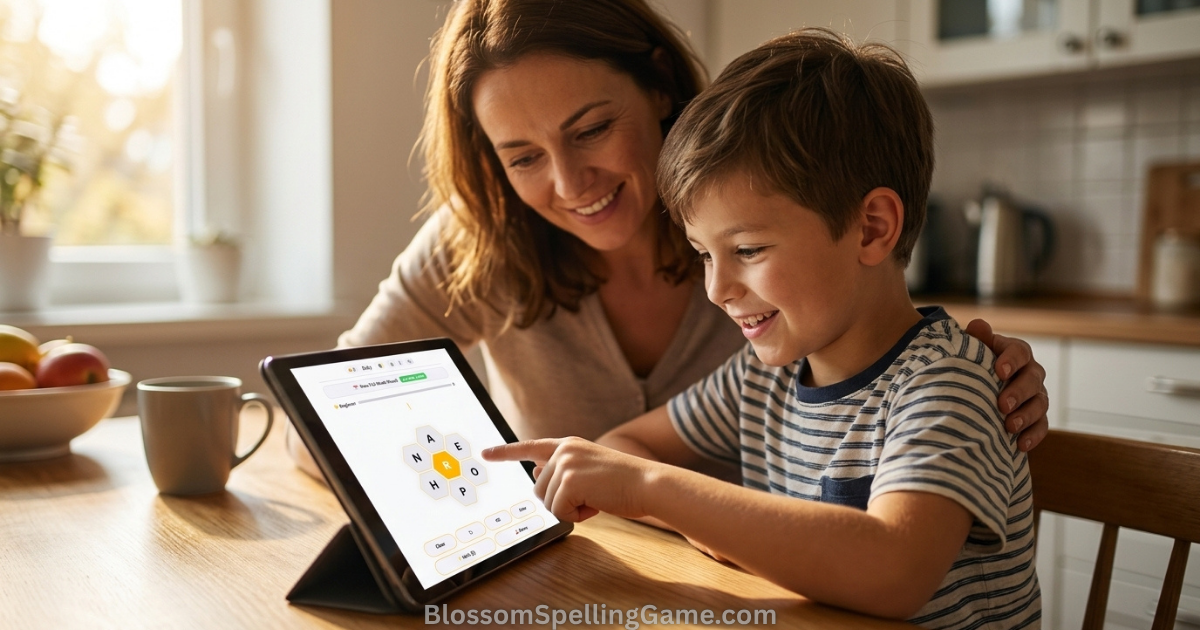
Your kid picked up your phone, saw the flower grid, and asked what you were playing. Or maybe a teacher mentioned word games as a homework supplement and you’re wondering whether Blossom fits the bill. Or perhaps you’re looking for screen time that actually does something useful — something that doesn’t involve explosions, in-app purchases, or YouTube rabbit holes.
Whatever brought you here, you want a real answer: is Blossom Word Game actually good for kids, or is it just a fun adult puzzle that happens to be content-safe?
The honest answer is: it depends entirely on the child’s age and reading level. For the right age group, Blossom is genuinely one of the better vocabulary-building tools available in a game format — and it has practical advantages over both traditional spelling homework and most educational apps on the market. For younger children who aren’t ready for it, pushing Blossom early creates frustration rather than growth.
This guide breaks it all down: minimum age and reading level recommendations, how children engage with the game differently from adults, what parents can do to maximize the educational value, whether it works for kids who struggle with spelling, and the content-safety and privacy considerations that matter most to families.
Is Blossom Word Game Good for Kids?
⚡ Quick Answer: Yes — for children aged 10 and up with solid reading skills, Blossom Word Game is genuinely beneficial. It builds active vocabulary recall, reinforces spelling patterns, and rewards persistence without punishment. For children aged 7–9, it can work with active parental involvement. For children under 7, the 4-letter minimum word requirement and the constraint-based puzzle format will likely produce more frustration than growth. The game is content-safe, ad-free in its core form at BlossomSpellingGame.com, and requires no account or personal information — making it parent-friendly from a privacy standpoint.
What Reading Level Does Blossom Require?
This is the first question most parents should ask — and it’s rarely addressed in general Blossom guides written for adults.
Blossom requires a child to:
- Read and recognize 4-letter words at minimum
- Have a working vocabulary broad enough to generate multiple words from a constrained letter set
- Understand that letters can combine in different sequences to form different words
- Tolerate ambiguity — there’s no “right answer” to work toward, only words to discover
In terms of reading grade levels, this corresponds roughly to late 2nd grade through early 3rd grade as the absolute floor — approximately age 7–8 for typically developing readers. However, being able to technically meet these requirements and being able to find the game engaging and rewarding are two different things.
The practical minimum for independent play: A child who can fluently read 4th-grade-level text — typically age 9–10 — has the vocabulary breadth to find enough words independently that the game feels satisfying rather than exhausting. Below this level, the puzzle tends to produce more “I can’t find anything” frustration than word-discovery satisfaction.
The practical minimum for supported play (with a parent): A child who can read at 2nd-grade level (age 7–8) can enjoy Blossom productively when a parent plays alongside — suggesting words, explaining rejected submissions, and helping maintain engagement during the harder moments.
Age-by-Age Breakdown: Who Benefits Most?
Rather than a single age recommendation, here’s how the experience actually varies across childhood age ranges:
Ages 5–6: Not Recommended for Independent Play
At this stage, most children are still building basic phonemic awareness and sight word recognition. The 4-letter minimum means common early-reader words (CAT, DOG, RUN, THE) don’t count. The puzzle format — seven constrained letters with a mandatory center letter — adds a layer of abstraction that most early readers aren’t developmentally ready to navigate independently.
Exception: A very advanced early reader (reading at 2nd–3rd grade level) might engage successfully with sustained parental support. But for typical development, there are better vocabulary tools at this stage.
Ages 7–9: Works Well With Parent Support
Children in this range typically have the reading foundation to recognize and spell 4- to 5-letter words, but their active vocabulary production — generating words spontaneously from constraints — is still developing. This makes independent Blossom play hit-or-miss.
What works: Collaborative play where a parent and child work the puzzle together. The parent handles longer word suggestions and explains why certain letter combinations are valid English words; the child handles shorter word discovery and gains exposure to vocabulary patterns they wouldn’t encounter independently.
What to watch for: Frustration with the center letter rule. Children at this age often find “I found a word but it got rejected” genuinely upsetting if they don’t fully understand why. Take a few minutes before playing to explain the center letter requirement clearly — show them an example or two before starting the real puzzle.
Ages 10–12: The Sweet Spot
This is the age range where Blossom delivers its strongest educational value without requiring adult scaffolding.
Children at this stage typically have vocabulary breadth sufficient to find 6–8 words independently, which provides enough success to maintain engagement. The puzzle’s structure — open-ended, no timer, no “lives,” no judgment for failed submissions — suits the social dynamics of this age group better than competitive games. There’s no embarrassment in finding fewer words; there’s just the private satisfaction of finding more.
The specific educational payoff at this age: Children aged 10–12 are at a critical period for vocabulary consolidation — the words they actively use and recognize during this window form the core of their adult vocabulary. Blossom’s generative format (producing words rather than recognizing them) creates stronger vocabulary encoding than passive reading exposure at exactly the developmental moment when that encoding matters most.
Ages 13–17: Excellent, Especially for SAT/ACT Preparation
Teenagers who engage with Blossom regularly report noticeable improvements in the speed at which vocabulary comes to them — not just recognition, but production. This is directly relevant to written expression in academic settings.
For high school students preparing for standardized tests, Blossom’s daily puzzle habit builds exactly the vocabulary retrieval speed that timed writing sections demand. It’s not a replacement for direct test preparation, but it’s a genuinely useful complement — particularly because teens are more likely to maintain a daily word game habit than a formal vocabulary study routine.
The engagement challenge with teens: Some teenagers resist activities that feel educational. The fact that Blossom is genuinely, intrinsically engaging — not dressed-up homework — is an advantage here. Most teens who try it for a week without being told it’s “educational” keep playing voluntarily.
How Kids Play Blossom Differently From Adults
Understanding how children actually approach the puzzle — rather than how adults do — helps parents set appropriate expectations and know when to step in.
Children tend to start with words they know socially, not words they know orthographically. An adult scans letters and thinks in spelling patterns. A child thinks of a word they know (say, “TRAIN”) and then tries to spell it from the available letters. This backward approach — concept first, letters second — is actually a valid word-finding method, but it requires sufficient vocabulary that the child can generate candidate words mentally before checking the letters.
Children are more likely to try proper nouns. Names of friends, places they know, and characters from media come naturally to children’s active vocabulary. The immediate rejection of “LONDON” or “MARIO” can feel confusing or unfair. Take a moment to explain the proper noun rule early — it prevents repeated frustration.
Children abandon searches faster. Adults trained in puzzle-solving often push through the “stuck” feeling. Children typically have a shorter tolerance window before the game stops feeling fun. The shuffle button is particularly valuable for younger players — it gives them an immediate, active thing to do when stuck, which resets engagement better than just staring at the same letters.
Children find short wins more motivating than long strategic plays. While adults are advised to hold back on 4-letter words and save slots for longer words, younger players benefit from a different approach: submit short words as you find them to maintain the sense of momentum and achievement. The 12-word slot budget strategy that maximizes adult scores is less important than keeping a child engaged through steady small wins.
Children are often less inhibited about testing uncertain words. The “just try it” attitude that adult players need to cultivate comes naturally to most children. Encourage this — every rejection is a learning moment about spelling and word validity, and there’s no penalty for testing.
What Blossom Actually Teaches — And What It Doesn’t
Being precise about this matters, because the marketing language around “educational word games” is often broader than the actual evidence supports.
What Blossom genuinely teaches:
Active vocabulary recall. The game requires children to produce words from memory — not recognize words from a list. This generative process is cognitively more demanding than passive vocabulary exposure and produces stronger long-term retention. Regular Blossom play builds the speed and fluency of word retrieval in a way that reading alone doesn’t.
Spelling pattern awareness. Every time a child forms a word in Blossom — physically selecting letters in sequence — they’re reinforcing that word’s spelling through active construction. This is more effective than visual memorization of word lists because it involves motor production alongside visual confirmation.
Letter combination intuition. After weeks of daily play, children develop a feel for which letter combinations form English words and which don’t. This phonological pattern knowledge transfers to reading fluency and to spelling novel words by analogy.
Persistence without punishment. The game’s design — no lives, no timer, no shame for rejected submissions — teaches children to try things, accept failure as information rather than judgment, and keep searching. This growth mindset dimension has value beyond vocabulary.
What Blossom does NOT teach:
Definitions. The game accepts or rejects words but never explains what they mean. A child who discovers that LICHEN is a valid word learns that it’s a real word — but not what a lichen is. Follow-up conversations about new words the game accepts are where the semantic learning happens.
Grammar rules explicitly. Children learn implicitly that certain word forms (plurals, past tenses, present participles) work, but the game doesn’t explain why RUNNING works and RUNNED doesn’t. Parental discussion fills this gap.
Reading comprehension. Blossom is a spelling and vocabulary production game, not a reading comprehension tool. It doesn’t develop the text-level understanding skills that reading full sentences and passages builds.
Blossom vs. Traditional Spelling Homework
This comparison comes up naturally for parents whose children have weekly spelling lists — and the answer is more nuanced than “Blossom is better.”
Where Blossom outperforms spelling lists:
Traditional spelling homework typically asks children to write each word several times, use it in a sentence, or take a memorization test. These methods train recognition and rote recall but don’t necessarily build the kind of flexible, active vocabulary production that Blossom exercises.
When a child finds a word in Blossom, they’ve generated it spontaneously from a constrained context — a cognitively richer process than copying it from a list. The words encountered in Blossom tend to stick better precisely because of this active engagement.
Additionally, Blossom exposes children to words they wouldn’t encounter in a curated spelling list — broader, less predictable vocabulary that expands their word knowledge beyond the prescribed curriculum.
Where traditional spelling homework outperforms Blossom:
Spelling lists target specific words the curriculum has determined are age-appropriate and educationally important. Blossom’s letter sets are random — some days the available letters allow for rich vocabulary, other days the set is constrained in ways that produce fewer interesting words.
More importantly, spelling tests have an explicit assessment component: they tell a parent and teacher whether a child can reproduce specific words correctly under pressure. Blossom provides no accountability for specific target words — it’s a fluency builder, not a mastery checker.
The practical recommendation: Blossom works best as a supplement to, not a replacement for, structured spelling instruction. The two approaches train different dimensions of the same skill and complement each other well.
Blossom vs. Educational Word Apps
There are dozens of apps specifically marketed as educational vocabulary games for children. How does Blossom compare?
Blossom’s advantages over most educational apps:
No gamification pressure mechanics. Most educational apps use lives, timers, streaks-with-penalties, and leaderboards to maintain engagement. While these mechanics drive short-term engagement, they create anxiety around failure that can make language learning feel stressful. Blossom’s pressure-free design — no lives, no timer, no punishment for wrong answers — creates a genuinely lower-anxiety vocabulary environment.
Real dictionary words only. Some educational apps use simplified or artificially constructed word lists that don’t reflect actual English vocabulary. Blossom’s Merriam-Webster foundation means every word a child finds and every word they’re exposed to is a real English word with a real dictionary definition.
No ads in core gameplay. At BlossomSpellingGame.com, the puzzle itself is not surrounded by advertising. Most free educational apps are heavily monetized with ads that are not always age-appropriate and that interrupt the learning experience. The Blossom browser experience is clean.
No progression system that could become addictive. Educational apps often use level unlocks, rewards, and progression trees to create compulsive engagement. Blossom’s daily-reset design creates a natural stopping point every day — there’s no “just one more level” spiral because there’s only one puzzle per day.
Where educational apps outperform Blossom:
Dedicated educational apps typically offer explicit instruction, definitions, usage examples, and progress tracking by specific vocabulary targets. They’re designed to meet specific curriculum standards. Blossom offers none of this explicitly — it’s an enrichment tool, not a curriculum tool.
Is It Good for Kids Who Struggle With Spelling or Reading?
This is the most important question for many parents — and it deserves an honest answer rather than enthusiastic reassurance.
For children with reading difficulties (dyslexia, reading fluency challenges):
Blossom is likely to be frustrating rather than helpful for children with significant reading difficulties. The game’s format — visually scanning seven letters and generating words from memory — relies heavily on phonological processing and orthographic knowledge that children with reading difficulties often find challenging. The immediate rejection feedback (without explanation) can also feel punishing.
Better alternatives for this population: structured literacy programs, phonics-based apps specifically designed for developing readers, and one-on-one reading support. Blossom can be revisited once foundational reading skills are more established.
For children who struggle specifically with spelling but read fluently:
This is actually where Blossom can help. Children who read well but spell inconsistently often have strong receptive vocabulary (they recognize words) but weaker productive spelling (they can’t reproduce them accurately). Blossom’s format — physically constructing words from letters — trains productive spelling in a low-stakes environment.
The caveat: a child with specific spelling difficulties who keeps having valid-feeling words rejected may find the game discouraging. Monitor their reaction in the first few sessions. If rejection frustration exceeds word-discovery satisfaction within 10 minutes, the game isn’t a good fit yet.
For children who find traditional vocabulary study boring:
This is Blossom’s strongest use case for academically typical children who resist formal study. The intrinsic engagement of the puzzle format — the genuine problem-solving satisfaction of finding a word — is motivating in a way that vocabulary flashcards and spelling lists rarely are. Children who refuse to study vocabulary willingly often play Blossom for twenty minutes without prompting.
How Parents Can Play Alongside Kids to Maximize Value
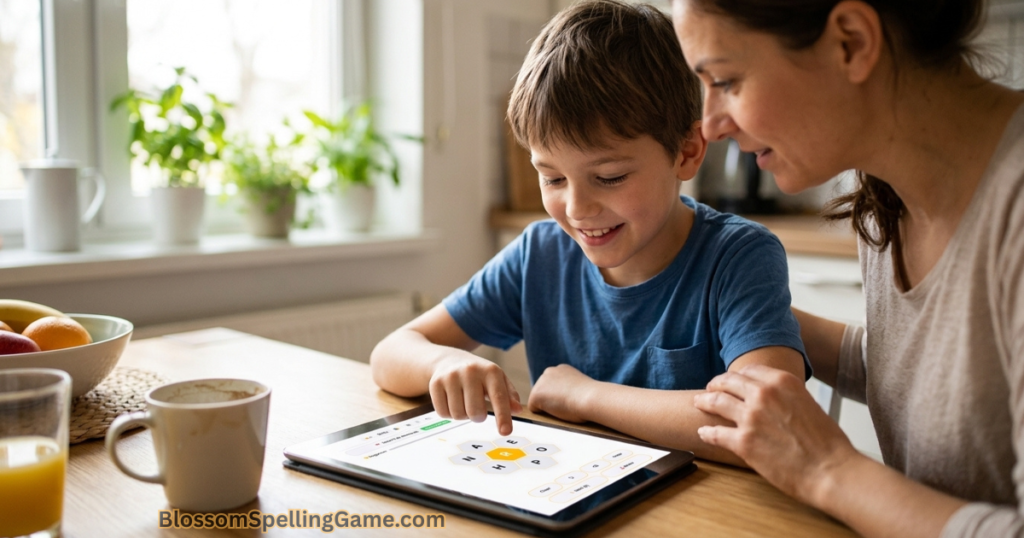
The educational value of Blossom for children under 12 increases dramatically when a parent plays alongside rather than just handing over the device. Here’s a practical framework for collaborative play:
Before starting: Explain the center letter rule clearly with a quick demonstration. Show that every word must contain the center petal letter. Test one example word with the center letter (accepted) and one without (rejected). Children who understand this rule before they start experience dramatically less frustration.
During play — for ages 7–9: Take turns suggesting words. The child proposes any word they know; you check whether the letters are available and whether the center letter is included. If the word works, let the child tap in the letters themselves — the physical letter selection reinforces spelling. If it doesn’t work, explain why briefly without making it a lesson. Keep the tone exploratory: “Let’s try it and see.”
During play — for ages 10–12: Let the child lead independently but stay available. When they get stuck, offer a letter combination rather than a complete word: “What if we tried words that start with ST?” or “What words can you think of with these three letters?” This scaffolding helps without removing the discovery satisfaction.
After play — any age: Spend two minutes discussing one or two words that appeared in the puzzle. If the game accepted a word the child didn’t know (like BRINE or CANOPY), ask them to guess what it means before you explain it. This converts vocabulary exposure into vocabulary learning.
The family play model: For families with children of different ages, Blossom works well as a shared puzzle where everyone contributes words at their own level. Younger children find short words; older children and adults find longer ones. The collaborative format reduces competitive pressure and creates natural vocabulary conversations between siblings.
Blossom in the Classroom — Can Teachers Use It?
Blossom isn’t specifically designed for classroom use, but it has practical features that make it viable as a supplementary classroom activity.
What works in a classroom setting:
The daily puzzle format means every student is working with the same letter set — which makes class discussion natural. After giving students 10–15 minutes to find words independently or in pairs, a teacher can lead a full-class discussion of which words people found, which they missed, and why certain words were rejected. This is genuine vocabulary work dressed as game play.
The no-account-required access at BlossomSpellingGame.com means no COPPA compliance concerns, no student data collection, and no IT approval hurdles for most districts. Students open the browser, play the puzzle, and that’s it.
What doesn’t work in a classroom setting:
Blossom has no teacher dashboard, no progress tracking by student, and no reporting features. It can’t be used for formal assessment. Teachers can observe engagement and facilitate discussion, but there’s no way to pull data on individual student performance.
For structured classroom use, Blossom works best as a warm-up activity (5–10 minutes at the start of class) rather than a core instructional tool. Used this way, it builds vocabulary fluency and creates a calm, focused entry into the school day — similar to sustained silent reading but with an active vocabulary component.
Content Safety and Privacy: What Parents Need to Know
For parents evaluating any game for children, content safety and privacy are non-negotiable considerations. Blossom rates very well on both.
Content safety:
The Merriam-Webster word list used by Blossom is a standard general English dictionary. The game does not contain offensive language, violent imagery, sexual content, or inappropriate themes. The puzzle is purely letter-based — there are no story elements, characters, or chat features that could introduce problematic content.
One minor consideration: Merriam-Webster’s dictionary includes some words that adults might not want young children asking about. However, the game doesn’t define words or use them in context — it simply accepts or rejects them. In practice, the probability of a young child forming and recognizing an age-inappropriate word from a random 7-letter set is extremely low.
Privacy:
BlossomSpellingGame.com does not require account creation to play the daily puzzle. No name, email address, age, or personal information is collected from anonymous players. This means there are no COPPA (Children’s Online Privacy Protection Act) compliance concerns for anonymous play — the game collects nothing.
If your child creates an account for streak tracking, standard account data (email, password) applies. Review the site’s current privacy policy for the specific terms before account creation.
Advertising:
The core puzzle at BlossomSpellingGame.com contains minimal advertising. There are no pop-up ads, video ads, or interstitial ads that interrupt gameplay. Some display ads may appear around the game interface — review the current experience directly before introducing it to younger children, as ad content can vary.
In-app purchases:
None within the core daily puzzle. The game does not prompt children to spend money.
Screen Time Considerations
The screen time question is one every parent navigates, and Blossom has some genuine advantages over most digital entertainment from a screen time quality perspective.
Active vs. passive screen time: Blossom is active screen time — the child is generating, thinking, and problem-solving throughout the session. This is meaningfully different from passive consumption (watching videos, scrolling) in terms of cognitive engagement. Most pediatric guidelines on screen time distinguish between passive and active/educational screen use, typically with greater tolerance for the latter.
Natural session limits: The daily puzzle typically takes 10–25 minutes for a child playing independently. Once all 12 words are submitted, the session ends naturally. There’s no infinite scroll, no autoplay, no “one more level” mechanic driving extended sessions. For parents concerned about children disappearing into a device for hours, Blossom’s built-in daily endpoint is a genuine advantage.
One puzzle per day: The daily reset design means there’s a hard limit on Blossom-related screen time of roughly one puzzle session per day. Even the most engaged child can’t play Blossom for four hours — there’s only one puzzle available.
No social features: There are no chat functions, social feeds, or online interaction features in the core puzzle. Children are not communicating with strangers or experiencing the social pressure dynamics that characterize social media and multiplayer games.
A reasonable guideline: For children aged 10–12, a single daily Blossom session of 15–20 minutes is well within any reasonable screen time framework and delivers measurable educational value. For younger children playing with parental support, a shared 10-minute session several times per week is a proportionate and beneficial use of screen time.
FAQ
What age is Blossom Word Game appropriate for?
Blossom is most appropriate for children aged 10 and older for independent play. Children aged 7–9 can engage productively with active parental support. The game is not recommended for children under 7 without significant scaffolding, as the 4-letter word minimum and constrained letter-set format require a vocabulary breadth most children under 7 haven’t developed yet.
Is Blossom Word Game educational for kids?
Yes — specifically for vocabulary breadth, active spelling pattern recognition, and word retrieval speed. The game builds these skills through active word generation rather than passive recognition, which produces stronger retention. It doesn’t replace structured spelling instruction or reading comprehension development, but it’s a genuinely effective vocabulary enrichment tool.
Is Blossom Word Game safe for children?
Yes. The game uses a standard Merriam-Webster dictionary with no violent, sexual, or inappropriate content. At BlossomSpellingGame.com, no personal information is collected from anonymous players (no account required), there are no in-app purchases, and no chat or social features expose children to strangers.
Can Blossom Word Game help kids with spelling?
For children who read fluently but spell inconsistently, yes. The game’s format — physically constructing words from letters — trains productive spelling in a low-stakes environment. For children with significant reading or phonological difficulties, Blossom may be frustrating rather than helpful; structured literacy support is more appropriate for this group.
Is Blossom appropriate for elementary school kids?
For upper elementary (grades 4–5, ages 9–11), yes — it’s in the game’s educational sweet spot. For lower elementary (grades K–3), the vocabulary requirements make independent play difficult. Teacher-facilitated group play or parent-supported home play can work for grades 2–3.
Can teachers use Blossom Word Game in the classroom?
Yes, as a supplementary warm-up activity. It requires no student accounts, no IT setup, and no data collection — just browser access. It works well for 10-minute vocabulary warm-ups followed by class discussion of the words found. It doesn’t have teacher dashboards or assessment tools, so it’s a discussion and engagement tool rather than a formal instructional resource.
How does Blossom compare to educational word apps for kids?
Blossom’s advantages over most educational apps: no ads in gameplay, no addictive progression mechanics, no time pressure, no lives or punishing failure states, and real dictionary words from a trusted source. Its limitations: no definitions, no explicit instruction, no curriculum alignment, and no progress tracking for specific learning targets. It’s a better enrichment tool than most educational apps but not a replacement for curricula-aligned vocabulary instruction.
Will Blossom help with SAT or ACT vocabulary for high schoolers?
As a daily vocabulary fluency habit, yes — it builds the kind of active word retrieval speed that timed writing sections demand. It’s not a direct SAT/ACT prep tool (it doesn’t target test-specific vocabulary) but it’s a useful complement to formal test preparation for motivated students.
Can kids play Blossom without parents seeing their data?
No personal data is collected from anonymous players at BlossomSpellingGame.com. No account is required for the daily puzzle, so no name, email, or age information is stored for children playing without an account. Parents can supervise by simply playing alongside or reviewing the puzzle on the same device.
What if my child gets frustrated with Blossom?
Frustration in younger players usually stems from one of three sources: not understanding the center letter rule (explain it before starting), expecting proper nouns to work (explain this briefly), or not finding enough words to feel successful (adjust expectations and play collaboratively). If frustration consistently exceeds engagement within 10–15 minutes of play, the game may not be the right fit at this age — try again in 6–12 months.
Final Thoughts
Blossom Word Game isn’t a magical educational tool that replaces structured learning. But it’s also not just an adult puzzle that happens to be content-safe for children. For the right age group — roughly 10 and up for independent play, 7–9 with parental support — it’s one of the better vocabulary enrichment tools available in a game format, precisely because it doesn’t feel like enrichment.
The daily puzzle design, the absence of addictive mechanics, the no-account browser access, and the real Merriam-Webster word list all make it genuinely parent-friendly. The intrinsic satisfaction of finding words — that small private achievement every time a submission lands — makes it genuinely kid-friendly.
If you have a child in the 10–14 range who tolerates screen time better than vocabulary homework, the easiest thing you can do is open BlossomSpellingGame.com together tonight, play one puzzle side by side, and see what happens. There’s nothing to download, nothing to sign up for, and nothing to spend. Just seven letters in a flower and the question of how many words the two of you can find before midnight.