
How long does a Blossom Word Game puzzle take? Anywhere from 3 minutes to an hour — here’s what determines your session length and what’s typical at each skill level.
There’s no timer in Blossom. That’s intentional — the game is designed to fit your schedule rather than impose one. But that freedom creates a genuine question: how long should a session take? Am I spending too long? Too little? Is 20 minutes normal, or is something wrong?
The honest answer is that session length in Blossom varies more than almost any other daily word game, because it depends on three things that vary dramatically between players: skill level, personal play style, and what “done” means to you. A quick minimum-viable session can take under 3 minutes. A comprehensive expert session hunting every possible word can take 45 minutes or more on the same puzzle.
This guide maps the realistic time ranges at each player level, explains what’s actually driving the variation, and helps you calibrate what session length makes sense for your goals — not what’s “correct,” because there isn’t one, but what fits your specific situation.
The Range: 3 Minutes to 45+ Minutes
The single most important thing to understand about Blossom session length: there is no universally correct duration. The same daily puzzle legitimately produces session times from under 3 minutes to well over 45, depending on who’s playing and what they’re trying to accomplish.
The minimum viable session (under 3 minutes): Find one valid word, submit it, close the game. Streak protected. Session complete. This is the “maintenance mode” approach covered in our Daily Habit Guide — not an ideal session, but a fully legitimate one on days when time genuinely doesn’t allow more.
The casual beginner session (5–12 minutes): Finding 6–9 words through straightforward vocabulary scanning, without systematic suffix/prefix hunting or dedicated pangram-hunting. This is where most new players naturally land — enough engagement to feel productive, finishing before the session becomes a grind.
The engaged intermediate session (12–20 minutes): Finding 10–12 words through deliberate vocabulary searching, including some suffix and prefix extension work and a genuine pangram attempt. This is the “standard” session range that most regular players describe as their typical experience.
The dedicated advanced session (20–35 minutes): Finding 12 words through systematic coverage of the letter set — constellation mapping, exhaustion sequence, precision slot management, bonus petal optimization. At this level, the session continues as long as there are credible words left to find.
The comprehensive expert session (35–45+ minutes): Attempting to find every valid word in the puzzle — not just the most accessible ones, but obscure-but-valid vocabulary, all suffix and prefix extensions, multiple word forms. This is the “Queen Bee” equivalent in Blossom, pursued by players chasing perfect or near-perfect scores. Most players never play at this level, and it’s entirely unnecessary for a satisfying daily habit.
What Determines Session Length
Five main factors control how long any specific Blossom session runs:
1. Vocabulary depth: Players with deeper active vocabulary find words faster, producing more words in less time — or the same number of words in less time, creating room to extend the session into harder territory.
2. Strategy sophistication: Players applying systematic suffix/prefix scanning, category sweeps, and pangram-hunting methodology extract more words per minute of search time than players searching intuitively. This can actually reduce session length for the same word count, or increase word count for the same session length.
3. Letter set difficulty: Some letter sets are genuinely more productive than others. A vowel-rich set with common consonants generates more accessible words per minute of search than a consonant-heavy set with a rare center letter. Difficult letter sets either produce shorter sessions (you give up searching earlier) or longer ones (you keep trying to find words that feel like they should be there).
4. Personal completion threshold: Some players stop when the obvious words run out. Others continue until they’ve hit 12 slots. Others continue past 12 words finding additional valid submissions. The definition of “done” matters enormously to session length.
5. Distraction level: A focused 10-minute session produces more words than a distracted 20-minute session. Blossom is a vocabulary retrieval task that benefits from directed attention — phone interruptions, background TV, and divided attention all extend session length per word found without improving outcomes.
Timing by Skill Level
Here’s the realistic time expectation for each player level, calibrated against the session outcomes typical at that level:
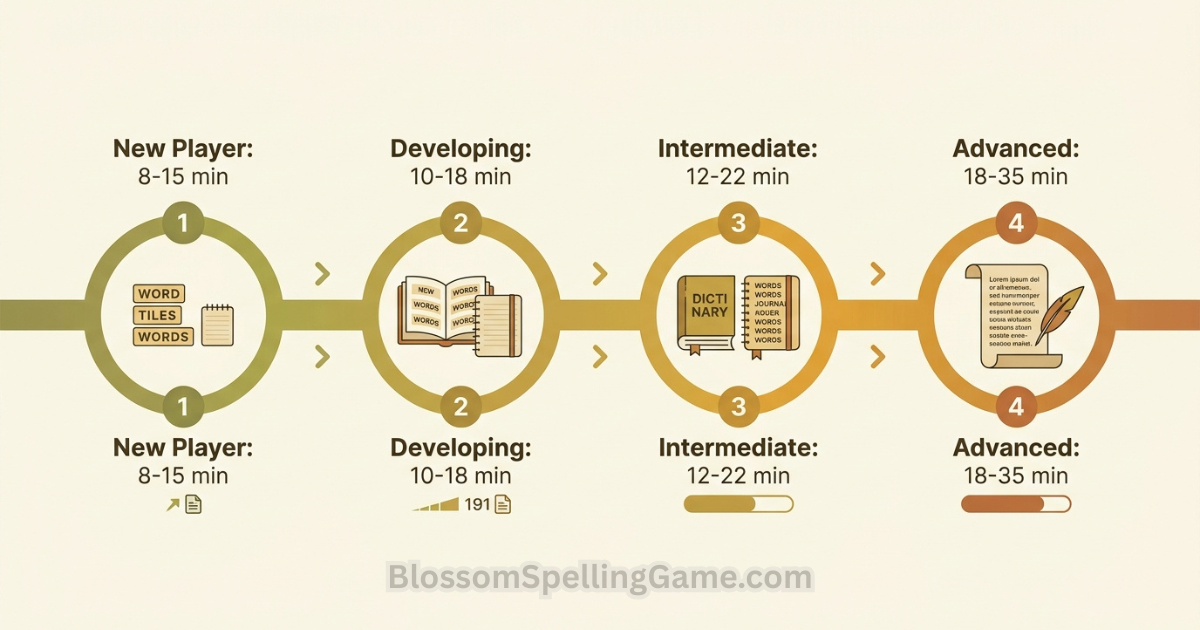
New players (first 1-4 weeks): Typical session: 8–15 minutes Typical word count: 5–8 words What’s happening: Getting familiar with the center letter rule, learning what kinds of words the game accepts, building intuition for the letter set. Sessions often end when the player runs out of ideas rather than slots.
Developing players (1–3 months regular play): Typical session: 10–18 minutes Typical word count: 8–11 words What’s happening: Suffix and prefix patterns becoming familiar, more systematic searching, occasionally finding the pangram. Sessions often end after a full 12-slot completion or a few minutes of failed new-word attempts.
Intermediate players (3–12 months): Typical session: 12–22 minutes Typical word count: 10–12 words What’s happening: Consistent suffix/prefix application, reliable pangram-hunting methodology, bonus petal optimization. Session length stabilizes in this range as efficiency improves.
Advanced players (12+ months, deliberate strategy): Typical session: 18–35 minutes Typical word count: 12 words + continued searching beyond minimum What’s happening: Full vocabulary coverage attempts, multi-phase search methodology, late-game recovery protocols. Sessions extend because players have more tools to deploy and more vocabulary territory to cover systematically.
The Puzzle Difficulty Factor
Session length doesn’t just vary by player — it varies by puzzle, for all players simultaneously.
Easy letter sets (common center letter, good vowel-consonant balance, familiar letter combinations): Even novice players find words relatively quickly, producing more words per minute of search. Advanced players may complete systematic coverage faster than usual.
Hard letter sets (rare center letter like X, Z, Q; unusual vowel counts; uncommon letter combinations): All players find words more slowly. Sessions either end earlier (fewer words found before the player exhausts their ideas) or run longer (the player spends more time on each word before finding it).
The paradox: Hard puzzles often produce shorter sessions for beginners (they give up earlier) and longer sessions for advanced players (they refuse to give up and methodically work harder territory). Easy puzzles often produce the reverse: beginners play longer because words keep coming; advanced players finish faster because their systematic approach deploys efficiently.
Practical implication: If a session took unusually long or short, don’t attribute it entirely to your performance. Compare the letter set difficulty to your typical experience — rare center letters and unusual consonant combinations naturally extend search time for everyone.
What “Finished” Means to Different Players
One of the most variable factors in session length is what the player considers a completed session. Unlike games with fixed completion criteria, Blossom’s only hard completion point is filling all 12 slots — and even that isn’t required.
Finished = streak protected: One valid word submitted. Minimum time, minimum engagement, maximum streak protection.
Finished = exhausted obvious words: Played until no new words came to mind easily, then stopped. Session ends when the low-hanging fruit is gone.
Finished = filled all 12 slots: Played until all word slots were filled, regardless of score. Session ends at the 12-word completion marker.
Finished = found the pangram: Session ends specifically after finding the pangram, with other words secondary. Some players treat pangram discovery as the natural conclusion.
Finished = genuinely exhausted the vocabulary territory: Applied systematic coverage to the full letter set — suffix sweep, prefix scan, category sweep, negative space analysis — and then stopped. This is the “true” completion criterion by which expert players measure their sessions.
None of these is objectively correct. The right completion criterion depends on how much time you have, what you’re trying to accomplish, and what gives you the most satisfaction from the session. A player in the habit-building phase benefits from stopping when they feel satisfied, not when they’ve exhausted every strategy. A player actively working on score improvement benefits from pushing past the obvious completion point.
Is Spending More Time Always Better?
No — and this deserves emphasis because longer isn’t intuitively associated with worse in most skill-building contexts.
The diminishing returns curve: Each additional minute of search time produces fewer new words than the previous minute, as the most accessible vocabulary is found first and the remaining words are progressively harder to surface. The first five minutes of a session typically produce your best word-per-minute rate; the last five minutes often produce very few additional words relative to time invested.
The distraction danger: Extended sessions in distracted conditions — partial attention, frequent interruptions, playing while doing something else — produce poor word-per-minute rates and often fail to generate the words that focused play would find in a quarter of the time.
The quality vs. quantity principle: A focused 12-minute session with deliberate suffix/prefix scanning typically outperforms a distracted 25-minute session with scattered, intuitive searching — both in word count and in satisfaction. If you’re going to play longer, play more intentionally, not just for longer.
The right question: Rather than “how long should I play?”, ask “am I still finding new words at a rate that justifies continued searching?” When new words stop coming and extended effort isn’t producing results, stopping is often the correct call — both for your score-per-time efficiency and for maintaining a positive relationship with the game.
The Daily Habit Sweet Spot
For most players pursuing a sustainable daily habit — covered fully in our Daily Habit Guide — the optimal session length is the one that’s long enough to feel genuinely satisfying and short enough to remain completable every day without becoming a burden.
Research on habit formation suggests that habits that take variable, sometimes-long amounts of time are harder to maintain consistently than habits with a predictable time cost. For Blossom, this argues for having a target session length in mind rather than an open-ended “play until done” approach.
The most commonly reported sustainable session length: 15–20 minutes. Long enough for a satisfying vocabulary workout that often includes finding the pangram; short enough to fit comfortably into a morning routine before other demands begin.
For time-constrained players: A reliable 8–10 minute session beats an inconsistent 20–30 minute session. Shorter but consistent produces better long-term outcomes than longer but sporadic — both for skill development (covered in our Cognitive Benefits guide) and for habit maintenance.
For improvement-focused players: Gradually extending your typical session by 2–3 minutes, rather than dramatically increasing all at once, allows skill development to keep pace with time investment and prevents the session from becoming a frustrating grind before you have the tools to fill the extended time productively.
Practical Time Budgeting for Different Schedules
If you have 5 minutes or less: Minimum viable session. Find and submit one word to protect your streak, then close. Do this rather than skipping — a brief session is vastly better for habit continuity than a missed day. See our Streak Guide for the reasoning.
If you have 5–10 minutes: A solid casual session. Submit what you find naturally, without systematic extension-testing or dedicated pangram-hunting. Accept whatever word count emerges and close without pushing for more.
If you have 10–20 minutes (the standard window): This is the full recommended session. Apply basic suffix/prefix scanning, make a genuine pangram attempt in the middle of the session, optimize for the bonus petal letter on late-session submissions. This time window supports the complete strategy at intermediate level.
If you have 20–30 minutes: Add the full exhaustion sequence from our Advanced Strategies guide — constellation mapping, systematic category sweeps, multiple pangram search passes, negative space tracking. This is the window where the difference between intermediate and advanced players becomes visible in outcomes.
If you have 30+ minutes: Attempt comprehensive coverage. Apply every technique in the advanced toolkit, check the archive afterward to see what you missed, and do a brief post-session word bank update. This is optimal-benefit territory but not necessary for a healthy daily habit.
FAQ
How long does a Blossom Word Game puzzle take?
Anywhere from under 3 minutes (minimum viable, one word submitted) to 45+ minutes (comprehensive expert coverage of all valid words). The typical range for most regular players is 12–22 minutes. Session length depends on skill level, letter set difficulty, play style, and what the player considers “done.”
What’s a normal session length for Blossom?
For most regular players, 12–22 minutes is a typical session. Beginners often land in the 8–15 minute range; experienced players frequently run 15–25 minutes as their strategies become more systematic and their vocabulary coverage more thorough.
Is it better to play Blossom quickly or take more time?
Neither is universally better — focused, intentional play of any duration outperforms distracted play. If you’re going to extend your session, do so with deliberate strategy application, not aimless continued searching. A focused 12 minutes typically produces better outcomes than a distracted 25.
How long does it take to find the pangram?
Extremely variable. Some players find the pangram within the first two minutes; others spend 20+ minutes before finding it (or never do). The average time-to-pangram is closely tied to vocabulary depth and familiarity with the pangram-hunting methodology covered in our Pangram Guide.
What’s the minimum time needed for a complete Blossom session?
Technically under a minute — one valid word submission is all that’s required to complete the session and protect your streak. For a session that genuinely explores the puzzle (5+ words, at least one pangram attempt), 8–10 focused minutes is a reasonable minimum.
Does spending more time always lead to a higher score?
Not necessarily. Each additional minute produces fewer new words as accessible vocabulary depletes. Focused shorter sessions often outscore distracted longer sessions. The quality and intentionality of the search matters more than raw time invested beyond a certain threshold.
Final Thoughts
There’s no objectively correct Blossom session length — there’s the session length that fits your schedule and matches your current skill level’s productive capacity. That range shifts upward as your vocabulary and strategy develop, and it shifts down appropriately on days when time genuinely doesn’t allow more.
The most practically useful framing: budget a specific window (15 minutes is a good default), play deliberately within that window, and close when the time is up rather than playing open-endedly until you feel done. This keeps sessions predictable, sustainable, and appropriately intense — all of which matter more for long-term improvement than any specific minute count.
Play today’s puzzle at BlossomSpellingGame.com. Whatever time you have, it’s enough.