
The most productive best word patterns in Blossom Word Game — high-frequency letter clusters, vowel patterns, and structural templates that consistently surface scoring words.
Every Blossom player eventually develops a set of go-to mental templates — letter combinations they know consistently produce valid words when the right letters are available. The player who sees T, R, A, I, N and immediately thinks of the -ATION family, or spots S, T, R and runs through STR- words, is accessing a pattern library built from accumulated play experience.
This article makes that pattern library explicit. Not strategic tips about how to use patterns (covered in our Tips guide and Advanced Strategies guide), but a concrete reference catalog of the most reliable, highest-frequency word patterns in Blossom — the letter clusters, structural templates, and vowel-consonant combinations that most productively generate valid Merriam-Webster words when the required letters are available.
Think of this as a lookup reference: here’s what to test when you have these letters.
How to Use This Pattern Catalog
This article is designed as a reference, not a narrative. Scan the patterns relevant to your current letter set when you’re stuck, not as linear reading. The most productive use: bookmark it, and when a session stalls, check which patterns your available letters can activate.
Each pattern section describes the letter combination, gives high-frequency example words, and notes the letter requirements for activation — so you can quickly assess whether the pattern is viable in today’s puzzle without testing dead ends.
High-Frequency Consonant Cluster Patterns
These consonant combinations appear in large numbers of English words. When they’re available in your letter set, they unlock disproportionate word count.
STR- cluster (S, T, R required) One of the most productive three-consonant clusters in English. Activates immediately when S, T, and R are all present alongside at least two vowels. Key words: STRANGE, STRONG, STRIKE, STREAM, STRING, STREET, STRAIN, STRESS, STRIP, STRAY, STRUT, STRIDE, STROKE, STROBE Strategy: When you see S, T, R in your set, treat STR- as your first dedicated search territory before moving to other combinations.
SPL- cluster (S, P, L required) Less common than STR- but highly productive when available. Key words: SPLASH, SPLIT, SPLINT, SPLENDID, SPLAY, SPLICE, SPLEEN Strategy: P and L together with S signal SPL- territory. Short but valid words like SPLIT and SPLAY are easy finds; longer ones like SPLENDID require more letters but score highly.
SCR- cluster (S, C, R required) Key words: SCREEN, SCREAM, SCRUB, SCROLL, SCRAP, SCRIPT, SCRATCH, SCREW Strategy: When C and R are both in your set alongside S, run the SCR- family before treating C and R as separate petal letters.
THR- cluster (T, H, R required) Key words: THREE, THROW, THROUGH, THRUST, THREAD, THRONE, THRILL, THROB Strategy: H is an uncommon petal letter in Blossom — when it appears, immediately check whether T and R are also available to activate the THR- family.
SPR- cluster (S, P, R required) Key words: SPRING, SPREAD, SPRINT, SPROUT, SPRAY, SPREE Strategy: Pairs well with -ING: SPRING, SPREADING, SPROUTING all available when letters permit.
SHR- cluster (S, H, R required) Key words: SHRINK, SHRUG, SHRUB, SHRED, SHREWD Strategy: Another H-dependent cluster. When H appears, check SHR- alongside THR-.
PHL- / PHR- clusters (P, H + L or R) Key words: PHRASE, PHLEGM (rare but valid), PHRASEBOOK Strategy: PH digraph — when P and H are both in your set, they function as a single F-sound unit in words like PHRASE, PHONE (needs O), PHOTO (needs T, O).
Vowel Combination Patterns
Vowel combinations create distinctive word families. Knowing which vowel pairs are in your set narrows your search to specific productive territory.
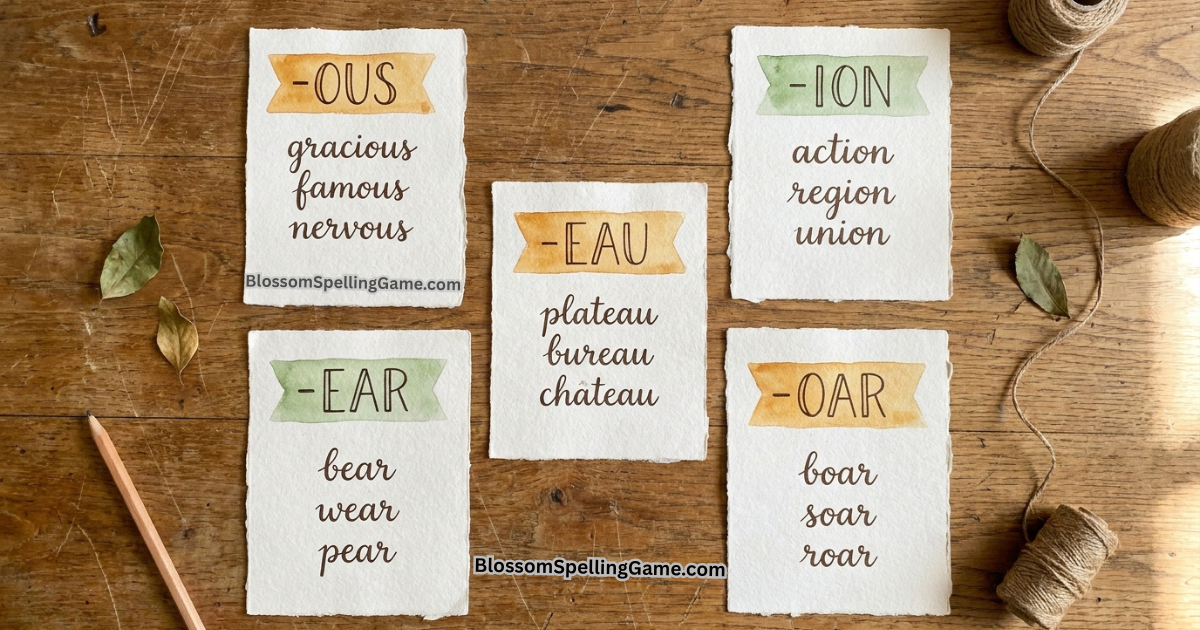
-EAU- pattern (E, A, U together) A French-loan vowel cluster that appears in more valid Blossom words than most players expect. Key words: BEAUTY, BUREAU, PLATEAU, TABLEAU, CHATEAU, BEAU, BEAUTIFUL Strategy: When E, A, U are all present, actively hunt -EAU- words — they’re often longer than typical vowel-heavy combinations and tend to be overlooked.
-OUI- / -OUI pattern (O, U, I together) Less common but signals specific vocabulary territory including ROUILLE (rare), LOUIS (proper noun — won’t work), FLUID-adjacent words. Strategy: More useful to scan for -OUS- combinations (O, U, S): FAMOUS, JOYOUS, NERVOUS, POROUS, ODIOUS.
-OUS- pattern (O, U, S required) Extremely productive. Activates a large adjective family. Key words: FAMOUS, JOYOUS, POROUS, ODIOUS, GLORIOUS, CURIOUS, FURIOUS, SERIOUS, VARIOUS Strategy: When O, U, and S are all in your set, actively generate -OUS adjective candidates before moving to other endings.
-ION pattern (I, O, N required) Both a standalone word (ION — too short at 3 letters) and the ending of a massive word family. Key words: NOTION, OPTION, MOTION, RATION, NATION, ACTION, LOTION, POTION, VISION Strategy: When I, O, N are present, run every common -ION word against your letter set — this single pattern often yields 3-5 valid words in productive letter combinations.
-EAR pattern (E, A, R required) Key words: NEAR, FEAR, HEAR, WEAR, YEAR, CLEAR, SMEAR, SPEAR, LEARN, EARLY, EARTH, HEART, SEARCH Strategy: -EAR produces both 4-letter minimum words and extended forms (CLEARLY, NEARLY, LEARNING, SEARCHING) when additional letters are available.
-OAR / -OAK / -OAT pattern (O, A + final consonant) Key words: BOARD, SOAR, ROAR, COACH, CLOAK, BLOAT, FLOAT, THROAT Strategy: OA is a productive vowel pair — when O and A are both in your set, systematically test common consonant endings.
-EE- pattern (double E) Activates when E is your center letter (reusable) or when E appears twice isn’t needed — words simply needing two E’s in sequence. Key words: STREET, SCREEN, STEEP, SPEED, GREED, FREED, STEEL, WHEEL, THREE Strategy: With E as center letter, remember every -EE- word automatically satisfies the center letter requirement while using E in the word twice legitimately.
Word-Ending Template Patterns
These are specific word endings that, when the required letters are available, reliably produce multiple valid Blossom submissions. Think of each as a template: [variable root] + [fixed ending].
-IGHT template (I, G, H, T required) Key words: BRIGHT, FLIGHT, KNIGHT, LIGHT, MIGHT, NIGHT, RIGHT, SIGHT, TIGHT, BLIGHT, FRIGHT, SLIGHT One of the most productive fixed-ending templates in English. H is the limiting factor — when H is in your set alongside I, G, T, test every common consonant or consonant cluster before -IGHT.
-OUND template (O, U, N, D required) Key words: BOUND, FOUND, GROUND, MOUND, POUND, ROUND, SOUND, WOUND, AROUND, HOUND, MOUND Strategy: When O, U, N, D are all present, systematically test every initial consonant and cluster: B-OUND, F-OUND, GR-OUND, H-OUND, M-OUND, P-OUND, R-OUND, S-OUND.
-ATION template (A, T, I, O, N required) Key words: NATION, STATION, RATION, CREATION, ROTATION, RELATION, DURATION, LOCATION One of the highest-scoring ending templates when letters allow — all -ATION words are at least 6 letters, producing 6+ points before any bonuses.
-TION template (T, I, O, N required) Broader than -ATION, covers words where the root doesn’t end in A: Key words: NOTION, MOTION, OPTION, LOTION, POTION, ACTION, SUCTION, FICTION, MENTION, TENSION
-NESS template (N, E, S required) Covered extensively in our Suffix guide but worth listing as a template: any adjective + NESS produces a valid noun. When N, E, S are available, every adjective in your set is a potential NESS word.
-MENT template (M, E, N, T required) Key words: MOMENT, COMMENT, CEMENT,LEMENT,ALMENT, TREATMENT, MOVEMENT, PAYMENT Strategy: M is a medium-frequency letter — when M appears alongside E, N, T, actively hunt -MENT words before treating M as an isolated petal.
-LING template (L, I, N, G required) Key words: DARLING, STARLING, DUCKLING, EARTHLING, HIRELING, INKLING Strategy: -LING produces both long words (EARTHLING, STARLING) and shorter ones (INKLING). When L, I, N, G are all present, test noun roots before the -LING ending.
-WARD template (W, A, R, D required) Key words: TOWARD, INWARD, ONWARD, FORWARD, OUTWARD, REWARD, WAYWARD Strategy: W is an uncommon letter — when it appears, immediately activate the -WARD family alongside the OVER- prefix family.
Word-Beginning Template Patterns
Fixed beginnings that signal specific vocabulary clusters when those starting letters are available.
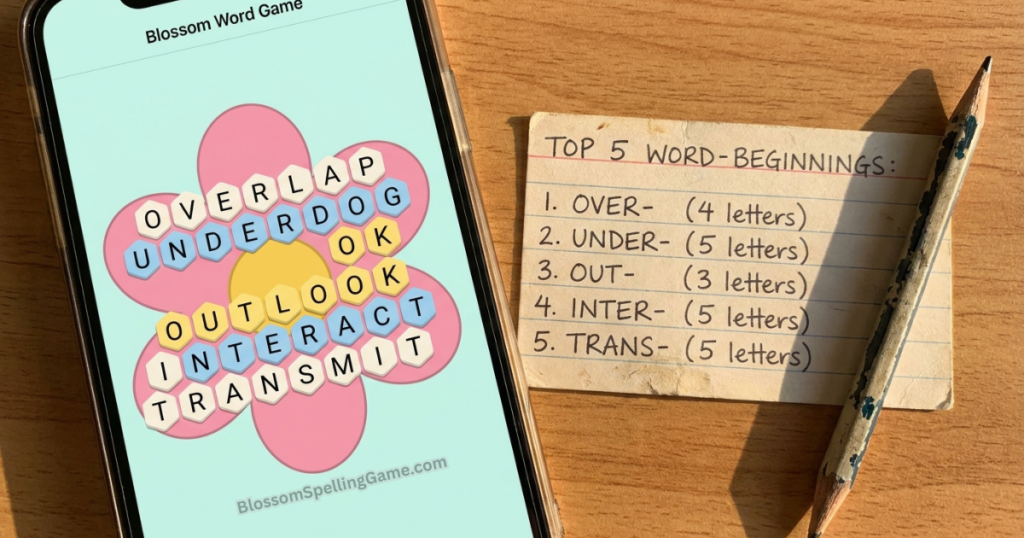
OVER- template (O, V, E, R required) Key words: OVERCOME, OVERLOOK, OVERFLOW, OVERRULE, OVERTURN, OVERDUE, OVERSIGHT Strategy: V is rare — when it appears with O, E, R, OVER- is your most productive word-beginning template. See our Prefix guide for the full OVER- vocabulary.
UNDER- template (U, N, D, E, R required) Key words: UNDERSTAND, UNDERTAKE, UNDERMINE, UNDERLINE, UNDERWATER, UNDERGO Strategy: Requires five specific letters — check availability carefully, but when all five are present, UNDER- words are among the longest and highest-scoring in any session.
OUT- template (O, U, T required) Key words: OUTLINE, OUTDOOR, OUTCOME, OUTSIDE, OUTRUN, OUTGROW, OUTRAGE, OUTLAST Strategy: Very common letter combination — O, U, T appear frequently. When all three are present, actively run the OUT- family before treating them as separate letters.
INTER- template (I, N, T, E, R required) Key words: INTEREST, INTERNAL, INTERACT, INTERNET, INTERIM, INTERPRET, INTERRUPT Strategy: INTER- words tend to be 8-10 letters, producing high point values. When I, N, T, E, R are all available, this is one of the highest-expected-value template searches available.
TRANS- template (T, R, A, N, S required) Key words: TRANSFER, TRANSFORM, TRANSPORT, TRANSIT, TRANSLATE, TRANSPARENT Strategy: All TRANS- words are 7+ letters and score accordingly. When T, R, A, N, S are all present, check TRANS- before treating them as individual petal letters.
COUNTER- template (C, O, U, N, T, E, R required) Key words: COUNTERACT, COUNTERFEIT, COUNTERPART, COUNTERPOINT Strategy: Requires 7 letters including the center letter — effectively only viable in very specific letter combinations, but produces extremely long words when it works.
Compound Word Structural Patterns
Closed compound words — two words written as one — are a consistent source of longer, higher-scoring words that players often miss because they don’t immediately read as “one word.”
LIGHT compounds STARLIGHT, SUNLIGHT, MOONLIGHT, FIRELIGHT, DAYLIGHT, FLASHLIGHT, SPOTLIGHT, FLOODLIGHT Pattern: [light source or illuminated object] + LIGHT Letters needed: L, I, G, H, T plus the root letters
WORK compounds TEAMWORK, FRAMEWORK, GROUNDWORK, NETWORK, ARTWORK, HOMEWORK, WOODWORK, IRONWORK Pattern: [domain or material] + WORK Letters needed: W, O, R, K plus the root letters
LAND compounds MAINLAND, FARMLAND, HIGHLAND, LOWLAND, WOODLAND, HOMELAND, WETLAND, ISLAND Pattern: [terrain descriptor] + LAND Letters needed: L, A, N, D plus the root letters
SIDE compounds HILLSIDE, LAKESIDE, RINGSIDE, ROADSIDE, HILLSIDE, BEDSIDE, FIRESIDE, INSIDE, OUTSIDE Pattern: [location] + SIDE Letters needed: S, I, D, E plus the root letters
STONE compounds LIMESTONE, MILESTONE, CORNERSTONE, COBBLESTONE, SANDSTONE, GEMSTONE, KEYSTONE Pattern: [type or quality] + STONE Letters needed: S, T, O, N, E plus the root letters
Strategy for compound word hunting: When you spot a common high-frequency word component (LIGHT, WORK, LAND, SIDE, STONE, HOUSE, WOOD, FIRE) in your letter set, actively scan for words that can precede it to form valid closed compounds. This is one of the most reliable sources of 8-10 letter words in any session.
Double-Letter Patterns Worth Knowing
Double letters in Blossom are valid — any letter in your set can appear multiple times in a single word. These patterns specifically require a double letter to appear in the word, which is only possible if the letter can be reused from your set.
Double-L words TALL, BALL, CALL, FALL, HALL, WALL, SPELL, SHELL, STILL, SPILL, SKILL, GRILL, REALLY, FINALLY, TOTALLY, USUALLY Strategy: L is a common petal letter. When L is in your set, words requiring LL are all fair game.
Double-S words GRASS, CLASS, GLASS, STRESS, PRESS, BLESS, DRESS, GUESS, LESSON, PASSION, MISSION, POSSESS Strategy: When S is in your set, -SS words activate. POSSESS requires three S’s (one in the prefix POS-, one in the middle, one at the end — actually just two S’s: PO-SS-ES-S — four letters in the word are S). Only two distinct S instances needed since letters can repeat from the same petal.
Double-T words BUTTER, BETTER, LETTER, MATTER, BITTER, LITTLE, BOTTLE, SETTLE, BATTLE, PRETTY, SETTING, GETTING Strategy: T is one of the most common center letters and petal letters. When T is in your set, -TT- words are highly available.
Double-R words BARREL, CARROT, MIRROR, TERROR, HORROR, CURRENT, CORRECT, ARRANGE, ARRIVE, ERROR Strategy: R is a common letter. When R is in your set, words with RR are available across many root types.
The Most Productive 7-Letter Pattern Templates
These specific structural patterns — all producing 7-letter words and thus scoring 12 base points before any bonuses — are worth memorizing as dedicated search targets.
[4-letter root] + -ING (12 points) READING, WRITING, TURNING, BURNING, FALLING, CALLING, EARNING, TURNING, WALKING, TALKING, HELPING, MELTING Strategy: Any 4-letter verb root + ING = 7-letter word = 12 points + potential pangram.
[3-letter root] + -TION (7 points base, -TION adds 4 letters) NOTION, MOTION, OPTION, LOTION, POTION — only 6 letters. Need longer roots: MENTION (7), TENSION (7), PORTION (7), CAUTION (7), FACTION (7), AUCTION (7) Strategy: 3-letter Latin roots + TION = 7-letter words. When T, I, O, N are available, hunt 3-letter compatible roots.
[3-letter root] + -NESS (7 letters, scores 12) SADNESS (7), MADNESS (7), BADNESS (7), GLADNESS (8), FITNESS (7), WITNESS (7) Strategy: 3-consonant + -NESS = 7-letter words when N, E, S are available alongside the root.
RE- + [5-letter root] (7 letters, scores 12) REFORM, RETURN, RESULT, REMIND, REMAIN, REPAIR, REPEAT, RECALL, REFILL, RESIST, REPORT, REVIEW, REVEAL, REMOVE Strategy: RE- + 5-letter common verb = 7 letters. When R and E are both in your set, systematically test 5-letter root candidates.
FAQ
What are the most productive word patterns in Blossom Word Game?
The highest-yield patterns are the -ING suffix (adds 3 letters to any verb root, very high applicability), the -TION ending (produces 7+ letter words when T, I, O, N are available), the -OUS ending (large adjective family when O, U, S are present), and the RE- prefix (attaches to most common verbs when R and E are in your set). Consonant clusters like STR-, OUT-, and INTER- also unlock large word families.
How do I find longer words using patterns?
Start from a recognizable fixed ending or beginning and build backward or forward. See a T, I, O, N in your set? List -TION words and check if your remaining letters can form valid roots. See STR- in your letters? Run through STRONG, STRANGE, STREAM, STRING systematically. Pattern-first searching is faster than letter-by-letter random generation.
What double-letter words should I know for Blossom?
Words with double-L (REALLY, FINALLY, SKILL), double-T (BETTER, SETTING, BATTLE), double-S (STRESS, LESSON, PASSION), and double-R (CURRENT, CORRECT, BARREL) are consistently valid and worth testing when the base letter appears in your set, since letters can be reused in Blossom.
Do compound words count in Blossom?
Yes — closed compound words (written as one word without hyphens or spaces) are valid dictionary entries that Blossom accepts. STARLIGHT, FRAMEWORK, MAINLAND, FIRESIDE are all valid when letters allow. Hyphenated compounds and two-word phrases are not accepted.
Final Thoughts
The players who consistently find the most words in any letter set aren’t necessarily the ones with the largest raw vocabularies — they’re the ones who’ve built the most comprehensive internal pattern library. Every STR- word, every -TION candidate, every OVER- variant they know is a pre-computed word family that activates instantly when the right letters appear, without requiring a fresh vocabulary search from scratch.
This catalog is a starting point for building that library. The patterns that prove most useful to you specifically will depend on your existing vocabulary strengths and gaps — but the ones listed here are the most broadly reliable starting points across the widest range of Blossom players.
Play today’s puzzle at BlossomSpellingGame.com. Before your first submission, scan your letters for any pattern templates you recognize — STR-, -ION, OVER-, -IGHT — and let those familiar territories be your first search zones.