

How to actively maximize vocabulary learning from Blossom Word Game — specific techniques for turning daily sessions into genuine vocabulary growth, not just entertainment.
Most people who play Blossom Word Game improve their vocabulary as a side effect — words accumulate, unfamiliar terms get confirmed as real through accepted submissions, and the daily retrieval practice builds fluency over time. That passive improvement is real and documented.
But passive improvement is slower and shallower than deliberate improvement. Players who actively extract vocabulary learning from each session — by doing specific things before, during, and after play — build vocabulary faster, retain new words more reliably, and develop a more useful word knowledge than those who simply play and let learning happen organically.
This guide is entirely practical: specific actions, specific habits, specific techniques. The why-it-works is covered in our Vocabulary Improvement guide. This guide is the how-to-do-it companion — what to do with that knowledge to actually accelerate your vocabulary growth session by session.
The Three-Phase Vocabulary Session Structure
Most players treat a Blossom session as one undifferentiated block of time — open, play, close. Players who want to maximize vocabulary growth structure sessions in three distinct phases with different intentions.
Phase 1 — Active play (10-20 minutes): Play normally but apply the uncertainty-first rule (below). Focus on finding words and applying the scoring strategies from our Tips guide.
Phase 2 — Quick look-up (2-3 minutes, during or immediately after): While the session is still fresh, look up any word you found that you weren’t sure about. Not all words — just the uncertain ones, the ones where you submitted and thought “I wonder what that actually means.”
Phase 3 — Archive review (5 minutes, next day): After the daily reset, check yesterday’s complete word list in the archive. Identify the words you missed. Look up any you don’t know. Add interesting ones to your vocabulary journal.
Total time investment beyond normal play: 7-8 minutes. Vocabulary learning rate compared to passive play: roughly 3-4x higher, because you’re closing the learning loop on every session rather than leaving it open.
During Play: The Uncertainty-First Rule
This is the single highest-impact in-session change for vocabulary growth.
What it is: Deliberately submit words you’re uncertain about — not words you know are valid, but words at the edges of your vocabulary where you’re genuinely unsure.
Why most players do the opposite: The natural tendency is to submit confident words and hesitate on uncertain ones, to avoid “wasting” a slot on a word that might not be accepted. But since rejected submissions don’t cost slots (only accepted words count toward your 12), testing uncertain words is completely free from a slot perspective.
The vocabulary learning mechanism: A word you’re uncertain about and then test produces much stronger learning than a word you already know confidently. The uncertainty creates a “prediction error” signal in the brain — you expected one outcome (rejection or acceptance), got the opposite, and the brain treats this mismatch as high-priority information. This mechanism produces stronger long-term retention than encounters with words you already know.
Implementation: Each session, make a conscious effort to test at least 3-5 words that you’re genuinely unsure about. Not wild guesses — words you recognize from reading or passive vocabulary but wouldn’t be certain enough to use in writing. The accepted ones become vocabulary you can now deploy actively; the rejected ones tell you where your intuition was wrong about dictionary validity.
During Play: The Instant Lookup Habit
What it is: When a word you submitted gets accepted and you realize you don’t know exactly what it means — look it up immediately, before you forget.
The 30-second habit: Keep a browser tab with merriam-webster.com open alongside your Blossom session. When you submit a word you’re uncertain about and it gets accepted, immediately switch to M-W and read the definition. Don’t wait — do it now, while the word is freshly encoded in working memory. The semantic context (what the word means) will link to the freshly active phonological and orthographic memory (how it sounds and is spelled), creating a much richer vocabulary entry than either dimension alone.
What to look for in the definition:
- The primary meaning (what does this word actually mean?)
- The part of speech (noun, verb, adjective — this affects how you can use it)
- An example sentence if provided
- Related words listed at the bottom of the M-W entry (these often surface additional Blossom-relevant vocabulary)
The “use it in a sentence” extension: After reading the definition, spend 5 seconds mentally using the word in a sentence. Not written down — just thought through. This brief usage simulation activates the word’s semantic network and dramatically improves retention compared to reading a definition passively.
After Play: The Five-Minute Archive Review
This is covered in depth in our Archive Guide, but deserves emphasis here specifically as a vocabulary-building tool rather than just a puzzle-review tool.
The workflow:
- The morning after your session (after the daily reset), open the archive for yesterday’s puzzle
- Compare your submitted word list to the complete valid word list
- For every word you missed, identify which of three categories it falls into:
- Vocabulary gap: You didn’t know this word existed
- Retrieval gap: You know the word but didn’t retrieve it under the session’s constraints
- Strategy gap: You could have found it with better suffix/prefix application
Why categorizing matters: Each gap type has a different fix.
- Vocabulary gaps → look up the missed word and add to your vocabulary journal
- Retrieval gaps → note the word; it will come more easily next time it appears
- Strategy gaps → review the relevant technique (suffix guide, prefix guide, etc.)
The vocabulary journal connection: Every genuine vocabulary gap word — a word you missed because you didn’t know it existed — should go directly into your personal vocabulary journal (described below). These are the words where the greatest learning opportunity lives.
After Play: Building Your Personal Vocabulary Journal
This is the highest-leverage long-term habit for players who want to actively use Blossom as a vocabulary-building tool.
What it is: A simple, ongoing record of interesting words you encounter through Blossom — words accepted unexpectedly, words found in archive review that you didn’t know, words whose meanings you looked up and want to remember.
Format (keep it simple): One entry per word:
- The word
- Its definition (in your own words, not copied)
- An example sentence you wrote yourself
- Date encountered in Blossom
Platform: A notes app on your phone (so it’s accessible immediately after a session), a physical notebook, or a simple document — whichever you’ll actually maintain. Don’t make the format so elaborate that maintaining it becomes a task.
How to use it:
- Weekly review: Read through the past week’s entries once per week, spending 10-15 seconds on each word
- Writing application: When drafting anything written (emails, notes, papers), deliberately scan your recent vocabulary journal entries and see if any word fits what you’re writing
- Monthly review: Once per month, read the entire journal from the beginning. Words you’ve forgotten will jump out; words that have become genuinely active will feel familiar
The compounding effect: A journal maintained for 3 months typically contains 30-50 new words specifically acquired through deliberate Blossom-adjacent learning. In six months, 60-100. In a year, a genuinely meaningful vocabulary expansion, all traced to specific game sessions.
The Look-Up-and-Use Technique
This is a specific technique for converting a passively known word into an actively used one — the passive-to-active conversion that makes vocabulary genuinely yours rather than just something you recognize.
The three steps:
- Look it up: Read the Merriam-Webster entry for the word
- Write a sentence: Write one original sentence using the word. Not copied from M-W — your own. This can be in your vocabulary journal, a note app, or anywhere.
- Use it: Within 24 hours of the look-up, find a natural opportunity to use the word in context — in an email, a text, a conversation, anything written. Even one genuine usage is enough to begin the active-vocabulary encoding.
Why step 3 matters most: Reading a definition is passive exposure. Writing a sentence is active production but still in a controlled context. Actually using the word in live context — where you chose it because it fit what you were expressing — is the deepest encoding of all. It anchors the word to a real communicative context that you can mentally retrieve alongside the word’s form.
The minimum viable version: If fully implementing this for every new word feels like too much, apply it selectively to words you explicitly want in your active vocabulary. Words you’re curious about but don’t particularly need to use can stay in the journal without the look-up-and-use sequence. Reserve the three-step technique for the 5-10 most interesting or useful words you encounter per month.
Weekly Vocabulary Review Ritual
Spaced repetition — reviewing material at increasing intervals — is the most efficient way to move words from short-term to long-term memory. A simple weekly ritual implements this without requiring dedicated study time.
The 10-minute Sunday review (or any consistent weekly slot):
- Open your vocabulary journal
- Read this week’s new entries — spending 5-10 seconds on each, trying to recall the meaning before reading it
- Read any entries from two weeks ago where you couldn’t immediately recall the meaning
- Note any words that feel genuinely active now (you’ve used them or they came to mind naturally during the week) — these can be graduated to a “mastered” section
The underlying mechanism: Each review session reinforces the memory trace while the word is still somewhat accessible but before it would fully fade. This produces the “spacing effect” described in our Cognitive Benefits guide — distributed review over time produces stronger retention than concentrated review in one session.
Why weekly rather than daily: Daily review of the same words doesn’t provide enough forgetting gap to trigger the strengthening effect. Weekly review hits the sweet spot where the word is partially faded but still recoverable — which is exactly when effortful retrieval produces the strongest encoding boost.
Using Rejected Words as Learning Events
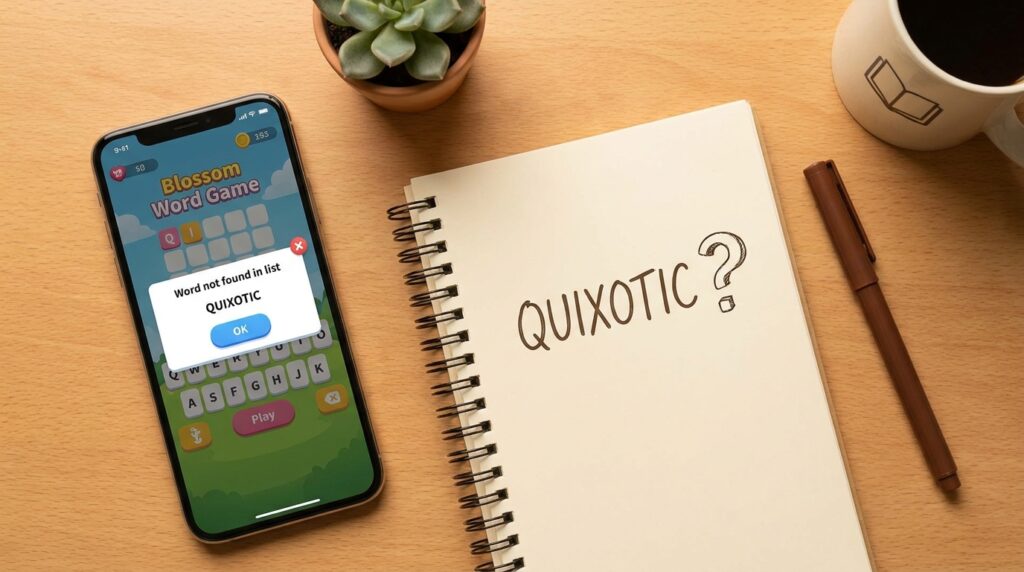
Rejections contain vocabulary information, not just scoring information — but only if you treat them as data rather than just failures.
The two productive responses to a rejection:
Response 1 — Confirm the correct form: If you submitted DREAMED and it was rejected, immediately try DREAMT. If GOODNESS was rejected, try GOODNESS again more carefully (was it a center letter error?) or GOODLY. The rejection tells you your submitted form was wrong — it doesn’t tell you the word doesn’t exist at all.
Response 2 — Look up the word: If a word you expected to be valid was rejected, look it up after the session. If it IS in M-W (valid word, just not in Blossom’s current validated set), note it — it may work in future sessions as Blossom’s list updates. If it ISN’T in M-W, you’ve identified a vocabulary boundary — your intuition about what’s “a real word” was wrong about this specific case.
Building negative vocabulary knowledge: Knowing what isn’t in the dictionary is as valuable as knowing what is. Each rejected word that you look up and confirm doesn’t exist (or exists only informally) calibrates your vocabulary intuition toward greater accuracy. This is how experienced players develop reliable word-validity instincts rather than perpetually guessing.
Connecting Blossom Words to Contextual Reading
The deepest vocabulary encoding comes from encountering a word in a rich semantic context — a sentence where meaning is supported by surrounding text. Blossom provides the form of words; reading provides the context.
The specific connection habit:
When you encounter a new word in Blossom — one you’ve looked up and added to your journal — deliberately watch for it when you read. Not by hunting through texts hoping it appears, but by remaining generally more alert than usual to vocabulary you recently encountered in Blossom.
This heightened attention, called the Baader-Meinhof phenomenon (or frequency illusion), means you’ll notice a word in your reading much more readily after deliberately learning it than you would have before. The word was probably always appearing in texts you read — you just weren’t primed to notice it.
The confirmation moment: When a Blossom word you recently learned appears in your reading in a full sentence, the meaning you looked up in the dictionary gets confirmed and contextualized by real usage. This is often the moment a word moves definitively from passive to active vocabulary — you now have both the definition AND a model sentence from a real author using it correctly.
Creating the opportunity deliberately: For words you especially want to absorb, search specifically for sentences using them. Searching “INEFFABLE used in a sentence” or finding a paragraph in a novel where a character uses OBSEQUIOUS — seeing the word in context from real written sources accelerates the encoding that dictionary definitions alone don’t fully achieve.
Targeting Your Specific Vocabulary Gaps
Generic vocabulary building — improving vocabulary across the board — is less efficient than targeted improvement in the specific areas where your gaps are largest.
Identifying your gaps:
After 20-30 sessions of archive review, patterns emerge in the words you consistently miss. These patterns usually fall into identifiable categories:
Domain gaps: You consistently miss words from a specific domain (botanical vocabulary, musical terminology, culinary terms, archaic English). This is addressable through selective reading in that domain.
Morphological gaps: You consistently miss specific suffix or prefix extensions — -OUS words, -ATE words, UNDER- words. Revisiting our Suffix and Prefix guides with these specific families as targets addresses this directly.
Register gaps: You consistently miss words from a specific register (formal academic vocabulary, archaic but active terms, scientific general vocabulary). This points to which type of reading would most benefit your Blossom vocabulary.
Pattern gaps: You consistently miss words following specific structural patterns (-IGHT words, compound words, double-letter words). The word patterns reference in our Word Patterns guide provides targeted practice for these.
Using the gap analysis: Once you’ve identified your top 2-3 vocabulary gap categories, allocate your learning time accordingly — archive review, vocabulary journal entries, look-up-and-use technique — specifically toward words in those categories rather than random vocabulary generally.
FAQ
Can you actively improve your vocabulary by playing Blossom?
Yes, significantly more so than through passive play alone. Players who apply deliberate vocabulary-building habits — the uncertainty-first rule, instant lookups, archive review, vocabulary journaling, and the look-up-and-use technique — improve their active vocabulary roughly 3-4 times faster than players who rely on incidental learning from normal play.
What’s the most important thing to do to learn vocabulary from Blossom?
The archive review habit — spending 5 minutes the day after each session looking at the complete word list and specifically looking up words you missed that you didn’t know — is the highest-leverage single habit. It closes the learning loop on every session rather than letting unenountered words pass unremarked.
Should I keep a vocabulary journal for Blossom?
If vocabulary building is a genuine goal rather than a side effect, yes. A simple journal — word, definition in your own words, example sentence, date encountered — maintained consistently for 3-6 months produces measurable vocabulary expansion that passive play alone doesn’t achieve at the same rate.
How long does deliberate vocabulary building take alongside normal play?
The core habits (instant lookup during play, 5-minute archive review after, vocabulary journal entry for new words) add about 7-10 minutes to a normal session. The weekly review adds another 10 minutes once per week. Total investment: roughly 20-25 additional minutes per week beyond normal play.
What types of words does Blossom help with most?
Tier 2 academic vocabulary — words like SALIENT, NUANCED, COGENT, UNTENABLE — where most educated adults have passive recognition but limited active production. Blossom’s generative format specifically targets this vocabulary tier, and deliberate practice maximizes the gains within it.
Final Thoughts
The difference between Blossom as entertainment and Blossom as a vocabulary-building tool is entirely in what you do with each session’s encounters. The game provides the raw material — accepted words, rejected forms, unfamiliar vocabulary surfaced through play — but converting those encounters into lasting vocabulary knowledge requires closing the loop deliberately.
Pick one habit from this guide and implement it for two weeks before adding another. The archive review is the highest-impact starting point for most players. Once that’s automatic, add the vocabulary journal. Then the look-up-and-use technique. Layer them gradually rather than starting everything at once.
A year of deliberate Blossom-adjacent vocabulary practice, built from 15 minutes of daily play plus 7-10 minutes of follow-up, produces vocabulary growth that would take significantly longer to achieve through casual reading alone — because the generative practice is a qualitatively better learning activity than passive exposure for the specific vocabulary skills that matter most.
Play today’s puzzle at BlossomSpellingGame.com. Before you close after the session, look up one word you found that you weren’t completely sure about. That one lookup is the first step of the whole system.