
A curated reference of rare but valid Blossom Word Game words — uncommon plurals, archaic terms, and unexpected dictionary entries organized by category with definitions.
Every experienced Blossom player has a story about the word they almost didn’t submit. The one that felt too obscure to be real, too unusual to be in the dictionary, too much like a guess to risk a slot on — and then got accepted.
Those surprising acceptances are some of the most memorable moments in Blossom play. They’re also, over time, some of the most educational — each one expands your working knowledge of what Merriam-Webster actually contains, and that knowledge compounds session after session.
This article is a curated reference of the rare-but-valid word categories that appear most frequently in Blossom: uncommon plurals, archaic but active dictionary entries, scientific vocabulary that’s crossed into general English, short words that feel too unusual to try, and word forms that feel wrong but are technically correct. Each entry includes a definition and notes on why it appears in Blossom despite feeling like it shouldn’t.
The purpose isn’t memorization — it’s calibration. The more you understand what Blossom actually accepts, the more confidently you’ll test words at the edges of your vocabulary rather than leaving them unsubmitted out of uncertainty.
Unusual But Valid Plurals
English has multiple plural formation systems inherited from Latin, Greek, and Old English, producing plural forms that don’t follow the standard -S or -ES pattern. These are consistently valid in Blossom when the letters allow.
Latin plurals (-A replaces -UM):
- DATUM → DATA (a datum; data is the plural — often used as singular in modern English but the plural form is standard)
- MEDIUM → MEDIA
- FORUM → FORA (less common than FORUMS but valid)
- CRITERION → CRITERIA
- PHENOMENON → PHENOMENA
- STRATUM → STRATA
- AQUARIUM → AQUARIA (also AQUARIUMS — both valid)
- CURRICULUM → CURRICULA
Greek plurals (-A replaces -ON):
- CRITERION → CRITERIA
- AUTOMATON → AUTOMATA
Latin plurals (-I replaces -US):
- CACTUS → CACTI
- FOCUS → FOCI
- STIMULUS → STIMULI
- RADIUS → RADII
- NUCLEUS → NUCLEI
- FUNGUS → FUNGI
- ALUMNUS → ALUMNI
- SYLLABUS → SYLLABI (also SYLLABUSES)
- TERMINUS → TERMINI
- LOCUS → LOCI
Greek plurals (-ES replaces -IS):
- ANALYSIS → ANALYSES
- BASIS → BASES
- CRISIS → CRISES
- THESIS → THESES
- HYPOTHESIS → HYPOTHESES
- AXIS → AXES
- DIAGNOSIS → DIAGNOSES
- PARENTHESIS → PARENTHESES
Why these matter for Blossom: These plural forms are often longer than their singular counterparts (NUCLEUS is 7 letters; NUCLEI is 6 — slightly shorter, but STIMULI is 7 letters from a 8-letter singular). When the right letters appear, these Latin and Greek plurals are reliable high-value words that less experienced players often don’t attempt.
Short Words That Feel Wrong
Some of the most surprising valid Blossom words are genuinely short — 4 or 5 letters — but feel unusual enough that players hesitate to submit them.
AEON — A very long indefinite period of time. From Greek AION. Completely standard in modern English, though the spelling EON is more common (both are valid).
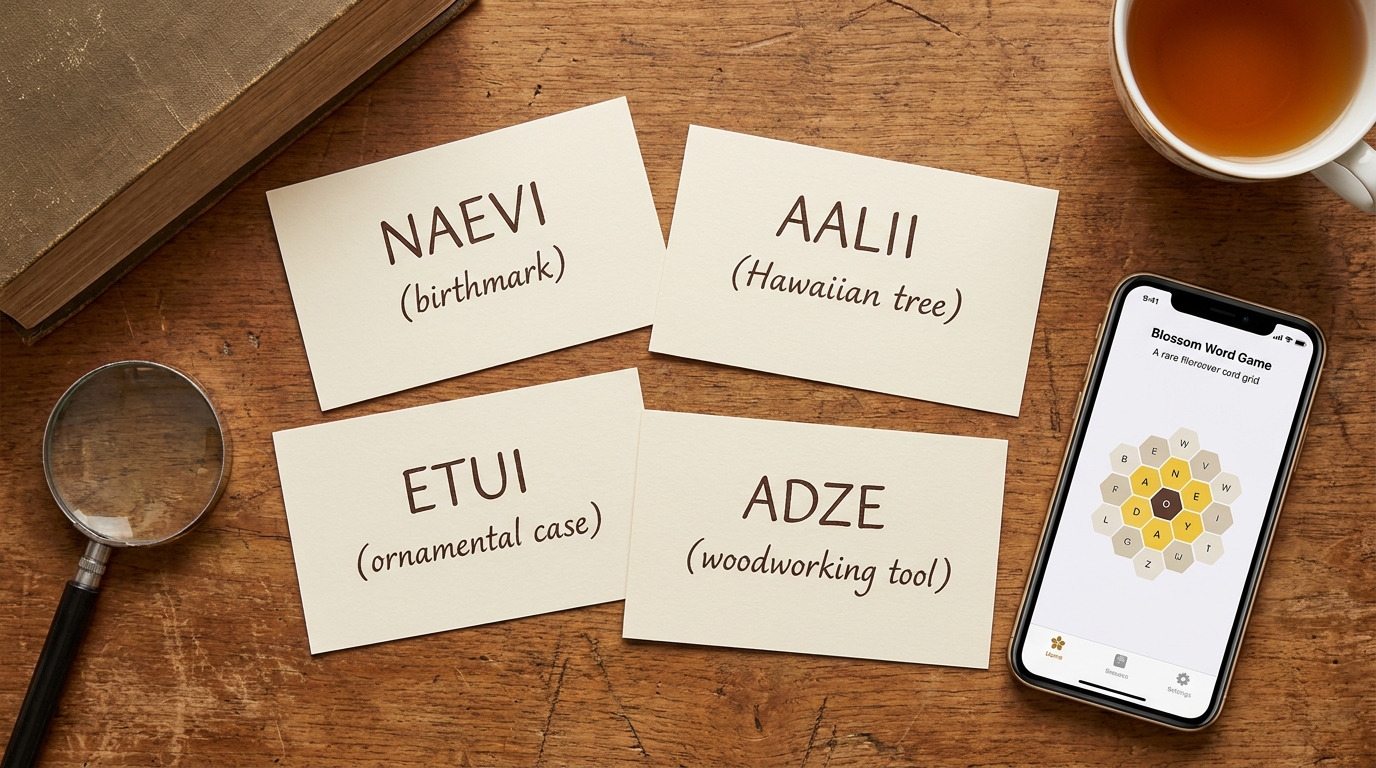
NAEVI — Plural of NAEVUS, a birthmark or mole. From Latin. Medical vocabulary that’s in standard M-W. Appears surprisingly often in Blossom sessions with N, A, E, V, I.
AALII — A Hawaiian tree (Dodonaea viscosa). Completely legitimate M-W entry. Particularly useful in Blossom because of its unusual double-A opening.
ADZE — A woodworking tool with an arched blade at right angles to the handle. Archaic in common usage but fully active in M-W. Valid in Blossom when A, D, Z, E are available.
ETUI — A small ornamental case for needles or other items. From French. Appears in M-W as a standard English borrowing.
OBOE — Common enough, but players sometimes hesitate because of the repeated O. Valid, of course. O can be reused in Blossom.
LIEU — “In lieu of” — in place of. Often uncertain because of the -IEU ending unusual in English. Fully valid.
QUAY — A wharf or platform for loading and unloading ships. Pronounced “KEY” — the spelling often surprises players. Valid.
KNAVE — A dishonest man; also the jack in a deck of cards. K is silent in pronunciation but present in spelling. Valid in Blossom when K, N, A, V, E are available.
JIBE — To be in accord; also a sailing term. Sometimes confused with GIBE (to taunt) — both are valid M-W entries.
LAVE — To wash. Archaic in modern speech but active in M-W. Appears in Blossom with L, A, V, E.
VALE — A valley. Poetic/literary but standard in M-W. Valid.
TOLE — Painted or lacquered metalware. Trade/craft vocabulary that appears in M-W.
ALOE — The succulent plant. Short, simple — but players sometimes hesitate on the vowel-heavy combination. Valid.
Archaic Terms Still Active in M-W
“Archaic” in dictionary terms means a word was common in an earlier period of English and is no longer in everyday use — but it’s still documented as a standard English word. Many archaic terms are fully valid in Blossom.
RUNE — A letter of an early Germanic alphabet; also a mystery or secret. Familiar enough but sometimes doubted by players. Valid.
BOLE — The trunk of a tree. Old English forestry vocabulary. Valid.
MERE — A lake or body of water (British dialect); also the adjective “nothing more than.” Both uses are valid M-W entries.
TARN — A small mountain lake. Valid. Often appears in Blossom sessions with T, A, R, N.
FELL — A high moorland. Also the past tense of FALL, and a verb meaning to cut down. Multiple valid meanings.
METE — To allot or distribute (“mete out”). Archaic in common speech but active in M-W.
FAIN — Willing or eager (archaic). Valid M-W entry.
DOTE — To be excessively fond of; also, to be mentally feeble from old age (archaic second meaning). Common enough in “doting parent” usage that it’s hardly archaic, but both meanings are valid.
GLOAM — Twilight, dusk (literary/archaic). From Old English. Valid.
LAVE — Already listed, but worth noting the archaic dimension: LAVE was the standard English word for “to wash” before WASH became dominant.
STAVE — A stick or staff; one of the strips forming a barrel; a musical staff; to ward off. Multiple meanings, all valid.
RIFE — Widespread; full of (as in “rife with problems”). Might feel archaic but is completely current. Valid.
WEAL — Well-being, prosperity (the “public weal”). Archaic in common speech. Valid in Blossom.
LOUR — To look threatening; to frown. British spelling of LOWER in the “darken/threaten” sense. Valid in M-W.
Scientific Words That Crossed Into General English
Some words that originate in scientific contexts have been sufficiently adopted into general English vocabulary that they appear in standard M-W and, consequently, in Blossom.
GENOME — The complete genetic material of an organism. Fully crossed into general vocabulary. Valid.
PROTEIN — A biological macromolecule. Completely standard. Valid.
NEURON — A nerve cell. Standard general vocabulary. Valid.
AORTA — The main artery from the heart. Medical vocabulary that’s fully general. Valid.
LARVA / LARVAE — The immature form of an insect. Both singular and plural valid.
PLASMA — The colorless fluid part of blood; also ionized gas. Multiple scientific senses, all general vocabulary. Valid.
SERUM / SERA — Blood serum; the Latin plural SERA is valid alongside SERUMS.
SPORE — A reproductive unit of fungi, ferns, and similar organisms. Fully general vocabulary. Valid.
PRION — A misfolded protein causing disease. Relatively recent scientific word that’s entered general vocabulary. Valid.
AMINO — As in amino acid — valid as a standalone adjective/modifier in M-W.
ALGAE — Plural of ALGA. Botanical vocabulary fully in general use. Valid.
FAUNA / FLORA — Animal and plant life respectively. Completely general vocabulary. Both valid.
Uncommon Word Forms (Past Tenses, Comparatives)
Some words have unexpected valid forms — irregular past tenses, unusual comparatives, or less common but legitimate inflections — that players hesitate to submit.
BESOUGHT — Past tense of BESEECH (to implore). Both BESEECHED and BESOUGHT are valid past tense forms.
BESPOKE — Past tense of BESPEAK; also adjective meaning custom-made. Valid.
CLEFT — Past tense of CLEAVE (to split). CLEAVED is also valid. CLEFT has an additional adjective meaning.
DWELT — Past tense of DWELL (alongside DWELLED). Both valid.
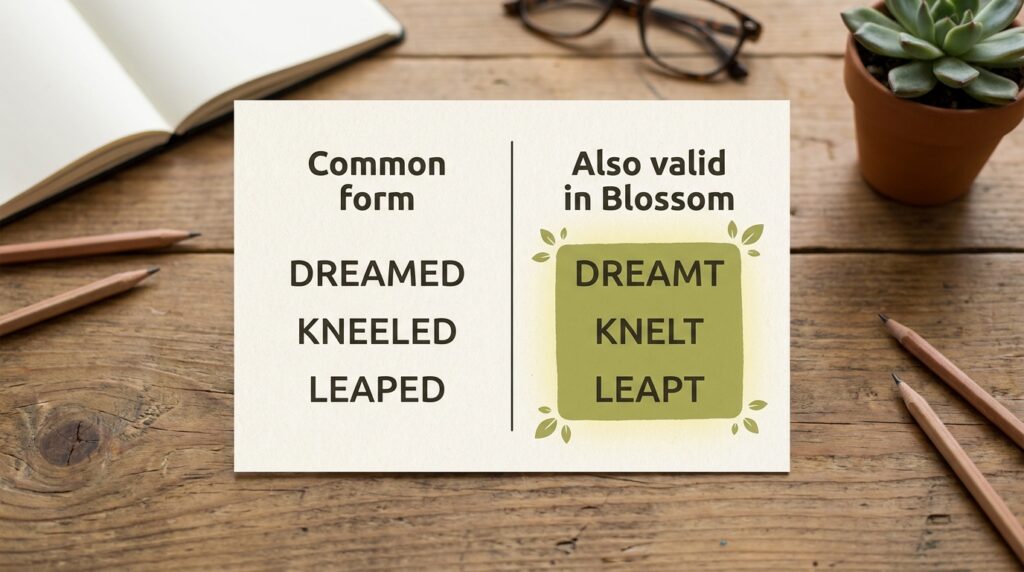
KNELT — Past tense of KNEEL (alongside KNEELED). Both valid.
LEAPT — Past tense of LEAP (alongside LEAPED). Both valid.
SPELT — Past tense of SPELL in British English; also a type of grain. Both meanings valid in M-W.
DREAMT — Past tense of DREAM (alongside DREAMED). Both valid in American English.
GILT — Past tense of GILD (to cover with gold); also an adjective and noun. Valid.
PLED — Past tense of PLEAD in some dialects (alongside PLEADED). Valid in M-W as an alternative form.
GRAVEN — Past participle of GRAVE (to engrave). Archaic but valid — “graven image.”
WOVE / WOVEN — Past tense and past participle of WEAVE. Both valid.
STROVE / STRIVEN — Past tense and past participle of STRIVE (alongside STRIVED). Both valid.
Why these matter for Blossom: These forms often appear longer than the regular past tense alternative (BESOUGHT vs. BESEECHED, DREAMT vs. DREAMED) and can catch players off guard. Test them — they’re valid and often high-scoring given their length.
Borrowed Words From Other Languages
English has borrowed vocabulary extensively from French, Italian, Spanish, German, and other languages. Many of these loanwords are fully standard in M-W and valid in Blossom despite feeling “foreign.”
From French:
- NAÏVE / NAIVE — Both spellings valid (with and without diacritic). Innocent or unsophisticated.
- GENRE — A type or category. Fully English now. Valid.
- ROUGE — Red; a red cosmetic. Valid.
- BEIGE — A pale sandy color. Valid.
- NICHE — A recess in a wall; a specialized role. Valid.
- FIANCÉ / FIANCÉE — Valid (the accented forms; the unaccented FIANCE also valid).
- CLIQUE — A small exclusive group. Valid.
- BUREAU — An office or desk. Valid.
From Italian:
- ARIA — A song in an opera. Valid.
- TEMPO — Speed or pace. Valid.
- GROTTO — A small cave. Valid.
- TORSO — The trunk of the body. Valid.
- MOTTO — A guiding principle. Valid.
- FIASCO — A complete failure. Valid.
- GUSTO — Enthusiasm. Valid.
From Spanish:
- PATIO — An outdoor area. Fully English. Valid.
- PLAZA — A public square. Valid.
- CARGO — Freight carried by a ship/plane. Valid.
- RODEO — A cowboy competition. Valid.
From Other Languages:
- SUSHI (Japanese) — Fully in M-W. Valid when S, U, S, H, I available (double S needed).
- SAUNA (Finnish) — A steam bath. Fully English. Valid.
- YOGA (Sanskrit) — The exercise system. Fully English. Valid.
- TYCOON (Japanese TAIKUN) — A wealthy businessman. Valid.
Words That Sound Informal But Are Dictionary-Standard
Players sometimes hesitate on words that feel too colloquial for a “real” dictionary — but Merriam-Webster is descriptive, not prescriptive, and includes many informal-register words as standard entries.
RUCKUS — A commotion. Informal in register but fully in M-W. Valid.
HULK — A large, heavy person or object; to move heavily. Valid.
LOUT — An uncouth person. Valid.
GAWK — To stare stupidly. Valid.
BOGGLE — To be astonished; to hesitate. Valid.
GRUFF — Rough or stern in manner. Valid.
BLURT — To say suddenly and impulsively. Valid.
SPUNK — Spirit or courage. Valid.
GUTSY — Brave; showing courage. Valid.
FEISTY — Spirited and determined. Valid.
GOOFY — Silly or eccentric. Valid.
KOOKY — Strange or eccentric. Valid.
ZANY — Amusingly eccentric. Valid (and one of the few short Z-containing words in Blossom).
WACKY — Eccentric or irrational. Valid.
PLUNK — To drop or throw heavily; also the sound. Valid.
Rare But High-Scoring Words to Know
These specific words are worth remembering because they’re rare enough that players don’t try them but valid enough to score well when the letters appear.
SATORI — A sudden spiritual awakening (Zen Buddhism). 6 letters, valid M-W entry. Appears when S, A, T, O, R, I are available.
ELEGY — A mournful poem or song. 5 letters, common literary vocabulary, valid.
RONDO — A musical form with a recurring theme. 5 letters, valid.
TENET — A principle or belief. 5 letters, valid. Requires T twice (T is petal, can be reused).
OLEIC — Relating to oil (as in oleic acid). 5 letters, valid.
TORTE — A rich cake. 5 letters, from German. Valid in M-W.
EGRET — A type of heron. 5 letters, valid.
GLOAT — To contemplate with smugness. 5 letters, valid.
TROTH — Pledged faith or loyalty. 5 letters, archaic but active in M-W (“plight one’s troth”). Valid.
LITHE — Flexible and graceful. 5 letters, valid.
SINEW — A tendon; also muscular strength. 5 letters, valid.
CRONE — An old woman. 5 letters, valid (somewhat archaic/literary).
USURP — To seize without right. 5 letters, valid.
SMOTE — Past tense of SMITE. 5 letters, archaic-feeling but valid.
KNOLL — A small rounded hill. 5 letters, valid. Requires double-L.
FIEND — A devil or an extremely devoted person. 5 letters, valid.
TAWNY — A warm sandy color. 5 letters, valid. Requires Y, which is less common.
AZURE — A bright blue color. 5 letters, valid. Z plus common letters.
CROON — To sing in a soft low voice. 5 letters, valid. Requires double-O (O reused).
How to Approach Uncertain Words in Play
The practical guide for what to do when you’re not sure if a word is valid.
The cost-benefit reality: In Blossom, rejected submissions don’t cost you a slot — only accepted words consume your slot budget. This means testing uncertain words is completely free from a slot-budget perspective. You lose nothing by submitting a word that gets rejected.
The threshold rule: If you’ve seen the word in print even once — in a novel, a crossword, a news article — try it. The Merriam-Webster standard is broader than most players assume, and words that feel obscure often have solid dictionary entries.
The morphology check: Before giving up on an uncertain word, consider whether a related form might be more standard. If UNSUNDER doesn’t work, try SUNDER or SUNDERED. If BESOUGHT seems unlikely, try both BESOUGHT and BESEECHED.
The category test: Ask yourself: is this word from a specific domain (music, botany, medicine, archaic English) that has clear M-W documentation? Domain vocabulary that’s made it into the general dictionary is usually fair game.
What usually doesn’t work: Very recent slang not yet in M-W, words from other languages not fully integrated into English, words you’ve only heard spoken and never seen written, invented words or nonce coinages. If you can’t verify it exists in M-W, the submission is more of a genuine guess.
FAQ
Do obscure words really appear in Blossom Word Game?
Yes — regularly. Blossom’s Merriam-Webster-based word list is much broader than most players expect, including archaic terms still active in the dictionary, scientific vocabulary that’s crossed into general English, unusual plurals (FUNGI, STIMULI, LARVAE), irregular verb forms (BESOUGHT, DREAMT, KNELT), and words borrowed from other languages. Players who test unusual candidates consistently find more valid words per session than those who only submit words they’re confident about.
What are some rare words that work in Blossom?
Reliable rare-but-valid words include: NAEVI (plural of naevus, a birthmark), AALII (a Hawaiian tree), ETUI (a small ornamental case), ADZE (a woodworking tool), TARN (a mountain lake), TROTH (pledged faith), LITHE (graceful and flexible), SINEW (tendon), AZURE (bright blue), and unusual plurals like CACTI, STIMULI, LARVAE, FUNGI, and PHENOMENA.
Can I use Latin or Greek plural forms in Blossom?
Yes — standard Latin and Greek plural forms documented in Merriam-Webster are valid in Blossom. This includes -I plurals (CACTI, ALUMNI, FOCI), -A plurals (STRATA, MEDIA, PHENOMENA), and -ES plurals (ANALYSES, THESES, CRISES).
What’s the best strategy for finding rare words in Blossom?
Test words you’re uncertain about — rejected submissions cost nothing. Think about domain vocabulary (botanical, musical, medical, archaic) that might apply to your letter set. Consider irregular verb forms alongside regular ones. If a word appears in your passive vocabulary from reading, it’s worth testing even if you wouldn’t use it in casual speech.
Does Blossom accept informal or slang words?
If they appear in Merriam-Webster as standard entries, yes. Words like RUCKUS, GAWK, FEISTY, ZANY, and GUTSY are informal in register but fully in M-W and valid in Blossom. The dictionary is descriptive (documenting how words are actually used) rather than prescriptive (only including “proper” formal vocabulary).
Final Thoughts
The rare-but-valid word categories in Blossom are a consistent, learnable territory — not random luck. Latin and Greek plurals follow predictable patterns. Archaic terms cluster in recognizable domains (nature, poetry, old trade vocabulary). Scientific words that’ve crossed into general English follow M-W’s widespread-use criterion. Irregular verb forms obey historical patterns that become recognizable with exposure.
Every unexpected acceptance is a signal: your vocabulary includes more than your active use of it suggests. The archive review habit — checking what the complete word list for yesterday’s puzzle contained — is the fastest way to build your rare-word knowledge systematically. Each session’s missed words, looked up and studied, expand the territory you’ll confidently search next time.
Play today’s puzzle at BlossomSpellingGame.com. When you see a word lurking at the edge of your vocabulary — the one you’re not quite sure about — test it. The slot budget doesn’t penalize curiosity.