
Blossom Word Game vs Quordle — one game generates words from constraint, the other deduces four words simultaneously. Here’s the full comparison and which fits you.
Quordle takes Wordle’s elegant single-word deduction and multiplies it by four — four hidden words, nine total guesses, every guess landing on all four boards simultaneously. It’s one of the more demanding entries in the post-Wordle puzzle landscape, and players who’ve found Wordle too easy often discover in Quordle the first daily word game that genuinely humbles them.
Blossom takes a completely different approach to difficulty. There’s no guessing, no elimination, no color-coded feedback narrowing a possibility space. You’re generating words from your own vocabulary under a letter constraint, with a slot budget that rewards strategic patience as much as word knowledge.
Both are demanding daily word games. Neither is harder than the other in any simple sense — they’re hard in fundamentally different ways, because they’re asking your brain to do fundamentally different things. This guide breaks down exactly what those differences are, where each game’s difficulty actually lives, and which one fits your particular cognitive preferences.
The Core Difference: Parallel Deduction vs. Single-Stream Generation
Quordle is fundamentally a deduction game, multiplied. You’re not generating words from your own vocabulary — you’re testing candidate guesses against four separate, simultaneous feedback systems, using the combined information from all four boards to narrow down four hidden answers within a shared guess budget.
Blossom is fundamentally a generation game, constrained. There’s no hidden answer to deduce — you’re producing valid words from your own internal vocabulary store, limited only by which seven letters are available and whether the center letter is included.
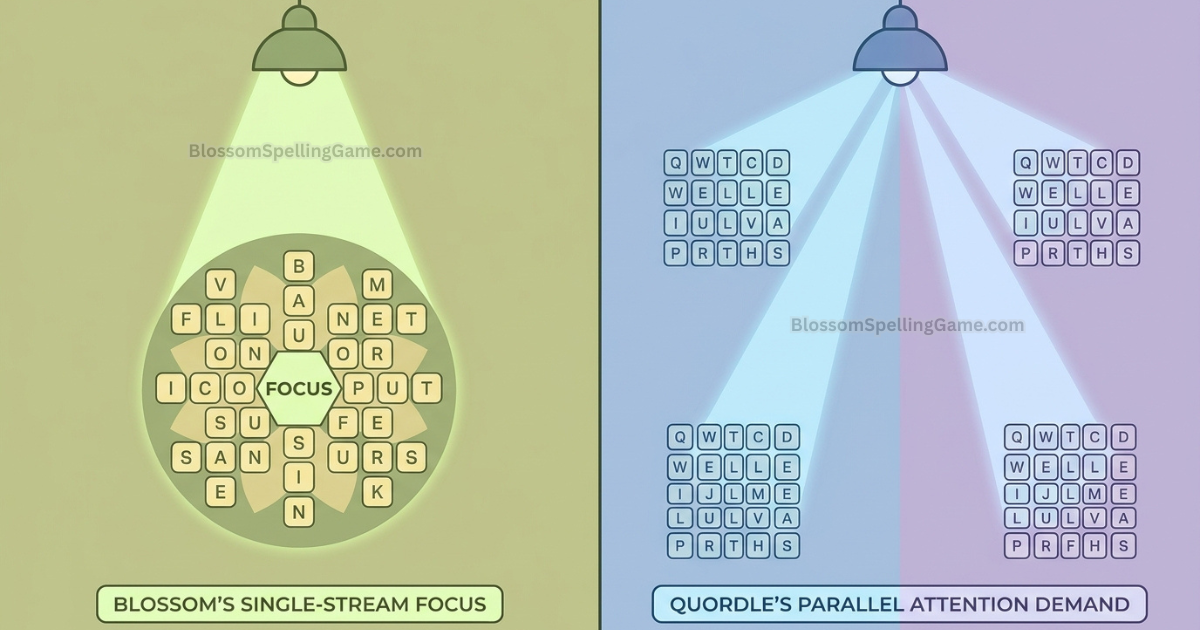
This distinction — deduction-against-feedback versus generation-from-constraint — is the same core distinction explored in our Blossom vs. Wordle comparison, but Quordle’s four-board structure adds a dimension that single-board Wordle doesn’t have: genuine parallel processing demand, where your cognitive resources must be actively divided across four simultaneous problem spaces rather than focused on one.
How Quordle’s Multi-Board Mechanic Actually Works
For Blossom players unfamiliar with Quordle’s specific mechanics, here’s what makes the multiplication to four boards genuinely different from simply playing Wordle four times.
Shared guesses, separate feedback: Every word you type is submitted to all four boards simultaneously. The same five-letter guess produces four different sets of color-coded feedback — one for each hidden word. This means a single guess is doing quadruple duty, and your job is to extract maximum information from each guess across all four feedback streams at once.
The guess budget pressure: You get nine total guesses to solve all four words — barely more than double Wordle’s standard six, despite needing to solve four separate answers. This creates intense pressure to make each guess maximally informative across all boards simultaneously, rather than optimizing for any single board.
The sacrifice decision: Because guesses are shared, you often face a genuine strategic trade-off: a guess that would be optimal for narrowing Board A might be wasted information for Board B, which you’ve already solved. Skilled Quordle play involves deciding which boards to actively prioritize with each guess and which to let ride on incidental information from guesses aimed at other boards.
The Attention-Splitting Cognitive Demand
This is the most distinctive cognitive feature of Quordle relative to both Wordle and Blossom — and it’s worth examining specifically.
Working memory load: Tracking four separate sets of confirmed letters, eliminated letters, and positional constraints simultaneously places a substantially higher load on working memory than tracking a single board. This is a quantitatively different demand from Wordle, not just a harder version of the same demand — you’re not solving one harder problem, you’re solving four problems that compete for the same limited attentional resources.
Visual scanning demand: Quordle’s four-board layout requires genuine visual attention-switching — your eyes and processing focus must move between four spatially separated grids, checking each one’s current state before formulating a guess that serves all four simultaneously.
How this compares to Blossom’s cognitive load: Blossom’s cognitive demand is different in kind, not just degree. There’s no attention-splitting across separate problem spaces — instead, there’s a sustained, single-stream vocabulary search under a slot-budget constraint, layered with strategic decisions about word value (discussed extensively in our Advanced Strategies guide). Blossom’s difficulty comes from depth within one search; Quordle’s comes from breadth across four parallel searches.
Which type of cognitive load is harder for you specifically: Players who excel at multitasking and rapid attention-switching often find Quordle’s format more natural. Players who prefer sustained, single-focus deep engagement often find Blossom’s format more comfortable. Neither preference is better — they reflect genuinely different cognitive styles.
Information Theory vs. Vocabulary Depth
Quordle and Wordle-family games reward a specific kind of strategic thinking rooted in information theory: which guesses maximize the information gained per attempt, given the accumulated constraints so far. Experienced Quordle players develop strong intuitions for high-information starting words (words with common, well-distributed letters) and learn to read partial feedback patterns efficiently across multiple boards.
Blossom rewards a different kind of strategic thinking rooted in vocabulary depth and morphological knowledge — how many words do you know, how quickly can you retrieve them under letter constraints, and how effectively can you extend short words into longer ones using suffix and prefix patterns.
The skill transfer question: Getting better at Quordle builds stronger information-theoretic intuition (recognizing which letters and patterns are statistically likely to appear, optimizing guess sequences) but doesn’t directly build vocabulary depth, since Quordle’s answer words are drawn from a constrained five-letter common-word list rather than open vocabulary. Getting better at Blossom builds vocabulary production and pattern recognition but doesn’t build the same deductive, probability-based reasoning that Quordle exercises. The two skill sets are genuinely complementary rather than overlapping.
Scoring and Completion Philosophy
Quordle’s binary completion model: You either solve all four words within nine guesses or you don’t — there’s no partial-credit scoring system, no numeric point total. The result is essentially binary: solved or failed, with the number of guesses used as a secondary efficiency metric players sometimes compare.
Blossom’s continuous scoring model: Every word you find adds incrementally to a numeric score, with no pass/fail threshold — you can have a mediocre session or an excellent one, and the score reflects that gradient precisely. This is covered in depth in our Blossom Scoring Guide.
What this means for the felt experience: Quordle delivers a sharper, more binary satisfaction (or disappointment) — you either beat the puzzle or you didn’t. Blossom delivers a more continuous, incremental satisfaction, where there’s always a sense of “could have done better” or “did reasonably well” rather than a clean pass/fail verdict. Players who prefer clear win/lose outcomes may gravitate toward Quordle’s model; players who prefer continuous improvement tracking may prefer Blossom’s.
Difficulty Curve Over Time
Quordle’s difficulty trajectory: Once a player has developed strong starting-word strategy and efficient information extraction across four boards, Quordle’s difficulty tends to plateau — the core skill (information-maximizing guesses under shared constraint) doesn’t have unlimited room to keep developing, similar to the difficulty-curve limitation noted for Wordle in our Wordle comparison.
Blossom’s difficulty trajectory: Because vocabulary depth and strategic slot management have a much higher ceiling — there’s always more vocabulary to learn, more suffix and prefix patterns to internalize, more refined pangram-hunting methodology to develop — Blossom’s difficulty curve extends much further into long-term play, as detailed in our Advanced Strategies guide.
The practical implication: For players seeking a game that remains genuinely challenging after months of daily play, Blossom’s longer difficulty curve has a real advantage. For players who want a consistently challenging but not endlessly deepening daily puzzle, Quordle’s plateau isn’t necessarily a downside — a stable, predictable challenge level can be exactly what some players want from a quick daily session.
Side-by-Side Comparison Table
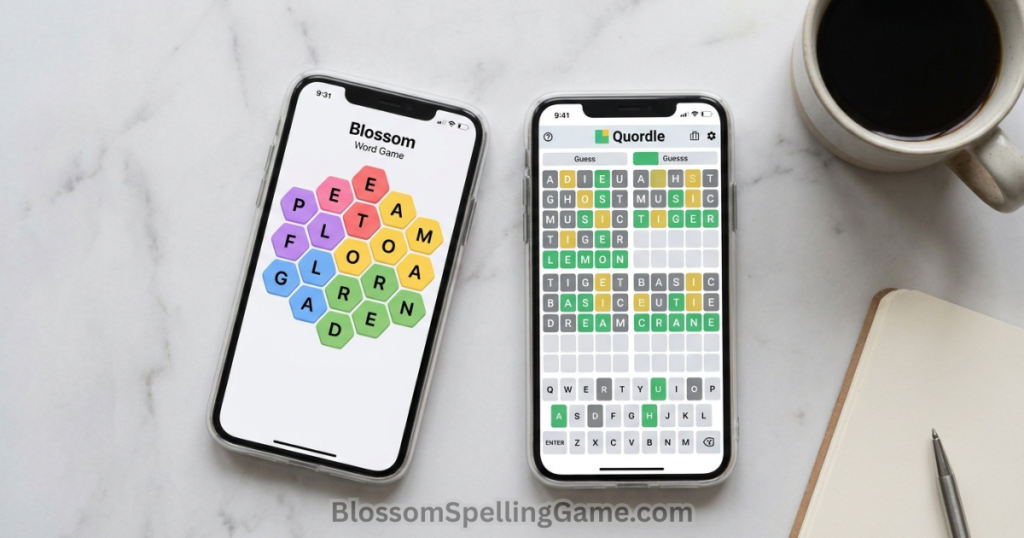
| Feature | Blossom Word Game | Quordle |
|---|---|---|
| Core mechanic | Generate words from 7 letters | Deduce 4 hidden words simultaneously |
| Cognitive type | Sustained single-stream generation | Parallel attention-splitting deduction |
| Number of guesses/attempts | 12 word slots | 9 shared guesses |
| Scoring | Continuous numeric score | Binary solved/failed |
| Vocabulary demand | High (open vocabulary) | Low-moderate (common 5-letter words) |
| Strategic skill rewarded | Vocabulary depth, slot management | Information-maximizing deduction |
| Difficulty curve | Long, deepens over months | Plateaus after initial mastery |
| Session length | 10-20 minutes | 5-15 minutes |
| Cost | Free (BlossomSpellingGame.com) | Free |
| Center/special letter rule | Yes (center letter mandatory) | No |
| Best for | Vocabulary builders, strategists | Multitaskers, deduction enthusiasts |
Who Each Game Is Built For
Choose Blossom if you: Prefer generating from your own knowledge over deducing against feedback, want a game with a long-term difficulty ceiling, enjoy continuous scoring over binary pass/fail outcomes, and want sustained single-focus engagement rather than attention-splitting demands.
Choose Quordle if you: Enjoy the Wordle format but found it too easy, prefer sharp deductive reasoning over vocabulary generation, like the challenge of dividing attention across multiple simultaneous problems, and want a quick, intensely focused 10-minute session.
Play both if you: Want to exercise genuinely different cognitive systems — sustained vocabulary generation and parallel deductive reasoning — in the same daily routine. The two together cover meaningfully more cognitive territory than either alone.
FAQ
What is the main difference between Blossom Word Game and Quordle?
Blossom is a word generation game — you produce valid words from seven constrained letters using your own vocabulary. Quordle is a parallel deduction game — you guess to narrow down four hidden five-letter words simultaneously using shared color-coded feedback. One rewards vocabulary depth; the other rewards information-maximizing deductive strategy.
Is Quordle harder than Blossom?
They’re hard in different ways rather than one being objectively harder. Quordle’s difficulty comes from parallel attention-splitting across four simultaneous boards under a tight shared guess budget. Blossom’s difficulty comes from vocabulary depth and strategic slot management within a single sustained search. Quordle’s difficulty plateaus once core deduction skills are mastered; Blossom’s difficulty curve extends much further with continued vocabulary and strategy development.
Can playing Quordle help my Blossom performance, or vice versa?
Limited direct transfer. Quordle builds information-theoretic deduction skills and letter-frequency intuition; Blossom builds vocabulary production and morphological pattern recognition. They’re complementary cognitive workouts rather than overlapping ones — playing both exercises more total cognitive territory than either alone, but improvement in one doesn’t directly translate to improvement in the other.
Which game is better for vocabulary building, Blossom or Quordle?
Blossom, by a wide margin. Quordle’s answer words are drawn from a relatively constrained common five-letter word list optimized for fair guessability, while Blossom draws from the full Merriam-Webster dictionary and requires active vocabulary production rather than guessing from a limited pool.
Is Quordle free like Blossom?
Yes, Quordle is free to play at quordle.com with no subscription required, similar to Blossom’s free access at BlossomSpellingGame.com.
Final Thoughts
Blossom and Quordle occupy genuinely different corners of the daily word game landscape — one asks you to produce, the other asks you to deduce; one rewards depth in a single search, the other rewards breadth across four simultaneous ones. Neither approach is more legitimate than the other, and the “which is harder” question has no clean answer because the difficulty lives in different cognitive territory entirely.
If you’ve been playing Quordle and finding yourself craving a game with more room to grow over months rather than weeks, Blossom’s deeper difficulty curve is worth trying. If you’ve been playing Blossom and want a sharper, faster daily deduction challenge to complement your vocabulary workout, Quordle fills that gap well.
Play today’s puzzle at BlossomSpellingGame.com and see how the generation-based challenge feels next to whatever deduction game is already in your rotation.