
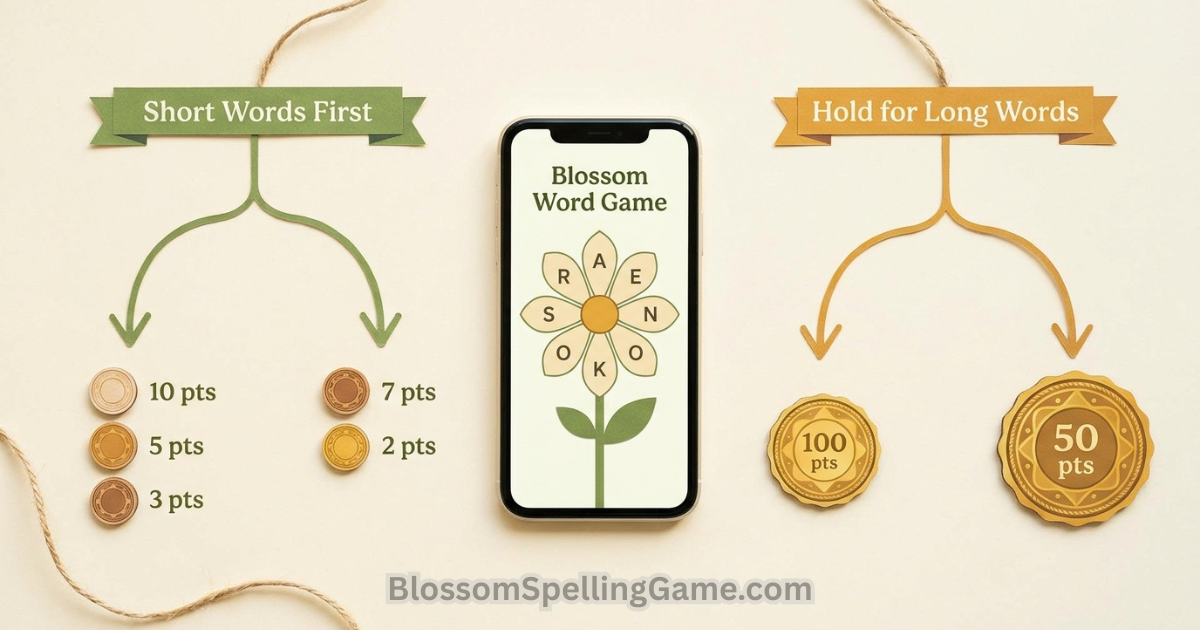
You open today’s puzzle. Within ten seconds you’ve spotted an easy 4-letter word. Do you submit it immediately, or do you sit on it, hoping something longer turns up first?
This single decision — submit now or wait — gets made dozens of times across a single Blossom session, and it’s one of the most persistent points of disagreement among players. Some swear by sweeping all the obvious short words first to build momentum and confidence. Others insist that submitting anything short before exhausting the long-word search is a guaranteed way to waste your scoring potential.
Both camps have a point, and the honest answer is that the right approach depends on where you are in your Blossom journey, not on which camp is objectively correct. This article settles the debate by examining it from a different angle than our existing strategy guides — not as advanced slot-architecture planning, but as a straightforward decision framework based on your specific skill level, psychological tendencies, and what the research on momentum and warm-up effects in puzzle-solving actually suggests.
The Two Camps and Why Both Have a Point
The “short words first” camp argues: Submitting easy words immediately builds confidence, creates early momentum, clears mental clutter so you can focus on harder searches, and guarantees you bank some points even if the session goes poorly overall. There’s no risk of finishing with zero words if you grab what’s available right away.
The “long words first” camp argues: The scoring math overwhelmingly favors length — a single 7-letter word outscores multiple 4-letter words combined. Submitting short words early burns slot budget that should be reserved for higher-value finds, and the letters used in obvious short words are often the same common letters that appear in the longer words you haven’t found yet.
Both arguments are correct, which is exactly why this debate persists. The resolution isn’t picking a winner — it’s recognizing that the right answer depends on factors specific to you and to the puzzle in front of you.
The Beginner Case for Short Words First
If you’re new to Blossom — in your first weeks of regular play — there’s a genuinely strong case for submitting short words as soon as you find them, and it has nothing to do with maximizing your score.
The completion psychology: New players who try to hold out for long words they haven’t yet learned to reliably find often end up with very few submissions by the end of a session, because their search skills aren’t developed enough to consistently surface 6+ letter words. Holding out for something that doesn’t materialize produces a frustrating, low-completion session that can discourage continued play.
The skill-building argument: Submitting words as you find them, even short ones, gives you faster feedback on what counts as valid in this specific letter set. Each accepted word teaches you something about the letter set’s vocabulary territory. New players benefit more from volume of feedback than from optimized scoring in their early sessions — the habit and the learning matter more than the score at this stage.
The realistic skill ceiling: A beginner who hasn’t yet internalized suffix hunting, prefix scanning, or the pangram search methodology genuinely may not find longer words even if they wait. In that case, “holding out” produces no benefit — you’re just delaying submissions of words you would have found anyway, without gaining access to words your current skill level can’t surface regardless of patience.
The recommendation for beginners: Submit short words as you find them for your first month or so of regular play. Focus on learning the game’s mechanics, building vocabulary search habits, and developing comfort with the center letter rule and suffix/prefix patterns. Score optimization is a second-stage skill that matters more once the fundamentals are automatic.
The Intermediate Case for Holding Out
Once you’ve played consistently for a month or more and have internalized the basic suffix and prefix search patterns covered in our Suffix Guide and Prefix Guide, the calculus shifts meaningfully.
You now have reliable tools for finding longer words: An intermediate player who knows to test -ING, -NESS, -ABLE extensions on every root they find has real tools for converting short words into longer ones, rather than just hoping a long word appears independently. At this stage, holding a short word specifically to test its extensions is a productive use of patience, not wishful waiting.
The scoring math becomes more relevant: Once you’re consistently finding 8-10 words per session, the marginal value of converting more of those words from 4-5 letters to 6-7+ letters becomes the primary lever for score improvement. This is exactly the stage where the “don’t submit short words too early” advice — covered extensively in our 10 Tips guide — starts paying real dividends.
The risk of habitual greediness: Intermediate players who developed a beginner habit of submitting immediately sometimes carry that habit forward even after they’ve built the skills to do better. This is the single most common reason intermediate players plateau below their actual potential — not a vocabulary limitation, but a submission-timing habit that hasn’t updated to match their improved search skills.
The recommendation for intermediate players: Default toward holding short words, specifically to test suffix and prefix extensions, for the first 6-8 slots of a session. Submit a short word immediately only when you’ve genuinely exhausted reasonable extension attempts and have moved on to searching elsewhere.
The Expert Answer: It’s Neither, It’s Both
Players at the advanced level — covered in depth in our Advanced Strategies guide — don’t actually follow a fixed “short first” or “long first” rule. They follow a dynamic framework that adjusts based on session phase, letter set signals, and remaining slot budget.
Early session (slots 1-6): Strong bias toward holding, specifically using the anti-wedge technique — treating obvious short words as scaffolds for longer derivatives rather than submitting them directly. This isn’t really “long words first” so much as “don’t finalize short words until you’ve tested their extensions.”
Mid session (slots 7-9): A more situational approach — submit short words when continued holding isn’t producing extensions, but keep testing extensions on any new short words discovered.
Late session (slots 10-12): Strong bias toward submitting whatever is available, since the opportunity cost of continued searching diminishes as fewer slots remain and panic-driven errors become more likely under slot pressure.
The expert framework isn’t really about short versus long as a binary choice — it’s about treating every short word as a potential intermediate step rather than a final answer, until the evidence (failed extension attempts, dwindling slots) suggests it’s time to lock it in.
The Psychology of Momentum in Puzzle Solving
Beyond pure scoring optimization, there’s a psychological dimension to this debate worth taking seriously: does early submission success create momentum that improves subsequent performance, or does it create complacency that reduces search effort?
The case for momentum: Research on motivation in goal-directed tasks generally finds that early small successes increase persistence and effort on subsequent, harder components of a task — a phenomenon sometimes described as “small wins” building toward larger ones. Applied to Blossom, finding and submitting a few easy words early may genuinely increase your motivation and focus for the harder pangram hunt that follows, rather than detracting from it.
The case against complacency: Conversely, locking in easy wins early can create a subtle psychological release valve — “I’ve already got some points banked, I don’t need to push as hard” — that reduces the intensity of subsequent search effort. This is a real risk, particularly for players who use early submissions as a signal that the session is “going fine” and ease off mental effort as a result.
The individual variation: Which effect dominates for you specifically is genuinely personal. Players who find early wins motivating should lean toward submitting them. Players who notice their effort drops after banking a few easy points should lean toward holding out longer before any submission, specifically to avoid triggering their own complacency response.
The Warm-Up Effect: Does Starting Short Actually Help Cognition?
There’s a cognitive argument for short words first that’s distinct from the psychological momentum argument above — a genuine warm-up effect on retrieval speed.
What warm-up effects are: Cognitive performance on retrieval-heavy tasks often improves over the first few minutes of engagement, as the relevant neural systems shift from a resting state into active engagement. This is sometimes called a “priming” or “warm-up” period, and it’s well documented across many types of cognitive tasks, including language retrieval.
Applied to Blossom: The first word you find in any session may take noticeably longer to surface than the fifth or sixth, even on letter sets of comparable difficulty, simply because your vocabulary retrieval systems are still warming up. Easy, short words provide low-friction warm-up reps that activate the retrieval system without requiring you to simultaneously manage the higher cognitive load of suffix-testing or pangram-hunting.
The practical implication: There’s a reasonable case for submitting one or two genuinely easy words at the very start of a session — not for scoring reasons, but as a deliberate warm-up that primes your retrieval system before you shift into the more demanding extension-testing and pangram-hunting phases. This is somewhat different from a “short words first” strategy in general — it’s specifically a brief, intentional warm-up period (the first 30-60 seconds) rather than a sustained approach throughout the session.
A Simple Decision Framework Based on Your Skill Level
Here’s a consolidated, practical framework based on everything above:
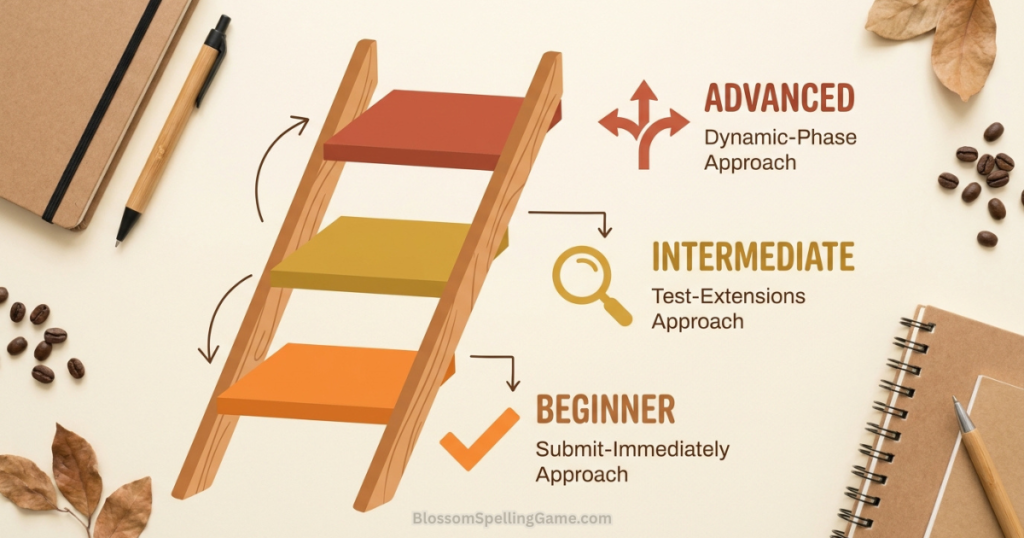
If you’re in your first month of regular play: Submit short words as you find them. Building habits and vocabulary search comfort matters more than score optimization right now.
If you’ve been playing for 1-6 months and know basic suffix/prefix patterns: Hold short words specifically to test their suffix and prefix extensions before submitting. Default to patience in the first half of your session, situational submission in the second half.
If you’ve internalized advanced techniques (anti-wedge, slot architecture, constellation mapping): Follow the dynamic phase-based approach from our Advanced Strategies guide — strong holding bias early, situational mid-session, accept-anything late.
Regardless of skill level: Consider a brief, intentional warm-up — one or two quick easy submissions in your first 30-60 seconds — before shifting into your skill-appropriate strategy for the remainder of the session.
The Specific Letter Set Exception
One situational factor overrides general skill-level guidance: what the letter set itself signals about its difficulty.
Rare or difficult center letters (X, Z, Q, J, V): When the center letter is genuinely uncommon, the total number of valid words in the puzzle tends to be lower across the board. In these sessions, holding out for length is less productive because there may simply be fewer long words available regardless of search effort. Submit good words — of any reasonable length — more readily in these sessions, since the opportunity cost of waiting is lower (there may not be much more to find).
Vowel-heavy letter sets: These tend to support more, and longer, words overall. The case for patience and extension-testing is strongest here, since the likely payoff for holding out is genuinely higher.
Consonant-heavy letter sets: These often support fewer total words but sometimes unlock specific long compound words or technical vocabulary. Holding out can pay off, but the search itself takes more deliberate effort since common suffix patterns may be less available.
What the Pros Actually Do
Across the community of consistently high-scoring Blossom players, the actual reported behavior — as opposed to the advice given to beginners — tends to converge on the dynamic, phase-based approach rather than either pure extreme. Almost no expert player submits every short word the instant they find it, and almost no expert player holds every word until the absolute last possible moment regardless of context. The skill that distinguishes high scorers isn’t a fixed rule about short versus long — it’s the judgment to recognize, session by session and even slot by slot, which situation calls for which approach.
This is, admittedly, a less satisfying answer than a simple rule would be. But it’s the honest one, and it’s consistent with how expertise generally develops in any strategic skill domain: beginners benefit from simple, consistent rules; experts develop the judgment to deviate from those rules appropriately.
FAQ
Should I submit short words immediately in Blossom or wait for longer ones?
It depends on your skill level. Beginners should submit short words as found, prioritizing habit-building and learning over score optimization. Intermediate and advanced players should generally hold short words to test suffix and prefix extensions first, submitting only after reasonable extension attempts have failed, with submission urgency increasing as slots run low later in the session.
Does submitting short words early hurt my score?
It can, primarily because the letters used in obvious short words are often the same common letters that appear in longer words you haven’t found yet — submitting early can create a psychological “this letter is used” feeling that reduces your likelihood of testing extensions. This effect matters more for intermediate and advanced players with the skills to find those extensions; it matters less for beginners who may not find the extension regardless.
Is there a benefit to starting with short words even for skilled players?
Yes, specifically as a brief warm-up. Submitting one or two easy words in the first 30-60 seconds of a session may help “warm up” vocabulary retrieval systems before shifting into more demanding suffix-testing and pangram-hunting. This is different from sustained short-words-first play throughout an entire session.
How do I know when to stop holding a short word and just submit it?
A reasonable rule: if you’ve tested the obvious suffix and prefix extensions (covered in our Suffix and Prefix guides) and none have worked, submit the word. Continuing to hold it without active testing in progress provides no additional benefit and adds unnecessary cognitive overhead.
Does the letter set itself affect whether I should prioritize short or long words?
Yes. Rare-center-letter puzzles tend to have fewer total valid words, making the patience strategy less rewarding — submit reasonable words more readily. Vowel-heavy puzzles tend to support more long words, making patience and extension-testing more rewarding.
Final Thoughts
The short-versus-long debate doesn’t have a single universal answer because it isn’t really one question — it’s several different questions depending on who’s asking. A new player asking this question needs permission to submit what they find and build confidence. An intermediate player needs a nudge toward patience and extension-testing. An advanced player already knows the answer is dynamic and situational.
If you’re not sure which category you’re in, the simplest test is this: do you reliably find suffix and prefix extensions of words you discover, when you deliberately look for them? If yes, hold and test before submitting. If you’re not yet confident in that search, submit what you find and focus on building that specific skill — the patience strategy will pay off once you have something to be patient for.
Play today’s puzzle at BlossomSpellingGame.com, and notice which instinct — submit now or hold and search — feels more natural. That instinct is telling you something real about where you currently are in your Blossom development.