
“Word games are good for your brain” is true but vague enough to be almost meaningless — it’s the kind of claim that sounds scientific without actually telling you anything specific. Which part of your brain? Doing what, exactly? And does it matter which word game you’re playing, or are they all interchangeable?
This article takes a different approach from typical brain-game coverage. Rather than discussing cognitive benefits as abstract psychological mechanisms (covered in depth in our Cognitive Benefits guide), this is a tour through actual brain anatomy — the specific regions and neural systems that light up during different types of word game play, and how Blossom, Wordle, NYT Connections, NYT Strands, and traditional crosswords each engage that anatomy differently.
This isn’t neuroscience for its own sake. Understanding which brain systems a game engages tells you something genuinely useful: which games are complementary (engaging different systems) versus redundant (engaging the same system twice), and which specific cognitive territory your daily word game habit is and isn’t covering.
A Map of the Language Brain
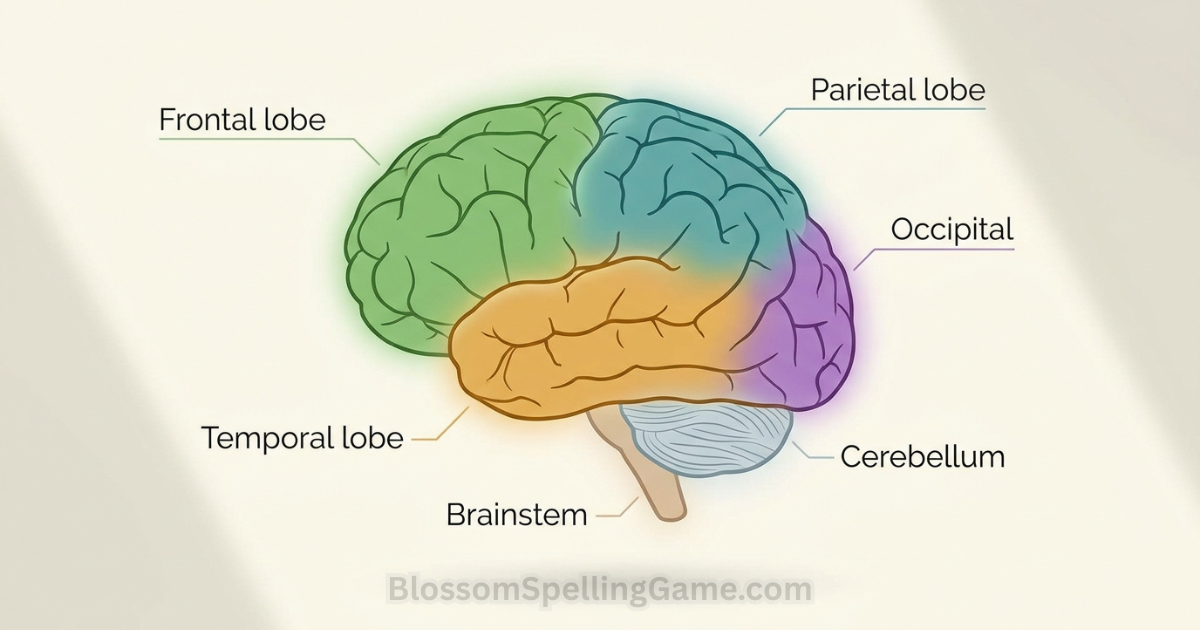
Language processing in the brain isn’t localized to a single “language center” — it’s distributed across a network of regions, each handling a different component of the overall task. Understanding this network, even at a basic level, clarifies why different word games feel so different to play despite all being “word games” in the broadest sense.
The core language network includes regions in the left hemisphere for most right-handed people (and a majority of left-handed people too) — primarily in the frontal and temporal lobes, with supporting contributions from parietal regions for certain tasks and from memory systems like the hippocampus for learning new vocabulary.
What follows is a tour through the specific regions most relevant to word game play, and which games most directly engage each one.
Broca’s Area and Word Production
What it does: Broca’s area, located in the frontal lobe, is most associated with language production — specifically the planning and execution of speech and, by extension, the generation of words you’re about to produce (whether spoken or written). Damage to this area classically produces difficulty generating fluent speech while comprehension remains relatively intact.
Why this matters for word games: Games that require you to generate words from memory — pulling a word out of your own vocabulary store and producing it — engage this production-oriented system most directly. This is distinct from games where words are presented to you and your job is to recognize or evaluate them.
Which games engage this most:
Blossom is a strong Broca’s-area-relevant game because its core mechanic is pure production: you’re not selecting from a list, you’re generating words from your own internal vocabulary store under letter constraints. Every single submission requires active word generation.
Wordle engages this system more lightly — you’re generating guess words, but the deductive, elimination-based nature of the game means much of your cognitive effort goes toward narrowing possibilities rather than pure generation. You’re producing words, but the production is more constrained and rule-governed by the accumulated color feedback.
NYT Connections and NYT Strands engage this system the least among popular word games, because the words themselves are already given to you (in Connections, the 16 words are presented; in Strands, the words are hidden but present in the grid). Your job is selection and recognition, not generation from scratch.
The practical implication: If you want a game that specifically exercises word-production fluency — useful for writing and speaking confidence — Blossom and similarly generative games provide stronger engagement of this system than recognition-based or deduction-based formats.
Wernicke’s Area and Word Comprehension
What it does: Wernicke’s area, located in the temporal lobe, is most associated with language comprehension — understanding the meaning of words and language you encounter, whether spoken or written. It works in close coordination with Broca’s area but handles a distinct function: understanding rather than producing.
Why this matters for word games: Games that require you to understand or evaluate words, categories, or clues presented to you engage this comprehension system more heavily than games requiring pure production.
Which games engage this most:
NYT Connections engages this system heavily — understanding the 16 presented words, evaluating their possible category memberships, and recognizing semantic relationships between them is fundamentally a comprehension task layered with categorization.
Traditional crosswords engage this system substantially — interpreting often cryptic or punny clues requires sophisticated language comprehension, sometimes involving understanding wordplay, double meanings, and indirect references.
Blossom engages this system more lightly during the core word-finding task (since you’re generating, not interpreting clues) but does engage it when you encounter an unfamiliar accepted word and try to infer or recall its meaning.
The practical implication: Games heavy on clue interpretation (crosswords) or category evaluation (Connections) provide stronger comprehension-system engagement, while generative games like Blossom provide stronger production-system engagement. This is one of the clearest reasons these games feel cognitively different despite both being “word games.”
The Angular Gyrus and Letter-Sound Mapping
What it does: The angular gyrus, located at the junction of the temporal, parietal, and occipital lobes, plays an important role in integrating different types of information related to language — including the mapping between written letters and their corresponding sounds, and broader semantic integration across multiple senses.
Why this matters for word games: This region is particularly relevant to spelling and to the kind of letter-pattern recognition that distinguishes valid from invalid letter sequences — exactly the skill exercised by orthographic vocabulary work covered in our Spelling guide.
Which games engage this most:
Blossom engages this system substantially through its letter-by-letter word construction mechanic — every successful word submission requires correctly mapping the intended sounds of a word to its correct letter sequence, and every rejection of a misspelled attempt provides correction feedback relevant to this letter-sound mapping system.
Wordle engages this system through its color-feedback mechanic, which requires tracking letter-position relationships precisely — a related but distinct demand on this integrative region.
Crossword puzzles engage this region moderately, primarily through the spelling-out of answers once the word itself has been determined from the clue.
The practical implication: Games requiring precise letter-by-letter construction (Blossom) provide stronger engagement of this letter-sound integration system than games where the answer, once known, requires less active spelling construction.
The Hippocampus and New Word Learning
What it does: The hippocampus, located in the medial temporal lobe, is critical for forming new long-term memories — including, specifically, the encoding of new vocabulary into long-term storage. This is the system most responsible for converting a word you’ve just encountered into a word you’ll remember tomorrow.
Why this matters for word games: Any game that exposes you to genuinely new vocabulary — words you didn’t already know — engages this memory-formation system. Games that only use vocabulary you already possess don’t create new learning, regardless of how much they exercise other systems.
Which games engage this most:
This is where the specific letter sets and word lists matter more than the game format itself. Blossom’s Merriam-Webster-based word list regularly surfaces vocabulary at the edges of a player’s active vocabulary — words like LUCENT, FELICITY, or UNTENABLE that a player may recognize passively but rarely encounters in production contexts. Each unexpected acceptance is a hippocampus-relevant learning event, as covered in our Vocabulary Improvement guide.
Crossword puzzles, particularly those from quality publishers, frequently introduce genuinely unfamiliar vocabulary through clues, also engaging this system substantially.
Wordle and Connections, by their nature, generally use more common vocabulary (since the answer must be guessable through deduction or recognizable enough to form a fair category), which means less novel-word encoding occurs during typical play.
The practical implication: If genuine vocabulary growth (not just exercise of existing vocabulary) is a priority, games and word lists that regularly surface unfamiliar-but-valid words provide more hippocampal engagement — more actual new learning — than games using only highly common vocabulary.
The Prefrontal Cortex and Strategic Word Games
What it does: The prefrontal cortex, at the front of the frontal lobe, is the brain’s primary executive function center — responsible for planning, decision-making, impulse control, and the strategic management of resources toward a goal. This system operates somewhat independently of the core language network and contributes to word games specifically when strategic decisions, not just word knowledge, determine performance.
Why this matters for word games: Games with a pure “find the word” mechanic engage language systems primarily. Games with resource constraints, scoring trade-offs, and strategic decision points layer prefrontal executive function on top of the language task.
Which games engage this most:
Blossom engages this system substantially through its 12-slot budget mechanic. Every decision about whether to submit a short word now or hold out for a longer one, whether to prioritize the bonus petal letter, and how to sequence the pangram hunt against other word-finding requires ongoing strategic resource management — a genuinely separate cognitive demand layered on top of vocabulary retrieval.
Wordle engages this system through its deductive constraint management — tracking which letters are confirmed, eliminated, or uncertain, and strategically selecting guesses that maximize information gain, is a planning-heavy executive function task.
NYT Connections engages this system through its category-commitment decisions — deciding which words to group together, especially when avoiding the misdirection traps requires holding multiple hypotheses in mind and strategically testing them.
Traditional crosswords engage this system more lightly during typical solo play, since most crossword solving is sequential (one clue at a time) without significant resource-allocation trade-offs, though competitive timed crossword solving adds a time-management executive function dimension.
The practical implication: Games combining language demands with strategic resource management (Blossom, Wordle, Connections) provide a dual cognitive workout that pure recall-based word games don’t — exercising prefrontal executive function alongside language systems.
The Visual Word Form Area and Reading-Based Games
What it does: The visual word form area, located in the fusiform gyrus (part of the temporal lobe, on the underside of the brain), specializes in rapidly recognizing written words as unified visual patterns — the system that lets skilled readers recognize a familiar word instantly rather than sounding it out letter by letter.
Why this matters for word games: Games requiring rapid visual scanning and pattern recognition across multiple words or letter arrangements engage this system, distinct from the production-oriented Broca’s area system.
Which games engage this most:
NYT Strands engages this system heavily — scanning a letter grid for word-shaped patterns across multiple directions requires exactly the kind of rapid visual word-pattern recognition this region specializes in.
Crossword puzzles engage this system moderately when scanning completed sections of the grid or recognizing partial word patterns from already-filled letters.
Blossom engages this system more lightly, since the letters aren’t arranged in a way that invites scanning for pre-existing word patterns — you’re constructing words rather than finding them already present in a visual field.
The practical implication: Visual word-search-style games (Strands) provide distinctive engagement of this rapid-recognition visual system that generation-based games (Blossom) don’t replicate — supporting the case made in our Blossom vs. Strands comparison that these games are genuinely complementary rather than redundant.
The Parietal Lobe and Spatial Word Search Games
What it does: The parietal lobe, particularly regions involved in visuospatial processing, handles the mental representation of spatial relationships — tracking positions, paths, and directions in physical or visual space.
Why this matters for word games: Games requiring you to track paths through a spatial arrangement — tracing a word through a grid in multiple possible directions — engage this spatial system in a way that purely verbal, non-spatial word games don’t.
Which games engage this most:
NYT Strands is the clearest example among popular word games — tracing potential word paths through a multi-directional letter grid is fundamentally a spatial task layered onto a verbal one, requiring the parietal system to track letter adjacency and path direction simultaneously with the temporal/frontal systems handling word recognition.
Blossom’s flower-shaped letter arrangement has a visual layout, but because you’re not tracing paths through it (the letters are simply available for use in any combination, not connected by spatial adjacency requirements), it engages this spatial system much less than Strands does.
Crosswords engage this system moderately through the two-dimensional grid structure, particularly when working out how answers intersect and constrain each other spatially.
The practical implication: For players whose cognitive strengths or interests lean toward spatial processing, grid-based search games like Strands provide a different and complementary cognitive workout compared to constraint-based generation games like Blossom.
Comparing Word Games by Brain System Engaged
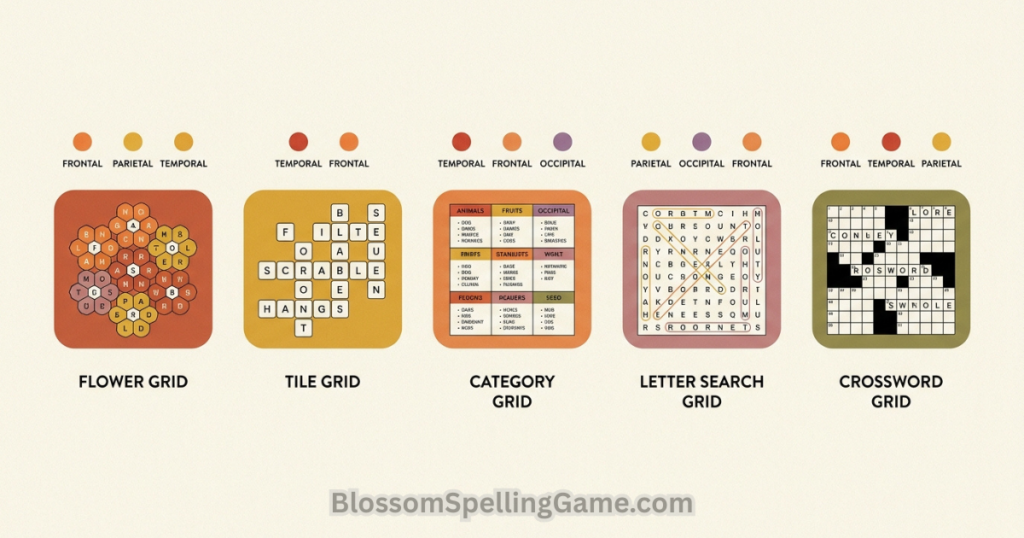
Here’s a consolidated view of how the major daily word games compare across the systems discussed:
| Brain System | Blossom | Wordle | Connections | Strands | Crosswords |
|---|---|---|---|---|---|
| Broca’s (production) | Very High | Moderate | Low | Low | Low |
| Wernicke’s (comprehension) | Low-Moderate | Moderate | High | Moderate | High |
| Angular gyrus (letter-sound) | High | Moderate | Low | Moderate | Moderate |
| Hippocampus (new learning) | High* | Low-Moderate | Low-Moderate | Moderate | High |
| Prefrontal (strategy) | High | High | Moderate-High | Moderate | Low-Moderate |
| Visual word form (recognition) | Low | Low | Low | High | Moderate |
| Parietal (spatial) | Low | Low | Low | High | Moderate |
*Hippocampal engagement depends heavily on word list quality and personal vocabulary level — high only when the game regularly surfaces genuinely unfamiliar vocabulary.
What this comparison reveals:
No single game provides comprehensive coverage across all these systems. Blossom is strong on production, letter-sound integration, new word learning, and strategic resource management, but weak on the visual-spatial systems that Strands engages heavily. Crosswords are strong on comprehension and new vocabulary learning but lighter on production and strategy. Connections is strong on comprehension and moderate on strategy but doesn’t engage production or spatial systems much at all.
This isn’t a ranking of which game is “best” — it’s a map of which game covers which cognitive territory, which is far more useful for deciding how to build a complete routine.
Building a Brain-Complete Word Game Routine
Given the brain-system mapping above, here’s how to think about building a daily or weekly word game routine that covers meaningfully different territory rather than redundantly exercising the same system multiple times.
The production-comprehension balance:
Pair a generative game (Blossom) with a comprehension-heavy game (Connections or a crossword) to ensure you’re exercising both the “produce words” and “understand words/clues” systems, rather than spending all your word-game time in one mode.
The verbal-spatial balance:
Pair a purely verbal game (Blossom, Wordle) with a spatial-verbal hybrid (Strands) to engage the parietal and visual word form systems that pure constraint-based games don’t reach.
The strategy layer:
Games with resource constraints or deductive elimination (Blossom, Wordle, Connections) add executive function engagement beyond pure language processing — worth prioritizing if cognitive variety, not just vocabulary, is your goal.
The new-learning priority:
If vocabulary growth specifically matters to you, prioritize games and word lists known for surfacing unfamiliar vocabulary — quality crosswords and Blossom’s broader Merriam-Webster-based word list both serve this function better than games constrained to highly common vocabulary.
A sample complete routine:
Blossom (10-15 minutes: production, letter-sound mapping, strategy, new vocabulary) + Strands (5-10 minutes: visual-spatial pattern recognition, moderate comprehension) + a quick crossword or Connections (5 minutes: comprehension, category reasoning). This combination, totaling 20-30 minutes, provides meaningfully broader brain-system coverage than 30 minutes spent on any single game type.
FAQ
Which brain region does Blossom Word Game use the most?
Blossom most heavily engages Broca’s area (word production), the angular gyrus (letter-sound mapping relevant to spelling), the hippocampus (new vocabulary learning, when unfamiliar words are encountered), and the prefrontal cortex (strategic decisions around the 12-slot budget and bonus petal sequencing). It engages visual-spatial systems much less than grid-based games like NYT Strands.
Do different word games exercise different parts of the brain?
Yes, meaningfully. Generative games like Blossom primarily engage word-production systems (Broca’s area) and strategic planning (prefrontal cortex). Clue-based games like crosswords and category games like Connections more heavily engage comprehension systems (Wernicke’s area). Grid-search games like Strands uniquely engage visual-spatial processing systems (parietal lobe, visual word form area) that other word games barely touch.
Is it better to play one word game deeply or several different ones?
For broader brain-system coverage, playing several different game types provides more complete cognitive engagement than deep play on a single game, because different game mechanics engage substantially different brain systems. A combination of a generative game (Blossom), a comprehension-based game (crossword or Connections), and a spatial-search game (Strands) covers meaningfully more territory than extended play on any one of them alone.
Does word game vocabulary actually create new memories in the brain?
Yes, when the words encountered are genuinely new to the player — this process specifically involves the hippocampus, which is responsible for converting new information into long-term memory. Games using only vocabulary a player already knows well don’t create this new-learning effect regardless of how much they’re played; the benefit depends on regularly encountering unfamiliar-but-valid words, which is more likely in games with broad, less curated word lists like Blossom’s Merriam-Webster standard.
Why does Blossom feel so different from NYT Strands even though both are word games?
Because they engage substantially different brain systems. Blossom is primarily a language-production task (Broca’s area, prefrontal strategic planning) with minimal spatial demand. Strands is primarily a visual-spatial search task (parietal lobe, visual word form area) layered with moderate language comprehension. The felt difference in how the games play reflects this real difference in underlying brain system engagement.
Final Thoughts
“Word games are good for your brain” undersells what’s actually happening. Different word games engage genuinely different, identifiable brain systems — production versus comprehension, spatial search versus pure verbal constraint, strategic planning versus straightforward recall. None of this requires neuroscience expertise to use practically: it just means that variety in your word game routine isn’t a nice-to-have, it’s the difference between exercising one cognitive system repeatedly and building genuinely broad cognitive engagement.
Blossom’s particular strength is production, letter-sound integration, and strategic resource management — a genuinely distinctive combination among popular daily word games. Pairing it deliberately with a spatial-search game like Strands or a comprehension-heavy game like a crossword or Connections fills in the territory Blossom doesn’t reach on its own.
Play today’s puzzle at BlossomSpellingGame.com, and consider what the rest of your word game routine is — or isn’t — covering.