
Can Blossom Word Game Help With Spelling? is it actually improve your spelling? Here’s the honest, detailed answer — what it fixes, what it can’t, and who benefits most.
You’ve been spelling RECEIVE wrong your entire adult life. Or maybe it’s NECESSARY (one C or two? one S or two?), or DEFINITELY (not DEFINATELY, no matter how many times your fingers want to type it that way), or SEPARATE (not SEPERATE — a mistake so common that autocorrect has probably saved you from it thousands of times without you noticing).
Spelling anxiety is more common among otherwise literate, intelligent adults than most people admit. And the question of whether a daily word game can actually fix it — not just build general vocabulary, but specifically improve your spelling — deserves a more thorough answer than a passing mention in a broader vocabulary article.
This guide is that dedicated answer. Not vocabulary building broadly, but spelling specifically: which spelling error patterns Blossom directly addresses, which it doesn’t touch, how the mechanism actually works at a cognitive level, whether it’s a fit for people with diagnosed spelling difficulties, and how it compares to dedicated spelling tools and traditional instruction methods.
The Specific Mechanism: How Blossom Actually Builds Spelling Skill
To understand whether Blossom helps with spelling, it’s worth being precise about what spelling skill actually is and which part of it the game exercises.
Spelling involves at least three distinct cognitive components: phonological awareness (mapping sounds to letters), orthographic memory (visual/stored memory of correct letter sequences), and morphological knowledge (understanding how word parts combine, which predicts spelling for related words). Most spelling instruction targets all three simultaneously through repetition and rule-teaching.
Where Blossom’s mechanism specifically operates:
Blossom’s core mechanic — constructing words letter by letter from a constrained set, then receiving immediate accept/reject feedback — most directly exercises orthographic memory: the stored, visual representation of correct letter sequences. Every successful submission is effectively a confirmation trial: “yes, this exact sequence of letters is the correct spelling of this word.” Every rejection of an attempted misspelling is a correction trial: “no, that sequence is not how this word is spelled.”
This differs meaningfully from how most people think about vocabulary-building games helping spelling. It’s not that Blossom teaches spelling rules explicitly (it doesn’t explain anything) — it’s that the repeated confirm/reject cycle, applied across hundreds of words over months of play, builds the same kind of implicit pattern knowledge that extensive reading builds, but through active production rather than passive exposure.
Why active production matters more for spelling specifically:
Reading exposes you to correct spellings, but research on spelling acquisition consistently shows that passive exposure (reading) is a weaker driver of spelling accuracy than active production (writing, typing, or otherwise generating the letter sequence yourself). This is because spelling is fundamentally a production skill — you need to generate the correct sequence, not just recognize it when it’s presented to you. Blossom’s format requires exactly this production at every single submission.
The Motor Memory Dimension Most Guides Miss
This is a dimension of spelling skill that almost no discussion of “educational word games” addresses — and it’s specifically relevant to Blossom’s tap-or-type interface.
What motor memory contributes to spelling:
Beyond the purely visual/orthographic memory of what a word looks like, there’s a kinesthetic, motor-memory component to spelling that’s built through the physical act of writing or typing a word repeatedly. This is why many people report that they “know” a word is spelled correctly partly because typing or writing it “feels right” — the motor sequence of fingers moving in a specific pattern has become associated with the correct spelling, independent of consciously recalling the letters one by one.
How Blossom engages this:
Every word submission in Blossom involves a specific sequence of taps (on mobile) or keystrokes (on desktop) that physically encode the letter sequence through repeated motor action. When you submit RECEIVE correctly multiple times across different puzzle sessions (whenever the letters allow), you’re not just reinforcing the visual memory of the word — you’re building the motor pattern that makes future spelling of that word feel automatic.
Why this matters for words you “always get wrong”:
Words that you’ve consistently misspelled for years often have an established incorrect motor pattern — your fingers have learned to type “recieve” rather than “receive” through repeated incorrect practice (perhaps in casual texting or quick note-taking where autocorrect wasn’t active or didn’t catch it). Breaking this pattern requires not just learning the correct spelling intellectually, but building a new, competing motor sequence strong enough to override the old one.
Blossom’s repeated correct-production requirement — you cannot submit an incorrect spelling and have it “count,” ever — provides exactly the kind of high-repetition correct practice needed to build a new dominant motor pattern. This is a genuinely different mechanism from simply reading the correct spelling in a dictionary or vocabulary list, which doesn’t engage motor memory at all.
Specific Spelling Error Patterns Blossom Helps Correct
Rather than discussing spelling improvement in the abstract, here are the specific, well-documented English spelling error categories that Blossom’s mechanic directly addresses — and how.
Doubled consonant errors:
One of the most common English spelling error categories involves whether a consonant doubles before a suffix (RUNNING vs. RUNING, OCCURRED vs. OCCURED, BEGINNING vs. BEGINING). Because Blossom requires constructing these words letter by letter and rejects incorrect single-consonant attempts, repeated exposure to the doubling pattern across many different root words builds an intuitive sense for when doubling applies — particularly relevant to our Suffix Guide’s coverage of the consonant-doubling rule.
Silent letter errors:
Words with silent letters (KNOWLEDGE, RHYTHM, SUBTLE, GNAW, WRESTLE) are frequently misspelled because the silent letter has no phonetic cue. Each successful Blossom submission of a silent-letter word reinforces that the silent letter is present in the correct spelling — a form of correction that pure phonetic reasoning (“sound it out”) cannot provide, since the silent letter by definition isn’t represented in pronunciation.
The -IE vs. -EI pattern:
The famous (and famously exception-riddled) “i before e except after c” pattern (BELIEVE vs. RECEIVE vs. WEIRD) is a persistent adult spelling difficulty. Blossom’s letter-by-letter construction, applied across many -IE and -EI words as they appear in different letter sets over months of play, provides repeated correct-pattern reinforcement for specific words — building word-specific orthographic memory even where the general rule has exceptions.
Double letter vs. single letter confusion:
Words like NECESSARY (one C, two S’s), ACCOMMODATE (two C’s, two M’s), and MISSPELL (ironically, often misspelled with one S) involve specific double-letter patterns that don’t follow predictable rules and must essentially be memorized word by word. Repeated correct construction in Blossom builds exactly this word-specific memorization through production practice.
Homophone and near-homophone spelling confusion:
Words that sound similar but are spelled differently based on meaning (STATIONARY vs. STATIONERY, PRINCIPAL vs. PRINCIPLE, COMPLEMENT vs. COMPLIMENT) are a persistent error category for many adult writers. Blossom doesn’t address the semantic distinction (it can’t tell you which one to use in context), but it does reinforce the correct spelling of whichever form is constructible from the available letters — building stronger orthographic memory for each specific form.
Foreign-origin spelling patterns:
Words borrowed from French, Latin, and Greek often carry spelling patterns that don’t follow typical English phonetic rules: RESTAURANT, ENTREPRENEUR, RENDEZVOUS, PSYCHOLOGY, RHYTHM. These words are common sources of adult spelling errors because their letter patterns don’t match intuitive English sound-to-spelling mapping. Successfully constructing these words in Blossom — when letters allow — provides correct-pattern reinforcement that phonetic reasoning alone wouldn’t generate.
What Blossom Does NOT Help With
An honest treatment requires equal attention to the limitations — and there are real ones specific to spelling.
It doesn’t address words you never encounter:
Blossom only reinforces spelling for words that happen to be formable from a given day’s letter set. If you have a persistent, specific misspelling of a word that rarely or never appears in your Blossom sessions (because the letters required don’t frequently align), the game provides no correction opportunity for that specific word. This is a meaningful limitation compared to targeted spelling instruction, which can specifically drill the words you personally struggle with.
It doesn’t teach spelling rules explicitly:
Blossom never explains why a word is spelled the way it is, never states a rule, and never provides the kind of explicit instruction (“remember: I before E except after C”) that helps some learners generalize spelling patterns to new, unencountered words. Players who learn best through explicit rule instruction may find Blossom’s implicit, exposure-based approach less effective than direct teaching.
It doesn’t address homophone selection in context:
As mentioned above, Blossom can reinforce the correct spelling of THEIR, THERE, or THEY’RE individually, but it has no mechanism for teaching you which one to use in a specific sentence — that’s a contextual, grammatical skill entirely separate from spelling the individual word correctly. Homophone confusion in actual writing is often a usage problem, not a spelling problem, and Blossom doesn’t touch the usage dimension at all.
It doesn’t address capitalization, punctuation, or other mechanics:
Spelling is one piece of writing mechanics. Blossom has zero engagement with capitalization rules, punctuation, or other writing mechanics that often travel alongside spelling concerns in broader “writing skills” discussions.
It doesn’t provide diagnostic assessment:
Blossom can’t tell you specifically which spelling patterns you struggle with, doesn’t track your error history, and doesn’t generate a personalized list of your weak spots. Dedicated spelling assessment tools and structured curricula provide this diagnostic function that casual gameplay doesn’t replicate.
The Autocorrect Dependency Problem
This is a genuinely contemporary spelling issue that deserves specific attention — and one where Blossom’s design offers an unusual, useful counterbalance.
The problem:
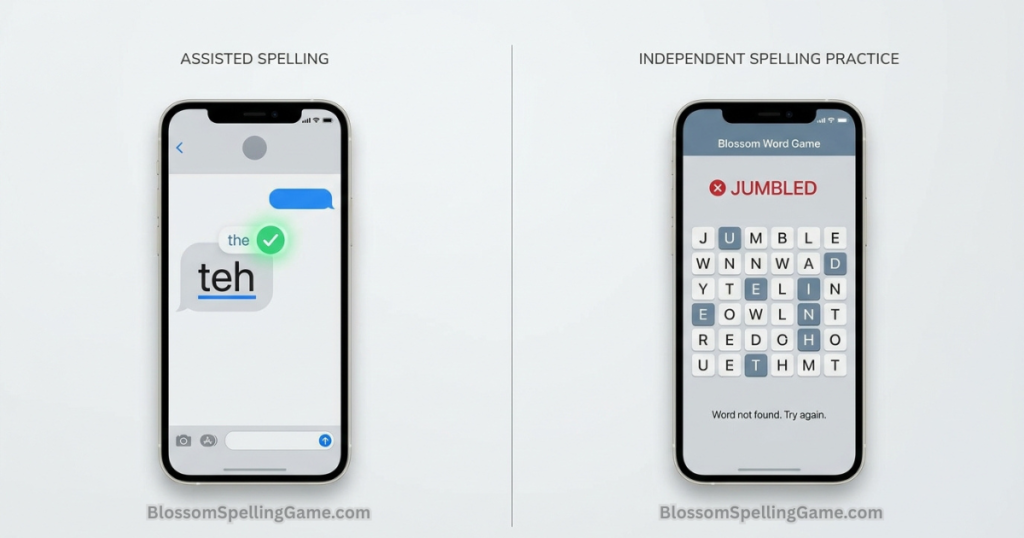
Decades of consistent autocorrect and spell-check availability across phones, word processors, and messaging apps has created a documented pattern: many adults have outsourced spelling accuracy to software so completely that their own independent spelling ability has atrophied. People routinely type words incorrectly and rely entirely on autocorrect’s silent fix, never consciously registering that they made an error in the first place — which means no learning occurs, even though the final output looks correct.
Why this matters:
In contexts without autocorrect — handwriting, filling out paper forms, typing in interfaces that don’t auto-correct, or any situation requiring independent spelling under pressure — this atrophied spelling skill becomes visible and can be genuinely embarrassing or professionally costly (misspelled words in a handwritten note, an email typed in a context without spell-check, a name spelled incorrectly in an important document).
How Blossom counteracts this specifically:
Blossom provides zero autocorrect and zero spelling suggestions. You either spell the word correctly, or it’s rejected — full stop, with no silent correction happening behind the scenes. This is one of the only common digital activities most adults engage in regularly that requires fully independent, unassisted spelling, with immediate, unambiguous feedback on whether you got it right.
Playing Blossom regularly is, in effect, one of the few sustained opportunities most adults have in their digital lives to practice spelling without a safety net — and the discipline this builds (knowing you have to get it exactly right, because nothing will fix it for you) transfers usefully to other no-autocorrect contexts.
Adult Spelling Anxiety: An Underserved Population
This is a population that almost no “educational word game” content addresses directly — adults who have struggled with spelling their entire lives and carry genuine embarrassment about it into adulthood.
The pattern:
A meaningful number of otherwise capable, intelligent, well-read adults have a persistent gap between their vocabulary knowledge and their spelling accuracy. They know far more words than they can reliably spell, and this gap often traces back to specific learning experiences (inconsistent early spelling instruction, undiagnosed learning differences, or simply individual variation in how reliably orthographic memory forms for different people). The anxiety this creates is real: avoiding writing tasks, over-relying on others to check written work, feeling embarrassed in professional contexts when a misspelling is noticed.
Why low-stakes practice matters specifically for this population:
Adults who already feel anxious or embarrassed about spelling often avoid spelling-focused practice precisely because it surfaces the anxiety directly — a spelling test, a public correction, a moment of being caught out. Blossom’s format sidesteps this dynamic entirely: there’s no audience, no grade, no judgment. A rejected word is simply rejected — privately, instantly, with no social consequence. You can attempt a word you’re genuinely unsure about as many times as needed, in complete privacy, with zero stakes attached to getting it wrong.
This low-stakes environment is precisely what allows anxiety-driven avoidance to be bypassed. Adults who would never sign up for a “spelling improvement” course (because doing so requires admitting and exposing the difficulty) often engage readily with a word game that happens to build the same skill as a side effect of normal play.
A realistic note on severity:
For adults with persistent, significant spelling difficulty that goes beyond typical variation — particularly if it’s accompanied by broader reading or writing difficulty — Blossom is a supportive practice tool, not a sufficient intervention on its own. If spelling difficulty is significantly affecting work or daily functioning, an assessment for an underlying learning difference (such as dyslexia, discussed below) by a qualified professional is the appropriate next step, with Blossom serving as a complementary, low-stakes practice activity alongside more targeted support.
Dyslexia and Spelling Difficulties: An Honest Treatment
This deserves careful, honest treatment rather than either dismissal or oversold promise.
What’s true:
Dyslexia is a specific, neurologically-based learning difference that primarily affects phonological processing — the ability to map sounds to letters — which has direct consequences for both reading and spelling. People with dyslexia often have spelling difficulty that’s qualitatively different from “just needing more practice” — it involves a different underlying processing pattern, not simply less exposure to correct spellings.
Where Blossom might help, cautiously:
For some people with mild-to-moderate dyslexia, the visual, pattern-based, low-stakes repetition that Blossom provides may offer a supportive practice environment — particularly because of the complete absence of time pressure and the privacy of the format (no one watching you get something wrong). Some individuals with dyslexia report that games requiring letter manipulation, played at their own pace, provide a more comfortable practice format than traditional spelling drills.
Where caution is warranted:
Blossom was not designed as a dyslexia intervention and has not been evaluated as one. The structured, evidence-based interventions for dyslexia (such as Orton-Gillingham-based approaches and similar structured literacy programs) involve carefully sequenced, multisensory instruction specifically designed around the phonological processing differences that characterize dyslexia. Blossom’s unstructured, letter-constraint-based gameplay doesn’t replicate this sequencing and shouldn’t be treated as a substitute for it.
The honest recommendation:
For someone with diagnosed dyslexia or a suspected but undiagnosed reading/spelling difficulty, the appropriate first step is assessment and, if indicated, structured literacy intervention from a qualified specialist. Blossom can be a genuinely enjoyable supplementary activity once foundational support is in place — particularly valuable for the low-pressure repetition it offers — but it should never be positioned as a replacement for appropriate professional support when a genuine learning difference is present.
Blossom vs. Dedicated Spelling Apps and Tools
A practical comparison for anyone deciding between Blossom and apps specifically built for spelling improvement.
Dedicated spelling apps (typical features):
Most purpose-built spelling apps use spaced-repetition flashcard systems, explicit rule instruction, diagnostic assessment of your specific weak words, and structured progression through difficulty levels. Examples include apps built around personalized word lists, often integrating with school curricula or standardized test vocabulary.
Where dedicated spelling apps outperform Blossom:
Personalization (targeting your specific error patterns rather than whatever words a given letter set happens to produce), explicit instruction (teaching rules directly rather than relying on implicit pattern exposure), and diagnostic tracking (showing you exactly which words and patterns you’re weak on over time).
Where Blossom outperforms dedicated spelling apps:
Intrinsic enjoyment — Blossom doesn’t feel like spelling practice, which means people who would never open a dedicated “improve your spelling” app will happily play Blossom daily without feeling like they’re doing remedial work. The vocabulary breadth is also broader and less curriculum-constrained — Blossom exposes you to a wider range of genuinely useful adult vocabulary than most school-oriented spelling apps, which often focus on grade-level word lists rather than the words sophisticated adult writing actually requires.
The practical recommendation:
If you have specific, identified spelling weak points (a list of words you know you consistently misspell), a dedicated tool that lets you specifically drill those words will be more efficient than hoping they appear in Blossom’s letter sets. If you want a sustainable, enjoyable daily habit that builds general spelling confidence and vocabulary breadth as a side effect of genuine engagement, Blossom is the better long-term fit. Many people benefit from both: occasional targeted drilling of known weak words, combined with daily Blossom play for broader, sustained engagement.
Blossom vs. Traditional Spelling Tests and Bees
A comparison specifically addressing how Blossom’s mechanism differs from the classic spelling test or spelling bee format that most adults experienced in school.
The traditional format:
A word is presented (often spoken aloud), and you must produce the correct spelling — typically under some degree of time pressure and, in the case of spelling bees, public observation and judgment. This format tests pure recall under pressure, with real social stakes attached to failure.
How Blossom differs:
Blossom presents no specific word to spell — instead, you generate candidate words from your own vocabulary and test whether your spelling matches the dictionary standard. This is a meaningfully different cognitive task: traditional spelling tests assess recall of a specific predetermined word; Blossom assesses whether the words you naturally generate happen to be spelled correctly, with the freedom to avoid words you’re unsure about entirely.
The implication:
This difference means Blossom is a weaker direct measure of spelling ability (you can simply avoid submitting words you’re uncertain how to spell, sidestepping the difficulty) but a gentler and more sustainable practice format (there’s no pressure to attempt words beyond your confidence, no public failure, and no predetermined list dictating what you must spell correctly today).
For pure spelling assessment purposes, a traditional spelling test remains more diagnostic. For sustained, low-anxiety spelling practice as an ongoing habit, Blossom’s format has clear advantages — particularly for adults who have negative associations with spelling tests from school experiences.
A Practical Spelling-Focused Play Method
For readers specifically interested in maximizing the spelling benefit of Blossom play, here’s a deliberate approach that goes beyond casual play.
Step 1: Attempt uncertain words deliberately.
Rather than only submitting words you’re fully confident about, deliberately attempt words where you’re genuinely unsure of the spelling. Since rejected submissions cost nothing, this is risk-free — and it’s specifically where the spelling-correction mechanism does its work. Playing only with words you already spell confidently provides no spelling-improvement value at all.
Step 2: Notice and note rejections that surprised you.
When a word you expected to be accepted gets rejected, pause and check the correct spelling immediately (via Merriam-Webster or a quick search) rather than just moving on. This conversion of “surprise rejection” into “explicit correction” meaningfully strengthens the learning effect — passively noticing a rejection without follow-up provides weaker correction than actively confirming the right spelling.
Step 3: Re-test corrected words in future sessions.
After learning the correct spelling of a word you’d been getting wrong, actively look for opportunities to use that word again in future Blossom sessions when the letters allow. This repeated, spaced retrieval — submit, get it right, encounter the opportunity again days or weeks later, get it right again — is exactly the spaced practice pattern that produces durable spelling memory.
Step 4: Pay attention to suffix and prefix spelling rules specifically.
Many persistent adult spelling errors involve suffix attachment (doubling consonants, dropping silent E, changing Y to I). Deliberately reviewing our Suffix Guide and Prefix Guide’s spelling rule sections builds the explicit rule knowledge that complements Blossom’s implicit pattern exposure — the two approaches work better together than either alone.
FAQ
Can Blossom Word Game actually improve my spelling?
Yes, specifically through orthographic memory reinforcement and motor memory building. Every successful word submission confirms a correct spelling through active production (not just passive reading), and every rejected misspelling provides immediate, private correction. This is most effective for words that appear repeatedly across your sessions over time, and least effective for words you rarely encounter in the game’s letter sets.
What kinds of spelling errors does Blossom help most with?
Doubled consonant errors (RUNNING vs RUNING), silent letter omissions (KNOWLEDGE, RHYTHM), the -IE vs -EI pattern, double-letter memorization (NECESSARY, ACCOMMODATE), and foreign-origin spelling patterns (RESTAURANT, RENDEZVOUS) are all error categories that Blossom’s repeated correct-construction mechanic directly addresses.
Does Blossom help with dyslexia-related spelling difficulty?
Cautiously and as a supplement only. Blossom wasn’t designed as a dyslexia intervention and hasn’t been evaluated as one. For diagnosed or suspected dyslexia, structured literacy intervention from a qualified specialist is the appropriate primary approach. Blossom may offer a comfortable, low-pressure supplementary practice environment once appropriate support is in place, but shouldn’t replace it.
Is Blossom better than a dedicated spelling app?
For different purposes. Dedicated spelling apps offer better personalization (targeting your specific known weak words) and explicit rule instruction. Blossom offers better sustainability (genuine enjoyment rather than remedial-feeling practice) and broader vocabulary exposure. Many people benefit from combining both: targeted drilling of known weak words alongside daily Blossom play for general engagement.
Why does autocorrect make spelling skills worse, and does Blossom help with that?
Consistent autocorrect availability allows people to type words incorrectly repeatedly without ever consciously registering the error, since the correction happens silently. This can lead to atrophied independent spelling ability. Blossom provides no autocorrect or spelling suggestions — every submission requires correct, independent spelling with immediate clear feedback, making it one of the few common digital activities that exercises unassisted spelling regularly.
Is Blossom good for adults who have always struggled with spelling?
Often yes, specifically because of its low-stakes, private format. Adults with longstanding spelling anxiety frequently avoid spelling-focused practice because it exposes the difficulty (tests, corrections, judgment). Blossom’s private rejection feedback — with no audience and no grade — removes much of this anxiety, making it accessible to people who would never engage with more exposed forms of spelling practice.
Does Blossom teach spelling rules?
No — Blossom never explains why a word is spelled a certain way or states explicit rules. It works through implicit pattern exposure via repeated correct production, not direct instruction. Players who benefit most from explicit rule-teaching should pair Blossom with resources that do explain rules directly, such as our Suffix and Prefix vocabulary reference guides.
Final Thoughts
The honest answer to “can Blossom Word Game help with spelling” is yes, specifically and meaningfully — through a mechanism that’s different from, and complementary to, traditional spelling instruction. The repeated, active, low-stakes correct-production cycle builds orthographic and motor memory in a way that passive reading or occasional spelling tests don’t achieve as effectively.
It’s not a complete spelling solution. It doesn’t explain rules, doesn’t target your specific known weak words deliberately, and isn’t a substitute for structured intervention if a genuine learning difference like dyslexia is present. But as a sustained, genuinely enjoyable daily practice that happens to exercise spelling skill as a side effect of normal play, it’s one of the more effective tools available — particularly for adults who have specific spelling anxiety and would never engage with anything that felt like remedial spelling work.
The practical takeaway: attempt the words you’re unsure about, not just the ones you’re confident in. That’s where the actual correction happens, and it’s free every single time you try.
Play today’s puzzle at BlossomSpellingGame.com — and the next time you’re not sure how a word is spelled, type it anyway and find out.