
The Common English prefixes Blossom Word Game players — what each prefix means, where it comes from, which specific words it produces, and how to avoid common confusions.
You know RE- adds “again” and UN- means “not.” That’s where most prefix knowledge ends for most people — and it’s just enough to be useful in Blossom without being enough to unlock the full word count the game’s letter sets contain.
The gap between “I know what RE- means” and “I know which specific words RE- produces from this particular letter set” is a vocabulary gap. Closing it doesn’t require memorizing thousands of words — it requires understanding how each prefix works, where it comes from, which root types it combines with, and which words those combinations produce that actually appear in Blossom.
This guide is a vocabulary reference, not a strategy guide. For the Blossom-specific strategy of how to use prefixes during play — the letter availability screen, the prefix-first workflow, the productivity rankings — see our Blossom Prefix Strategy Guide. This article covers something different: the actual vocabulary knowledge that makes that strategy work. What each prefix means, where it originated, which confusions to avoid, and which specific high-value words each prefix produces in Blossom.
The Four Origins of English Prefixes
Understanding where English prefixes come from clarifies a lot of otherwise arbitrary-seeming behavior — like why IN- means “not” in INVISIBLE but means “into” in INHALE, or why the same negation idea is expressed differently by UN-, IN-, DIS-, and NON-.
English draws its prefix vocabulary from four main historical sources:
Old English / Germanic prefixes: UN-, OUT-, OVER-, UNDER-, FORE-, AFTER-, WITH-. These attach primarily to Germanic-root words (the everyday vocabulary of English — walk, run, stand, feel, think). They’re the most natural-feeling prefixes because they’ve been part of the language the longest and attach to the most familiar roots.
Latin prefixes: RE-, DE-, DIS-, IN-/IM-/IL-/IR-, PRE-, POST-, SUB-, INTER-, TRANS-, CONTRA-, PRO-, MULTI-, SEMI-, SUPER-, AUTO-, MICRO-, MEGA-. These attach primarily to Latin-derived vocabulary (the academic and formal layer of English). Because most academic and technical English vocabulary comes from Latin, this is the largest and most productive prefix family for advanced vocabulary.
Greek prefixes: ANTI-, HYPER-, HYPO-, MONO-, POLY-, AUTO- (also Greek), MICRO-, MACRO-, TELE-, PHOTO-. Greek prefixes appear primarily in scientific, medical, and technical vocabulary.
French prefixes: Many words absorbed from French in the medieval period carry prefixes that originally came from Latin but entered English through French: EN-/EM- (ENABLE, EMBRACE), COUNTER- (COUNTERACT). Some RE- and DIS- words also entered through French.
Why this matters for Blossom:
The origin of a prefix predicts which types of root words it attaches to. UN- (Old English/Germanic) attaches to Germanic roots: UNHAPPY, UNKIND, UNWRAP, UNLOCK. IN- (Latin) attaches to Latin-derived roots: INVISIBLE, INCORRECT, INHUMAN. Mixing them up — trying UNHAPPY vs. INAHPPY — leads to the right word because you understand which prefix family the root belongs to.
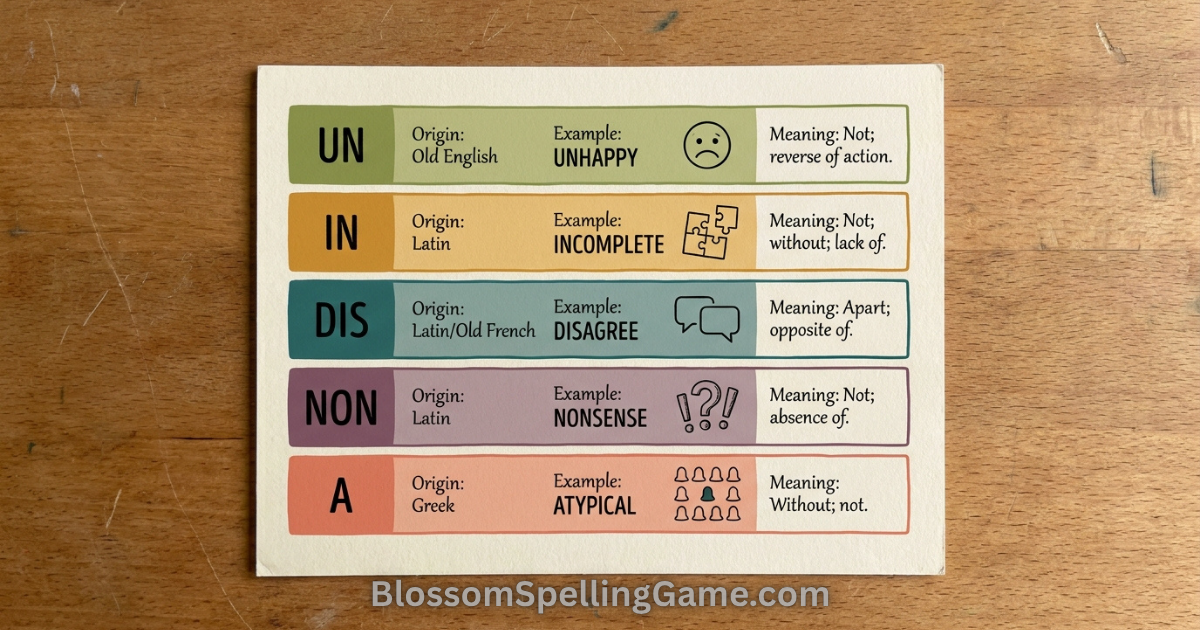
The Negation Prefixes: UN-, IN-, DIS-, NON-, A-
Negation is one of the most common prefix functions in English — and it’s expressed through five different prefixes that are NOT interchangeable. Understanding which roots take which negation prefix is one of the most practically useful vocabulary distinctions for Blossom players.
UN- — The Germanic Negator
Origin: Old English Meaning: Not; reversal of action Attaches to: Primarily adjectives (especially participial adjectives ending in -ED, -FUL, -ABLE, -WORTHY, -KNOWN) and verbs of fastening/securing
The rule: UN- is the right negation prefix for words of Germanic/Old English origin and for past participles used as adjectives.
UN- + adjective: UNHAPPY, UNKIND, UNWISE, UNFAIR, UNCLEAR, UNSAFE, UNUSUAL, UNREAL, UNSTEADY UN- + past participle: UNDONE, UNTIED, UNBROKEN, UNLOVED, UNSUNG, UNTOLD UN- + fastening verb: UNLOCK, UNPACK, UNTIE, UNWRAP, UNZIP, UNBUTTON
High-value Blossom words with UN-:
| Word | Letters | Points |
|---|---|---|
| UNAFRAID | 8 | 15 pts |
| UNAWARE | 7 | 12 pts |
| UNCANNY | 7 | 12 pts |
| UNCLEAR | 7 | 12 pts |
| UNEASY | 6 | 6 pts |
| UNFAIR | 6 | 6 pts |
| UNHAPPY | 7 | 12 pts |
| UNLIKELY | 8 | 15 pts |
| UNNATURAL | 9 | 16 pts |
| UNUSUAL | 7 | 12 pts |
The UN- mnemonic: UN- undoes Anglo-Saxon words. If the root feels like an everyday English word (HAPPY, FAIR, KIND, WISE), UN- is usually right.
IN- (and IM-, IL-, IR-) — The Latin Negator
Origin: Latin Meaning: Not Attaches to: Primarily adjectives of Latin/French origin
The rule: IN- is the right negation prefix for words of Latin origin. BUT — IN- changes its form depending on the first letter of the root word:
- Before B, M, P: becomes IM- (IMMATURE, IMPOSSIBLE, IMBALANCE)
- Before L: becomes IL- (ILLEGAL, ILLOGICAL, ILLITERATE)
- Before R: becomes IR- (IRREGULAR, IRRESPONSIBLE, IRRATIONAL)
- Before all other consonants and vowels: stays IN- (INDIRECT, INFORMAL, INHUMAN)
This morphophonological adaptation (the prefix changing its form to match the following sound) is called assimilation — the prefix assimilates to the sound it precedes.
High-value Blossom words with IN-/IM-/IL-/IR-:
| Word | Letters | Points |
|---|---|---|
| INDIRECT | 8 | 15 pts |
| INFORMAL | 8 | 15 pts |
| INTERNAL | 8 | 15 pts |
| ILLEGAL | 7 | 12 pts |
| IMAGINE | 7 | 12 pts |
| IMPROVE | 7 | 12 pts |
| INCLUDE | 7 | 12 pts |
Common mistakes: Trying UNLEGAL instead of ILLEGAL. Trying UNBOSSIBLE instead of IMPOSSIBLE. Trying INBALANCE instead of IMBALANCE. When the root begins with B, M, P, L, or R — shift from IN- to the assimilated form.
DIS- — The Separation and Opposition Negator
Origin: Latin (from DIS- meaning “apart,” “away”) Meaning: Not; reversal; removal; separation Attaches to: Primarily verbs (creating the opposite action) and some nouns/adjectives
The critical distinction from UN-: DIS- typically attaches to Latin-origin verbs and implies separation or removal, not just negation. DISCONNECT (DIS + CONNECT = sever the connection), DISHONEST (DIS + HONEST = lack honesty), DISPLACE (DIS + PLACE = remove from place).
DIS- + verb: DISAGREE, DISCOVER, DISMISS, DISTRUST, DISTURB, DISPLACE, DISPLAY, DISRUPT DIS- + noun: DISEASE, DISHONOR, DISORDER, DISCOMFORT
High-value Blossom words with DIS-:
| Word | Letters | Points |
|---|---|---|
| DISASTER | 8 | 15 pts |
| DISCOUNT | 8 | 15 pts |
| DISCOVER | 8 | 15 pts |
| DISORDER | 8 | 15 pts |
| DISPLAY | 7 | 12 pts |
| DISTANT | 7 | 12 pts |
| DISTURB | 7 | 12 pts |
The DIS- mnemonic: DIS- disrupts and disperses — it separates things, opposes actions, or removes qualities. If the meaning involves undoing, opposing, or separating (rather than simply negating), DIS- is likely right.
NON- — The Pure Negator
Origin: Latin Meaning: Not; absence of (purely logical negation, no connotation of opposition or reversal) Attaches to: Nouns and adjectives across all origin types
The NON- distinction: NON- is the “neutral” negation prefix — it simply signals the absence of something, without any implication of opposition, reversal, or contrast. Compare NONPROFIT (simply = not for profit) vs. ANTI-PROFIT (which would imply opposition to profit). NON- is more neutral and clinical than UN-, DIS-, or ANTI-.
NON- + noun: NONSENSE, NONFICTION, NONPROFIT, NONVIOLENCE NON- + adjective: NONSTOP, NONTOXIC, NONSTANDARD
High-value Blossom words with NON-: NONSENSE (8 letters, 15 pts), NONSTOP (7 letters, 12 pts)
A- / AN- — The Greek Negator
Origin: Greek Meaning: Without; lacking Attaches to: Primarily Greek-origin roots (common in scientific/medical vocabulary)
A- (before consonants): ATYPICAL, AMORAL, ASYMMETRY AN- (before vowels): ANONYMOUS, ANARCHY
Blossom relevance: These words are less common in everyday Blossom letter sets because many require uncommon letter combinations. But when the letters align: AMORAL, ATONAL, ANARCHY all produce valid Blossom submissions.
Words That Look Prefixed but Aren’t — The False Prefix Trap
This is one of the most practically useful sections for Blossom players — and one that no prefix guide ever covers. Certain common words begin with letters that spell a prefix but have nothing to do with that prefix. Treating them as prefix+root combinations leads to wasted search time and incorrect analogies.
The UNCLE problem: UNCLE begins with UN- but is not “not + CLE.” It comes from Old French ONCLE, from Latin AVUNCULUS (maternal uncle). There is no root “CLE” and UN- is not functioning as a negation here. Trying to extend this logic — assuming any UN- word can be analyzed as negation + root — produces errors.
False prefixes to watch for:
Words starting with UN- that aren’t negative:
- UNDER (not UN + DER — it’s a standalone preposition/prefix)
- UNDO — wait, this one IS UN + DO (to reverse doing)
- UNCLE — not prefixed
- UNIFORM — not UN + IFORM; comes from Latin UNI- (one) + FORM
Words starting with DIS- that aren’t reversals:
- DISCOUNT — actually IS DIS + COUNT in its original sense (to count down, reduce)
- DISH — not DIS + H; comes from Old English DISC
- DISCOVER — actually IS DIS + COVER (to uncover)
Words starting with IN- that aren’t negation:
- INCOME — not IN + COME negated; IN- here means “into” (money coming in)
- INFER — IN- means “into” (to carry in/toward a conclusion)
- INNATE — IN + NATUS (born into); IN- means “in” not “not”
Words starting with RE- that aren’t “again”:
- RECORD — RE + CORD (cord = heart in Latin); the RE- is “again” in the sense of putting back to heart, but the etymology is complex
- RELUCTANT — RE- is a Latin intensifier here, not “again”
- RESULT — Latin RESULTARE (to spring back); RE- = back
Words starting with PRE- that aren’t “before”:
- PRETTY — from Old English PRÆTIG; not PRE + TTY
- PREVENT — actually IS PRE + VENT (to come before, to come first)
The practical Blossom implication:
When you’re trying to find words by applying prefix logic, be aware that not every word beginning with prefix-like letters is actually prefixed. UNCLE doesn’t have a variant AUNCLE. DISH doesn’t have a prefixed form INDISH. This false-prefix trap most commonly causes wasted search time rather than actual errors, but knowing the distinction helps you allocate your search effort more efficiently.
The Reversal Prefixes: RE-, DE-, UN- (Again)
Three prefixes all express reversal or undoing — and they’re not freely interchangeable.
RE- — The Universal Repeater and Reverser
Origin: Latin Meaning: Again; back Attaches to: Almost any verb, with very high productivity
RE- is the most productive prefix in English for Blossom purposes — it attaches to more verb roots than any other prefix. See our Prefix Strategy Guide for the full productivity analysis.
RE- meaning “again”: REBUILD (build again), REREAD (read again), REPLAY (play again), RETURN (turn back/go back again)
RE- meaning “back”: REPAY (pay back), RECALL (call back), RESTORE (bring back to original state), REFLECT (bend back)
Etymology note: Both meanings come from the same Latin RE- — the “back” meaning is the original, and “again” is derived from it (doing something again = bringing the action back).
High-scoring RE- words specifically for Blossom:
| Word | Letters | Points | Notes |
|---|---|---|---|
| RESTRUCTURE | 11 | 18 pts | If all letters available |
| REPRESENT | 9 | 16 pts | |
| RECOGNIZE | 9 | 16 pts | |
| RECONCILE | 9 | 16 pts | |
| RECONSIDER | 10 | 17 pts | |
| REMARKABLE | 10 | 17 pts | |
| REPRODUCE | 9 | 16 pts | |
| REINFORCE | 9 | 16 pts |
DE- — The Removal Prefix
Origin: Latin Meaning: Remove; reduce; reverse; down from
DE- implies removal or reduction rather than simple reversal:
- DECODE (remove the encoding, reveal what’s underneath)
- DEFROST (remove the frost)
- DECREASE (reduce in size)
- DESTROY (break down completely)
- DEFLATE (remove air, reduce)
DE- vs. RE-: REACTIVATE means activate again. DEACTIVATE means stop the activation, remove active status. The directionality is opposite.
High-value Blossom DE- words:
| Word | Letters | Points |
|---|---|---|
| DECORATE | 8 | 15 pts |
| DECREASE | 8 | 15 pts |
| DEDICATE | 8 | 15 pts |
| DESCRIBE | 8 | 15 pts |
| DESERVE | 7 | 12 pts |
| DESTROY | 7 | 12 pts |
| DEVELOP | 7 | 12 pts |
UN- as Reversal (vs. UN- as Negation)
UN- serves double duty — negation AND reversal. The reversal use specifically attaches to verbs of fastening, securing, covering, or achieving:
- UNLOCK (reverse the locking)
- UNPACK (reverse the packing)
- UNWRAP (reverse the wrapping)
- UNDO (reverse the doing)
- UNCOVER (reverse the covering)
This is distinct from negation UN-: UNHAPPY (not happy — a state) vs. UNLOCK (reverse the locking — an action). The same letters, two different functions.
The Intensifying Prefixes: OVER-, UNDER-, OUT-, SUPER-, HYPER-, ULTRA-
These prefixes don’t negate or reverse — they intensify or compare. Understanding their specific nuances helps predict which roots they attach to.
OVER- — Excess and Superiority
Origin: Old English Core meaning: Too much; above; across
OVER- excess: OVEREAT (eat too much), OVERCOME (go above/surpass), OVERRULE (rule over) OVER- position: OVERLOOK (look from above), OVERFLOW (flow over)
Blossom note: V is an uncommon letter, making OVER- less frequently available. But when O, V, E, R all appear, actively hunt OVER- words — they’re high-scoring and often overlooked by other players.
High-value OVER- words:
| Word | Letters | Points |
|---|---|---|
| OVERCOMING | 10 | 17 pts |
| OVERRULE | 8 | 15 pts |
| OVERLOOK | 8 | 15 pts |
| OVERFLOW | 8 | 15 pts |
| OVERCOME | 8 | 15 pts |
UNDER- — Insufficiency and Position Below
Origin: Old English Core meaning: Too little; below; beneath
UNDER- insufficiency: UNDERPERFORM (perform too little), UNDERPAY (pay less than deserved) UNDER- position: UNDERSTAND (stand under/among — original metaphorical sense), UNDERMINE (dig under), UNDERLINE (mark below)
Etymology gem: UNDERSTAND originally meant “stand in the midst of” or “stand close to” — the sense of being surrounded by something, which evolved to mean comprehending. This is why UNDERSTAND doesn’t mean “stand under” in the literal sense.
High-value UNDER- words:
| Word | Letters | Points |
|---|---|---|
| UNDERSTAND | 10 | 17 pts |
| UNDERTAKE | 9 | 16 pts |
| UNDERMINE | 9 | 16 pts |
| UNDERLINE | 9 | 16 pts |
| UNDERWAY | 8 | 15 pts |
OUT- — Surpassing and External
Origin: Old English Core meaning: Beyond; surpassing; external
OUT- surpassing: OUTRUN (run faster than), OUTPERFORM (perform better than), OUTWIT (be wittier than) OUT- external: OUTDOOR (outside the door), OUTHOUSE, OUTLINE (the outer edge/line)
Distinction: OUT- in the “surpassing” sense is particularly productive for Blossom because it attaches to many common action verbs: OUTRUN, OUTLAST, OUTLIVE, OUTSMART, OUTGROW, OUTSELL.
SUPER-, HYPER-, ULTRA- — Three Degrees of “More”
These three are often confused. Here’s the precise distinction:
SUPER- (Latin): Above/greater than normal in a formal, established sense. SUPERNATURAL (above nature), SUPERIOR (of greater quality), SUPERVISE (oversee from above).
HYPER- (Greek): Excessively, beyond normal limits in an extreme or disordered sense. HYPERACTIVE (excessively active), HYPERSENSITIVE (overly sensitive), HYPERTENSION (abnormally high tension).
ULTRA- (Latin): Beyond the extreme end of a scale. ULTRAVIOLET (beyond the violet end of the visible spectrum), ULTRASONIC (beyond audible sound frequencies).
The practical distinction: SUPER- is the everyday intensifier; HYPER- suggests excess or dysfunction; ULTRA- suggests the extreme edge of a continuum.
High-value words:
SUPERNATURAL (11 letters), SUPERSTAR (9 letters), SUPERIOR (8 letters), SUPERVISE (9 letters), HYPERLINK (9 letters), ULTRAVIOLET (11 letters when V and I available)
The Location Prefixes: IN-, SUB-, INTER-, TRANS-, FORE-, PRE-, POST
These prefixes express spatial or temporal position — where or when something is in relation to something else.
IN- (Location sense) — Into and Within
Origin: Latin Meaning: Into; within; inward
This is the second function of IN- (distinct from IN- as negation):
- INCOME (money coming in)
- INHALE (breathe in)
- INSERT (place into)
- INDOOR (within the house)
- INWARD (toward the inside)
Distinguishing negation IN- from location IN-: Negation IN-: INACTIVE (not active), INVISIBLE (not visible), INCORRECT (not correct) Location IN-: INCOME (coming in), INHALE (breathing in), INSIDE (within)
The semantic test: does the word mean “not [root]” or “into/within [root]”? If the latter, you’re dealing with location IN-.
SUB- — Below and Subordinate
Origin: Latin Meaning: Under; below; secondary; less than
SUBTERRANEAN (under the earth), SUBMARINE (under the sea), SUBSCRIBE (write under/below), SUBTLE (finely woven underneath, from Latin subtilis)
Blossom note: SUB- requires S, U, B — B is an uncommon letter in Blossom, limiting availability. But SUBJECT (7 letters, 12 pts), SUBURB (6 letters, 6 pts), and SUBWAY (6 letters, 6 pts) are all valid when letters align.
INTER- — Between and Among
Origin: Latin Meaning: Between; among; mutually
INTERACT (act between/with each other), INTEREST (literally “between being” — being concerned), INTERNATIONAL (between nations), INTERRUPT (break between)
High-value INTER- words: INTERNATIONAL (13 letters when all available), INTERRUPT (9 letters, 16 pts), INTERPRET (9 letters, 16 pts), INTERACT (8 letters, 15 pts), INTEREST (8 letters, 15 pts)
TRANS- — Across and Through
Origin: Latin Meaning: Across; beyond; through; changing
TRANSFER (carry across), TRANSFORM (change the form entirely), TRANSPARENT (visible through/across), TRANSPORT (carry across)
High-value TRANS- words: TRANSPARENT (11 letters), TRANSFORM (9 letters, 16 pts), TRANSPORT (9 letters, 16 pts), TRANSFER (8 letters, 15 pts)
FORE- — Before in Position
Origin: Old English Meaning: In front; before; in advance
FORESIGHT (seeing what’s ahead), FORETHOUGHT (thinking ahead), FOREGROUND (the front ground), FORECAST (project ahead)
Etymology note: FORE- is Old English, but its Latin equivalent is PRE-. Both mean “before” — FORE- in spatial terms (in front) and PRE- in temporal terms (earlier in time), though the distinction has blurred in modern usage.
PRE- vs. POST- — Before and After in Time
PRE- (Latin: before): PREVIEW (see before), PREDICT (say before), PREPARE (make ready before), PREVENT (come before to stop)
POST- (Latin: after): POSTWAR (after the war), POSTPONE (place after/delay), POSTSCRIPT (written after), POSTDATE (date after)
The PRE-/POST- pair: These two directly oppose each other. When you’ve found a PRE- word, ask if a POST- equivalent exists and has the necessary letters.
The Number and Size Prefixes: SEMI-, MULTI-, MONO-, MICRO-, MEGA
SEMI- — Half and Partial
Origin: Latin Meaning: Half; partially
SEMICIRCLE (half a circle), SEMIFINAL (the round before the final — halfway to the final), SEMIANNUAL (every half year), SEMIAUTOMATIC (partially automatic)
MULTI- — Many
Origin: Latin Meaning: Many; multiple
MULTIPLY (make many), MULTIPLE (having many), MULTITUDE (a great many), MULTITASK (do many tasks simultaneously)
MONO- — One
Origin: Greek Meaning: Single; one; alone
MONOTONE (one tone), MONOLOGUE (speaking alone), MONOPOLY (single seller), MONOGAMY (one marriage)
Blossom note: MONO- requires M, O, N, O — the double O limits availability since each letter appears only once in the standard set unless O is a petal that can be reused alongside a different letter. Test MONOLOGUE and MONOTONE when the letter combination works.
MICRO- vs. MACRO- — Small vs. Large
MICRO- (Greek: small): MICROPHONE (small sound), MICROSCOPE (small viewer), MICROCHIP
MACRO- (Greek: large): MACROECONOMICS (large-scale economics), MACROSCOPIC (visible at large scale)
MEGA- — Large and Extreme
Origin: Greek Meaning: Large; great; one million
MEGAPHONE (large sound amplifier), MEGALOPOLIS (very large city), MEGABYTE (one million bytes)
The Origin and Connection Prefixes: AUTO-, PRO-, ANTI-, CONTRA-, CO
AUTO- — Self
Origin: Greek Meaning: Self; by oneself; independently
AUTOMATIC (self-operating), AUTOMOBILE (self-moving vehicle), AUTOGRAPH (self-written signature), AUTONOMY (self-rule)
Etymology gem: AUTOMOBILE is literally “self-mover” — AUTO (self) + MOBILE (moving). The word is half-Greek, half-Latin, reflecting how English freely combines prefix origins.
PRO- — For, Forward, and Before
Origin: Latin and Greek Meaning: In favor of; forward; before; in front of
PRO- “in favor of”: PROACTIVE (actively in favor), PRODUCE (lead forward) PRO- “forward”: PROGRESS (step forward), PROPEL (drive forward) PRO- “before”: PROLONG (lengthen before it ends), PROPHECY (seeing before)
High-value PRO- words: PROFOUND (8 letters, 15 pts), PROGRESS (8 letters, 15 pts), PROTECT (7 letters, 12 pts), PROVIDE (7 letters, 12 pts), PRODUCE (7 letters, 12 pts)
ANTI- — Against and Opposite
Origin: Greek Meaning: Against; opposite; preventing
ANTIDOTE (against the poison), ANTISOCIAL (against social norms), ANTIFREEZE (preventing freezing), ANTIQUE (against newness — very old)
Etymology note: ANTIQUE doesn’t actually use ANTI- as a prefix in the “against” sense — it comes from Latin ANTIQUUS (of former times). This is one of those false-prefix situations where the word’s history is unrelated to its superficial letter pattern. However, ANTIQUE IS a valid Blossom word when the letters are available — just don’t try to apply anti + que logic to find related words.
CONTRA- and COUNTER- — Against and Opposing
Origin: Latin Meaning: Against; in opposition; contrary
CONTRADICT (speak against), CONTRAST (stand against — show difference), CONTRABAND (against the ban) COUNTERACT (act against), COUNTERPART (matching opposite part), COUNTERFEIT (falsely made against the real)
Blossom note: Both require many letters (CONTRA = 6 letters, COUNTER = 7 letters), limiting availability. But when the letters are present, these produce extremely long, high-scoring words.
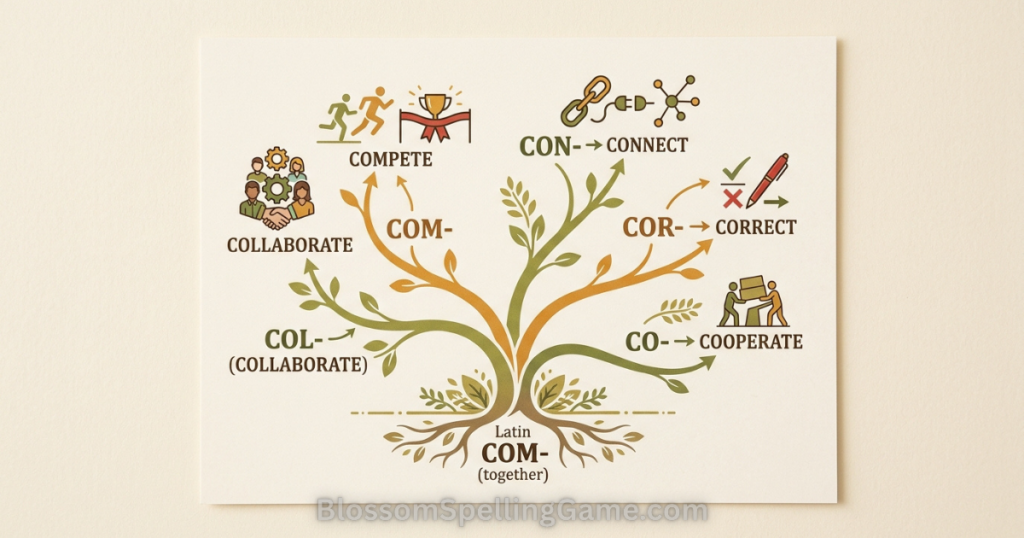
CO- / COL- / COM- / CON- / COR- — Together
Origin: Latin Meaning: Together; with; jointly
This prefix has many forms depending on what follows:
- CO- (before vowels and some consonants): COOPERATE, COEXIST
- COL- (before L): COLLABORATE, COLLECT
- COM- (before B, M, P): COMBINE, COMPETE, COMPRESS
- CON- (before most consonants): CONNECT, CONSIDER, CONSTRUCT
- COR- (before R): CORRECT, CORRESPOND
High-value CO-family words: COLLABORATE (11 letters), CORRESPOND (10 letters), CONTRIBUTE (10 letters), CONSTRUCT (9 letters, 16 pts), CONSIDER (8 letters, 15 pts), CONNECT (7 letters, 12 pts)
The Confusable Prefix Pairs
These prefix pairs are the most common source of Blossom submission errors and vocabulary confusion. Knowing the precise distinction prevents both mistakes.
UN- vs. IN- for negation: UN- for Germanic-root adjectives: UNHAPPY (happy = Germanic origin), UNKIND, UNFAIR IN- for Latin-root adjectives: INVISIBLE (visible = Latin origin VISIBILIS), INCORRECT, INDIRECT
Test: If the root word can be traced to Old English or Old German (everyday words like HAPPY, FAIR, KIND), use UN-. If the root has Latin or French origins (longer, more formal-sounding words like VISIBLE, CORRECT, DIRECT), use IN-.
RE- vs. DE-: RE- means doing something again or bringing back: REACTIVATE (activate again) DE- means removing or undoing: DEACTIVATE (remove active status)
These directly oppose each other. RE-BUILD (build again); DEMOLISH (tear down — but note: DEMOLISH uses DE- in the sense of removal, not reversal).
OVER- vs. SUPER-: OVER- implies excess relative to what’s appropriate: OVEREAT (eat more than you should) SUPER- implies excellence or superiority above others: SUPERIOR (of higher quality)
UNDER- vs. SUB-: UNDER- (Old English): Used in everyday vocabulary with familiar roots: UNDERSTAND, UNDERGO, UNDERPAY SUB- (Latin): Used with Latin-origin roots: SUBMARINE, SUBSCRIBE, SUBSTANTIAL
PRE- vs. FORE-: PRE- (Latin): Primarily temporal “before”: PREVIEW, PREDICT, PREVENT FORE- (Old English): Both spatial “in front” and temporal “before”: FOREFRONT, FORESIGHT, FORECAST
High-Value Blossom Words by Prefix — Quick Reference
This is the vocabulary reference table most useful for active Blossom play — organized by prefix, showing the highest-scoring words each prefix produces.
UN- words (8+ letters = 15+ points): UNNATURAL (9 letters, 16 pts), UNLIKELY (8 letters, 15 pts), UNAFRAID (8 letters, 15 pts), UNLAWFUL (8 letters, 15 pts), UNSTEADY (8 letters, 15 pts)
IN- words (8+ letters): INDIRECT (8, 15 pts), INFORMAL (8, 15 pts), INTERNAL (8, 15 pts), INNOCENT (8, 15 pts), INCREASE (8, 15 pts)
DIS- words (8+ letters): DISASTER (8, 15 pts), DISCOUNT (8, 15 pts), DISCOVER (8, 15 pts), DISORDER (8, 15 pts), DISTINCT (8, 15 pts)
RE- words (8+ letters): REPRESENT (9, 16 pts), RECOGNIZE (9, 16 pts), REINFORCE (9, 16 pts), REPRODUCE (9, 16 pts), REMAINDER (9, 16 pts)
DE- words (8+ letters): DECORATE (8, 15 pts), DECREASE (8, 15 pts), DEDICATE (8, 15 pts), DESCRIBE (8, 15 pts), DESPERATE (9, 16 pts)
OVER- words (7+ letters): OVERCOME (8, 15 pts), OVERLOOK (8, 15 pts), OVERFLOW (8, 15 pts), OVERRULE (8, 15 pts), OVERTURE (8, 15 pts)
UNDER- words (8+ letters): UNDERTAKE (9, 16 pts), UNDERMINE (9, 16 pts), UNDERLINE (9, 16 pts), UNDERSTAND (10, 17 pts)
INTER- words (8+ letters): INTERACT (8, 15 pts), INTEREST (8, 15 pts), INTERPRET (9, 16 pts), INTERRUPT (9, 16 pts)
PRE- words (7+ letters): PREPARE (7, 12 pts), PRESENCE (8, 15 pts), PRESERVE (8, 15 pts), PREVIOUS (8, 15 pts)
TRANS- words (8+ letters): TRANSFER (8, 15 pts), TRANSFORM (9, 16 pts), TRANSPORT (9, 16 pts)
Prefix Mnemonics That Actually Work
For prefixes that don’t stick instinctively, a mnemonic can anchor the meaning permanently.
UN-: “UN-does familiar words.” UNHAPPY, UNKIND, UNFAIR — these are all familiar, everyday words. UN- undoes the ordinary.
IN- (negation): “IN-formal Latin.” The roots that take IN- are typically formal, Latin-derived words. INVISIBLE, INCORRECT, INDIRECT — they sound formal and academic.
DIS-: “DIS-connects things.” Think of DIS- as disconnect — it separates, severs, opposes. DISCONNECT, DISPLACE, DISRUPT — things being pulled apart.
RE-: “RE-turn and RE-peat.” RE- either sends something back (return) or does it again (repeat). If you can’t tell which — it doesn’t matter for Blossom purposes; the word is valid either way.
DE-: “DE-construction.” DE- takes things apart, reduces them, removes elements. DECODE, DEFROST, DEFLATE, DESTROY.
UNDER-: “UNDER-appreciated.” UNDER- implies not enough — the underdog, the underpaid, the undervalued.
OVER-: “OVER-whelmed.” OVER- implies too much — overwhelmed, overloaded, overdone.
PRE-: “PRE-view — see before you go.” PRE- always comes before, in time or order.
POST-: “POST-script — written after.” POST- always comes after.
INTER-: “INTER-national — between nations.” INTER- sits between things.
TRANS-: “TRANS-Atlantic — across the ocean.” TRANS- crosses from one side to the other.
SEMI-: “SEMIcircle — half a circle.” SEMI- is always half or partial.
ANTI-: “ANTIdote — against the poison.” ANTI- opposes or prevents.
AUTO-: “AUTOmatic — by itself.” AUTO- is self, acting alone.
FAQ
What is the most useful prefix to know for Blossom Word Game?
RE- is the single most productive prefix for Blossom — it attaches to more verb roots than any other prefix, requires only R and E (common letters), and produces words of 6–10+ letters. After RE-, the negation prefixes (UN-, IN-, DIS-) are collectively the most productive family because they apply across a huge range of common adjectives and verbs.
What’s the difference between UN- and IN- for negation?
UN- (Old English) negates Germanic-origin words: UNHAPPY, UNKIND, UNFAIR. IN- (Latin) negates Latin-origin words: INVISIBLE, INCORRECT, INDIRECT. When the root sounds like an everyday informal word, use UN-. When it sounds formal or academic, use IN-. Also remember that IN- changes to IM- before B/M/P, IL- before L, and IR- before R.
Why does IN- sometimes mean “not” and sometimes mean “into”?
These are two different Latin prefixes that look identical in English. Latin IN- meaning “not” comes from the negative particle; Latin IN- meaning “into/within” comes from the preposition. English inherited both without distinguishing them. Context determines meaning: INVISIBLE = not visible (negation); INHALE = breathe into (location).
What’s the difference between OVER-, SUPER-, HYPER-, and ULTRA-?
OVER- (Old English) implies excess relative to what’s appropriate. SUPER- (Latin) implies excellence or superiority above others. HYPER- (Greek) implies excessive or beyond normal limits, often with a disordered connotation. ULTRA- (Latin) implies the extreme end of a continuum, the furthest possible degree.
Are there words in Blossom that look prefixed but aren’t?
Yes — common examples include UNCLE (not UN + CLE), DISH (not DIS + H), and PRETTY (not PRE + TTY). These words begin with prefix-like letter sequences but their etymologies have nothing to do with those prefixes. The practical Blossom implication is to avoid trying to find related words by substituting what looks like a prefix — these false-prefix words don’t have productive derivational families.
How do I know which negation prefix to use for an unfamiliar word?
Check the word’s origin. If it’s a formal/academic word (likely Latin origin), try IN-. If it’s an everyday word (likely Germanic/Old English origin), try UN-. If neither works, try DIS- (for verbs and words implying separation) or NON- (for nouns expressing neutral absence). In Blossom specifically — since submitting costs nothing, try all viable options and let the game confirm which is in the dictionary.
What are the highest-scoring prefix words in Blossom?
Long prefix combinations with productive suffixes produce the highest scores. UNDERSTANDING (13 letters, 20 pts when all letters available), REPRESENTING (12 letters), TRANSFORMING (12 letters), OVERCOMPLICATE (13 letters). More realistically in a given letter set: any UNDER- or TRANS- word of 9+ letters (16+ points) or any OVER-/INTER- word of 8+ letters (15+ points) is a high-scoring find.
Final Thoughts
Prefixes aren’t just word parts — they’re the organizational architecture of English vocabulary. Understanding that UN- comes from Old English while IN- comes from Latin, that OVER- expresses excess while SUPER- expresses superiority, that the CO-/COL-/COM-/CON-/COR- variants are all the same prefix adapting to different sounds — this kind of vocabulary knowledge makes pattern recognition in Blossom faster and more reliable.
Every letter set that contains R and E opens the RE- vocabulary. Every set with D, I, S opens the DIS- family. Every set with U and N opens both UN- negation and the fastening-verb reversal category. Knowing these families deeply — knowing not just the prefix labels but the specific words each prefix produces — is what converts letter combinations into word counts.
This article is the vocabulary foundation. The Blossom Prefix Strategy Guide is the gameplay application. Used together, they cover everything you need to extract maximum word count from every prefix-containing letter set Blossom gives you.
Play today’s puzzle at BlossomSpellingGame.com. The letter set is fresh, and somewhere in it, a prefix family is waiting to be unlocked.