
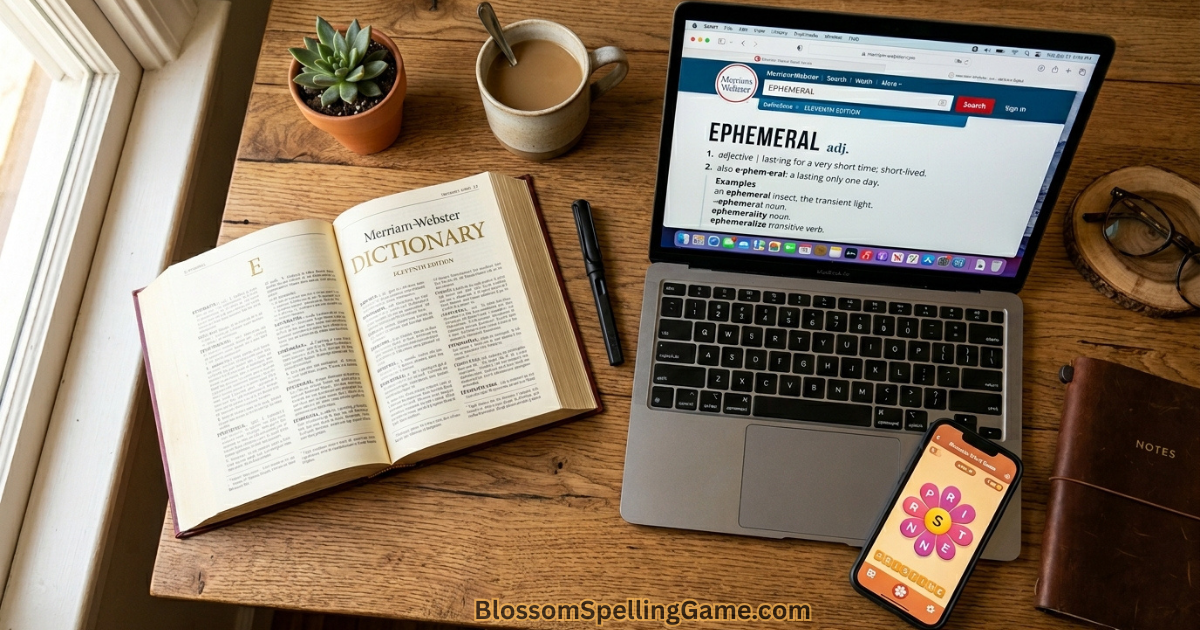
What dictionary does Blossom Word Game use? Merriam-Webster — but which edition, how it updates, why some real words still fail, and what this means for your game.
You submitted a word you’ve used your entire life. Rejected. You tried a word from last week’s crossword. Rejected. Then, almost by accident, you tested something obscure you half-remembered from a novel — and it worked.
If this experience sounds familiar, the explanation lives in a specific question that most Blossom guides never properly address: which dictionary does Blossom use, exactly, and how does it actually work?
The short answer — “Merriam-Webster” — is accurate but incomplete. Merriam-Webster isn’t one thing. It’s a family of dictionary products with meaningfully different scopes, update cycles, and inclusion standards. The specific version Blossom uses, how that word list is maintained, how it differs from other major word game dictionaries, and what the gap looks like between “words M-W contains” and “words Blossom accepts” — all of that determines why the game behaves the way it does.
This guide answers the dictionary question completely: what M-W product powers Blossom, how words get added to it, which recent additions are now in Blossom, how Blossom’s word list compares to Scrabble dictionaries and the NYT’s curated list, and exactly what the “not in word list” rejection actually means in dictionary terms.
The Short Answer: Which Dictionary Blossom Uses
⚡ Short Answer: Blossom Word Game uses Merriam-Webster’s dictionary as its word validation standard — specifically a version aligned with Merriam-Webster’s comprehensive database, which is the most authoritative American English dictionary available. The game accepts words that appear as standard dictionary entries (common nouns, verbs, adjectives, adverbs) while excluding proper nouns, abbreviations, hyphenated compounds, and words shorter than four letters. The word list updates periodically as Merriam-Webster formally adds new words to its database.
That’s the accurate one-paragraph answer. The rest of this article covers what “Merriam-Webster’s dictionary” actually means in practice — because the details change how you play.
The Merriam-Webster Dictionary Family — Which Version Matters
“Merriam-Webster” isn’t a single dictionary — it’s a publishing organization that produces several distinct dictionary products, each with different scopes and inclusion thresholds.
Merriam-Webster Online (merriam-webster.com) The freely accessible web dictionary. This is the version most people consult when they look up a word, and it’s the most directly associated with Blossom’s word validation. M-W Online is a comprehensive general-purpose dictionary that covers standard American English vocabulary across all domains — nouns, verbs, adjectives, adverbs, and their standard inflected forms.
Merriam-Webster’s Collegiate Dictionary The print/digital edition aimed at general readers and students. Slightly more conservative in scope than the full M-W Unabridged, the Collegiate is the reference standard for most American writing contexts. Some rarer words in M-W Unabridged don’t appear in Collegiate.
Merriam-Webster Unabridged The most comprehensive M-W product — significantly larger than both the Online and Collegiate editions. The Unabridged includes archaic words, highly technical vocabulary, rare but valid entries, and more complete coverage of word variants. It’s available by subscription.
Which version powers Blossom? Blossom’s word validation draws from a database aligned primarily with M-W’s comprehensive online and Unabridged resources, not just the Collegiate. This is why the game accepts some words that feel “too obscure for a word game” — words that appear in the full dictionary database but that most casual dictionary users never encounter.
This also explains why Blossom occasionally accepts words that the NYT Spelling Bee (which uses a more conservatively curated editorial list) rejects. Blossom’s standard is the dictionary; Spelling Bee’s standard is an editorial selection from the dictionary.
The practical implication: When you’re unsure whether a word will be accepted, the most reliable check is merriam-webster.com. If the word appears there as a standard entry — with a definition, part of speech, and no “archaic” or “dialectal” qualifier — there’s a strong chance Blossom accepts it.
How Merriam-Webster Decides to Add New Words
This is one of the most practically useful pieces of dictionary knowledge for Blossom players — because it explains both why some words you expect to work don’t, and why some unexpectedly informal words do.
Merriam-Webster uses a corpus-based, evidence-driven process for word inclusion. The core standard: a word must demonstrate sustained usage across a broad range of independent print sources over time before it earns a formal dictionary entry.
The three criteria M-W applies:
Widespread use: The word must appear in a significant variety of independent sources — not concentrated in one community, publication, or region. A word used primarily in one online forum or one regional dialect doesn’t qualify, no matter how frequently it appears there.
Sustained use over time: The word must have been in consistent use for a meaningful period — typically measured in years, not months. This is why viral slang that peaks and fades rarely makes it into M-W, while words that gradually accumulate usage across a decade typically do.
Meaningful use: Appearances must be in contexts that use the word meaningfully — not just defining it, citing it as a curiosity, or ironically quoting it. The word needs to function as vocabulary in actual writing and speech.
What this means for Blossom:
Words that feel like “obvious” additions — common slang, popular new coinages — often haven’t yet met M-W’s criteria at the time they feel obvious to users. The dictionary is intentionally conservative about adding new words precisely to maintain its credibility as a stable reference standard.
Conversely, words that feel “too old” or “too formal” for a casual word game often have extremely solid M-W entries accumulated over centuries of English print documentation. ABLUTION, CONCATENATE, SERENDIPITOUS — these feel uncommon in speech but have deep print documentation.
How Often Blossom’s Word List Actually Updates
This is a question players frequently ask and almost never get a direct answer to. Here’s the most accurate picture available.
Merriam-Webster’s update cycle: M-W adds words to its online dictionary several times per year — typically in spring and fall update batches. Each batch adds dozens to hundreds of new words. Merriam-Webster publicizes major additions and sometimes these become news items (the “new words added to M-W” stories you occasionally see).
Blossom’s word list integration: Blossom’s word validation database updates to incorporate M-W additions, but typically with some lag — not every M-W batch update is immediately reflected in Blossom’s validation system. The integration happens over time rather than simultaneously with every M-W update.
The practical consequence for players: A word formally added to Merriam-Webster may not immediately work in Blossom. If you know a word was recently added to M-W but it’s still being rejected in Blossom, the most likely explanation is that Blossom’s database hasn’t yet incorporated that specific update cycle.
Testing new words: Because rejected submissions cost nothing in Blossom (they don’t consume your 12-slot budget — only accepted words do), testing recently added words is essentially free. If a word was added to M-W within the past year and it’s not working in Blossom, check again a few months later.
Why the lag exists: Word game validation databases aren’t automatically synced to live dictionary APIs — they’re curated sets maintained separately. Integrating updates requires manual review to ensure the word meets gameplay criteria (not just M-W criteria) — specifically checking that new entries aren’t proper nouns, abbreviations, or problematic in other game-specific ways.
Recent M-W Additions That Now Work in Blossom
Merriam-Webster has been actively adding words from digital culture, science, and evolving informal usage throughout the 2020s. Here’s a category overview of recent additions that players encounter in Blossom:
Digital and technology vocabulary: Words like FINTECH, DEEPFAKE, CRYPTOCURRENCY, and related technical vocabulary have been added to M-W as they’ve achieved widespread mainstream usage in print. Short-form technology words that cross into general vocabulary — not just used by tech specialists — typically meet M-W’s broad-usage threshold.
Health and wellness vocabulary: Medical and health terms that crossed from specialist usage into widespread public understanding — particularly accelerated by pandemic-era public health discourse — have been added to M-W. Some of these appear in Blossom when the letters align.
Food and culture vocabulary: M-W has added food terms with widespread documentation: BANH MI, SHEET PAN (as a compound modifier), OAT MILK. Cultural vocabulary that appears consistently across a wide range of independent publications qualifies.
Informal but now standard vocabulary: Words that originated as slang but achieved sustained formal usage: SELFIE (added 2014), PHOTOBOMB (added 2014), BINGE-WATCH (2017), STAN (2019 — both noun and verb forms), AMIRITE (2022).
A note on testing recent words in Blossom: Because Blossom’s word list integration lags M-W updates, the most reliable approach is to test any recent addition and note the result. A word that fails today may work in three to six months if it was recently added to M-W’s formal database.
Words in M-W That Still Fail in Blossom — The Gap
This is the nuance that most “Blossom uses Merriam-Webster” explanations skip — and it’s one of the most practically useful things to understand.
Not every word in Merriam-Webster’s dictionary works in Blossom. There’s a meaningful gap between “the full M-W database” and “Blossom’s validated word list.” Here’s where the gap lives:
Proper nouns with lowercase variants: As covered in our Why Blossom Rejects Real Words guide, some words have both proper noun and common noun/adjective definitions in M-W. Whether the lowercase common meaning is in Blossom’s validated list varies case by case.
Highly archaic entries: M-W’s Unabridged contains words last used in 14th-century English that technically remain valid dictionary entries. Blossom’s list draws from “active” vocabulary — words in current or recent usage — not every archaic entry in the full historical record.
Very technical specialist vocabulary: Words used exclusively in a narrow specialist context (advanced biochemistry, medieval heraldry, specialized legal terminology) may appear in M-W’s comprehensive database but not in Blossom’s game-specific validated list. The game’s list is calibrated toward vocabulary that’s broadly accessible.
Certain inflected forms: M-W doesn’t separately list every possible inflected form of every word. When a word’s inflection is fully regular (WALK → WALKED → WALKING → WALKER), M-W may list only the base form with an implied set of standard forms. Blossom accepts those standard forms, but non-standard or unusual inflections that aren’t independently listed may not work.
Recently added words during the lag period: As discussed above, words formally added to M-W but not yet integrated into Blossom’s validated list constitute a temporary gap that resolves over update cycles.
The practical takeaway: Blossom uses a curated subset of M-W’s comprehensive database — one that prioritizes current, broadly accessible vocabulary while excluding archaic entries, highly specialized technical terms, and words still in the integration pipeline. When a word is in M-W but fails in Blossom, one of these gap categories is almost always the explanation.
How Blossom’s Dictionary Compares to Scrabble Dictionaries
Many players come to Blossom from competitive Scrabble or word game backgrounds. If that’s you, understanding how M-W differs from Scrabble word lists is immediately practical.
The main Scrabble dictionaries:
TWL (Tournament Word List) — the official North American Scrabble tournament word list. Maintained by Hasbro/Mattel, NOT Merriam-Webster. The TWL includes many short, unusual words (QI, ZA, AA, OX valid in Scrabble; some not in general Blossom use due to the 4-letter minimum) and excludes some M-W words that were deemed inappropriate for a brand-associated game.
SOWPODS — the international Scrabble word list used in British and international tournaments. Draws from Collins Dictionary (British English standard) rather than Merriam-Webster. Contains many words valid in British English that aren’t in American Merriam-Webster.
Collins Scrabble Words (CSW) — the current name for SOWPODS. Uses Collins English Dictionary, which is notably broader than M-W in its inclusion of informal, dialectal, and international English vocabulary.
NWL (NASPA Word List) — the North American Scrabble Players Association tournament standard. Similar scope to TWL.
Key differences from Blossom’s M-W standard:
| Feature | Blossom (M-W) | Scrabble TWL/NWL | Scrabble Collins/SOWPODS |
|---|---|---|---|
| Standard | American English (M-W) | North American competitive | International (Collins) |
| Short words | 4-letter minimum | 2-letter words valid | 2-letter words valid |
| British spellings | Generally excluded | Generally excluded | Included |
| Informal/slang | Included if in M-W | Curated inclusion | More liberal inclusion |
| Proper noun overlap | Common-noun forms only | Same | Same |
| Technical vocab | M-W standard | Broader Scrabble-specific | Broadest |
What this means practically:
If you play competitive Scrabble with TWL and try to transfer that knowledge to Blossom, you’ll encounter two categories of surprises:
Words valid in Scrabble TWL that fail in Blossom: QI, ZA, AA, XI, KI — these are valid Scrabble words but either too short (under 4 letters) or not in M-W’s standard entries.
Words valid in Blossom that fail in Scrabble TWL: Some M-W words that were excluded from Scrabble dictionaries for brand/content reasons. And vice versa.
Words valid in SOWPODS (Collins) that fail in Blossom: British spellings, words common in British/Australian English but not in American M-W.
The key distinction: Scrabble dictionaries are compiled specifically for competitive gameplay, with explicit decisions about which words to include or exclude based on game design considerations. M-W is a general-purpose reference dictionary compiled for linguistic accuracy. The overlap is large but the difference is meaningful.
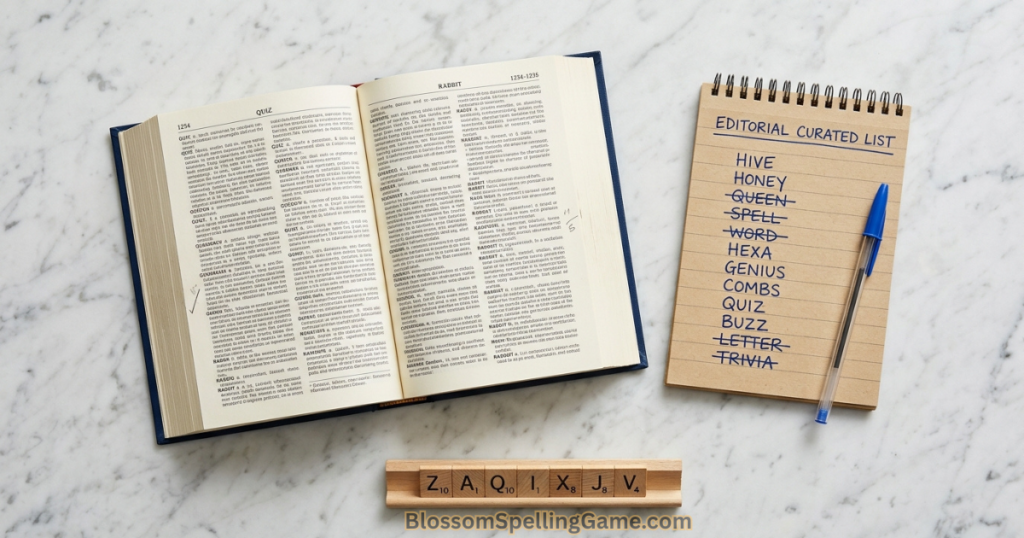
Blossom vs. NYT Spelling Bee: The Dictionary Difference in Practice
This comparison has been touched on elsewhere in our catalog, but deserves a focused dictionary-level examination for Article 18’s audience.
NYT Spelling Bee’s word list: The Spelling Bee uses a list curated internally by NYT puzzle editors — it’s not a direct map to any published dictionary. Editors select words they consider fair, interesting, and appropriate for the game’s audience. They explicitly exclude words they deem offensive, too obscure, or inappropriate for various reasons that have nothing to do with dictionary validity.
The practical differences:
Words M-W has that NYT rejects: Common words that NYT editors have decided don’t meet their fairness standard — often because they feel the word is too obscure for a general audience despite being in the dictionary. TEMPS, FRAT, ALOUD have been famously rejected by Spelling Bee while being completely valid M-W entries.
Words NYT accepts that M-W might question: The NYT list occasionally accepts proper nouns’ common-noun forms more liberally than M-W’s strict parsing would suggest, or accepts informal terms that are borderline M-W entries.
The frustration asymmetry: Blossom’s M-W standard creates occasional frustration when an expected word fails (usually because it’s in the gap between M-W’s full database and Blossom’s validated subset). But the reason for rejection is always principled — the word doesn’t meet the dictionary standard.
NYT Spelling Bee’s editorial standard creates frustration that feels more arbitrary — the word IS in the dictionary, it’s just that an editor decided not to include it. This editorial opacity is why many players find Blossom’s dictionary-based approach more satisfying, even when it occasionally produces surprising rejections.
How Merriam-Webster Handles Informal and Slang Words
One of the most interesting aspects of M-W’s approach — and one that directly affects Blossom gameplay — is how the dictionary handles the boundary between informal/slang vocabulary and “proper” dictionary vocabulary.
M-W’s descriptive (not prescriptive) approach:
Merriam-Webster is famously descriptive rather than prescriptive. This means the dictionary documents how English is actually used, not how language authorities think it should be used. M-W doesn’t refuse to include a word because it originated as slang, because it’s “incorrect” by traditional grammar standards, or because language purists object to it.
The standard is usage: if a word is in widespread, sustained use in independent print sources, it gets documented.
What this means for Blossom:
Words that feel “too informal” for a serious dictionary — SELFIE, BLOG, EMAIL, UNFRIEND, HANGRY — have all been added to M-W as they’ve achieved broad print usage. Once in M-W, they become candidates for Blossom’s validated list (subject to the update lag discussed earlier).
This is why Blossom occasionally accepts words that feel casually informal. The game’s M-W standard doesn’t distinguish between “formal vocabulary” and “informal vocabulary” — it distinguishes between “in the dictionary” and “not in the dictionary.”
Usage labels in M-W: M-W does use labels like “informal,” “slang,” “dated,” “offensive,” and “dialectal” within entries. These labels document register and usage context but don’t determine inclusion — a word labeled “slang” is still a dictionary word. Whether these labeled words appear in Blossom’s validated list may depend on how the game’s word list curators handle label-bearing entries.
Technical and Scientific Vocabulary in Blossom
Players often wonder why some scientific or technical words work in Blossom while others don’t. The M-W standard explains this pattern precisely.
Words in M-W’s general dictionary: Scientific and technical terms that have crossed into mainstream general vocabulary appear in M-W’s standard dictionary. GENOME, PIXEL, ALGORITHM, PROTEIN, BACTERIA, FOSSIL, MOLECULE — these began as specialist terms but achieved sufficient general usage to earn full M-W dictionary entries with general-audience definitions.
These words work in Blossom when the letters are available.
Words in specialist dictionaries only: Highly technical terms that remain in specialist use — detailed biochemical nomenclature, advanced mathematical terminology, medical subspecialty vocabulary — may appear in technical reference resources but not in M-W’s general dictionary. These fail in Blossom because they’re not in the standard dictionary Blossom uses.
Latin genus names and biological nomenclature: Scientific names for species (HOMO SAPIENS, CANIS LUPUS, QUERCUS ROBUR) are Latin proper nouns — they’re always capitalized and by definition are proper nouns. They don’t appear in general-use dictionaries as common nouns. These fail in Blossom on the proper noun rule, not on the dictionary presence rule.
However — common names for organisms that have been incorporated as standard English nouns DO appear in M-W: FUNGI (plural of fungus), BACTERIA (plural of bacterium), CACTUS (both singular and CACTI plural), ALGORITHM (from mathematics but now general vocabulary). These work in Blossom.
The practical rule: Ask: “Is this a technical term that only specialists use, or has it crossed into mainstream general English?” If your grandmother would understand it without explanation, it’s probably in M-W and probably works in Blossom.
Compound Words: Open, Closed, and Hyphenated
This is one of the dictionary mechanics that most directly affects word game play — and one that M-W handles in a specific way.
Three types of compound words:
Open compounds: Two or more words written separately that function as a single concept. ICE CREAM, HIGH SCHOOL, REAL ESTATE. These are two-word phrases in M-W, not single-word entries. In Blossom, these don’t work as single submissions because they contain a space.
Hyphenated compounds: Words joined by a hyphen: WELL-KNOWN, FINE-TUNE, T-SHIRT. M-W lists these as hyphenated entries. In Blossom, hyphenated words are rejected regardless of their M-W status — the hyphen makes them invalid. For the full explanation, see our Why Blossom Rejects Real Words guide.
Closed compounds: Two or more words written as a single word without hyphen or space: BREAKFAST, BOOKSHELF, SUNLIGHT, THUNDERSTORM, HARDCOVER. These are single M-W entries and typically work in Blossom when letters are available.
The evolution problem: English compound words frequently migrate from open to hyphenated to closed over time as usage solidifies. EMAIL started as E-MAIL (hyphenated), became email (closed). WEBSITE started as WEB SITE (open), became website (closed). COOPERATE was once CO-OPERATE.
M-W’s current listing reflects the dominant current usage for each compound. When a word is in transition — listed with a hyphen in some sources but as a closed compound in others — Blossom’s behavior may be inconsistent. The general advice: try the closed compound form when the hyphenated form fails.
Closed compound hunting in Blossom: This is an underused word-finding strategy. Large compound words — THUNDERSTORM, DOWNSTREAM, UNDERSTAND, OVERPOWER, BREAKDOWN, STANDSTILL — often use many of your seven letters and can be among the longest words in a given puzzle. When your letter set includes combinations that look like two shorter words, ask whether those two words form a standard closed compound.
Regional American English in the Game’s Word List
English varies regionally, and M-W handles this variation in a specific way that affects Blossom gameplay.
M-W’s regional coverage: Merriam-Webster documents American English as used across the country, including regional vocabulary — words used primarily in specific geographic areas. These entries typically carry labels like “chiefly Southern,” “chiefly dialectal,” or “chiefly British” (for British English words that appear in American contexts).
What appears in Blossom: Regional vocabulary that has achieved sufficient national print documentation appears in M-W’s general dictionary without a label. BAYOU (Louisiana/Southern US), HOAGIE (Mid-Atlantic), GRINDER (New England) — these regional food and regional vocabulary words appear in M-W because they’ve been documented nationally even if used primarily regionally.
Vocabulary that’s exclusively local — words understood only within a very specific community — typically doesn’t meet M-W’s “widespread independent use” threshold and doesn’t appear in the general dictionary. These don’t appear in Blossom.
The practical implication: If you know a regional word that you’re confident is in widespread use across the country (even if it originated in one region), try it in Blossom. Regional vocabulary that’s crossed into national awareness — particularly food terms, cultural practices, and music genres — often has strong M-W documentation.
What “Not in Word List” Actually Means
When Blossom rejects a submission with “not in word list,” players often interpret this as “not a real word.” That interpretation is frequently wrong — and understanding what the message actually means improves your gameplay.
“Not in word list” means one of these things:
- The word isn’t in Merriam-Webster’s dictionary. This is the intended meaning — the word genuinely isn’t in the standard American English dictionary. It may be slang, very informal, a proper noun used informally, a word from another language, or a nonce coinage.
- The word is in M-W but not in Blossom’s validated subset. As discussed, Blossom’s list is a curated subset of M-W’s full database. Some M-W words — particularly archaic, highly technical, or very recently added entries — may not be in Blossom’s current validated list.
- The word form is wrong. The base word is in M-W, but the specific inflected form you submitted isn’t separately listed. The game accepts RUNNING but maybe not an unusual past participle form of an irregular verb.
- The word doesn’t contain the center letter. This rejection happens before dictionary lookup — Blossom checks the center letter rule before consulting the dictionary. If center letter isn’t present, the rejection appears regardless of whether it’s a real word.
- The word is under four letters. Similarly, the length check happens before dictionary lookup.
Why this matters for strategy: When a word you’re confident is valid gets rejected, mentally walk through these five possibilities in order. If you’re sure it contains the center letter and it’s at least four letters, the rejection is almost certainly in category 2 (gap between M-W and Blossom’s subset) or category 3 (wrong form). Neither of these means your vocabulary is wrong — they mean the game’s database doesn’t have that specific entry yet.
For a complete breakdown of all rejection reasons with examples, see our comprehensive rejection guide.
How to Use Dictionary Knowledge Strategically
Understanding Blossom’s M-W foundation isn’t just academically interesting — it’s practically useful for improving your gameplay.
Check M-W before submitting uncertain words: Before spending mental energy testing a word you’re unsure about, quickly look it up on merriam-webster.com. If it’s not there, it won’t work in Blossom. If it is there with a standard entry (no “archaic,” “dialectal,” or “chiefly British” qualifier), it will likely work in Blossom (with the caveat of the update lag for very recent additions).
Use M-W’s entry structure to find word families: M-W entries often show word family members — the entry for BRIGHT, for example, shows BRIGHTER, BRIGHTEST, BRIGHTLY, BRIGHTNESS, BRIGHTEN as related forms. This is a direct map of the suffix and prefix extensions likely to work in Blossom.
Understand the “active” vocabulary filter: Blossom’s list draws from active, current M-W vocabulary. If M-W’s entry for a word includes labels like “archaic,” “dated,” or “historical,” that word is less likely to appear in Blossom’s validated list — not because it’s not in the dictionary, but because Blossom’s list prioritizes words in current use.
Exploit closed compounds: M-W’s database contains thousands of closed compound words that aren’t immediately obvious word game candidates. Building a mental habit of thinking “does these two shorter words combine into a single closed compound?” is one of the highest-leverage dictionary-awareness strategies in Blossom.
Trust the dictionary for obscure words: If merriam-webster.com lists a word as a standard entry, try it in Blossom. Players routinely leave points on the table because they assume a word is “too unusual” for the game. The M-W standard is more inclusive of unusual vocabulary than most players assume — and rejected submissions cost nothing.
FAQ
What dictionary does Blossom Word Game use?
Blossom Word Game uses Merriam-Webster’s dictionary as its word validation standard — specifically aligned with M-W’s comprehensive database, which includes the vocabulary covered by both M-W Online and the more extensive M-W Unabridged. The game validates words against this database with specific gameplay exclusions: no proper nouns, no abbreviations, no hyphenated words, and a 4-letter minimum.
Does Blossom use the same dictionary as Scrabble?
No. Blossom uses Merriam-Webster, which is the standard American English dictionary. Scrabble uses either the TWL/NWL (Tournament Word List for North American play) or Collins Scrabble Words (SOWPODS) for international play. These Scrabble dictionaries include many short words (under 4 letters) valid in Scrabble but too short for Blossom, and may include or exclude different words than M-W based on competitive game design decisions rather than linguistic documentation.
Why does Blossom reject words that are in the dictionary?
Several reasons: the word may be in M-W but not yet integrated into Blossom’s validated subset (update lag); it may be an archaic or highly technical M-W entry outside Blossom’s “active vocabulary” scope; it may be a proper noun even if it has a lowercase variant; or the specific inflected form submitted isn’t separately listed. See our full rejection guide for all reasons.
Does Blossom accept British English spellings?
Generally no — Blossom uses American English (Merriam-Webster) as its standard, and American spellings are the primary validated forms. Some British variants listed as acceptable alternatives in M-W may occasionally work, but American spellings are always the safer choice (COLOR not COLOUR, CENTER not CENTRE).
How often does Blossom’s word list update?
Blossom’s word list updates periodically, tracking Merriam-Webster’s formal addition cycles. M-W adds words several times per year; Blossom’s integration of these additions typically occurs with some lag. A word added to M-W may take several months to appear in Blossom’s validated list.
Is Merriam-Webster’s dictionary the most comprehensive English dictionary?
For American English, M-W is the most authoritative standard. The Oxford English Dictionary (OED) is broader in historical coverage — it documents the complete historical record of English words across all varieties and eras. But the OED is a historical dictionary, not a current-usage standard. For current American English, M-W is the definitive reference, which is why Blossom uses it.
Why does Blossom sometimes accept words that NYT Spelling Bee rejects?
Blossom uses M-W as an objective dictionary standard. NYT Spelling Bee uses an editorially curated list — NYT editors select which M-W words to include and which to exclude based on considerations of fairness and accessibility. Some legitimate M-W words are in Blossom but not in Spelling Bee because NYT editors chose to exclude them. This is a persistent source of frustration for Spelling Bee players who switch to Blossom and find it accepts words they expected to fail.
Can I use merriam-webster.com to check if a word will work in Blossom?
Yes — with caveats. If a word appears in M-W with a standard entry and no “archaic,” “dialectal,” or “chiefly British” qualifiers, it’s a strong candidate for Blossom. The main caveats: very recently added words may not yet be in Blossom’s validated list (update lag), and some technically valid M-W entries may be outside Blossom’s active vocabulary scope. In practice, merriam-webster.com is the best pre-submission check available.
Does Blossom accept words from other languages?
Words from other languages that have been formally borrowed into American English and appear in M-W as standard entries can work in Blossom. Loanwords like SCHADENFREUDE, TSUNAMI, ENTREPRENEUR, FIESTA, NAIVE — fully integrated into M-W American English — are valid. Words that are still primarily foreign-language terms and appear in M-W with a “foreign phrase” label rather than as standard English words typically don’t work.
Final Thoughts
The answer to “what dictionary does Blossom use?” is Merriam-Webster — but now you know what that actually means.
It means a comprehensive, evidence-based, descriptive American English dictionary that includes informal vocabulary when it’s in widespread print use, excludes words still below the documentation threshold, and updates several times per year as English vocabulary evolves. It means a word list broader than the NYT Spelling Bee’s editorial curation and different from Scrabble’s competitive dictionaries in specific, predictable ways.
Most practically: it means merriam-webster.com is your most reliable pre-submission check. If the word has a standard entry there — not labeled archaic, not labeled chiefly British, not primarily a proper noun — there’s a strong chance Blossom accepts it.
And when you hit the inevitable “not in word list” rejection for something you’re sure is a real word: check M-W, check whether it might be in the update-lag gap, check whether the form you submitted is the one M-W lists, and then try the closest standard form. The dictionary is the standard. Understanding the standard is most of the game.
Play today’s puzzle at BlossomSpellingGame.com — the seven letters are fresh, the M-W word list is ready, and there are words in that flower you haven’t found yet.