
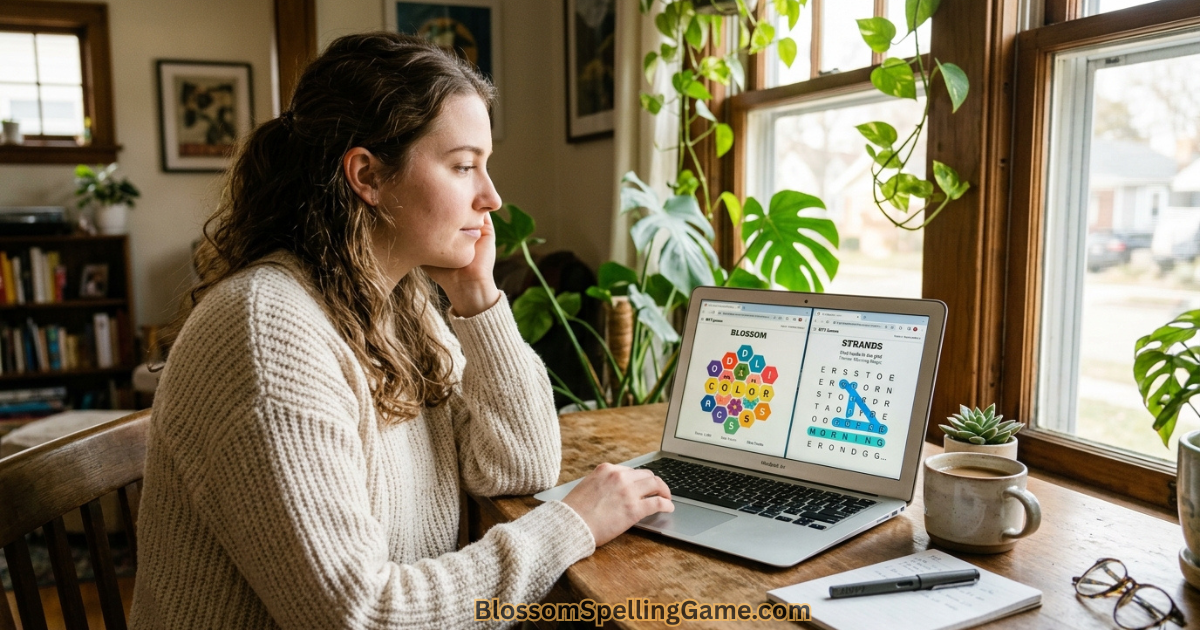
Blossom Word Game vs NYT Strands — both daily word puzzles, completely different mechanics. Here’s the honest comparison: which one builds better skills and fits your routine.
Both games involve finding words. Both reset every day. Both have that one special high-value word that anchors the puzzle — Blossom’s pangram, Strands’ spangram. Both are built by serious puzzle designers who care about craft.
And yet — playing them back to back feels like switching between two completely different sports. One is a memory sport. The other is a visual sport. One asks you to generate from nothing. The other asks you to find what’s already there.
That difference — generation versus discovery, phonological memory versus spatial scanning — is what makes Blossom Word Game and NYT Strands genuinely complementary rather than competing. Understanding it is also what helps you decide how each fits into your daily routine, whether one is better suited to your particular strengths, and how getting good at one affects your performance in the other.
This guide goes deeper than the surface comparison. Not just “Strands is a word search with a theme” versus “Blossom is a letter game with a pangram” — but what those mechanics actually demand from your brain, where each game’s difficulty lives, what each one is genuinely better at teaching, and which player profile thrives in each.
The Core Mechanic Difference: Generation vs. Discovery
⚡ Quick Answer: Blossom Word Game is a word generation game — you produce valid words from a constrained letter set using your own vocabulary. NYT Strands is a word discovery game — you find words that are already hidden in a letter grid. Both test vocabulary, but through completely opposite cognitive operations. Blossom asks “what words can you make?” Strands asks “where are the words hiding?”
This generation-versus-discovery distinction sounds simple. Its implications run through every dimension of how the games feel, what they test, and what kind of player excels at each.
In Blossom, the words don’t exist anywhere in the puzzle interface until you submit them. You’re not finding hidden content — you’re creating content from raw letter material. Your vocabulary is the source. The puzzle provides constraints; you provide the words. If your vocabulary doesn’t contain a specific word, that word doesn’t appear in your session, regardless of whether the letters would allow it.
In Strands, every word you’ll find is already present in the grid, fully spelled out, waiting for you to trace its path. Your job is spatial navigation — identifying letter sequences that form theme-related words across the grid’s horizontal, vertical, and diagonal paths. The words are there whether you find them or not. Your vocabulary helps you recognize them when you see them, but the challenge is visual search, not verbal generation.
This means two players with identical vocabularies will perform very differently on each game based on their respective strengths in phonological memory (Blossom) versus spatial pattern recognition (Strands).
How NYT Strands Actually Works — The Mechanics That Matter
If you’re a Blossom player who hasn’t tried Strands, here’s what’s waiting for you — focusing on the mechanics that define the experience.
Every day, Strands presents a grid of letters — typically 6×8 or similar dimensions — with a daily theme displayed at the top. Your job is to find all the words hidden in the grid that relate to the theme, plus one special word: the spangram.
The rules that make Strands distinct:
Every letter belongs to exactly one word. This is the most important rule — and it’s what elevates Strands from a conventional word search into a genuine puzzle. In a standard word search, letters can be used in multiple words or left unused. In Strands, the entire grid is partitioned — when you correctly identify all theme words and the spangram, every single letter on the board has been used exactly once. This constraint means finding one word reveals which letters aren’t available for others, creating a cascading logic that compounds as you solve.
Words can go in any direction. Unlike some word searches that only allow horizontal and vertical paths, Strands allows diagonal paths too. Words can change direction. A single word might trace an L-shape, a zigzag, or any connected path through adjacent letters. This dramatically increases the spatial complexity — a word you’re looking for might be anywhere in the grid, oriented in any direction.
The theme is your primary guide. You know the theme before you start. “Types of bread,” “Olympic sports,” “Things in a kitchen” — the theme tells you exactly what category of words you’re looking for. This thematic scaffolding is simultaneously Strands’ most helpful feature and its most interesting puzzle element.
Non-theme words fund hints. If you find valid English words that aren’t part of the theme, they don’t count as theme solutions — but they bank toward hint tokens. Every three non-theme words found earns one hint, which reveals one letter of an unfound theme word. This creates an interesting strategic decision: do you deliberately hunt non-theme words to earn hints, or do you focus exclusively on theme words?
The spangram spans the board. The spangram is a theme word (or phrase) that connects two opposite edges of the grid — touching both a left/right edge and a top/bottom edge as it traces through the letters. Finding the spangram illuminates it in golden color and is the visual centerpiece of each puzzle’s resolution.
The Spatial vs. Phonological Search Divide
This is the cognitive science dimension that most comparison articles skip — and it’s the most revealing differentiator between the two games.
What Blossom engages:
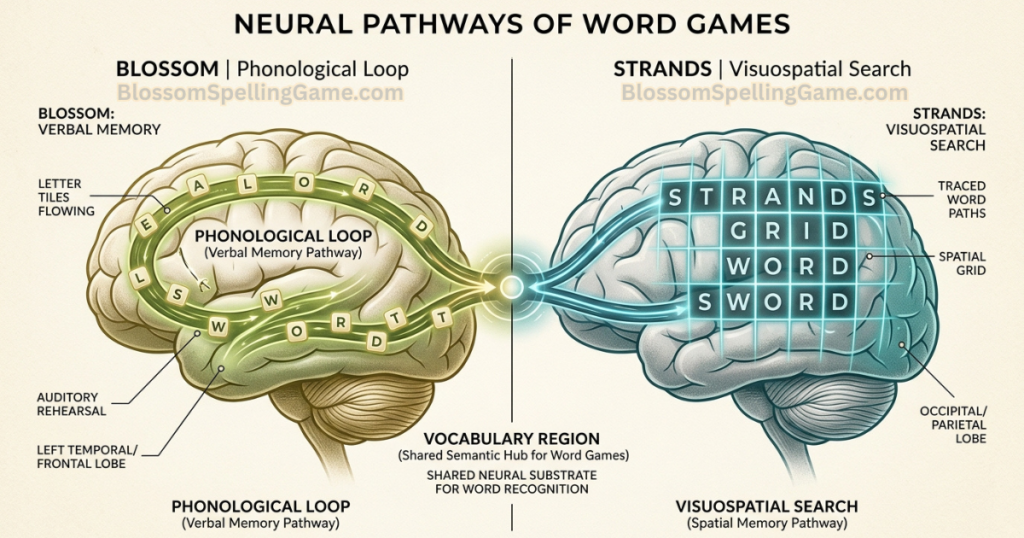
When you’re playing Blossom, your brain’s primary workhorse is the phonological loop — the cognitive system responsible for verbal working memory, the mental representation of words as sound patterns. You’re holding the letter set in mind and running it against your stored vocabulary, asking your verbal memory to surface words that match the available letters.
This is a fundamentally language-native operation. Your brain processes the letters as potential word-parts and searches your lexicon for matching patterns. The bottleneck is vocabulary depth and retrieval speed — how many words do you know, and how quickly can you access them under constraint?
What Strands engages:
When you’re playing Strands, your brain’s primary workhorse is the visuospatial sketchpad — the cognitive system responsible for spatial working memory, the mental representation of objects and their positions in space. You’re scanning a grid, holding letter positions in mind, and tracing potential word paths through connected adjacencies.
This is a fundamentally spatial operation. Your brain processes the grid as a visual field and searches for connected letter sequences that form recognizable words. The bottleneck is spatial pattern recognition — how efficiently can you scan a grid, hold partial paths in working memory, and recognize word shapes in non-linear spatial configurations?
Why this matters for you:
Most people have a noticeable strength asymmetry between phonological and visuospatial processing. Strong readers and writers typically excel at phonological tasks (Blossom). Strong visual processors, architects, designers, and spatial thinkers often excel at visuospatial tasks (Strands).
This means your relative performance in the two games is partly a function of your cognitive profile — and improving at one doesn’t automatically improve the other, because they’re using different cognitive systems. The skills that make you better at Blossom (vocabulary breadth, phonological retrieval speed) don’t directly make you better at Strands (spatial scanning, grid path recognition).
The Theme Mechanic — Strands’ Defining Feature
Strands’ theme mechanic is the game’s most distinctive feature — and the one that creates the most interesting strategic questions. It’s also what makes Strands feel fundamentally different from any other word game, including Blossom.
How the theme changes everything:
In Blossom, you’re searching open vocabulary territory. Any valid Merriam-Webster word that fits your letters is potentially in play. Your search space is the entire English language filtered by letter constraints.
In Strands, you’re searching a specific semantic category. The theme narrows your search space from “all words” to “words in this category.” TYPES OF PASTA limits you to RIGATONI, FUSILLI, PENNE, FARFALLE. OLYMPIC SPORTS limits you to ROWING, ARCHERY, GYMNASTICS, FENCING. The theme is simultaneously the puzzle’s main clue and its tightest constraint.
The theme-reveal experience:
One of Strands’ most distinctive moments is the gradual theme-revelation. Sometimes the theme is immediately clear (PARTS OF A PLANT), and you start searching directly. Other times the theme is deliberately cryptic — a wordplay twist on an obvious phrase, or a thematic connection that only becomes apparent once you’ve found two or three words.
When the cryptic theme suddenly makes sense — when you realize that “GOING VIRAL” means the words are all types of computer viruses, or that “WHAT A DRAG” means the words are all things you drag and drop — that revelation is Strands’ signature emotional moment. It’s a fundamentally different experience from any Blossom moment, which are always individual word discoveries rather than holistic theme revelations.
What thematic knowledge the game requires:
Different Strands themes favor different knowledge domains. A puzzle themed around “TYPES OF CHEESE” requires food knowledge. A puzzle themed around “SHAKESPEARE’S PLAYS” requires literary knowledge. A puzzle themed around “PARTS OF A MUSICAL SCORE” requires music theory knowledge.
This cultural and domain knowledge requirement creates larger performance variance in Strands than in Blossom. In Blossom, vocabulary depth is the primary differentiator — and most educated adults have overlapping vocabulary pools. In Strands, theme-specific knowledge can completely determine whether a puzzle is easy (you know this domain well) or extremely hard (you’re unfamiliar with this category).
Pangram vs. Spangram: A Deeper Comparison
The pangram-spangram parallel is the most commonly cited similarity between Blossom and Strands. Both are the high-value single word that anchors each daily puzzle. But the similarities are mostly superficial — the finding experience and strategic role are quite different.
How each is found:
Blossom’s pangram is found by exhaustive vocabulary search under letter constraints. You generate candidates systematically, test them against the letter set, and either find the word or don’t. The hunt is an active, internally-driven process. Nothing in the visual interface points you toward the pangram — the letters just sit there, equally available, until your vocabulary surfaces the answer.
Strands’ spangram is found by spatial grid analysis. You’re looking for a path through the letter grid that touches both a left/right edge and a top/bottom edge while forming a theme-related word. The visual constraint (must span the board) is actually a helpful narrowing force — you know the spangram has to cross the grid, which eliminates huge portions of the letter space from consideration.
What each requires:
Finding Blossom’s pangram requires knowing (or discovering) a word that uses all seven letters. The difficulty is vocabulary-driven — if the pangram is a word outside your active vocabulary, you won’t find it regardless of how systematically you search.
Finding Strands’ spangram requires spatial analysis of grid paths that cross the board while forming a theme-related word. The difficulty is spatial and thematic — you need to find the path AND recognize that the word fits the theme. Players with strong spatial scanning skills often find Strands’ spangram before they’ve completed the easier theme words, because the spanning constraint makes it visually distinct.
Strategic role in each game:
In Blossom, the pangram is the highest-scoring single submission — finding it should be a deliberate early-session priority because it earns the +7 bonus. The 12-slot budget makes finding the pangram urgently important.
In Strands, the spangram is more of a solving beacon than a strategic priority. Because its letters are marked distinctively once found, it helps you understand which grid regions contain theme words vs. which contain non-theme words. Many experienced Strands players hunt the spangram early — not primarily for its satisfaction, but because finding it illuminates the grid structure and makes the remaining words easier to locate.
Which hunt is more satisfying?
This is deeply subjective — and it’s a good diagnostic question for figuring out which game suits you.
If you prefer the Blossom pangram hunt: you enjoy searching your own vocabulary, you like the internal, effortful nature of the discovery, and you find satisfaction in knowing the answer came entirely from your own word knowledge.
If you prefer the Strands spangram hunt: you enjoy visual scanning, you like the constraint of a spatial path, and you find satisfaction in the visual “click” of tracing a word across a grid.
Hint Systems: How Each Game Handles Being Stuck
Both games acknowledge that players get stuck — and both have hint systems. But the systems work very differently and reflect fundamentally different design philosophies.
Blossom’s hint system:
Blossom offers a direct hint button that, when tapped, reveals information about words you haven’t found yet — typically the first letter of an undiscovered word, or a partial reveal. The hint is a direct give — the game tells you something specific about the solution you’re missing.
The strategic question in Blossom: save hints for the pangram. Most experienced players recommend not burning hints on regular words — the hint value is highest when applied to the one word that earns the +7 bonus.
Strands’ hint economy:
Strands’ hint system is more elaborate and strategically interesting. Finding valid English words that aren’t theme words earns hint tokens — every three non-theme words banks one hint, which then reveals one letter in an unfound theme word.
This creates a genuine strategic decision: do you deliberately hunt non-theme words (essentially spending time on “wrong” answers) to earn hints for harder theme words? Or do you avoid the hunt-for-hints approach and solve the theme words directly?
The hint economy is a design choice that reflects Strands’ game philosophy: even “wrong” words are useful, and the game rewards broad vocabulary over narrow thematic focus. It’s a more forgiving, player-friendly approach than Blossom’s single-button hint.
Which system is better?
For players who find getting stuck frustrating: Strands’ hint economy is gentler — you always have something productive to do (find non-theme words for hints) even when you’re stuck on theme words.
For players who prefer minimal scaffolding: Blossom’s sparse hint system preserves the “earned” feeling of each discovery. The puzzle is largely self-contained, and solving feels more wholly your own.
Difficulty Sources: Where Each Game’s Challenge Lives
Understanding where each game’s difficulty comes from is essential for setting realistic expectations — and for knowing what kind of player you’ll need to be to excel at each.
Blossom’s difficulty is linguistic and strategic:
The challenge in Blossom has two dimensions:
- Vocabulary depth: Do you know enough words that use the available letters? The pangram specifically is often a word at the edges of common vocabulary.
- Strategic optimization: Even with the same vocabulary, different players score very differently based on slot budget management, bonus petal letter sequencing, and pangram prioritization.
Blossom’s difficulty is consistent within a letter set — the same letters produce the same difficulty for all players. It varies across puzzles based on letter combination and pangram obscurity, but within a given day, all players face identical challenges.
Strands’ difficulty is thematic and spatial:
The challenge in Strands has two dimensions:
- Thematic knowledge: Do you know the domain well enough to generate word candidates? A puzzle themed “TYPES OF CLASSICAL MUSIC FORMS” is harder for non-musicians regardless of spatial skill.
- Spatial scanning efficiency: How quickly can you trace potential word paths through a grid with irregular orientations?
Strands’ difficulty is variable by player knowledge background — a puzzle themed around baseball is much harder for non-baseball fans than for fans, even if both players have equivalent vocabulary. This creates larger performance variance between players than Blossom typically produces.
The editorial factor:
Strands is editorially constructed by the NYT puzzle team — the theme, word selection, and grid layout are all deliberate choices. This means difficulty is partly a function of editorial skill and partly of player domain knowledge. Some days the theme is immediately accessible; other days it’s deliberately cryptic.
Blossom’s difficulty is more mechanically determined — it flows from the inherent properties of the letter combination rather than editorial choice. Players often perceive this as “fairer,” because when Blossom is hard, there’s a clear structural reason.
Vocabulary Knowledge vs. Thematic Knowledge
This is one of the most practically useful distinctions for predicting how you’ll perform in each game.
Blossom tests vocabulary knowledge:
The game’s question is: how many valid English words do you know that can be formed from these seven letters? This is a measure of your active vocabulary — not just words you’d recognize if you saw them (passive vocabulary) but words you can produce spontaneously from letter constraints.
The Merriam-Webster dictionary standard means the knowledge domain is consistent: standard American English vocabulary, across all subject areas, without strong bias toward any particular cultural domain.
Strands tests thematic knowledge:
The game’s question varies by day: how many types of pasta do you know? How many Shakespeare plays? How many Olympic events? How many parts of a camera? The knowledge domain shifts entirely with each daily theme.
This makes Strands performance highly variable by player background in a way Blossom isn’t. A culinary school graduate will dominate food-themed puzzles. A sports journalist will excel at sports-themed ones. A musician will find music-themed puzzles easy. None of this advantage transfers across themes in the way vocabulary depth transfers across all Blossom puzzles.
The interesting overlap:
Both games benefit from broad vocabulary — in Blossom directly, in Strands because recognizing words when you see them in a grid requires knowing they’re words. The difference is that Blossom requires production (generating words without seeing them first) while Strands requires recognition (identifying words when their letters are present in a grid).
Recognition tasks are cognitively easier than production tasks — which is partly why many players find Strands less vocabulary-intensive than Blossom, even though both games involve vocabulary. You don’t need to know FUSILLI exists to play Blossom (if it’s not in your active vocabulary, you won’t find it). But if FUSILLI is traced in a PASTA-themed Strands grid, you’ll likely recognize the letter sequence even if you don’t cook.
Scoring and Completion: What “Done” Looks Like
The two games have completely different answers to the question: how do you know when you’ve succeeded?
Blossom: Numeric score with rank
Every submission earns points based on word length. The session ends when you’ve filled all 12 word slots. Your total score maps to a rank (Beginner → Genius). The pangram earns a +7 bonus. The bonus petal letter adds +5 per word.
This numeric system creates clear skill differentiation — two players who both find 12 words can have vastly different scores based on which words they chose. High scores require strategic decision-making (slot budget management, pangram priority) as much as vocabulary depth.
Strands: Binary theme-word completion
You’ve succeeded when you’ve identified all theme words and the spangram. There’s no numeric score — just a completion grid showing which words you found in which order, how many hints you used, and how many non-theme words you found along the way.
The completion-based system makes every successful session feel equivalent — finding all theme words in 10 minutes with zero hints looks identical in the completion grid to finding them in 30 minutes with three hints used. For players motivated by measurable skill improvement, this lack of differentiation can feel flat.
What this means for habit formation:
Blossom’s numeric scoring creates a measurable improvement arc that’s immediately visible session to session. Watching your score climb as your strategy improves is a powerful motivational feedback loop.
Strands’ completion focus creates a different motivation: the clean satisfaction of a solved puzzle, independent of efficiency. The game rewards completion rather than optimization.
How Skills Transfer Between the Two Games
Skills that transfer FROM Blossom TO Strands:
Vocabulary activation speed. Playing Blossom regularly builds rapid word retrieval — the ability to quickly recognize whether a letter sequence forms a valid word. This directly helps in Strands when you’re scanning the grid: faster recognition means faster path identification.
Pangram-hunting spatial instinct. Blossom players who’ve internalized the pangram hunt — looking for words that use multiple unusual letters — sometimes apply this instinct spatially in Strands, looking for longer paths that touch unusual grid regions.
Theme-word generation. Blossom’s category sweep technique (mentally running through semantic categories against your letters) partially transfers to Strands’ thematic search. If the Strands theme is TYPES OF FABRIC and you’ve practiced generating words by semantic category in Blossom, you’ll access that vocabulary faster.
Skills that transfer FROM Strands TO Blossom:
Spatial letter pattern recognition. Strands develops the ability to see letter combinations in non-linear spatial arrangements. This spatial flexibility can translate to Blossom in a subtle way: players who regularly play Strands sometimes report “seeing” words in their Blossom letter sets from unusual angles — reading petal letters in non-obvious orders.
Thematic vocabulary breadth. Strands exposes you to vocabulary in specific domain contexts — seeing FUSILLI in a PASTA puzzle deepens your vocabulary in that domain. When a PASTA-related word becomes available in a Blossom puzzle later, Strands-trained players may retrieve it faster because it’s been recently activated in thematic context.
Pattern completion tolerance. Strands’ partial-path tracing — following a letter sequence through the grid without being sure where it ends — develops comfort with incomplete information. This patience with ambiguity can help in Blossom’s later stages when you’re hunting words without feedback.
The honest verdict: Skills transfer is real but limited. The games use different cognitive systems deeply enough that getting excellent at one doesn’t make you excellent at the other. What does transfer: general vocabulary engagement, thematic word access, and the habit of thinking carefully about letter combinations.
Who Each Game Is Actually Built For
Choose Blossom Word Game if you:
- Prefer working from your own vocabulary (generation over recognition)
- Are motivated by numeric scores and measurable improvement over time
- Enjoy the open-ended vocabulary search without category constraints
- Have consistent vocabulary depth regardless of cultural domain
- Want a game that rewards strategy (slot budget, bonus petal, pangram priority) as well as vocabulary
- Prefer consistent difficulty driven by mechanics rather than editorial choices
- Value free access with no subscription required
- Are building active vocabulary production speed
Choose NYT Strands if you:
- Prefer visual search and spatial discovery over verbal generation
- Enjoy the thematic framing — knowing you’re looking for a specific category of words
- Have broad cultural knowledge across many domains (food, sports, music, literature, science)
- Find satisfaction in clean completion (finding all words) rather than numeric optimization
- Enjoy the hint economy mechanic — earning hints through non-theme words
- Are already in the NYT Games ecosystem
- Prefer puzzles where the theme creates a conceptual “aha” beyond just finding words
- Find word search grids visually engaging
Play both if you:
- Want to exercise both verbal generation (Blossom) and visual discovery (Strands) daily
- Have 25 minutes total for word games
- Enjoy variety in the type of thinking your daily puzzle demands
- Want the spangram-like satisfaction alongside the pangram satisfaction
- Are interested in building both phonological and visuospatial vocabulary skills
Cost, Access, and Daily Experience
Blossom Word Game: Free at BlossomSpellingGame.com — no account, no subscription, no payment. Browser-based, no download. Resets at midnight ET. Session: 10–20 minutes.
NYT Strands: Available at nytimes.com/games/strands. The free tier has limitations; full access is part of the NYT Games subscription (which also includes the Crossword, Connections, Wordle, and Spelling Bee). Resets at midnight ET. Session: 5–15 minutes.
The cost implications:
If you’re choosing between Blossom and Strands as your primary daily word game and budget is a factor, Blossom is the clear choice — free with no restrictions. If you’re already an NYT Games subscriber, Strands comes at no additional cost and the question is purely about which game fits your cognitive preferences.
The session experience comparison:
Blossom sessions feel more open-ended within their structure — you’re hunting from your own vocabulary with a fixed 12-slot budget, and sessions can feel very different from day to day depending on letter set and how quickly words flow. Some days take 10 minutes; some take 25.
Strands sessions feel more guided within their structure — the theme tells you exactly what you’re looking for, and sessions tend to converge to a narrower time range (5–15 minutes for most players). The experience is more consistently bounded.
Side-by-Side Comparison Table
| Feature | Blossom Word Game | NYT Strands |
|---|---|---|
| Core mechanic | Generate words from 7 letters | Find hidden words in a letter grid |
| Cognitive type | Phonological — verbal memory | Visuospatial — spatial scanning |
| Knowledge domain | Broad vocabulary (any word) | Domain-specific (thematic category) |
| Search space | Open — any valid dictionary word | Constrained — theme words only |
| Theme/constraint | Letter constraints (which letters available) | Thematic constraints (which words fit theme) |
| Special word | Pangram (uses all 7 letters) | Spangram (spans the full board) |
| Finding the special word | Vocabulary search | Spatial path tracing |
| Scoring | Numeric points + rank | Completion (words found, hints used) |
| Hint system | Direct hint button | Earn hints via non-theme words |
| Session length | 10–20 minutes | 5–15 minutes |
| Difficulty source | Letter combination + vocabulary depth | Theme domain + spatial scanning |
| Difficulty consistency | Structural (letter-set dependent) | Editorial + domain knowledge dependent |
| Penalty for errors | None (free submissions) | None (wrong paths cost only time) |
| Slot/attempt limit | 12 word slots | No limit — find all theme words |
| Social sharing | Score + rank | Completion grid (words found order) |
| Word list source | Merriam-Webster dictionary | NYT editorial (theme-selected words) |
| Cost | Free (BlossomSpellingGame.com) | NYT Games subscription |
| Account required | No | Yes (registration/subscription) |
| Skills built | Active vocabulary production | Spatial word recognition, thematic recall |
| Best for | Vocab builders, strategists | Visual thinkers, thematic knowledge players |
FAQ
What is the main difference between Blossom Word Game and NYT Strands?
Blossom is a word generation game — you produce words from seven constrained letters using your own vocabulary. Strands is a word discovery game — you find theme-related words already hidden in a letter grid. Blossom uses phonological (verbal) memory; Strands uses visuospatial (spatial) scanning. Same daily word puzzle format, completely different cognitive operations.
Is NYT Strands free like Blossom?
Blossom at BlossomSpellingGame.com is completely free — no account, no subscription, no payment required. NYT Strands has a limited free tier but full access requires an NYT Games subscription. If cost is a consideration, Blossom is the clear no-cost daily option.
Which is harder, Blossom or NYT Strands?
They’re hard in different ways. Blossom’s difficulty is consistent across players and driven by letter combination mechanics. Strands’ difficulty varies significantly by player domain knowledge — a puzzle about classical music is much harder for non-musicians. Neither is definitively harder overall; it depends on your vocabulary breadth versus your domain knowledge profile.
What is the spangram in Strands — is it the same as the pangram in Blossom?
They share the structure of being the single highest-value hidden word in each puzzle, but they work differently. Blossom’s pangram uses all seven available letters at least once and earns a +7 bonus. Strands’ spangram is a theme-related word (or phrase) whose path spans the full letter grid, touching opposite edges. Finding Blossom’s pangram requires vocabulary search; finding Strands’ spangram requires spatial path tracing.
Do skills from playing Blossom transfer to Strands?
Partially. Blossom builds active vocabulary retrieval speed, which helps you recognize letter sequences in the Strands grid faster. Strands builds spatial pattern recognition and thematic vocabulary access, which can modestly improve your category-sweep technique in Blossom. But because the games use different cognitive systems (phonological vs. visuospatial), improvement in one doesn’t dramatically accelerate improvement in the other.
Which game is better for building vocabulary?
Blossom is more effective for building active vocabulary production — the ability to generate words spontaneously from constraints. This is a more demanding and more transferable vocabulary skill than the recognition tasks Strands exercises. Strands builds thematic vocabulary in specific domains, which is valuable but more context-specific. For general vocabulary building, Blossom has the edge.
Can I play Blossom and Strands in the same daily routine?
Yes — and they complement each other well. Blossom (15–20 minutes, verbal generation) followed by Strands (5–10 minutes, spatial discovery) covers two meaningfully different cognitive activities without competing for the same mental resources. Both reset at midnight ET, so both are fresh every morning.
Which game resets at the same time?
Both reset at midnight Eastern Time. Both are available immediately after midnight ET each day.
Is Strands a word search?
Strands is an elevated word search — it uses the same core mechanic (finding words in a letter grid) but adds the constraint that every letter belongs to exactly one word, the theme guides your search to a specific category, and the spangram creates a spatial challenge within the grid. It’s significantly more complex than a standard word search.
Final Thoughts
Here’s the clearest framing for this comparison: Blossom and Strands are daily word games the way tennis and squash are racket sports. Same general family, genuinely different physical demands, each rewarding a different skill set.
Blossom rewards vocabulary production — the ability to reach into your own mental lexicon and pull out words under constraint. Strands rewards visual discovery — the ability to recognize hidden words in a spatial field guided by thematic knowledge. Both are legitimate, valuable cognitive activities. Neither is objectively superior.
The question worth asking is not “which game is better?” but “which game is better matched to how my brain works?” If you find yourself naturally reaching for words (you’re a talker, a writer, someone who thinks in language), Blossom is your game. If you find yourself naturally scanning visual fields (you’re a reader of patterns, a spatial thinker, someone who solves puzzles by looking), Strands will feel more natural.
Most committed word game players end up enjoying both for the different things they demand — and spending 20 minutes with Blossom followed by 10 minutes with Strands is one of the more cognitively complete daily routines available in the free/low-cost word game space.
Start today’s session at BlossomSpellingGame.com — free, no download, no account. Seven letters, 12 slots, one pangram hiding somewhere in there. The spangram can wait until tomorrow.