
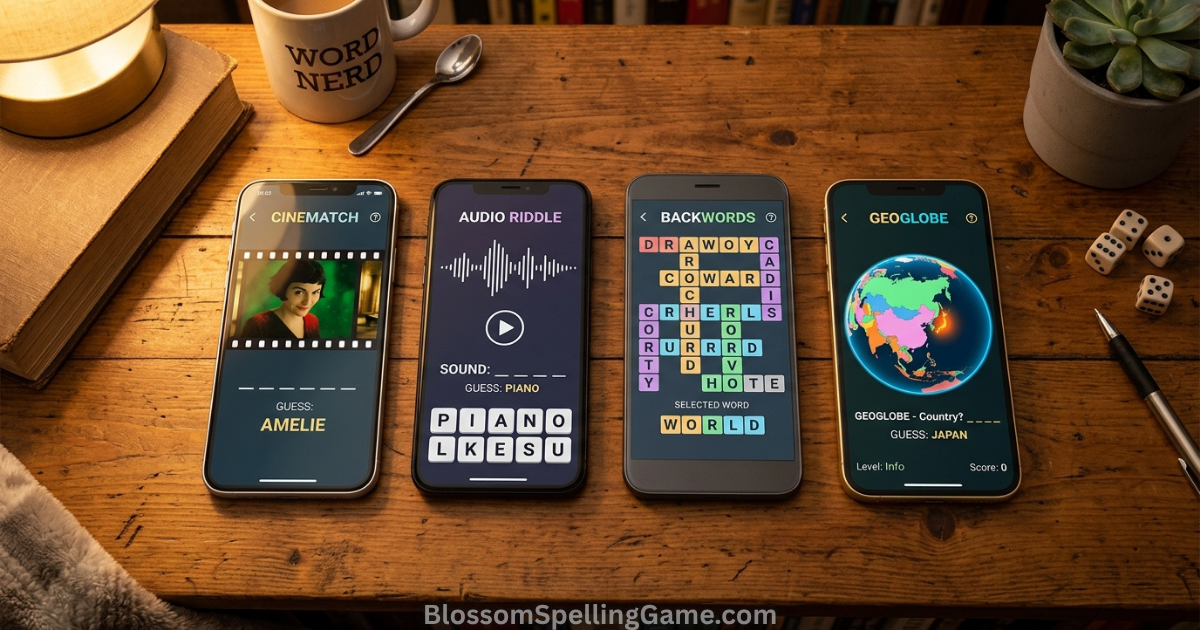
Word games have quietly become one of the most competitive categories in online gaming — and not because of prize money or leaderboards. Because of something simpler: they’re genuinely, reliably satisfying in a way that most other digital entertainment isn’t.
There’s a reason millions of people open a word puzzle before they check their email in the morning. It’s not habit or obligation. It’s that specific feeling — the vocabulary click, the moment a hidden word surfaces from seven constrained letters — that delivers a small, clean win at the start of the day.
The good news is that in 2026, the best word games you can play are almost all free. The explosion of daily puzzle games that followed Wordle’s viral moment in 2022 created an entire ecosystem of high-quality, no-cost vocabulary challenges — and the ecosystem has only gotten richer since.
The challenge now isn’t finding free word games. It’s knowing which ones are actually worth your time. There are hundreds. Most are mediocre. A handful are genuinely excellent, and knowing which handful to put in your daily rotation makes all the difference between a rewarding ten-minute morning habit and a cluttered collection of apps you opened twice.
This guide organizes the best free word games of 2026 by category — because different word games scratch genuinely different itches, and the right game for you depends on what kind of challenge you’re looking for. Whether you’re after a daily puzzle, a multiplayer battle, a crossword fix, or something that exercises vocabulary in a completely different way, there’s a great free option here.
How We Chose This List
A quick note on selection before diving in: every game on this list meets three non-negotiable criteria.
Free to play in its core form. Some games offer optional premium upgrades — that’s fine. The core daily experience must be accessible without payment.
Actively maintained in 2026. The word game graveyard is full of puzzles that launched, peaked, and quietly disappeared. Every game here is currently live and updated.
Genuinely worth recommending. Not “it exists and it’s free” but “it delivers real value, has real craft behind it, and will still be enjoyable three weeks from now.”
One more thing: if you play Blossom Word Game at BlossomSpellingGame.com, you’ll notice it appears in the daily puzzles category — because it belongs there. This guide exists partly to help Blossom players discover what else the free word game world has to offer, and partly to help anyone looking for free word games find Blossom for the first time.
Category 1: Daily Word Puzzles — One Fresh Puzzle Every Day
This is the category that defines the modern word game moment. One puzzle per day, shared by all players, resets at midnight. The format creates daily habits, social sharing, and that satisfying sense of completeness that endless-mode games can never quite deliver.
Blossom Word Game
Where to play: BlossomSpellingGame.com (free, no account required)
What it is: Seven letters arranged in a hexagonal flower — one center letter mandatory in every word, six petals to mix freely. Your goal is to find as many valid words as possible within your 12-word slot budget, with a +7 bonus for finding the pangram — a word that uses all seven letters.
Why it stands out in 2026: Blossom is one of the few daily word games that combines vocabulary generation with strategic resource management. The 12-slot budget mechanic means every submission is a decision, not just a discovery. Players who think about which words to commit to score dramatically higher than those who submit everything immediately — and that strategic depth is what keeps the game interesting long past the honeymoon period.
The Merriam-Webster dictionary backing means the word acceptance is consistent and trustworthy, the bonus petal letter adds a scoring layer most games don’t have, and the clean browser experience at BlossomSpellingGame.com requires zero downloads or sign-ups.
Session length: 10–25 minutes | Best for: Vocabulary builders, strategic thinkers, daily habit players
Wordle (NYT)
Where to play: nytimes.com/games/wordle (free with basic NYT registration)
What it is: One five-letter word per day. Six guesses. Green tiles confirm correct letter-position pairs, yellow tiles signal correct letter in wrong position, gray tiles eliminate letters. The original viral daily word game, now owned by the New York Times.
Why it still holds up: Wordle’s genius is its constraints. Five letters, six guesses, one shared answer for everyone on Earth that day — the universality of the experience is unmatched. When you solve it in three, the emoji grid you share is a language everyone in your group chat speaks. Four years after going viral, it still delivers that reliable daily click.
The free tier requires a basic NYT registration but no payment. Full NYT Games access (which bundles Wordle with Connections, Strands, and the crossword) requires a subscription — but Wordle alone remains free.
Session length: 2–5 minutes | Best for: Quick morning wins, social sharers, deduction thinkers
Knotwords
Where to play: knotwords.com (free daily puzzle; full game ~$4)
What it is: A crossword-meets-anagram hybrid. Letters are pre-placed in sections of a crossword grid, and you rearrange them within each section to form valid intersecting words. The daily puzzle is free; the full game with additional puzzle packs requires a one-time purchase.
Why it’s worth knowing about: Knotwords occupies a unique space between anagram solving and crossword completion. You’re not guessing — all the letters are already there. You’re rearranging. This “all letters present, wrong order” mechanic is genuinely different from anything else on this list and exercises a specific kind of spatial-linguistic reasoning. Designed by Zach Gage and Jack Schlesinger, two of the best puzzle game designers currently working, it has a quality and elegance that sets it apart from most free word game options.
Session length: 5–15 minutes | Best for: Crossword fans who want something different, spatial thinkers
Dordle
Where to play: zaratustra.itch.io/dordle (free, browser)
What it is: Two Wordles simultaneously. One set of guesses applies to both boards at once — you’re solving two hidden five-letter words in seven attempts with a single shared guess track. The predecessor to Quordle, and still the cleanest introduction to the “multiple simultaneous Wordles” format.
Why it matters in 2026: Dordle is the gateway drug to multi-board word guessing. It’s significantly harder than Wordle but less overwhelming than Quordle’s four boards. For players who’ve mastered Wordle and want the next challenge without jumping straight to four simultaneous puzzles, Dordle is the perfect step. And it’s completely free — no registration, no limitations.
Session length: 5–10 minutes | Best for: Wordle veterans, players scaling up difficulty
Phrazle
Where to play: phrazle.com (free, browser)
What it is: Like Wordle, but the hidden answer is an entire phrase — two to four words — rather than a single five-letter word. Color-coded feedback works similarly to Wordle but applies across a multi-word grid. You get six attempts to guess the complete phrase.
Why it’s an interesting variation: Phrazle tests a completely different dimension of vocabulary knowledge than single-word guessing games. Recognizing phrases, idioms, and common word groupings requires a different mental model — you’re thinking about language patterns rather than letter patterns. The phrase-guessing format creates unexpected difficulty spikes when common phrases share many letter combinations. It’s free, it’s daily, and it’s one of the more underappreciated entries in the post-Wordle puzzle ecosystem.
Session length: 5–15 minutes | Best for: Language enthusiasts, idiom lovers, Wordle players seeking fresh challenge
Category 2: Multiplayer and Social Word Games
Some word game players want a partner — either the competitive energy of playing against another person or the collaborative warmth of building words together. These free games deliver both.
Words With Friends 2
Where to play: iOS App Store / Google Play (free with ads; optional premium)
What it is: The classic Scrabble-style multiplayer word game, reimagined for mobile and social play. Form words on a crossword-style board using letter tiles, each with point values, competing against a friend or a matched opponent. Games play out asynchronously — you take your turn whenever you have a moment, your opponent responds on their schedule.
Why it remains relevant in 2026: Words With Friends 2 has evolved significantly from its early versions. The current iteration includes a Solo Challenge mode for single-player play, word radar hints, and a community of millions of active players. For anyone who grew up playing Scrabble and wants that competitive tile-placement strategy in a mobile format, nothing else comes close at the free tier.
The free version includes ads, which can interrupt the experience slightly. The premium version removes them. Either way, the core gameplay is free and the community is large enough that finding active opponents is never a problem.
Session length: Asynchronous — turns take 1–5 minutes; full games run days | Best for: Competitive players, Scrabble fans, social gamers
Word Master
Where to play: hellowordmaster (free, browser)
What it is: A free, open-source Wordle clone with one key addition: you can play against a friend in real time. Both players get the same word and race to solve it in the fewest guesses. The multiplayer Wordle experience the original game never officially offered.
Why it fills a gap: Wordle’s social layer is one of its great strengths, but the sharing mechanic is asynchronous — you compare results after both players have solved independently. Word Master makes that competition simultaneous. Knowing your friend is on the same word, racing toward the same answer, adds genuine stakes to the familiar guessing mechanic. It’s lightweight, browser-based, free, and doesn’t require accounts.
Session length: 3–7 minutes | Best for: Competitive friends, Wordle fans wanting real-time competition
Category 3: Crossword and Grid-Based Word Games
Crosswords represent the oldest form of competitive word puzzling — and in 2026, several genuinely excellent free versions have emerged alongside the institutional giants.
NYT Mini Crossword
Where to play: nytimes.com/crosswords/game/mini (free daily)
What it is: A 5×5 crossword published by the New York Times every day. Around 10 clues, solvable in 1–5 minutes for most players. The clues range from pop culture references to wordplay to current events, and the compact grid means every entry is short — typically 3–5 letters.
Why it belongs on this list: The Mini is the gateway drug for people who’ve always wanted to do crosswords but found the full NYT puzzle intimidating. It’s complete, polished, editorially curated, and — critically — free without a subscription. The NYT requires registration but no payment for Mini access. For players who want wordplay rather than vocabulary generation, the Mini is the best free daily option available.
Session length: 1–5 minutes | Best for: Casual word players, crossword beginners, trivia lovers
Crosswordle
Where to play: crosswordle.vertiginous (free, browser)
What it is: The Wordle format applied to a crossword grid. You’re given a completed (but hidden) mini-crossword and have to deduce all the words simultaneously using color-coded feedback across intersecting entries. Each guess affects multiple words at once — changing one letter in a crossing word reveals information about both.
Why it’s clever: Crosswordle sits at an interesting intersection of logical deduction and crossword vocabulary. The intersecting feedback creates a uniquely constrained puzzle — a correct letter in a crossing position simultaneously confirms it for two words, which means progress compounds faster than in single-word guessing games but the wrong-letter cost is also higher. It’s free, daily, and rewards systematic thinking in a way that neither standard crosswords nor standard Wordles fully do.
Session length: 5–15 minutes | Best for: Crossword fans, logical deduction players, Wordle veterans
Redactle
Where to play: redactle.com (free, browser)
What it is: Every day, a Wikipedia article is displayed with most words redacted (blacked out). You guess words to reveal the text — each correct guess reveals every instance of that word throughout the article. The challenge is identifying the article’s topic from progressively revealed text. You have unlimited guesses, and the game tracks how many guesses it took.
Why it’s uniquely compelling: Redactle is unlike anything else on this list. It’s not about spelling or letter patterns — it’s about vocabulary inference and encyclopedic knowledge working together. As more words reveal themselves, you’re building a partial picture of a Wikipedia article and trying to identify the subject. Knowing that the article contains a revealed word like “continental” and “1918” and “treaty” narrows the topic toward a historical event — it’s pattern recognition applied to knowledge rather than letters.
Session length: 10–40 minutes (highly variable) | Best for: Trivia enthusiasts, knowledge-based thinkers, patients
Category 4: Word Association and Meaning-Based Games
These games test vocabulary knowledge at the level of meaning rather than spelling — a genuinely different cognitive challenge that exercises semantic memory and conceptual relationships.
Contexto
Where to play: contexto (free, browser)
What it is: Every day, there’s a secret word. You guess words, and the game tells you how contextually similar your guess is to the answer — ranked numerically based on how words are used in similar contexts across a large text corpus. Unlike Semantle (which uses word vectors), Contexto uses contextual usage patterns. A word that appears in similar sentences to the answer ranks closer to #1.
Why it’s worth your time: Contexto creates a fascinating vocabulary archaeology experience — you’re digging through meaning relationships, following trails of context, gradually narrowing toward a word from the patterns of similar usage. It rewards both vocabulary breadth and the kind of associative thinking that formal word games rarely exercise. It’s also significantly more accessible than Semantle for most players — the contextual ranking system feels more intuitive than raw vector distance.
Session length: 10–30 minutes | Best for: Vocabulary enthusiasts, semantic thinkers, players who found Semantle too abstract
Globle
Where to play: globle-game (free, browser)
What it is: A geography-meets-word-knowledge daily puzzle. You guess country names, and the globe lights up with color-coded proximity feedback — warmer colors indicate you’re geographically closer to the mystery country, cooler colors mean you’re farther. It’s Wordle’s feedback mechanic applied to world geography.
Why it fits a word game list: Globle’s core mechanic is word entry — you’re guessing country names, which requires both spelling knowledge and geographical awareness. It occupies a hybrid space between word game and geography quiz that appeals to the same intellectually curious player profile that loves daily word puzzles. The knowledge dimension goes beyond vocabulary into world geography, making it a particularly effective complement to purely letter-based word games.
Session length: 3–10 minutes | Best for: Geography enthusiasts, knowledge-based players, world travelers
Wordle Unlimited
Where to play: wordleunlimited (free, browser)
What it is: Exactly what it sounds like — the Wordle format but without the one-puzzle-per-day limit. Play as many games as you want, with random five-letter words drawn from a large dictionary. Some versions also let you set a custom word for a friend to guess.
Why it serves a real need: The core Wordle format is excellent. The one-puzzle-per-day limit is a feature for most players but a frustration for those who want more. Wordle Unlimited solves this cleanly — same mechanics, same satisfaction, no artificial scarcity. The word list is broader than the official NYT version, which means occasional obscure words appear. For players who want Wordle as genuine vocabulary training (not just a daily check-in), the unlimited format lets them build real solving instincts through repetition.
Session length: 2–5 minutes per game, unlimited games | Best for: Wordle fans wanting more, vocabulary trainers, puzzle grinders
Category 5: Creative and Hybrid Word Games
The most interesting developments in free word gaming in 2026 have happened at the edges — games that combine word knowledge with other puzzle types to create experiences that don’t fit neatly into any existing category.
Framed
Where to play: framed (free, browser)
What it is: A daily movie guessing game where you’re shown frames from a film — one at a time, up to six — and try to identify the movie from visual context. You type movie title guesses after each frame reveal. It’s Wordle’s structure applied to film stills rather than letter patterns.
Why it’s on a word game list: Framed sits in the productive overlap between word game and cultural knowledge quiz. Typing and recognizing film titles — including correct spelling of less obvious words — engages vocabulary knowledge in a different dimension. More importantly, Framed has found enormous success with the same daily-puzzle-sharing culture that word games created, which means it fits naturally into a daily word game routine for players who want visual variety alongside their letter-based puzzles.
Session length: 2–8 minutes | Best for: Film enthusiasts, cultural knowledge players, visual thinkers
Heardle (Variants)
Where to play: Multiple free browser versions (heardle.app clones)
What it is: Music Wordle. A song’s intro plays in short clips — 1 second, 2 seconds, 4, 7, 11, 16 — and you try to identify the song and artist as early as possible from progressively longer audio snippets. The original Heardle was shut down after Spotify acquisition, but community-run versions focused on specific genres and eras are thriving.
Why it belongs here: Heardle variants test a unique vocabulary intersection — song titles, artist names, and lyrical content are all word knowledge that Heardle exercises. Genre-specific versions (90s Heardle, Alt Heardle, Classical Heardle) let players specialize. Like Framed, it complements letter-based word games by exercising a different kind of cultural vocabulary without competing for the same cognitive space.
Session length: 2–5 minutes | Best for: Music fans, pop culture enthusiasts, daily variety seekers
Antiwordle
Where to play: antiwordle (free, browser)
What it is: The reverse of Wordle. Instead of trying to find the hidden word in as few guesses as possible, your goal is to avoid guessing it for as many guesses as possible. You’re forced to use revealed information — green confirmed letters must be reused in that position, yellow letters must appear somewhere — while trying to avoid the final correct answer as long as possible.
Why it’s genuinely interesting: Antiwordle is a masterclass in constraint-based thinking. You have to keep using the information the game gives you while steering away from the actual answer — which means finding words that satisfy all confirmed letter constraints but introduce new unconfirmed letters in ambiguous positions. It’s harder than it sounds and exercises systematic vocabulary generation in a delightfully perverse way. The free browser version has no limitations.
Session length: 5–15 minutes | Best for: Wordle experts, systematic thinkers, players who find Wordle too easy
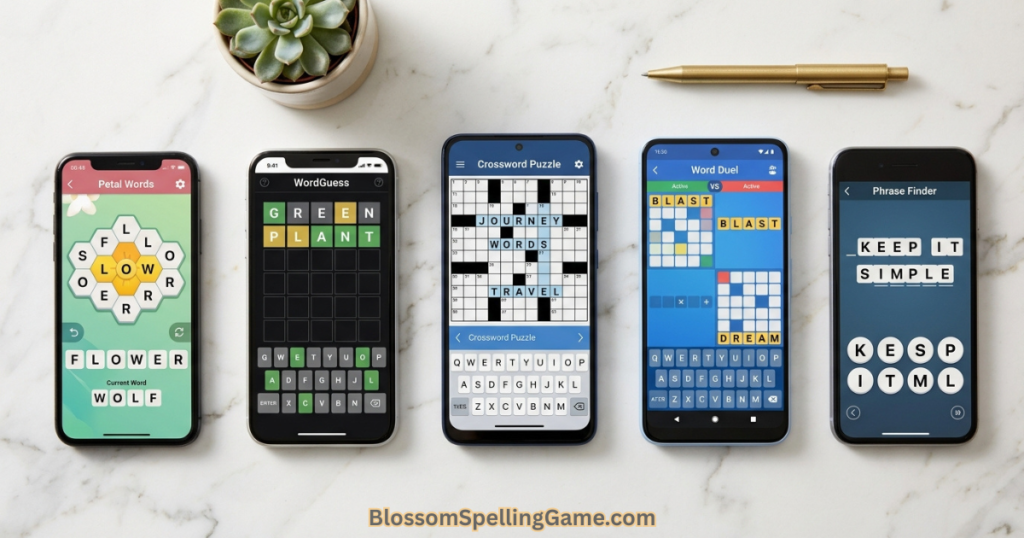
The Best Free Word Game by Player Type
Not sure where to start? Here’s the fast decision guide:
| Your Profile | Best Free Game to Start With |
|---|---|
| You want a daily vocabulary workout | Blossom Word Game (BlossomSpellingGame.com) |
| You want the classic daily puzzle everyone knows | Wordle (NYT) |
| You want to play against a friend | Word Master (real-time) or Words With Friends 2 (async) |
| You love crosswords but want something new | Knotwords or Crosswordle |
| You want to test world knowledge | Globle or Redactle |
| You want meaning-based vocabulary challenge | Contexto |
| You want Wordle but harder | Dordle → then Phrazle |
| You have 2 minutes and want a win | NYT Mini Crossword |
| You want to play unlimited Wordle | Wordle Unlimited |
| You think Wordle is too easy | Antiwordle |
| You want something totally different from letters | Framed (movies) or Heardle (music) |
Building a Free Daily Word Game Routine in 2026
The most satisfying approach to free word games isn’t playing one obsessively — it’s building a deliberate routine that takes 30–40 total minutes and covers different cognitive territory each day.
Here’s a framework that works well without creating pressure:
The Opener (5 minutes): Wordle or NYT Mini Crossword. Something fast, decisive, and shareable. Gets your brain into word mode and gives you a quick win before anything else.
The Main Workout (15–20 minutes): Blossom Word Game at BlossomSpellingGame.com. The deepest daily vocabulary challenge on this list — vocabulary generation, strategic slot management, and the pangram hunt create a genuinely complete mental workout.
The Knowledge Round (5–10 minutes): Globle, Contexto, or Redactle. One of the meaning/knowledge-based games that exercises a different type of vocabulary — semantic associations and world knowledge rather than letter patterns.
The Wild Card (5 minutes, optional): Framed, Heardle, or Antiwordle on rotation. Keeps the routine from getting stale by introducing completely different formats a few times a week.
Total: 30–40 minutes, split naturally across a morning. Every game on this routine is free. None require accounts (with minor exceptions). All deliver genuine value per minute that passive entertainment simply doesn’t match.
FAQ
What is the best free word game in 2026?
For vocabulary depth and strategic gameplay, Blossom Word Game at BlossomSpellingGame.com is the strongest daily free option — it combines vocabulary generation, the pangram mechanic, and a unique 12-word slot budget that creates genuine strategic decisions. For the most universally known and socially shareable experience, Wordle remains the gold standard. The best answer genuinely depends on whether you prioritize depth or social connection.
Are there any completely free word games with no ads?
BlossomSpellingGame.com offers a clean, minimal-ad daily puzzle experience with no account required. Knotwords’ daily puzzle, Crosswordle, Antiwordle, and Word Master are all ad-free browser experiences. Dordle and Phrazle also run clean without interruption advertising. Words With Friends 2 includes ads in its free version — the premium removes them.
What is the best free word game to play with friends?
Word Master (hellowordmaster.com) for real-time simultaneous play against a friend. Words With Friends 2 for asynchronous competitive play at your own pace. Both are free in their core forms.
What free word games are similar to Wordle?
Dordle (two simultaneous Wordles), Phrazle (phrase guessing), Crosswordle (crossword grid deduction), and Antiwordle (reverse Wordle) all use the core Wordle feedback mechanic in creative variations. Wordle Unlimited offers the same format with unlimited games.
What is the hardest free word game available?
Redactle, Contexto, and Antiwordle are the most cognitively demanding options on this list. Redactle has no guessing limit but requires broad encyclopedic knowledge. Antiwordle demands systematic vocabulary control that pushes even expert players. Dordle and Crosswordle are harder than Wordle for most players without reaching the extreme difficulty of the others.
What free word games don’t require an account or sign-up?
BlossomSpellingGame.com, Knotwords daily puzzle, Crosswordle, Antiwordle, Dordle, Phrazle, Wordle Unlimited, Contexto, Globle, Word Master, and Framed all play without account creation. Wordle requires basic NYT registration (free). Words With Friends 2 requires a Facebook or account login.
Are there free word games that work offline?
Most browser-based daily puzzle games require an internet connection to load the daily puzzle. Words With Friends 2 downloads cached data and allows some offline functionality in the app version. Blossom Word Game can stay cached in a browser session once loaded, allowing play if connection drops mid-session.
Which free word game is best for building vocabulary?
Blossom Word Game stands out here because its core mechanic — generating words from a constrained letter set — requires active vocabulary production rather than letter pattern deduction. This generative format builds vocabulary more effectively than recognition-based games. Contexto and Redactle build semantic and knowledge-based vocabulary dimensions that complement Blossom well.
Conclusion
The free word game landscape in 2026 is genuinely impressive. What started with one viral five-letter guessing game has expanded into an entire ecosystem covering vocabulary generation, deduction, multiplayer competition, semantic association, crossword logic, geography, film, and music — all free, all browser-accessible, all worth a place in a thoughtful daily routine.
The games on this list aren’t interchangeable. Each one exercises a different mental muscle, creates a different kind of satisfaction, and rewards a different player profile. The best approach isn’t picking one and committing for life — it’s building a small rotation of three or four games that together cover the cognitive territory you most enjoy.
If you’re starting fresh: begin with Blossom at BlossomSpellingGame.com and Wordle. Give both a week. Then pick one or two games from the knowledge-based or creative categories to round out your routine.
The puzzle resets tonight at midnight Eastern Time. You’ve got today’s session to make the most of — free, no download, no sign-up. Just a flower, seven letters, and however many words you can find.