
You’ve been playing it every morning for weeks. Maybe it’s become part of your coffee ritual — open the browser, stare at that flower-shaped grid, and quietly battle seven letters until the right words click into place. But at some point, a perfectly reasonable question floats up:
Who actually made this thing?
It’s one of those questions that sounds simple but leads somewhere genuinely interesting. The Blossom Word Game didn’t just appear out of thin air. There’s a real story behind it — one that connects a 170-year-old American dictionary publisher, a wave of post-Wordle word game mania, and a design philosophy built around making people feel smart rather than frustrated.
If you’ve been playing casually and never thought to dig into the backstory, this guide has everything. Who built it, why it was built the way it was, how it connects to Merriam-Webster’s broader mission, and what that heritage means for the puzzle you play every day.
Let’s get into it.
Who Made the Blossom Word Game?
⚡ Quick Answer: The Blossom Word Game was developed in partnership with Merriam-Webster, one of America’s most trusted dictionary publishers. The game is hosted on Merriam-Webster’s platform and uses their official dictionary as its word validation engine. Third-party sites like BlossomSpellingGame.com also offer free versions of the game built around the same core mechanics.
The short version: Merriam-Webster made it. Or more precisely, Merriam-Webster backed it, licensed it, and built it into their digital ecosystem as part of a broader push into interactive vocabulary tools.
But that “who” is only half the story. The more interesting question is why — why would a dictionary company that’s been publishing reference books since 1831 decide to build a flower-shaped word puzzle with a pangram mechanic? The answer reveals something genuinely interesting about where language learning is going in 2026.
Merriam-Webster: The Dictionary Giant Behind the Game
If you grew up in an American school, you’ve probably used a Merriam-Webster dictionary. They’ve been around since 1831, when Noah Webster’s original American Dictionary of the English Language was acquired by George and Charles Merriam of Springfield, Massachusetts. The company that became Merriam-Webster has been the defining authority on American English spelling, pronunciation, and usage ever since.
Here’s something most people don’t realize: Merriam-Webster is not just a book publisher anymore. They’ve been aggressively building out their digital presence for the past decade — not just because physical dictionaries are declining in sales, but because they genuinely see interactive vocabulary tools as part of their core mission.
Their website already attracted tens of millions of monthly visitors who came to look up words. Adding games — especially daily word games that bring people back every 24 hours — was a natural extension of that traffic ecosystem.
Why Merriam-Webster Got Into Word Games?
This is the part that actually surprised me when I started researching it.
Merriam-Webster didn’t enter the word game space by accident, and they didn’t just chase the Wordle trend. Their interest in interactive vocabulary tools predates the 2022 word game explosion by several years. They’d already built vocabulary quizzes, “Word of the Day” features, and spelling tools into their website — all with the goal of making the dictionary feel alive and engaging rather than just a reference shelf you consult and close.
When Wordle went viral in late 2021 and early 2022 — eventually selling to the New York Times for a reported seven-figure sum — it validated something that Merriam-Webster already suspected: people genuinely enjoy engaging with language as a game, not just as a utility.
The timing was right. The audience already existed on their platform. The word list infrastructure was already built. And critically — Merriam-Webster had something the NYT didn’t: 190 years of unparalleled credibility as a language authority. If they were going to put their name on a word game, the word validation had to be impeccable.
That credibility-first thinking shaped almost everything about how Blossom was designed.
The Design Philosophy Behind Blossom
Here’s something most write-ups about Blossom skip entirely, which is a shame — because the design choices are genuinely thoughtful.
The Flower Shape Isn’t Just Decorative
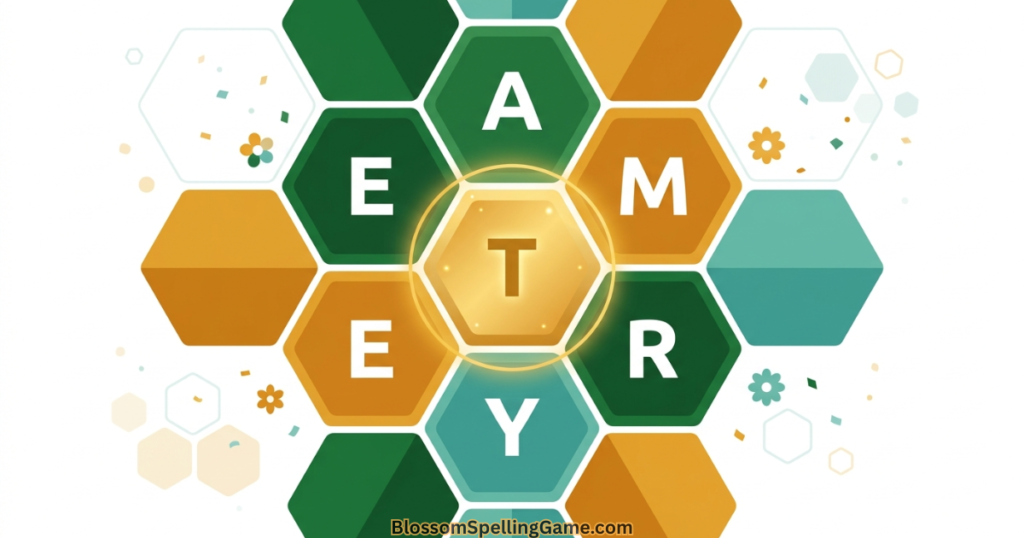
The hexagonal flower layout — one center letter, six surrounding petals — isn’t arbitrary aesthetics. It’s a spatial metaphor that does real cognitive work. Having a visual “center” changes how your brain frames the puzzle. Instead of seeing seven random letters, you see a core (the mandatory center letter) and a periphery (the optional petal letters you mix and match). That spatial organization makes the mandatory rule intuitive rather than confusing.
New players rarely need to be told “use the center letter in every word.” The visual design communicates it naturally before they even read the instructions.
The Word List Reflects Real American English
Because Merriam-Webster’s dictionary is the backbone of the game’s word validation, Blossom accepts a notably different set of words than games built on curated editorial lists. The NYT Spelling Bee, for example, uses an internally curated word list that rejects some perfectly valid English words — a decision that regularly frustrates experienced players.
Blossom, drawing on Merriam-Webster’s comprehensive database, tends to be more generous. If a word appears in the dictionary, it has a real chance of being accepted. That design choice reflects Merriam-Webster’s institutional belief that their dictionary should be the standard — and it shows.
The Scoring System Rewards Exploration
The scoring structure — where 4-letter words earn minimal points but 5+ letter words jump significantly in value — was clearly designed to push players toward genuine vocabulary exploration rather than grinding obvious short words. This feels like an intentional pedagogical choice, not just game balance.
Blossom scores words by length: 4-letter words earn 1 point, 5-letter words earn 5, and every letter beyond that adds 1 point. The pangram — a word using all 7 letters — earns a +7 bonus on top. A highlighted bonus petal letter adds +5 every time it appears in any word. For the full scoring breakdown, see our Blossom Scoring Guide.
The message the scoring sends is clear: this game rewards curiosity, not grinding.
How Blossom Fits Into the Daily Word Puzzle Craze?
Understanding who made Blossom requires understanding the moment it arrived in.
The daily word puzzle category effectively exploded between 2021 and 2023. Wordle was the spark, but the fire spread fast. Quordle, Heardle, Connections, Spelling Bee, Letterboxed — suddenly there was an entire genre built around the idea of one puzzle per day, shared with your social circle, with a satisfying score to post.
What made this format stick culturally? A few things:
The streak psychology. Knowing a new puzzle drops every day at midnight creates a natural reason to return. You’re not just playing a game — you’re maintaining a habit.
The social layer. Sharing your score (without spoiling the answers) turned a solo activity into a conversation starter. How’d you do today? I found the pangram. Did you get it?
The accessibility. No download, no account, no learning curve. Open a browser, play.
Merriam-Webster understood all of this and designed Blossom to fit naturally into that cultural rhythm. A daily reset at midnight. A sharable score. A clear rank system that gives you a goal to chase. It’s not accidental — every one of those choices reflects intentional design thinking.
What Makes Blossom’s Word List Different From Other Games?
This is one of the most practically important things to understand about who made Blossom — because the creator’s identity directly affects which words get accepted in your daily puzzle.
Since Merriam-Webster’s dictionary underpins the game’s validation system, the word acceptance rules have a specific character:
What gets accepted:
- Standard American English dictionary words of 4+ letters
- Plural forms, past tenses, and conjugations
- Some less common but legitimate vocabulary words
- Technical and scientific terms that appear in the dictionary
What gets rejected:
- Proper nouns (no names, places, or brands)
- Abbreviations and acronyms
- Hyphenated words
- Slang and informal terms not in the dictionary
- Words under 4 letters
One practical insight: because the dictionary is comprehensive, words that feel “too obscure to try” sometimes work. Merriam-Webster’s database is broad. If a word has ever appeared in serious American print, there’s a decent chance it’s in there. When in doubt, submit it — you lose nothing.
This is notably different from games like the NYT Spelling Bee, which uses an editorial curation layer that can feel arbitrary. With Blossom, the standard is clearer: Merriam-Webster’s dictionary is the judge, and that dictionary is public and verifiable.
The BlossomSpellingGame.com Version — Who Runs It?
Here’s where things get a little more layered.
There are multiple places to play Blossom-style word puzzles online. The original game lives on Merriam-Webster’s website. But there’s also BlossomSpellingGame.com — a free, browser-based platform that offers a daily spelling puzzle built around the same core mechanics.
BlossomSpellingGame.com is an independent platform that runs its own daily puzzle, offers a clean and beginner-friendly interface, and includes features like streak tracking, a score summary, and the ability to review past puzzle results. It’s completely free — no account required, no payment, no download.
The site has built a solid reputation as one of the best places to play for players who want a slightly more polished user experience than the base Merriam-Webster version offers. Its design is mobile-friendly, its layout is uncluttered, and its daily puzzle system is well-maintained.
Think of the relationship like this: Merriam-Webster established the format and the word-validation standard. BlossomSpellingGame.com took that format, built a clean experience around it, and made it accessible to an even wider audience — particularly beginners and casual daily players.
Has Blossom Changed Since It Launched?
Word games in this genre are rarely static — they get tweaked, refined, and occasionally overhauled based on player feedback. Blossom is no exception.
Since its initial launch, the game has seen several meaningful evolutions:
The bonus petal letter mechanic — the highlighted outer letter that adds +5 points every time it appears in a submitted word — wasn’t always as prominently featured. As the game developed, this mechanic became a more central part of the strategic layer, rewarding players who plan their word selection rather than just submitting everything they find.
The rank system has been refined. The tiered ranking — from Beginner up through Genius — has been calibrated over time to make each rank feel meaningful and achievable. Early versions were reportedly harder to navigate in terms of understanding what score was needed to advance.
The daily puzzle design has gotten more consistent. Early puzzles occasionally featured letter sets that made the pangram extremely obscure or nearly impossible for most players to find. The design team has since moved toward pangrams built around words that are challenging but reasonably within reach of a player with solid everyday vocabulary.
One thing I’ve noticed playing regularly: the puzzles feel curated in a way that rewards general vocabulary knowledge over niche expertise. You don’t need to be a Scrabble champion or a crossword fanatic. You need to have a decent command of everyday English — and then push slightly past your comfort zone.
That feels intentional. It feels like a game that was made by people who understand language education.
Why the Creator’s Identity Actually Matters to Your Gameplay?
You might be wondering: why does it matter who made the game? I’m just here to find the pangram.
Fair. But here’s why the backstory actually changes how you play.
Knowing it’s Merriam-Webster means you can trust the dictionary. When a word gets rejected, it’s genuinely not in the dictionary — not an arbitrary editorial decision. And when an obscure word gets accepted, you can look it up and learn something real.
It explains the word acceptance range. Some games feel inconsistent — they reject words you’re sure exist, then accept ones that feel made up. Blossom’s Merriam-Webster foundation gives it a consistency that more editorially curated games sometimes lack. The standard is the dictionary. Period.
It signals that this game will be maintained. Merriam-Webster isn’t a startup that could disappear next year. They’ve been around for nearly two centuries. The infrastructure behind your daily puzzle has institutional staying power, which matters if you’re building a daily habit around it.
And maybe most importantly: knowing that a language institution with 190 years of credibility is behind this game makes every new word you discover through it feel a little more meaningful. You’re not just gaming — you’re engaging with the living record of American English.
FAQ
Who created the Blossom Word Game?
The Blossom Word Game was created in partnership with Merriam-Webster, one of America’s oldest and most authoritative dictionary publishers. The game runs on Merriam-Webster’s word validation infrastructure and is hosted on their platform, as well as independent sites like BlossomSpellingGame.com.
Is Blossom Word Game made by Merriam-Webster?
Yes. Merriam-Webster is the primary publisher and authority behind the Blossom Word Game. Their dictionary database serves as the game’s word validation engine, which is why the game accepts and rejects words based on what appears in Merriam-Webster’s official dictionary.
Is Blossom Word Game the same as NYT Spelling Bee?
They share a similar format — seven letters in a hexagonal layout with a mandatory center letter — but they’re separate games from different publishers. Blossom uses Merriam-Webster’s dictionary; the NYT Spelling Bee uses an internally curated word list. The word acceptance can differ meaningfully between the two.
Who runs BlossomSpellingGame.com?
BlossomSpellingGame.com is an independent platform offering a free daily word puzzle built on the Blossom format. It provides a clean, beginner-friendly interface with streak tracking and a daily reset, and is completely free to play without any account creation.
When was the Blossom Word Game created?
While an exact launch date isn’t publicly prominent, the game emerged and gained significant traction during the post-Wordle word puzzle boom of 2022–2023, when daily word games became a mainstream daily habit for millions of Americans.
Is Blossom Word Game free?
Yes. The core daily puzzle is completely free on both Merriam-Webster’s platform and on BlossomSpellingGame.com. No subscription, payment, or account is required to play the daily puzzle.
Why does Blossom reject some real words?
All word rejections in Blossom are based on Merriam-Webster’s dictionary standards. Words get rejected if they’re proper nouns, abbreviations, hyphenated, under 4 letters, or simply not in the dictionary. If a legitimate word keeps getting rejected, it may be that the specific form (singular vs. plural, a specific conjugation) isn’t in the dictionary. See our full guide on why Blossom rejects real words for a deeper explanation.
Does Merriam-Webster update the Blossom word list?
Yes. Like the dictionary itself, the word validation database that powers Blossom is periodically updated as Merriam-Webster adds new words to the official dictionary. This is one reason why some newer coinages occasionally get accepted — they’ve been formally added to the dictionary.
Is there a Blossom Word Game app?
Yes. The game is available both as a browser-based experience and as a mobile app. For the full breakdown of app availability and features, see our dedicated guide: Is There a Blossom Word Game App?.
How is Blossom different from Wordle?
Wordle challenges you to guess a single five-letter word within six attempts — it’s a deduction game. Blossom challenges you to find as many valid words as possible from seven letters, with a focus on vocabulary breadth and word-pattern recognition. Different skills, different experience, different publisher.
Final Thoughts
Here’s the honest takeaway: most people play Blossom for months without ever thinking about who made it. And that’s fine — the puzzle stands on its own. But knowing that Merriam-Webster is the institution behind it actually changes something subtle about the experience.
Every word you discover is a real word, validated by America’s most respected dictionary. Every rejection is a genuine signal about the language, not an arbitrary editorial decision. And every daily puzzle is the product of a team that takes language seriously — seriously enough to have dedicated their entire institutional history to it.
That heritage shows up in the game’s design. The generous word list. The respect for the player’s intelligence. The scoring system that pushes you toward longer, more interesting words rather than letting you coast on four-letter basics.
Blossom isn’t just a game someone threw together to ride a trend. It’s a vocabulary product from a vocabulary institution — and the more you understand that, the more you appreciate what you’re actually doing when you sit down with those seven letters every morning.
Play today’s puzzle at BlossomSpellingGame.com and see what words the dictionary has waiting for you.