
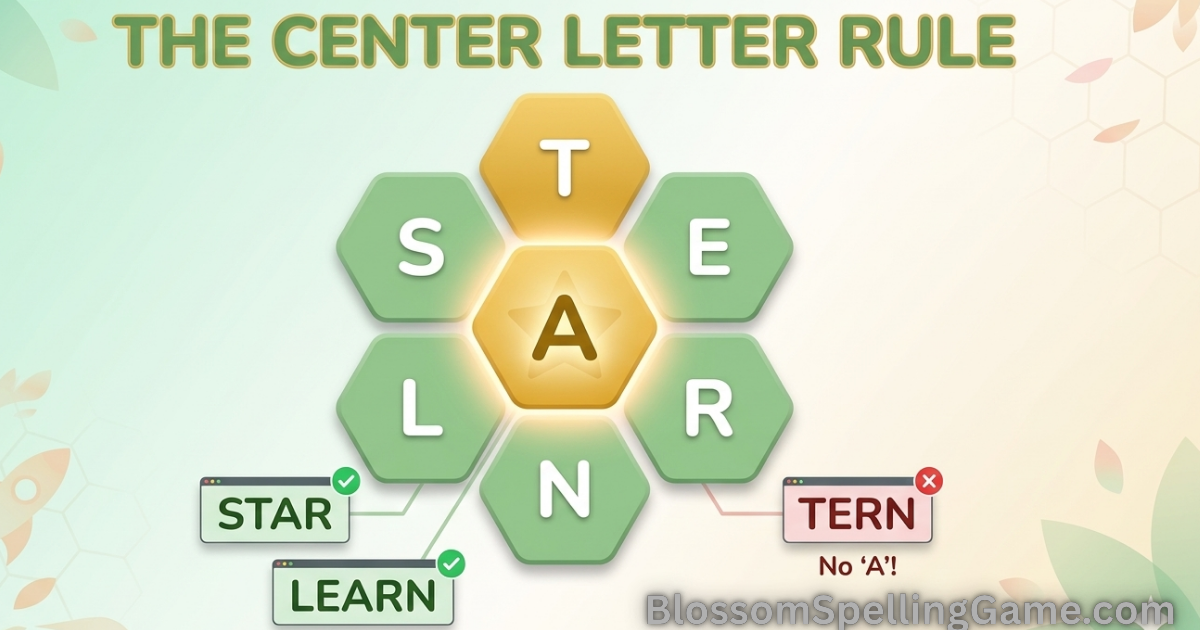
You opened the Blossom puzzle. Seven letters stare back at you — six arranged like petals around one letter sitting dead in the middle. You type a word. Rejected. You try again. Rejected again. Then you realize you keep forgetting to include that one letter in the center.
Sound familiar? You’re not alone.
The center letter rule is the single most important mechanic in Blossom — and it’s also the thing that trips up nearly every new player in their first few sessions. Once you actually understand it — not just what it is, but why it exists and how to work with it strategically — the whole game clicks into place.
This guide breaks it all down: what the center letter rule actually means, how it shapes your word-finding strategy, the mistakes beginners make, and the tactics that experienced players use to make the center letter work for them instead of against them.
Let’s get into it.
What Is the Center Letter Rule in Blossom?
Here’s the simple version: every word you submit in Blossom must contain the center letter. No exceptions.
It doesn’t matter how long your word is, how many rare letters it uses, or how clever the combination is. If the center letter isn’t somewhere in that word, the game rejects it. Full stop.
This single rule — arguably the most defining mechanic in the entire game — is what separates Blossom from a basic word scramble. It’s what gives the puzzle its structure and, honestly, its charm.
Quick Definition: The Blossom center letter rule states that every valid word you form must include the letter positioned in the center of the flower-shaped board.
Think of the center letter as the game’s anchor. Everything else — all six petal letters — can be mixed, matched, skipped, or reused freely. But that one letter in the middle? It goes in every word. Always.
How the Flower Layout Works
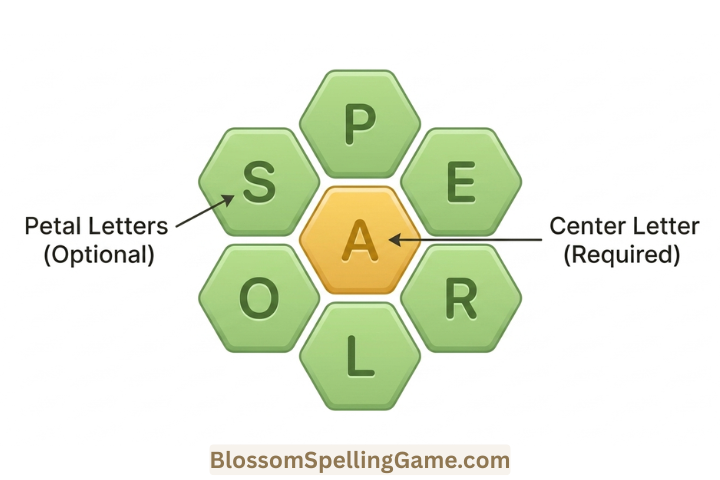
Before diving deeper into the rule, it helps to understand the board itself.
Blossom displays seven letters arranged in a flower pattern:
- One center letter — sits in the middle of the flower
- Six petal letters — surround the center letter in a hexagonal arrangement
Every day, a new set of seven letters appears. The puzzle is fresh, the combinations are different, but the structural rules stay the same. That center letter changes daily, which means each puzzle demands a completely new approach.
Here’s something that surprises people: the six petal letters can be reused across different words, and even within the same word. But the center letter isn’t just allowed in every word — it’s required in every word.
That’s the asymmetry. That’s what makes the puzzle interesting.
Why Every Word Must Include the Center Letter?
You might wonder — why this rule at all? Why not just let players use any combination of the seven letters?
It comes down to constraint-based creativity. This is actually a well-established principle in puzzle design: the right restriction opens up more interesting thinking, not less.
Without the center letter requirement, Blossom would essentially become a free-for-all word scramble with seven letters. Players would default to obvious combinations and quickly run out of interesting territory to explore. The game would feel flat.
By forcing every word through the center letter, the puzzle creates a unique challenge each day. A center letter like E opens the door to enormous vocabulary — endings like -ed, -er, -ness, -ment, plus thousands of common words. But a center letter like X or Z? That’s a completely different mental workout. Suddenly you’re digging into corners of your vocabulary you didn’t know existed.
One thing I’ve noticed after playing word puzzles for a while: the center letter doesn’t just add difficulty — it shapes each puzzle’s personality. Two puzzles with the same six petal letters but different center letters feel like completely different games.
The Center Letter and Scoring — What You Need to Know
Here’s where it gets interesting for players who want to maximize their score.
Blossom’s scoring system rewards word length, with longer words earning significantly more points.
Blossom scores words by length — 4-letter words earn 1 point, 5-letter words earn 5, and every letter beyond that adds 1 point. Finding the pangram (the word using all 7 letters) adds a +7 bonus on top. One highlighted petal letter also adds +5 every time it appears in a word. For the complete breakdown with examples, see our Blossom scoring guide .
The center letter appears in every word you submit — that’s not optional. But the petal letters come with their own scoring opportunities. Some puzzles feature a bonus petal letter (shown in yellow), which adds +5 points every time it appears in a word.
So the real scoring game isn’t just “include the center letter.” It’s: include the center letter, build as long a word as possible, and if there’s a bonus petal letter, work it into the mix too.
Most beginners focus only on getting 12 words. Experienced players think about which words will rack up the most points while meeting the center letter requirement.
Common Mistakes New Players Make
Let’s be real — this is where most players struggle when they first start. The center letter rule sounds simple, but in practice, it’s easy to forget when you’re in the zone.
Mistake 1: Building words without checking for the center letter first
This is the most common one. You spot a valid English word using four of the petal letters. You type it excitedly. Rejected. You forgot the center letter isn’t in there.
The fix? Before you type any word, glance at the center letter first. Train yourself to start from the center letter, not from the petal letters.
Mistake 2: Assuming the center letter goes at the start or end
Here’s a misconception that trips people up: the center letter doesn’t have to be the first or last letter. It just needs to be somewhere in the word. “RENTAL” with a center letter of N works fine. “PLANET” with a center letter of L works fine. Position doesn’t matter — presence does.
Mistake 3: Ignoring words where the center letter appears multiple times
Some words use the center letter more than once. “ELEMENT” with a center letter of E, for instance. These are perfectly valid — and they tend to be longer, which means more points. Don’t skip them.
Mistake 4: Overthinking it
Newer players sometimes second-guess themselves: “Does the center letter count if it’s in the middle of the word? What if the word has the center letter twice?” The answer is always simple — if it’s a valid English word of four or more letters, and the center letter appears at least once anywhere in the word, it counts. That’s it.
Smart Strategies: Using the Center Letter to Your Advantage
Most guides tell you to “include the center letter” and leave it at that. That’s not a strategy — that’s just repeating the rule. Here’s how to actually use the center letter to find more words and score higher.
Strategy 1: Start Your Word Search From the Center Letter
Instead of scanning all seven letters and trying to build words, flip the approach. Start with the center letter and ask: what common words contain this letter? Then check if the other letters on the board can fill out those words.
If the center letter is T, think: words ending in -tion, -ment, -ight, -ate. Words starting with tr-, th-, st-. Words with -tle, -ter, -tic. That mental framework immediately generates dozens of candidates.
Strategy 2: Use the Center Letter as a Suffix Anchor
Many English words end in common patterns that include frequently-used letters. If your center letter is E, think about words ending in -age, -ice, -ive, -able. If it’s R, think -er, -ard, -ure, -ry. These suffixes often appear in long, high-scoring words.
Strategy 3: Hunt for Center Letter Clusters
Some puzzles pair the center letter with petal letters that naturally cluster together in English. An S center letter with petal letters including T, R, A, N, D is a goldmine — words like STRAND, RANTS, DARTS, STAND all contain the S.
Spotting these clusters early lets you find multiple words quickly.
Strategy 4: Reuse the Center Letter Within Long Words
Remember — the center letter can appear multiple times in a single word. When you’re scanning for longer words (which score way more points), actively look for words where the center letter shows up twice. “EASTERN” with a center letter of E gives you two Es in one word. That’s fine, and it’s often a clue that longer, more complex vocabulary exists in the puzzle.
Center Letter vs. Petal Letters — Understanding the Difference
Here’s something that confuses people: if letters can be reused, why does the center letter have a special mandatory status?
The answer is game design, not linguistics. The six petal letters are resources — available but optional. The center letter is a requirement — non-negotiable on every play.
This creates an interesting dynamic. You can build a word using only the center letter and two petal letters. You can build a word using the center letter five times if the word calls for it. But you cannot build a valid word with zero instances of the center letter.
Think of it like a recipe: the petal letters are optional ingredients you can add or leave out, but the center letter is salt — you have to use it, every time, in every dish.
That distinction matters when you’re evaluating whether a word you’ve thought of will actually be accepted by the game. The quick filter: does it contain the center letter? Yes → evaluate further. No → discard immediately and don’t waste time submitting it.
The Pangram Connection — How the Center Letter Plays In?
If you’ve played Blossom for any length of time, you’ve heard about the pangram — the holy grail of each daily puzzle.
A pangram is a word that uses all seven letters at least once. And since the center letter must appear in every valid word anyway, pangrams automatically satisfy the center letter rule. But here’s the thing: the center letter often drives the pangram.
When you’re hunting for the pangram, start by asking: what seven-letter (or longer) word could exist using these specific seven letters, including the center letter? The center letter narrows the search considerably, which is actually helpful. It eliminates entire categories of possibilities and focuses your attention.
Most pangrams in Blossom contain the center letter once, but some use it twice or more. When you find a word candidate that seems to use all seven letters, verify the center letter is in there — though at that point, if it’s a seven-letter word using the exact board letters, it almost certainly is.
The pangram bonus adds 7 extra points on top of the word’s base score. A seven-letter pangram earns 12 points for length plus 7 points for the bonus — 19 points for a single word. That’s substantial.
Real Examples: Center Letter in Action
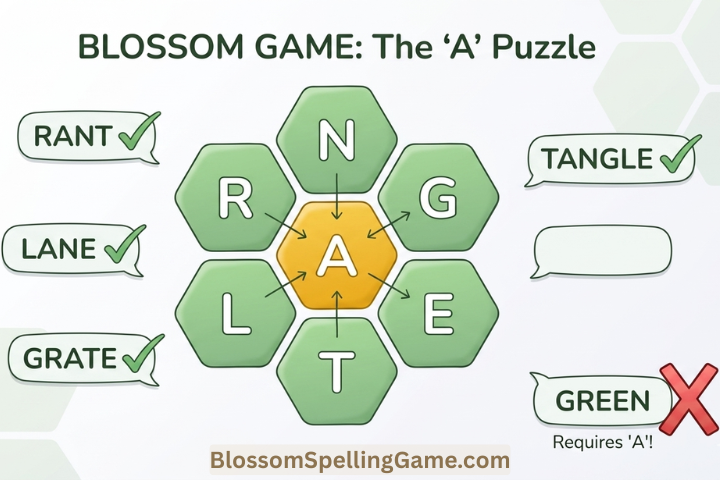
Let’s make this concrete. Imagine today’s puzzle has:
Center letter: A Petal letters: R, N, G, E, T, L
Your job is to find words that include A. Let’s think through it:
- RANT — R, A, N, T — ✅ contains A
- LANE — L, A, N, E — ✅ contains A
- REGAL — R, E, G, A, L — ✅ contains A (longer, more points)
- GRATE — G, R, A, T, E — ✅ contains A
- TANGLE — T, A, N, G, L, E — ✅ contains A (six letters, great score)
- GREEN — G, R, E, E, N — ❌ no A — rejected immediately
Now a word like ENTANGLE — E, N, T, A, N, G, L, E — that uses A and all petal letters — might be the pangram if all seven board letters appear. You’d check: does it use R? No — so not a pangram with this board. But still a great long word.
This mental process becomes fast with practice. You develop a reflex: does it have A? Yes or no, immediately. The words flow faster, and you stop wasting attempts on rejected submissions.
Tips for When You’re Stuck
Every player hits a wall. You’ve found eight words, the center letter isn’t sparking any new ideas, and the clock feels like it’s ticking even though Blossom is turn-based.
Here are things that actually work:
Shuffle the petal letters. The game lets you rearrange the flower layout. Sometimes seeing the letters in a different spatial arrangement unlocks words your brain wasn’t seeing. This sounds too simple to work. It absolutely works.
Say the center letter out loud, then free-associate. Literally just say the letter and see what words surface naturally. Your spoken vocabulary and your visual-scanning vocabulary are processed differently.
Try less common suffixes. You’ve probably tried -ing, -ed, -er. What about -al, -ous, -ful, -ish, -ive? Run the center letter through each of these endings and see if any valid word forms.
Work backwards from meaning. Instead of staring at letters, think of a category — animals, foods, places — and ask whether any word in that category uses the center letter and the available petal letters.
Take a genuine break. This isn’t a cop-out — it’s neuroscience. Your brain continues working on word associations in the background during rest. Come back after ten minutes and you’ll often spot words immediately that were invisible before.
FAQ
What is the center letter rule in Blossom?
The center letter rule in Blossom states that every word you submit must contain the letter positioned in the center of the seven-letter flower board. Words that don’t include the center letter are automatically rejected, regardless of length or validity.
Does the center letter have to be the first letter of the word?
No. The center letter can appear anywhere in the word — beginning, middle, or end. It simply must be present somewhere. “PLANET” with a center letter of A is just as valid as “APPLE” with a center letter of A.
Can the center letter be used more than once in a single word?
Yes, absolutely. If the word naturally contains the center letter more than once, the game accepts it. For example, “ELEMENT” with a center letter of E is valid — the E appears three times in that word, and that’s perfectly fine.
What happens if I submit a word without the center letter?
The game rejects it immediately. The word won’t count toward your total, and you won’t receive points for it. This is why training yourself to always check for the center letter before submitting is so important.
Does the center letter change every day?
Yes. Each daily puzzle features a completely new set of seven letters, including a new center letter. The center letter choice dramatically affects the puzzle’s difficulty and the types of words you’ll be hunting for.
Is there a bonus for using the center letter more often?
Not directly. However, the center letter contributes to your score through word length — longer words score more points, and longer words naturally tend to use more of the center letter (especially if it appears more than once). The bigger bonus in Blossom comes from the bonus petal letter (shown in yellow), not the center letter specifically.
Can I reuse the center letter in different words?
Yes — and you must. Since every word requires the center letter, you’ll use it in every single valid word you submit. There’s no limit to how many words can contain it.
What is the difference between the center letter and petal letters?
The center letter is mandatory — it must appear in every word. The six petal letters are optional — you can include any combination of them in your words, skip any of them, and reuse them across different words as much as you want.
Is the center letter always a common letter like E or A?
Not necessarily. Blossom sometimes features less common center letters, which can make the puzzle significantly more challenging. When the center letter is a rare consonant, the puzzle demands more creative vocabulary.
Does the center letter rule apply to the pangram too?
Yes — but pangrams automatically satisfy the rule because they use all seven letters, which includes the center letter. So if you’re hunting for the pangram, you don’t need to worry about the center letter separately; it will naturally be included.
Final Thoughts
The center letter rule is the heartbeat of Blossom. It’s what turns a simple word scramble into a genuine daily mental workout. Once you stop seeing it as a restriction and start seeing it as a tool — a lens that filters your vocabulary and focuses your strategy — everything changes.
New players spend their first sessions fighting against the center letter. Experienced players use it as their starting point, their compass, their filter.
Here’s the actionable takeaway: before you think about any word, think about the center letter first. Build from it. Let it shape your word search. The puzzle gets easier, your scores go up, and you start finding words you never would have seen before.
If you want to keep sharpening your skills, BlossomSpellingGame.com has a daily puzzle ready for you every morning — no downloads, no sign-up required. Give it a try today, and see how fast the center letter rule starts to feel like second nature.