
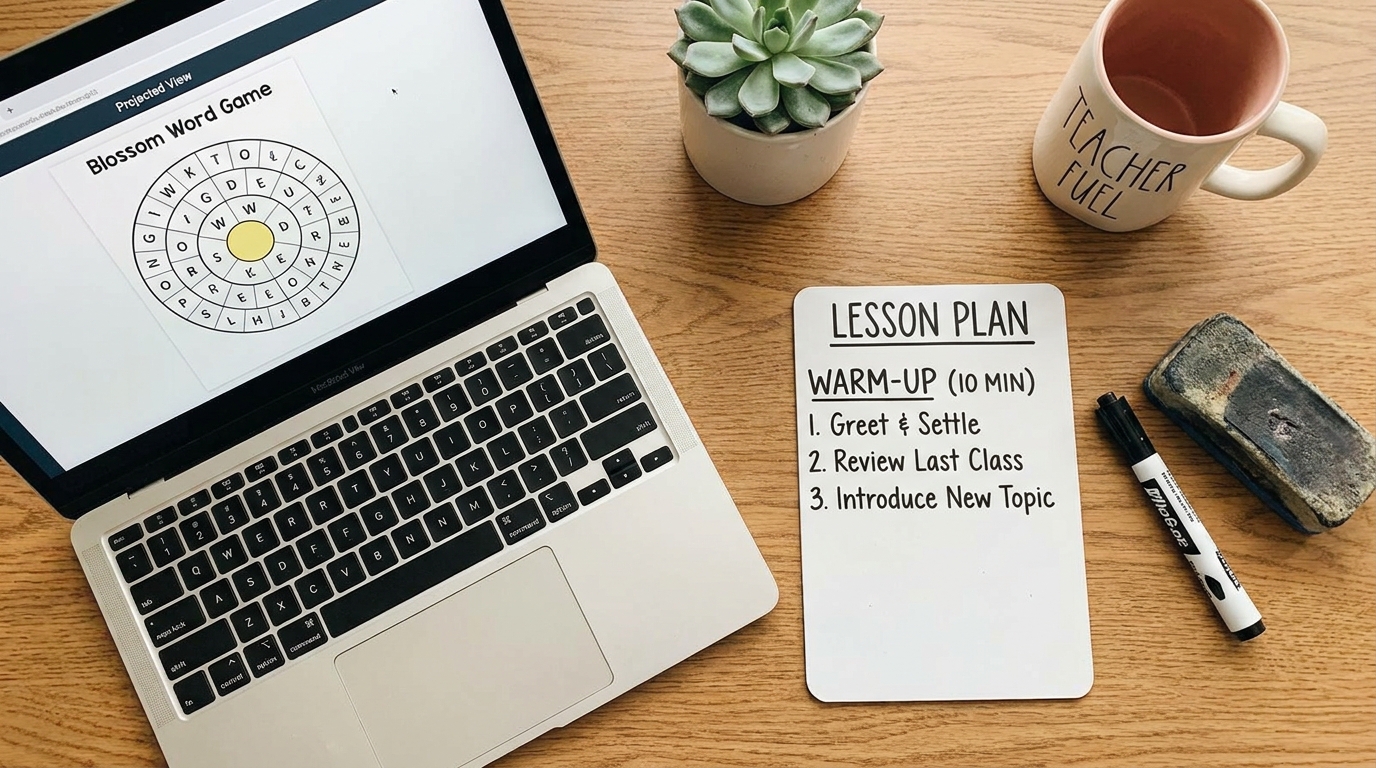
How teachers can use Blossom Word Game in the classroom — specific lesson frameworks, grade-level approaches, cooperative learning formats, and curriculum integration tips.
Blossom Word Game wasn’t designed for classrooms. No teacher dashboard, no standards alignment documentation, no progress tracking by student. What it does have — a daily letter set that every student sees simultaneously, a vocabulary-generation mechanic that produces genuine word retrieval practice, and a format that generates natural discussion — is enough to make it a genuinely useful supplementary classroom tool when used strategically.
This guide is written for teachers, not parents evaluating games for their children. It covers specific lesson frameworks by grade band, cooperative learning formats, subject-area integration beyond English, differentiation strategies for mixed-ability classrooms, vocabulary extension activities, and the specific question banks that turn a 10-minute game session into a 30-minute vocabulary lesson. The practical focus: what can you actually do with this tomorrow in class.
The 10-Minute Warm-Up Framework (All Grade Levels)
The most universally applicable classroom use of Blossom is as a structured daily warm-up. Here’s the core framework that works across grade levels, adjusted by depth in subsequent sections.
The basic 10-minute structure:
Minutes 0-2: Display today’s Blossom puzzle on the classroom projector/smartboard. Students write down the seven letters and begin generating word candidates individually (no sharing yet).
Minutes 2-7: Independent or pair word finding. Students attempt to find as many valid words as possible, writing each on a personal list. No submissions yet — just word generation on paper.
Minutes 7-10: Class reveal and discussion. Go around the room: what words did students find? Record on the board. Discuss any rejected forms, interesting vocabulary, word roots. Identify who found the pangram (or try together as a class if no one found it independently).
Why this works:
The individual generation phase before class discussion is pedagogically important. Students who share words immediately in small groups stop generating independently — social learning replaces individual retrieval practice. The individual-first structure ensures every student attempts genuine vocabulary retrieval before social collaboration provides scaffolding.
The class reveal creates a natural vocabulary teaching moment: words students found that peers didn’t spark discussion. Words one student found that others haven’t encountered lead to brief definition discussions. Rejected word forms (RUNNED instead of RAN, for example) become morphology teaching moments.
Elementary Classroom Applications (Grades 3-5)
Developmental context: Students in grades 3-5 are expanding beyond basic sight words into a broader vocabulary, developing spelling pattern awareness, and building the morphological knowledge (prefixes, suffixes, roots) that underlies reading comprehension.
Modified warm-up for younger students:
For grades 3-4, start with 5-letter-or-fewer words only. Display only the flower grid and ask: “What 4-letter words can you find? 5-letter words?” The shorter word constraint makes the task accessible without overwhelming students who are still developing vocabulary fluency.
For grade 5, full play is appropriate — but build up to it with scaffolded introduction: Week 1: Focus only on words starting with the center letter Week 2: Include words where the center letter is in any position Week 3: Full open word generation
Elementary-specific activity: The Word Family Tree
After the warm-up, pick one word the class found (e.g., RAIN) and build a word family tree on the board. What words come from the same root? RAINBOW, RAINCOAT, RAINDROP, RAINY, RAINS, RAINED, RAINING. This extends the Blossom session into the morphological word family awareness that underlies spelling and reading comprehension at this level.
Elementary-specific activity: Word of the Day Selection
Each day after the Blossom warm-up, the class votes on which word found is “most interesting.” The Word of the Day goes on the vocabulary wall. Students try to use it in a sentence before the day ends. Over a semester, this builds a substantial shared class vocabulary that students have personally encountered and chosen.
Connecting to reading:
When a Blossom word matches vocabulary from a current read-aloud or reading unit, highlight the connection explicitly: “We just found WANDER in our puzzle today — where did we see this word in our chapter book this week?” Cross-referencing game vocabulary to reading vocabulary deepens encoding for both.
Middle School Classroom Applications (Grades 6-8)
Developmental context: Middle schoolers are encountering academic vocabulary across content areas, developing awareness of Greek and Latin roots, and beginning to write in formal academic registers. Blossom’s vocabulary at this level regularly surfaces Tier 2 academic words — the vocabulary that matters most for academic success.
Full warm-up structure: The 10-minute framework works as described at full complexity. Middle schoolers are capable of independent word generation, suffix/prefix application, and pangram hunting within a 5-minute individual phase.
Middle-school-specific activity: Morphology Analysis
After the warm-up session, select 3-5 words the class found and analyze their structure:
- “GRADUAL — what’s the root? What does -AL do to it? Where else do we see -AL?”
- “RATIONAL — is this root related to REASON? Both come from Latin RATIO.”
- “IRREGULAR — what prefix? What does it mean here? What other words use this prefix?”
This morphology analysis activity takes 5 additional minutes and builds the Greek/Latin root knowledge that underlies not just vocabulary but reading comprehension in science and social studies.
Middle-school-specific activity: Vocabulary Register Discussion
Pose the question: “Would you use this word in a text to a friend? In an essay? In a formal speech?” Apply it to 2-3 words from the day’s session. This register awareness — knowing when and where different vocabulary fits — is a genuine middle school ELA standard that Blossom’s diverse word pool supports naturally.
Middle-school-specific activity: Pangram Challenge
Assign a 5-minute dedicated pangram hunt as a class challenge. Which student or team finds the pangram first? Discuss how they found it — what strategy did they use? This metacognitive discussion (thinking about thinking) is itself a valuable skill-building activity.
Connecting to content areas:
When a Blossom session happens to produce vocabulary that connects to current science, social studies, or history content, make the connection explicit. MIGRATE on a day when studying animal migration; RATION on a day studying WWII history; ELECTRON on a day covering atomic structure. These connections are serendipitous but surprisingly frequent over a year of daily play.
High School Classroom Applications (Grades 9-12)
Developmental context: High schoolers are preparing for standardized tests (SAT/ACT vocabulary), writing in formal academic register, encountering sophisticated vocabulary in literature and nonfiction, and beginning to prepare for college-level discourse. Blossom’s Merriam-Webster vocabulary regularly surfaces words at the SAT/ACT level and above.
Full warm-up with accelerated pace: High school classes often have shorter available warm-up time and faster students. Compress the individual phase to 3 minutes, the pair phase to 2 minutes, and the class discussion to 5 minutes. The discussion is the most valuable part for high schoolers.
High school-specific activity: Etymology Investigation
After finding LUCID, FERVENT, or UNTENABLE in a session, assign a 5-minute group investigation: find the Latin or Greek root, find two other English words using the same root, and share back to the class. This root-based vocabulary investigation connects to SAT vocabulary strategy (knowing roots helps decode unknown words) and builds the vocabulary depth that supports college writing.
High school-specific activity: Formal Writing Integration
Weekly assignment: Choose one new word found in Blossom this week. Use it in the next formal writing assignment (essay paragraph, discussion post, response journal). Students mark the word with an asterisk so you can see the integration attempt. Over a semester, this creates a paper trail of vocabulary acquisition that’s also a writing fluency exercise.
High school-specific activity: Crossword Construction
For ELA enrichment: use the week’s Blossom vocabulary as the basis for student-constructed crossword clues. Students write clues (not definitions — clues, with indirect hints) for words the class found that week. Exchange crosswords. This activity requires much deeper word knowledge than just recognizing a word — constructing a clue requires full semantic mastery.
Standardized test connection:
Weekly, identify one Blossom word that appears on SAT/ACT vocabulary lists. Brief discussion: definition, example sentence, common test context. Over a school year, this supplements test vocabulary preparation in a format more engaging than flashcard drilling.
Cooperative Learning Formats
Format 1: Team Blossom
Divide the class into teams of 3-4. Each team generates their word list independently (no cross-team sharing). After the individual phase, teams compare lists and combine unique finds — each team submits one shared list. Discussion: which team found the most words? Which team found the longest word? Did any team find the pangram?
This format builds collaborative vocabulary discussion within teams while maintaining competitive engagement across teams.
Format 2: Pair-Share Rotation
Students begin individually (2 minutes). Then pair with a neighbor and compare lists — each person shares their unique finds with the other (2 minutes). Finally, pairs join into groups of four and combine again (2 minutes). Class debrief in the final 4 minutes. This structured social expansion — individual → pair → quad → class — ensures every student contributes rather than deferring to the most vocabulary-fluent person in the group.
Format 3: Expert Jigsaw
Assign each table group a specific “search territory” — one group hunts -ING words, another hunts -ER words, another hunts words containing the bonus letter, another hunts the pangram. After individual search time, bring the class together and each group contributes their specialized finds. This jigsaw format divides vocabulary labor and creates natural discussion of why certain letter combinations produce certain word families.
Format 4: Silent Game (Written Only)
No speaking allowed during the entire Blossom session — students write only. After the game, each student passes their list to a neighbor for cross-checking. Words on both lists get a checkmark; words on only one list are discussed quietly. This format works well for classes that need to develop independent thinking before peer influence shapes responses.
Subject Area Integration Beyond ELA
Blossom’s random letter sets occasionally produce vocabulary from non-ELA domains. When they do, cross-curricular connections deepen both content vocabulary and linguistic engagement.
Science integration:
When Blossom produces PROTEIN, NEURON, LARVA, SPORE, PLASMA, GENOME, or similar scientific terms (all valid M-W words), briefly flag the connection: “We found NEURON today — who can tell me which content unit this connects to?” The unexpected appearance of science vocabulary in a word game creates a memorable cross-contextual encounter that strengthens content vocabulary encoding.
Social studies integration:
MIGRATE, RATION, RENDER, NATION, TREATY, TARIFF, COLONY — many social studies terms appear in Blossom letter sets. Brief cross-curricular flagging: “COLONY from our unit on American history appeared in our puzzle today — what’s the root of this word and how does that connect to what we’ve been studying?”
Math connection:
Less direct, but words like FACTOR, RATIO, PRIME, DIGIT occasionally appear in Blossom. When they do: “RATIO appeared today — in math, how is this word used? Does the mathematical meaning connect to the etymology?”
World Language connection:
For schools with world language programs, point out English words that clearly arrived from the target language: PASTA, FIESTA, ROUGE, GARAGE (from French), SOPRANO, TEMPO, ARIA (from Italian). These cross-linguistic connections support both vocabulary depth and language awareness.
Differentiation Strategies for Mixed-Ability Classrooms
Scaffolding for below-grade-level vocabulary:
Provide a hint card that lists common suffix families available in today’s letter set (-ING, -ED, -ER, etc.) before the session starts. This scaffolding gives struggling vocabulary learners a search strategy without giving them the answers.
Alternatively, allow below-grade-level learners to use physical letter tiles (tiles on a desk that they physically rearrange) rather than mental construction — the kinesthetic manipulation supports word generation for students whose working memory is heavily taxed by pure mental letter scanning.
Challenge extensions for above-grade-level vocabulary:
Set a minimum word count (e.g., “you must find at least 8 words”) and a minimum word length (e.g., “at least 3 of your words must be 6+ letters”) before class discussion time. This differentiates by expectation rather than by content — same letter set, higher bar.
For the most advanced students: require them to find the pangram before participating in class discussion. This creates a productive independent challenge that occupies them while other students complete the standard task.
ELL differentiation:
For English Language Learners, a pre-session vocabulary primer helps — a brief list of 3-5 words that are in today’s letter set, with definitions, provided before the session starts. This isn’t giving away the game; it’s providing the semantic knowledge that native speakers already have when they encounter these words. The ELL student still does the generative work of finding words — they just have more semantic context to draw on.
Additionally, allow ELL students to write word meanings alongside their found words during the session — this transforms a pure word-finding exercise into a combined vocabulary acquisition activity.
Post-Puzzle Discussion Question Bank
These discussion questions turn a 10-minute game session into an extended vocabulary lesson. Use 1-2 per session depending on time availability.
Vocabulary depth questions:
- “What does [word found today] actually mean? Can anyone use it in a sentence without looking it up?”
- “Is [word found today] formal or informal? Would you use it in a text message? In a college essay?”
- “Does [word found today] have a positive or negative connotation? What gives it that feel?”
Etymology questions:
- “Can anyone guess where [word found today] comes from? Latin? Greek? French? Old English?”
- “What other words share the same root as [word found today]?”
- “If [word found today] uses the prefix RE-, what does RE- tell us about the meaning?”
Metacognitive questions:
- “How did you find that word? What strategy were you using?”
- “Were there any words you almost didn’t submit because you weren’t sure they were real? What made you try anyway?”
- “Which words were hardest to find today? Why do you think they were harder?”
Vocabulary context questions:
- “Where might you encounter [word found today] in real life — what kind of writing or conversation?”
- “Has anyone seen [word found today] in something they’ve read recently?”
- “If you were the author of a novel and needed to use [word found today], what scene would you write it into?”
Vocabulary Extension Activities
Activity 1: The Vocabulary Sentence Challenge (5 minutes)
After the warm-up session, students write one sentence using a word they found today that they weren’t fully confident about. Share 3-4 sentences aloud. Brief discussion: did the student use the word correctly? What does the sentence reveal about their understanding?
Activity 2: Word Wall Contribution
Each student nominates one word from today’s session for the classroom vocabulary wall. Class votes on which word is “most worth learning.” The winning word goes on the wall with a student-generated definition and example sentence.
Activity 3: Root Connection Web
On the board, write one word from today’s session. Class collaboratively builds a root connection web: what’s the root? What other words share it? What prefix or suffix changes meaning? This vocabulary web typically produces 8-12 connected words from one starting point.
Activity 4: The Unknown Word Journal
Students keep a running “Unknown Word Journal” — any word accepted by Blossom that they didn’t know existed goes in the journal with a self-researched definition. Reviewed quarterly. This individual vocabulary tracking creates a personalized vocabulary record tied to authentic discovery rather than assigned word lists.
Activity 5: Weekly Vocabulary Quiz (Low Stakes)
End each week with a 5-question quiz on the 5 most interesting words from that week’s Blossom sessions — definitions provided orally, students write the word; or words provided, students write a sentence. Keeps weekly vocabulary front of mind without high-stakes assessment pressure.
Homework and At-Home Extension
The daily independent session:
For classes where you’ve introduced Blossom in school, assigning 10 minutes of daily home play is a low-effort, high-value vocabulary homework. The puzzle resets daily, so there’s no way to “cheat” by completing it more than once. The letter set is the same for every student, creating a shared experience to discuss in class the next day.
Parent communication guide:
When assigning Blossom as a home activity, send a brief parent note explaining:
- What Blossom Word Game is and where to access it (BlossomSpellingGame.com, no account required)
- The educational purpose (vocabulary fluency, generative word production, morphological awareness)
- What they might see their child doing (tapping letters, looking up word definitions, discussing words)
- That it’s appropriate for 10-20 minutes daily and has no timer or competitive pressure
The home-to-school connection:
On Mondays, ask students: “Did anyone find an interesting word over the weekend that they’d like to share?” This creates continuity between home and school play and models that vocabulary development is a continuous, not just school-based, activity.
Remote and Hybrid Classroom Adaptation
Synchronous remote sessions:
Share screen showing BlossomSpellingGame.com during a synchronous class meeting. Give students 3-4 minutes to find words independently on their own device, then bring the class back together in the video call for the collaborative discussion phase. Works identically to in-person with the added benefit of every student having their own interface rather than watching a shared one.
Asynchronous remote assignments:
Post today’s Blossom letter set in your LMS (Google Classroom, Canvas, etc.) or simply direct students to BlossomSpellingGame.com. Ask them to submit their top 5 words and a brief reflection question (e.g., “Which word did you learn something new today?”) through the LMS. Review submissions before class to identify interesting words for synchronous discussion.
The shared vocabulary document:
Create a shared Google Doc or Padlet for the class’s Blossom vocabulary. Each student adds one word daily with a definition and example sentence. Over a semester, this becomes a class-sourced vocabulary reference with genuine student ownership.

What Blossom Cannot Do (Honest Limitations)
No teacher dashboard or reporting: Blossom provides no way for a teacher to see individual student performance, track which words students found, or assess vocabulary mastery. It cannot replace formal vocabulary assessment.
No curriculum alignment: Blossom’s random letter sets don’t align to specific curriculum vocabulary lists. If your curriculum specifies that students need to master particular vocabulary this week, Blossom may or may not produce those words. It’s enrichment, not targeted instruction.
No differentiated student experience: Every student sees the same letter set. Blossom has no adaptive difficulty, no student accounts with progress tracking, and no way to assign specific vocabulary targets. Differentiation is entirely teacher-managed, not platform-managed.
Not a substitute for direct vocabulary instruction: Blossom produces incidental vocabulary learning through exposure and generation. It doesn’t provide explicit instruction, definitions, usage examples, or the structured learning sequences that vocabulary research supports for mastery of specific target words.
Best as enrichment, not core instruction: Blossom works best as a consistent supplementary activity — a daily warm-up that builds cumulative vocabulary fluency over time — rather than as a core instructional tool for any specific learning objective.
FAQ
What grade levels can use Blossom in the classroom?
Grades 3-12 with appropriate scaffolding. Grades 3-4 work best with simplified constraints (shorter words only, guided search strategies). Grades 5-8 benefit from the full game with morphology discussion extensions. Grades 9-12 can run the full game with etymology investigation and standardized test vocabulary connections.
Does Blossom align with ELA standards?
Not explicitly — Blossom has no standards documentation. However, its vocabulary generation format naturally supports several common ELA standards: vocabulary acquisition and use, morphological analysis (prefixes, suffixes, roots), and academic vocabulary development. Teachers should make the connections explicit rather than assuming the game documents them.
Can Blossom be used for formal assessment?
No — it has no teacher reporting, no student tracking, and no way to verify that specific students found specific words. It supports formative, observational assessment through class discussion but cannot generate gradebook data.
How do I introduce Blossom to students who’ve never seen it?
Spend 5 minutes on an introductory session: show the interface on the projector, explain the center letter rule, find 2-3 words together as a class before releasing students to work independently. Most students understand the mechanic within 3-5 minutes of exposure.
Is Blossom free for classroom use?
Yes — BlossomSpellingGame.com is completely free with no account required. There’s no classroom licensing, no per-student cost, and no premium tier required for any game feature. Students can access it on any device with a browser.
What if a student finishes finding words quickly while others are still searching?
Use the early-finish extension: ask fast finishers to write a definition for their most interesting word, construct a sentence using their longest word, or attempt to find the pangram (if they haven’t already). These brief extensions maintain engagement without requiring separate materials.
Final Thoughts
Blossom is a genuinely useful classroom tool — not because it was designed for classrooms, but because its core mechanic (independent vocabulary generation, immediate feedback, shared daily content) maps well to classroom vocabulary instruction goals when a teacher provides the pedagogical framework around it.
The game generates the vocabulary encounters. The teacher generates the learning. The class discussion turns an encounter into a memorable, contextualized vocabulary event. That division of labor — game providing exposure, teacher providing depth — is exactly how supplementary vocabulary tools work best in educational research on vocabulary acquisition.
Used consistently as a daily warm-up across a school year, Blossom provides approximately 180 vocabulary sessions — 180 opportunities for students to retrieve, discover, discuss, and contextualize vocabulary. That’s a meaningful cumulative vocabulary intervention for an activity that requires zero materials, zero teacher preparation beyond loading a browser, and ten minutes of class time.
The lesson plan is simple: load BlossomSpellingGame.com, display the flower grid, give students 5 minutes, discuss for 5 minutes. Everything else in this guide is enrichment on top of that core. Start simple and add complexity as the routine becomes comfortable.