
The complete Common English Suffixes vocabulary reference for Blossom Word Game — what each suffix means, where it comes from, which words it produces, and how to avoid common confusions.
Introduction
Most Blossom players know three suffixes: -ING, -ED, -ER. They use them. They score more points than players who don’t think about suffixes at all. And then they hit a plateau.
The gap between “I use -ING, -ED, -ER” and “I understand the full English suffix system” is a vocabulary gap — and closing it doesn’t require memorizing every word in the dictionary. It requires understanding what each suffix means, where it came from, which specific roots it attaches to, and which confusable suffix pairs are tripping you up.
This is the vocabulary reference companion to our Blossom Suffix Strategy Guide. That guide covers how to use suffixes strategically during play — letter availability screens, scoring math, stacking, the 60-second drill. This guide covers something different: the actual vocabulary knowledge that powers that strategy. Etymology, meaning, confusable pairs, false suffixes, and the specific high-value Blossom words each suffix produces.
After reading this, you’ll know not just that -NESS adds points — you’ll know which adjectives take -NESS, why some take -ITY instead, how to predict which form is correct, and which specific words each suffix produces that are most likely to appear in Blossom’s letter sets.
The Origins of English Suffixes
Like English prefixes, suffixes come from multiple historical sources — and knowing their origins predicts which root types they attach to.
Old English / Germanic suffixes: -NESS, -LING, -LET (Germanic), -DOM, -HOOD, -SHIP, -WARD, -SOME, -FUL, -LESS, -ER (agent), -EN (causative), -ISH. These attach primarily to Germanic-origin roots — the everyday vocabulary of English. They tend to feel natural and accessible.
Latin suffixes: -TION, -SION, -MENT, -ANCE, -ENCE, -ITY, -AL, -ARY, -ORY, -ATE, -IFY, -OR (agent). These attach primarily to Latin-derived vocabulary — the formal and academic layer of English. They produce longer, higher-scoring words.
Greek suffixes: -ISM, -IST, -IZE, -IC, -OLOGY, -ITIS, -PHOBIA. These appear in scientific, medical, and philosophical vocabulary.
French suffixes: -AGE, -ETTE, -EER, -EE, -URE (entered through French from Latin). Many of these carry a slightly formal or specialized register.
Why this matters for Blossom:
The suffix origin predicts which root it combines with. -NESS (Old English) attaches to familiar Germanic adjectives: DARKNESS, KINDNESS, BRIGHTNESS. -ITY (Latin) attaches to formal Latin-origin adjectives: ACTIVITY, FORMALITY, POSSIBILITY. Knowing this helps you predict which form is correct when you’re unsure — QUICKNESS or QUICKNESS? RAPIDNESS or RAPIDITY?
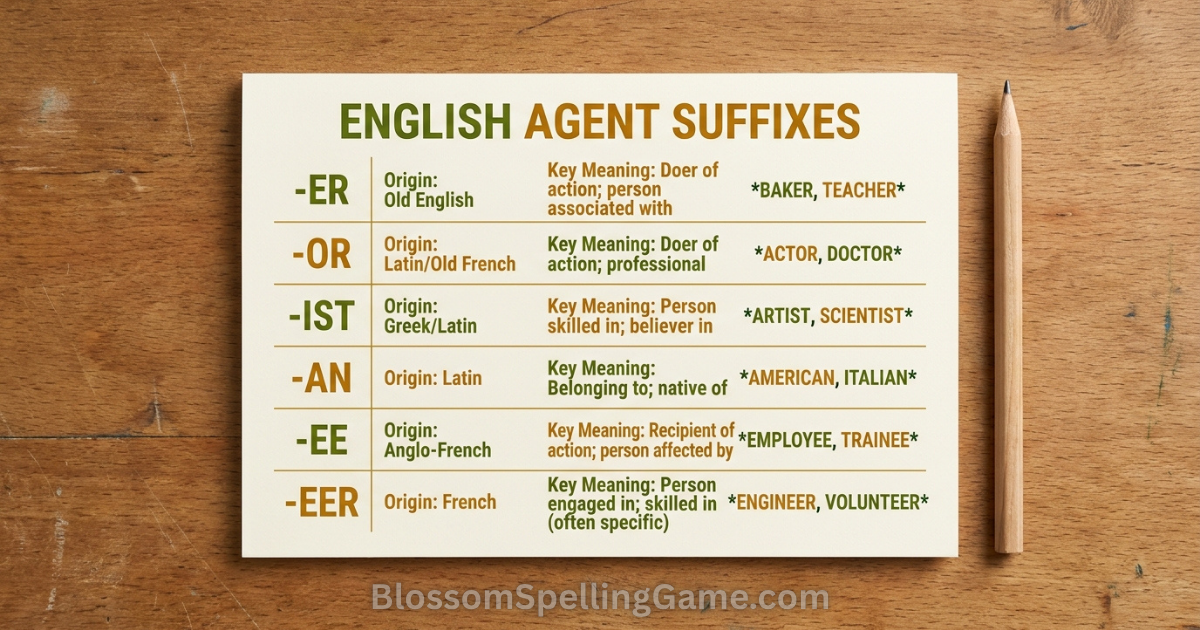
Agent and Person Suffixes: -ER, -OR, -IST, -AN, -EE, -EER
These suffixes all create words meaning “a person who does/is associated with something” — but they’re not interchangeable, and the difference matters for Blossom.
-ER — The Most Productive Agent Suffix
Origin: Old English Meaning: One who does; one associated with Attaches to: Verbs (primarily Germanic-origin verbs)
TEACHER (one who teaches), PLAYER (one who plays), WRITER (one who writes), DRIVER (one who drives), BUILDER (one who builds)
Key rule: -ER attaches primarily to verbs of action. If you can say “one who [verb]s,” -ER probably works.
Also functions as comparative adjective: BRIGHT + ER = BRIGHTER (more bright). FAST + ER = FASTER. This double function makes -ER one of the most productive suffixes in Blossom — it applies to both verb stems and adjectives.
High-value -ER Blossom words:
| Word | Letters | Points |
|---|---|---|
| GARDENER | 8 | 15 pts |
| TRAVELER | 8 | 15 pts |
| STRANGER | 8 | 15 pts |
| TOGETHER | 8 | 15 pts |
| PRISONER | 8 | 15 pts |
| REMINDER | 8 | 15 pts |
| WANDERER | 8 | 15 pts |
-OR — The Latin Agent Suffix
Origin: Latin Meaning: One who does (Latin-origin verbs) Attaches to: Latin-derived verb roots
ACTOR (from Latin ACTUS), DIRECTOR (from DIRIGERE), INSTRUCTOR (from INSTRUERE), SENATOR (from Latin SENATUS), DOCTOR (from DOCERE — to teach)
The -ER vs. -OR rule:
This is one of the most useful distinctions in English morphology. The general pattern:
- If the verb is Germanic (teach, drive, build, play), use -ER: TEACHER, DRIVER, BUILDER
- If the verb is Latin (act, direct, instruct), use -OR: ACTOR, DIRECTOR, INSTRUCTOR
Some -OR words have lost the connection to an obvious English verb (SENATOR, DOCTOR), but their Latin verb origins explain the suffix.
High-value -OR Blossom words:
| Word | Letters | Points |
|---|---|---|
| INSTRUCTOR | 10 | 17 pts |
| DIRECTOR | 8 | 15 pts |
| INSPECTOR | 9 | 16 pts |
| PROFESSOR | 9 | 16 pts |
| CONDUCTOR | 9 | 16 pts |
| GOVERNOR | 8 | 15 pts |
-IST — The Practitioner Suffix
Origin: Greek via Latin Meaning: One who practices, believes in, or specializes in Attaches to: Nouns and verbs across origins
ARTIST (one who makes art), TOURIST (one who tours), SCIENTIST (one who does science), PIANIST (one who plays piano), JOURNALIST (one who does journalism)
Blossom note: -IST requires I, S, T — all relatively common letters. When all three are present, scan for profession-forming roots.
High-value -IST Blossom words: NATURALIST (10 letters, 17 pts), JOURNALIST (10 letters), SPECIALIST (10 letters), GUITARIST (9 letters, 16 pts), SCIENTIST (9 letters)
-EE — The Recipient Agent Suffix
Origin: French Meaning: One who receives an action (as opposed to -ER who performs it)
EMPLOYEE (one who is employed — contrast EMPLOYER who employs) TRAINEE (one who is trained — contrast TRAINER) REFUGEE (one who takes refuge) ABSENTEE (one who is absent) NOMINEE (one who is nominated)
The -ER/-EE contrast: This is an elegant suffix pair that Blossom players consistently miss. When you find EMPLOYER or TRAINER, immediately ask: does EMPLOYEE or TRAINEE work with these letters?
-EER — The Specialized Practitioner
Origin: French from Latin -ARIUS Meaning: One who works with or is expert in
ENGINEER (one who works with engines/design), PIONEER (one who goes first), VOLUNTEER (one who volunteers), CAREER (course, path — slightly different use)
Blossom note: -EER requires E, E, R — the double E limits availability since E appears only once as a letter (though if E is the center letter, two E’s can appear in a word). Test ENGINEER and PIONEER when letter combinations allow.
Action and Process Noun Suffixes: -TION, -SION, -MENT, -AGE, -AL, -URE
These suffixes convert verbs into nouns meaning “the act of” or “the result of” something.
-TION and -SION — The Most Productive Noun-Forming Suffixes
Origin: Latin Meaning: The act of; the state of; the result of Attaches to: Latin-origin verbs
-TION: CREATION (act of creating), EDUCATION (act of educating), PROTECTION (act of protecting), DIRECTION (act of directing) -SION: CONFUSION (state of being confused), EXTENSION (act of extending), INVASION (act of invading), TENSION (state of being tense)
The -TION vs. -SION rule:
This is one of English’s more predictable spelling rules:
- Most verbs ending in -T or -TE take -TION: PROTECT → PROTECTION, CREATE → CREATION
- Most verbs ending in -D or -DE or -SS take -SION: EXTEND → EXTENSION, CONFUSE → CONFUSION, EXPRESS → EXPRESSION
- Verbs ending in -MIT take -SSION: SUBMIT → SUBMISSION, ADMIT → ADMISSION, COMMIT → COMMISSION
High-value -TION/-SION Blossom words:
| Word | Letters | Points |
|---|---|---|
| CONCENTRATION | 13 | 20 pts (when all available) |
| TRANSFORMATION | 14 | 21 pts |
| DEMONSTRATION | 13 | 20 pts |
| ORGANIZATION | 12 | 19 pts |
| CONTRIBUTION | 12 | 19 pts |
| CONSTRUCTION | 12 | 19 pts |
| DESTRUCTION | 11 | 18 pts |
| INSTRUCTION | 11 | 18 pts |
| PRODUCTION | 10 | 17 pts |
| SELECTION | 9 | 16 pts |
-MENT — The Result Suffix
Origin: Latin/French Meaning: The result of an action; the state of Attaches to: Verbs (usually Latin/French origin, but some Germanic)
MOVEMENT (result of moving), AGREEMENT (result of agreeing), TREATMENT (act/result of treating), GOVERNMENT (act of governing), MANAGEMENT (act of managing)
-MENT vs. -TION: Both convert verbs to nouns, but -MENT is more common with verbs that express general action or states, while -TION is more common with verbs expressing specific processes or transformations.
MOVE → MOVEMENT (general action result); PRODUCE → PRODUCTION (specific process result)
High-value -MENT Blossom words: ENTERTAINMENT (13 letters), MANAGEMENT (10 letters, 17 pts), ENVIRONMENT (11 letters), AGREEMENT (9 letters, 16 pts), TREATMENT (9 letters, 16 pts), MOVEMENT (8 letters, 15 pts)
-AGE — The French Process Suffix
Origin: French from Latin -ATICUM Meaning: The act/state of; a collection of; a percentage of
STORAGE (act of storing), DRAINAGE (act of draining), PASSAGE (act of passing), MARRIAGE (state of being married), BAGGAGE (collection of bags), PERCENTAGE (portion of 100)
Etymology note: -AGE often enters English through French, which explains its slightly formal feel despite the relatively simple word forms it creates. GARAGE, MIRAGE, CAMOUFLAGE — these are all French-origin -AGE words that feel “borrowed.”
Blossom note: -AGE requires A, G, E — all common letters. Systematically test it against available noun and verb roots.
High-value -AGE Blossom words: PERCENTAGE (10 letters, 17 pts), ENCOURAGE (9 letters, 16 pts), LANDSCAPE (9 letters — actually -SCAPE not -AGE), ADVANTAGE (9 letters, 16 pts), COVERAGE (8 letters, 15 pts), LANGUAGE (8 letters, 15 pts)
-URE — The Process and Result Suffix
Origin: Latin/French Meaning: Act of; state of; result of; something that performs
DEPARTURE (act of departing), STRUCTURE (something that is built), PRESSURE (act of pressing), NATURE (essential character), FUTURE (what is to come), CULTURE (cultivation, way of life)
Blossom note: -URE requires U, R, E — all reasonably common. When U, R, E are all available, scan for -URE word forms. DEPARTURE (9 letters, 16 pts), STRUCTURE (9 letters, 16 pts), SIGNATURE (9 letters, 16 pts)
Quality and State Noun Suffixes: -NESS, -ITY, -ANCE, -ENCE, -DOM, -HOOD, -SHIP
These suffixes create abstract nouns expressing qualities, states, or conditions — and several of them are commonly confused.
-NESS vs. -ITY — The Critical Distinction
Both create abstract nouns from adjectives. This is the most important confusable suffix pair for Blossom players.
-NESS (Old English):
- Attaches to: Germanic-origin adjectives, participial adjectives, and ANY adjective in informal usage
- Register: Neutral to informal
- Examples: DARKNESS (dark, Germanic), KINDNESS (kind, Old English), BRIGHTNESS (bright, Old English), SADNESS, HAPPINESS, HARDNESS
-ITY (Latin):
- Attaches to: Latin-origin adjectives, particularly those ending in -AL, -IC, -ID, -IVE
- Register: Formal, academic
- Examples: ACTIVITY (active → activity), FORMALITY (formal → formality), POSSIBILITY (possible → possibility), CREATIVITY, SENSITIVITY, GENEROSITY
The distinction rule:
If the adjective ends in -AL, -IC, -ID, -IVE, or -OUS → use -ITY: FORMAL → FORMALITY, ACTIVE → ACTIVITY, VIVID → VIVIDITY, CREATIVE → CREATIVITY, GENEROUS → GENEROSITY
If the adjective is an everyday Germanic word → use -NESS: DARK → DARKNESS, KIND → KINDNESS, BRIGHT → BRIGHTNESS
Both forms sometimes exist with different meanings:
BITTER → BITTERNESS (the quality of being bitter in taste/attitude) But no BITTERITY — Latin -ITY doesn’t attach here
FORMAL → FORMALITY (the state of being formal) But FORMALNESS also exists in informal usage as a near-synonym
High-value -NESS Blossom words: BRIGHTNESS (10 letters, 17 pts), GREATNESS (9 letters, 16 pts), AWARENESS (9 letters, 16 pts), DARKNESS (8 letters, 15 pts), KINDNESS (8 letters, 15 pts)
High-value -ITY Blossom words: CREATIVITY (10 letters, 17 pts), SENSITIVITY (11 letters, 18 pts), POSSIBILITY (11 letters, 18 pts), GENEROSITY (10 letters, 17 pts), FORMALITY (9 letters, 16 pts)
-ANCE vs. -ENCE — The Spelling Trap
Origin: Latin (both) Meaning: State of; quality of; act of
PERFORMANCE (state/act of performing), IMPORTANCE (state of being important) CONFIDENCE (state of being confident), DIFFERENCE (quality of being different)
The -ANCE vs. -ENCE rule:
This is one of English’s genuinely difficult spelling distinctions because the rule has many exceptions. The most reliable guides:
Use -ANCE after:
- Hard C (K sound): SIGNIFICANCE, ELEGANCE
- Hard G: ARROGANCE, EXTRAVAGANCE
- -ANT adjectives: IMPORTANT → IMPORTANCE, ELEGANT → ELEGANCE
- Many common words: PERFORMANCE, APPEARANCE, ASSISTANCE, RESISTANCE
Use -ENCE after:
- Soft C (S sound): INNOCENCE, EXCELLENCE
- -ENT adjectives: CONFIDENT → CONFIDENCE, DIFFERENT → DIFFERENCE, PERSISTENT → PERSISTENCE
- Many common words: INFLUENCE, SILENCE, ABSENCE, VIOLENCE
The Blossom implication: Since A and E are different letters with different availability in any given puzzle, knowing which spelling is correct for a specific word prevents wasted submissions. CONFIDENCE uses E, N, C, E. IMPORTANCE uses A, N, C, E. These are different letter requirements.
High-value -ANCE words: PERFORMANCE (11 letters), SIGNIFICANCE (12 letters), APPEARANCE (10 letters), RESISTANCE (10 letters), ASSISTANCE (10 letters)
High-value -ENCE words: INDEPENDENCE (12 letters), CONSEQUENCE (11 letters), INTELLIGENCE (12 letters), DIFFERENCE (10 letters), CONFIDENCE (10 letters)
-DOM — The Kingdom Suffix
Origin: Old English Meaning: State/condition of; realm of; all those who are
FREEDOM (state of being free), BOREDOM (state of being bored), KINGDOM (realm of a king), WISDOM (state of being wise), STARDOM (the realm of stars/celebrities)
The -DOM mnemonic: Think of KINGDOM — a domain or realm. FREEDOM is the “kingdom/realm” of freedom. BOREDOM is the state where boredom reigns.
-HOOD — The Status Suffix
Origin: Old English Meaning: State of being; period of life; group sharing a quality
CHILDHOOD (state/period of being a child), NEIGHBORHOOD (the group of neighbors), FALSEHOOD (state of being false), LIKELIHOOD (state of being likely)
High-value -HOOD Blossom words: NEIGHBORHOOD (12 letters), LIKELIHOOD (10 letters, 17 pts), CHILDHOOD (9 letters, 16 pts), FALSEHOOD (9 letters, 16 pts)
-SHIP — The Relationship and Skill Suffix
Origin: Old English Meaning: State of; condition of; skill of; relationship of
FRIENDSHIP (state of being friends), LEADERSHIP (quality/skill of leading), OWNERSHIP (state of owning), SCHOLARSHIP (state/skills of a scholar)
High-value -SHIP Blossom words: SCHOLARSHIP (11 letters), RELATIONSHIP (12 letters), LEADERSHIP (10 letters, 17 pts), FRIENDSHIP (10 letters, 17 pts)
Diminutive and Small Thing Suffixes: -LET, -LING, -ETTE
These suffixes create words meaning “small version of” or “young/minor version of.”
-LET — Small Thing
Origin: French -ELET Meaning: Small version of
BOOKLET (small book), DROPLET (small drop), STARLET (small/young star), PIGLET (young pig), LEAFLET (small leaf/sheet)
Blossom note: -LET requires L, E, T — all common. Systematically test it against nouns: STREAM → STREAMLET, BOOK → BOOKLET, STAR → STARLET, DROP → DROPLET.
-LING — Young or Small Being
Origin: Old English Meaning: Young; small; minor; belonging to
DUCKLING (young duck), STARLING (a bird — from its star-like spots as a young bird), EARTHLING (one who belongs to earth), UNDERLING (one who is under/subordinate), NURSELING (one being nursed)
Etymology note: -LING sometimes means “young of” (DUCKLING) and sometimes means “one characterized by” (UNDERLING, COWARDLING in older usage). The latter use is archaic but some forms persist.
-ETTE — Small and Feminine Version
Origin: French Meaning: Small version of; feminine version of (though feminist critique has largely abandoned the feminine use)
BOOKETTE (not standard), KITCHENETTE (small kitchen), CIGARETTE (small cigar), DISKETTE (small disk — now archaic), QUARTET (group of four — not exactly diminutive)
Blossom note: -ETTE requires E, T, T — the double T limits availability since T typically appears once. However, CIGARETTE, SILHOUETTE, and similar words work when letters align.
Adjective Suffixes: -ABLE, -IBLE, -FUL, -LESS, -OUS, -AL, -IC, -ISH, -IVE, -ARY
This is the largest suffix category for Blossom purposes — adjective suffixes tend to produce long words with high point values.
-ABLE vs. -IBLE — The Classic Confusion
Origin: Latin (both — -ABILIS and -IBILIS) Meaning: Capable of being; suitable for
Both mean “capable of being [verb]ed” — but they’re not interchangeable, and mixing them up costs you submissions.
The -ABLE vs. -IBLE rule:
Use -ABLE when:
- The base is a complete English word you can use independently: BREAK → BREAKABLE, READ → READABLE, WASH → WASHABLE, ACCEPT → ACCEPTABLE
- The base verb ends in -ATE: IRRITATE → IRRITABLE, NAVIGATE → NAVIGABLE
Use -IBLE when:
- The base is a Latin root that doesn’t stand alone as an English word: COMPAT- → COMPATIBLE, ELIG- → ELIGIBLE, VERT- → CONVERTIBLE
- The word ends in -SS: ACCESS → ACCESSIBLE, COMPRESS → COMPRESSIBLE
- The word ends in -T where T follows NS: DIGEST → DIGESTIBLE, SUGGEST → SUGGESTIBLE
The practical test: Can you use the base as a standalone English word? BREAK works alone → BREAKABLE. ELIG- doesn’t work alone → ELIGIBLE.
High-value -ABLE Blossom words: REMARKABLE (10 letters, 17 pts), COMFORTABLE (11 letters), UNFORGETTABLE (13 letters), REASONABLE (10 letters), UNBELIEVABLE (12 letters), CONSIDERABLE (12 letters)
High-value -IBLE Blossom words: RESPONSIBLE (11 letters), CONVERTIBLE (11 letters), INCREDIBLE (10 letters), ACCESSIBLE (10 letters), PERMISSIBLE (11 letters)
-FUL vs. -LESS — The Natural Pair
Origin: Old English (both) Meaning: -FUL = full of; having; -LESS = without; lacking
These naturally pair: almost every -FUL word has a -LESS partner and vice versa.
-FUL: CAREFUL (full of care), HELPFUL (full of help), GRACEFUL (full of grace), POWERFUL (full of power) -LESS: CARELESS (without care), HELPLESS (without help), GRACELESS (without grace), POWERLESS (without power)
When only one form exists: Some roots take only -FUL (GLEEFUL — no GLEELESS) or only -LESS (HOMELESS — HOMEFUL is not standard). But most common adjective roots take both.
The Blossom -FUL/-LESS strategy: When you find a word taking -FUL, always test -LESS immediately. They require the same root with different suffixes — same letter commitment, double the word count.
High-value -FUL/-LESS pairs: BEAUTIFUL/BEAUTILESS (BEAUTIFUL 9 letters, 16 pts — BEAUTILESS not standard, interestingly), WONDERFUL (9 letters, 16 pts), SUCCESSFUL (10 letters, 17 pts), COLORFUL (8 letters, 15 pts), HOPELESS (8 letters, 15 pts), WORTHLESS (9 letters, 16 pts)
-OUS / -IOUS / -EOUS — The Richness Suffix Family
Origin: Latin Meaning: Full of; characterized by; resembling
-OUS: FAMOUS (full of fame), DANGEROUS (full of danger), NERVOUS (full of nerves) -IOUS: GLORIOUS (full of glory), GRACIOUS (full of grace), PRECIOUS (of great price) -EOUS: GORGEOUS (of gorge — originally meaning throat, used for elaborate display), COURAGEOUS, OUTRAGEOUS
Which form to use:
-OUS attaches to most noun roots directly: DANGER → DANGEROUS, FAME → FAMOUS -IOUS attaches when the root ends in a soft sound: GRACE → GRACIOUS, GLORY → GLORIOUS -EOUS is rarer and mostly in specific words: GORGEOUS, COURAGEOUS, HIDEOUS
High-value -OUS words: MOUNTAINOUS (11 letters), OUTRAGEOUS (10 letters), COURAGEOUS (10 letters), DANGEROUS (9 letters, 16 pts), GLAMOROUS (9 letters, 16 pts), GLORIOUS (8 letters, 15 pts)
-AL — The “Relating To” Adjective Suffix
Origin: Latin Meaning: Relating to; of the nature of; pertaining to
MUSICAL (relating to music), NATURAL (relating to nature), LOGICAL (relating to logic), COASTAL (relating to coast), EMOTIONAL (relating to emotion)
-AL also forms nouns: ARRIVAL (act of arriving), TRIAL (act of trying), REFUSAL (act of refusing), PROPOSAL (something proposed). This dual function (adjective AND noun-forming) makes -AL particularly productive in Blossom.
High-value -AL Blossom words: EMOTIONAL (9 letters, 16 pts), UNIVERSAL (9 letters, 16 pts), THEATRICAL (10 letters), INDIVIDUAL (10 letters), STRUCTURAL (10 letters)
-IC vs. -ICAL — The Formal Adjective Pair
Origin: Greek via Latin Meaning: Of the nature of; relating to
HISTORIC vs. HISTORICAL: Both exist, with slightly different nuances (HISTORIC = important in history; HISTORICAL = relating to history or the past)
ECONOMIC vs. ECONOMICAL: ECONOMIC relates to economics as a field; ECONOMICAL means thrifty/efficient
The -IC/-ICAL distinction for Blossom: Both forms of many words are valid, but -ICAL adds one more letter (higher score). Test both: GEOGRAPHIC → GEOGRAPHICAL (12 letters when available).
High-value -IC words: SCIENTIFIC (10 letters, 17 pts), GEOGRAPHIC (10 letters), DEMOCRATIC (10 letters), ELECTRONIC (10 letters), ARITHMETIC (10 letters)
-ISH — The Approximate Adjective
Origin: Old English Meaning: Somewhat; resembling; characteristic of; relating to
CHILDISH (resembling a child), FOOLISH (resembling a fool), GREENISH (somewhat green), STYLISH (having style), SELFISH (concerned with self)
Etymology note: -ISH also creates nationality adjectives: ENGLISH, SPANISH, SWEDISH, TURKISH. These are proper adjectives (capitalized) and won’t work in Blossom as such — but their common-adjective uses (FOOLISH, CHILDISH) absolutely do.
The approximate meaning: GREENISH = somewhat green (not fully green). WARMISH = somewhat warm. This approximate meaning is distinctive to -ISH and not shared by -FUL, -OUS, or other adjective suffixes.
High-value -ISH Blossom words: OUTLANDISH (10 letters, 17 pts), ASTONISHING (11 letters, uses -ING on ASTONISH), STYLISH (7 letters, 12 pts), FOOLISH (7 letters, 12 pts), CHILDISH (8 letters, 15 pts)
-IVE — The Active Tendency Suffix
Origin: Latin Meaning: Having a tendency to; of the nature of; performing an action
CREATIVE (tending to create), PASSIVE (inclined to be acted upon), MASSIVE (having mass), ACTIVE (tending to act), DETECTIVE (one who detects)
Register note: -IVE words tend to be formal or academic. CREATIVE, PRODUCTIVE, NARRATIVE, DESCRIPTIVE — all common in professional and academic writing.
High-value -IVE Blossom words: PRODUCTIVE (10 letters, 17 pts), DESCRIPTIVE (11 letters), PERSPECTIVE (11 letters), IMPRESSIVE (10 letters), ATTRACTIVE (10 letters), CREATIVE (8 letters, 15 pts)
-ARY / -ORY / -ERY — Three Confusable Endings
Origin: Latin (all three)
-ARY: LITERARY (relating to literature), CUSTOMARY (relating to custom), IMAGINARY, PRELIMINARY, SECONDARY
-ORY: LABORATORY (place of labor/work), DIRECTORY (thing that directs), MEMORY (act of remembering), HISTORY (Greek origin, not strictly -ORY), ADVISORY (giving advice)
-ERY: BAKERY (place where baking happens), BRAVERY (state of being brave), MACHINERY (collection of machines), SCENERY (collection of scenes)
The confusable pattern: Many -ARY/-ORY/-ERY words sound similar in speech (unstressed -ary/-ory/-ery all reduce to a similar sound). Writing requires knowing which form the dictionary uses.
High-value -ARY words: REVOLUTIONARY (13 letters), EXTRAORDINARY (13 letters), CONTEMPORARY (12 letters), IMAGINARY (9 letters, 16 pts)
High-value -ORY words: INTRODUCTORY (12 letters), LABORATORY (10 letters, 17 pts), OBSERVATORY (11 letters)
High-value -ERY words: MACHINERY (9 letters, 16 pts), DISCOVERY (9 letters, 16 pts), STATIONERY (10 letters), BRAVERY (7 letters, 12 pts)
Adverb Suffixes: -LY, -WARD, -WISE, -WAYS {#adverb}
-LY — The Primary Adverb Suffix
Origin: Old English from -LICE Meaning: In the manner of
QUICKLY (in a quick manner), CAREFULLY (in a careful manner), GENTLY (in a gentle manner), STRONGLY, BRAVELY
The -LY spelling rules:
Most adjectives add -LY directly: QUICK → QUICKLY, STRONG → STRONGLY Adjectives ending in -LE drop the E: GENTLE → GENTLY, SIMPLE → SIMPLY Adjectives ending in -Y change Y to I: HAPPY → HAPPILY, EASY → EASILY Adjectives ending in -IC add -ALLY: BASIC → BASICALLY, DRAMATIC → DRAMATICALLY
High-value -LY Blossom words: IMMEDIATELY (11 letters), PARTICULARLY (12 letters), EXTRAORDINARY + LY… BEAUTIFULLY (11 letters), COMPLETELY (10 letters, 17 pts), NATURALLY (9 letters, 16 pts), CAREFULLY (9 letters, 16 pts)
-WARD and -WISE — Direction Suffixes
-WARD (Old English): Indicates direction toward: NORTHWARD, HOMEWARD, INWARD, ONWARD, BACKWARD, FORWARD
-WISE (Old English): Indicates manner or direction: CLOCKWISE, LENGTHWISE, OTHERWISE, LIKEWISE
Blossom note: Both require relatively uncommon letters (W in particular), limiting availability. But when W is in your set, these suffixes produce long, scoring words that other players miss.
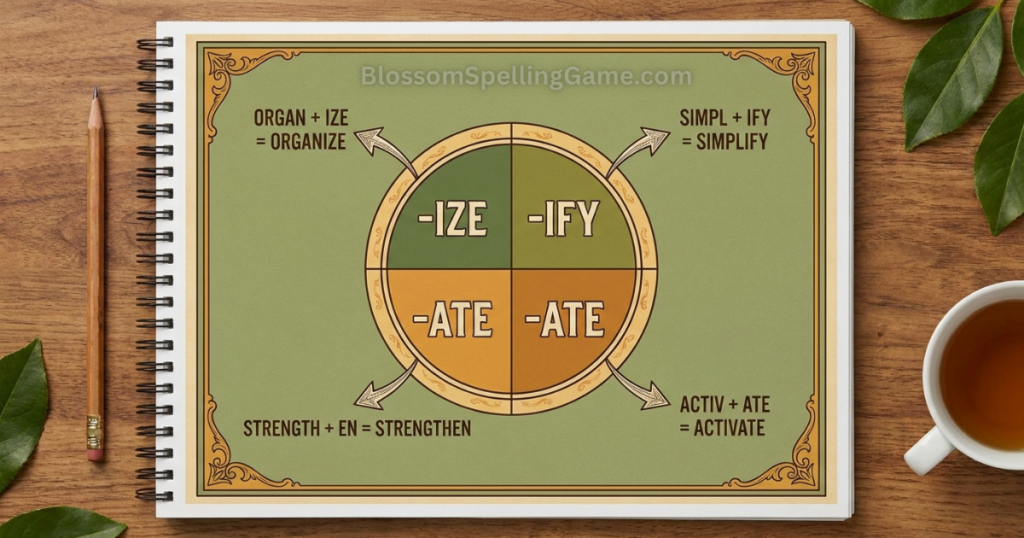
Verb-Forming Suffixes: -IZE, -IFY, -EN, -ATE
These suffixes convert nouns and adjectives into verbs.
-IZE (-ISE) — The Most Productive Verb-Former
Origin: Greek via Latin Meaning: To make; to become; to engage in
ORGANIZE (make into an organized system), REALIZE (make real), MODERNIZE (make modern), SUMMARIZE (make into a summary), MEMORIZE (commit to memory)
The -IZE vs. -ISE distinction: American English predominantly uses -IZE; British English uses -ISE for many words (ORGANIZE vs. ORGANISE). Since Blossom uses Merriam-Webster (American English), -IZE is the correct form.
High-value -IZE Blossom words: REORGANIZE (10 letters), MODERNIZE (9 letters, 16 pts), SUMMARIZE (9 letters, 16 pts), RECOGNIZE (9 letters, 16 pts), ADVERTIZE (9 letters — but ADVERTISE is more standard)
-IFY — Make/Cause to Be
Origin: Latin -FICARE (to make) Meaning: To make; to cause to become
SIMPLIFY (make simple), GLORIFY (make glorious), SOLIDIFY (make solid), AMPLIFY (make larger/louder), CLASSIFY (place in a class)
-IFY vs. -IZE: -IFY tends to create more internal change (“make completely different”) while -IZE often means “apply a system to.” SOLIDIFY (change state completely) vs. ORGANIZE (apply organizational system). But this distinction has many exceptions.
High-value -IFY Blossom words: INTENSIFY (9 letters, 16 pts), CLASSIFY (8 letters, 15 pts), SIMPLIFY (8 letters, 15 pts), GLORIFY (7 letters, 12 pts), MAGNIFY (7 letters, 12 pts)
-EN — The Causative Verb Former
Origin: Old English Meaning: To make; to become; to cause to be
BRIGHTEN (make bright), DARKEN (make dark), SOFTEN (make soft), STRENGTHEN (make strong), TIGHTEN (make tight), LENGTHEN (make longer)
The -EN rule: -EN primarily attaches to adjectives to create causative verbs. If the adjective ends in a consonant sound, -EN typically works: DARK → DARKEN, TIGHT → TIGHTEN, BRIGHT → BRIGHTEN.
High-value -EN Blossom words: STRENGTHEN (10 letters, 17 pts), ENLIGHTEN (9 letters, 16 pts), LIGHTEN (7 letters, 12 pts), TIGHTEN (7 letters, 12 pts), DARKEN (6 letters, 6 pts)
-ATE — The Causative Latin Verb Suffix
Origin: Latin -ATUS Meaning: To make; to cause; to perform the action of
GENERATE (cause to come into being), DEMONSTRATE (show thoroughly), ACCELERATE (cause to move faster), CELEBRATE (perform a celebration), EDUCATE (lead out — cause learning)
-ATE words often also function as adjectives: APPROPRIATE (adj. = fitting; verb = to take for oneself), SEPARATE (adj. = apart; verb = to divide), MODERATE (adj. = not extreme; verb = to regulate). This dual noun-adjective function adds Blossom value.
High-value -ATE Blossom words: DEMONSTRATE (11 letters, 18 pts), CONCENTRATE (11 letters), ACCELERATE (10 letters, 17 pts), CELEBRATE (9 letters, 16 pts), GENERATE (8 letters, 15 pts)
Words That Look Suffixed but Aren’t — The False Suffix Trap
Just as with prefixes, some words end in suffix-like sequences that have nothing to do with a suffix. Recognizing these prevents wasted search time when you’re trying to find word families.
Words ending in -ER that aren’t agent nouns:
- CORNER — not CORN + ER; from Latin CORNU (horn-shaped feature)
- SISTER — not SIS + TER; from Old Norse SYSTIR
- BUTTER — not BUTT + ER; from Old English BUTERE, from Latin BUTYRUM
- RENDER — not REN + DER; from Old French RENDRE
- WINTER — not WIN + TER; from Old English WINTER
Words ending in -MENT that aren’t action nouns:
- MOMENT — not MO + MENT; from Latin MOMENTUM (movement, impulse)
- CEMENT — not CE + MENT; from Latin CAEMENTUM (quarry stone)
- TORMENT — actually IS a valid prefix+root word (TOR + MENT where TOR- means torture)
Words ending in -NESS that aren’t quality nouns:
- TENNIS — not TENNI + S; from French TENEZ (hold!)
- CANVAS — not CANVA + S; not the -NESS suffix
- BONUS — not BO + NUS; from Latin BONUS (good)
Words ending in -FUL that aren’t “full of” adjectives:
- AWFUL — originally means “full of awe” — this IS the -FUL suffix, but the meaning has shifted
- FULL — not a word with -FUL suffix; it IS the source of the suffix
Words ending in -TION that aren’t action nouns:
- NATION — from Latin NATIO (birth, people) — actually IS the -TION suffix on NAT- (born)
- QUESTION — from Latin QUAESTIO — actually IS the -TION suffix on QUAES- (to seek)
- STATION — from Latin STATIO — IS the suffix on STAT- (to stand) These are all legitimate -TION words, but the base isn’t a recognizable English verb — the root is Latin.
Practical Blossom implication: Don’t try to find word families by removing what looks like a suffix from these false-suffix words. CORNER doesn’t derive a CORN verb family. SISTER doesn’t have a SIST root. When in doubt, the dictionary is the answer — if the “root” word doesn’t exist in English, the suffix is false.
The Most Confusable Suffix Pairs
These specific pairs produce the most errors — knowing the distinction prevents wasted submissions.
-ER vs. -OR (agent nouns): Germanic verbs → -ER: TEACHER, DRIVER, BUILDER, WRITER Latin verbs → -OR: ACTOR, DIRECTOR, INSTRUCTOR, SENATOR Test: Does the root look like an everyday English word (Germanic) or a formal/academic word (Latin)?
-ANCE vs. -ENCE: After hard C (K) or hard G → -ANCE: SIGNIFICANCE, ELEGANCE After -ENT adjectives → -ENCE: CONFIDENT → CONFIDENCE Many must simply be memorized, but the -ANT/-ENT adjective test covers the majority.
-ABLE vs. -IBLE: Base is a standalone English word → -ABLE: BREAKABLE, READABLE Base is a Latin root (not standalone) → -IBLE: ELIGIBLE, COMPATIBLE Test: Can you use the base word independently? Yes → -ABLE. No → -IBLE.
-NESS vs. -ITY: Germanic/everyday adjective → -NESS: DARKNESS, KINDNESS Latin/formal adjective (especially -AL, -IC, -IVE, -OUS) → -ITY: FORMALITY, CREATIVITY Test: Does the adjective sound formal/academic? -ITY. Everyday and familiar? -NESS.
-IZE vs. -IFY: Both create verbs meaning “make/cause.” No clean rule — must learn individual words. Rough guide: -IZE for applying a system or making into something (ORGANIZE, MODERNIZE); -IFY for causing a more complete transformation (SOLIDIFY, SIMPLIFY). But many exceptions exist.
-ARY vs. -ORY vs. -ERY: -ARY: Adjectives relating to (IMAGINARY, LITERARY) and some nouns (DICTIONARY, SECRETARY) -ORY: Primarily places/things (LABORATORY, DIRECTORY) and some adjectives (ADVISORY) -ERY: Primarily places (BAKERY, NURSERY) and collective/quality nouns (BRAVERY, MACHINERY) Test: Is it a place? -ERY if activity-based, -ORY if function-based. Is it an adjective relating to something? -ARY.
High-Value Blossom Words by Suffix — Quick Reference Tables
-TION/-SION words (10+ letters = 17+ points): CONSTRUCTION (12, 19 pts), INSTRUCTION (11, 18 pts), DESTRUCTION (11, 18 pts), TRANSFORMATION (14, 21 pts), CONCENTRATION (13, 20 pts)
-MENT words (8+ letters = 15+ points): ENTERTAINMENT (13, 20 pts), ENVIRONMENT (11, 18 pts), MANAGEMENT (10, 17 pts), AGREEMENT (9, 16 pts), IMPROVEMENT (11, 18 pts)
-NESS words (8+ letters): BRIGHTNESS (10, 17 pts), GREATNESS (9, 16 pts), AWARENESS (9, 16 pts), WORTHINESS (10, 17 pts)
-ITY words (9+ letters): SENSITIVITY (11, 18 pts), CREATIVITY (10, 17 pts), GENEROSITY (10, 17 pts), POSSIBILITY (11, 18 pts)
-ABLE words (9+ letters): REMARKABLE (10, 17 pts), REASONABLE (10, 17 pts), COMFORTABLE (11, 18 pts), ADMIRABLE (9, 16 pts)
-IBLE words (9+ letters): RESPONSIBLE (11, 18 pts), CONVERTIBLE (11, 18 pts), ACCESSIBLE (10, 17 pts), INCREDIBLE (10, 17 pts)
-OUS words (8+ letters): OUTRAGEOUS (10, 17 pts), COURAGEOUS (10, 17 pts), GLAMOROUS (9, 16 pts), DANGEROUS (9, 16 pts)
-IVE words (9+ letters): PRODUCTIVE (10, 17 pts), DESCRIPTIVE (11, 18 pts), IMPRESSIVE (10, 17 pts), ATTRACTIVE (10, 17 pts)
-ANCE/-ENCE words (9+ letters): PERFORMANCE (11, 18 pts), PERSISTENCE (11, 18 pts), DIFFERENCE (10, 17 pts), CONFIDENCE (10, 17 pts)
-LY words (9+ letters): COMPLETELY (10, 17 pts), ABSOLUTELY (10, 17 pts), NATURALLY (9, 16 pts), CAREFULLY (9, 16 pts)
Suffix Mnemonics That Actually Stick
-ER vs. -OR: “ERrands are everyday (Germanic); ORders come from the office (Latin).” -ER for everyday verbs; -OR for office/formal Latin verbs.
-ABLE vs. -IBLE: “If it stands ABLE on its own, add -ABLE.” BREAK can stand alone → BREAKABLE. COMPAT can’t stand alone → COMPATIBLE.
-NESS vs. -ITY: “KINDNESS is kind and simple; FORMALITY is formal and fancy.” -NESS for simple everyday words; -ITY for fancy formal ones.
-ANCE vs. -ENCE: “ConfidENt → confid ENCE. ElegANt → elegANCE.” The adjective ending (-ENT/-ANT) predicts the noun ending (-ENCE/-ANCE).
-FUL and -LESS: “They’re partners, not rivals.” Finding one almost always means the other is available. HOPEFUL → HOPELESS. HELPFUL → HELPLESS. Always test both.
-IZE vs. -IFY: “orGANIZE your gangs; simPLIFY your plans.” -IZE for organizing/systematizing; -IFY for simplifying/purifying. (Imperfect but better than nothing for the confused cases.)
-TION vs. -SION: “The action-T takes -TION; the division-D takes -SION.” Verbs ending in -T → -TION; verbs ending in -D or -SS → -SION.
-MENT: “Think MOVE-MENT — movement is the result of moving.” -MENT converts an action into its result or state.
-LING: “Baby DUCKLING.” -LING is for babies, small things, and subordinates.
-LY: “Act QUICKLY — -LY makes the action speedy.” -LY converts adjectives to adverbs describing how the action is performed.
FAQ
What suffix is most useful in Blossom Word Game?
-ING produces the highest raw word count because it applies to almost every verb and adds 3 letters (pushing 4-letter words to 7-letter pangram territory). For highest point-adding potential, -NESS, -TION, -MENT, -ABLE, and -IBLE all add 4+ letters and produce words worth 15+ points from 4-letter roots. See the Blossom Suffix Strategy Guide for the full scoring math.
What’s the difference between -ABLE and -IBLE?
If the base word stands alone as a common English word, use -ABLE: BREAKABLE, READABLE. If the base is a Latin root that doesn’t work alone in English, use -IBLE: ELIGIBLE, COMPATIBLE. The test: can you use the base as a standalone English word? Yes → -ABLE. No → usually -IBLE.
Why do some words use -ANCE and others -ENCE?
This is one of English’s genuinely difficult distinctions. The most reliable rule: if the corresponding adjective ends in -ANT (ELEGANT, IMPORTANT), use -ANCE (ELEGANCE, IMPORTANCE). If the adjective ends in -ENT (CONFIDENT, DIFFERENT), use -ENCE (CONFIDENCE, DIFFERENCE).
What’s the difference between -NESS and -ITY?
Both create abstract nouns from adjectives, but -NESS attaches to Germanic/everyday words (DARKNESS, KINDNESS, BRIGHTNESS) while -ITY attaches to Latin/formal words (FORMALITY, CREATIVITY, POSSIBILITY). Adjectives ending in -AL, -IC, -IVE, or -OUS typically take -ITY rather than -NESS.
What are false suffixes I should know about?
Words ending in suffix-like sequences that aren’t actually suffixed include: CORNER (not CORN + -ER), SISTER (not SIS + -TER), TENNIS (not TENNI + -S), CANVAS, BUTTER, WINTER. These words don’t have productive word families based on removing the apparent suffix.
How do I choose between -ER and -OR for agent nouns?
Use -ER for agents of Germanic-origin verbs (TEACHER from TEACH, DRIVER from DRIVE, BUILDER from BUILD). Use -OR for agents of Latin-origin verbs (ACTOR from ACT, DIRECTOR from DIRECT, INSTRUCTOR from INSTRUCT). When unsure, the formality test helps: -OR words tend to sound more formal and academic.
Which verb-forming suffix should I use — -IZE or -IFY?
No perfect rule, but rough guides: -IZE for applying a system or converting into something (ORGANIZE, MODERNIZE, CATEGORIZE); -IFY for causing a complete transformation in quality (SOLIDIFY, SIMPLIFY, PURIFY). When uncertain, test both in Blossom — the one that’s accepted is the correct dictionary form.
Final Thoughts
The suffix system of English is one of the most productive vocabulary expansion tools available — and in Blossom, that productivity translates directly to words found and points scored. Knowing not just that -NESS adds points, but that it attaches specifically to Germanic-origin adjectives while -ITY attaches to Latin-origin ones, means you can predict which form is correct without testing both every time.
The confusable pairs are where this knowledge pays off most immediately. -ABLE vs. -IBLE. -ANCE vs. -ENCE. -ER vs. -OR. Each of these pairs involves A vs. I or A vs. E — different letters with different availability in any given Blossom puzzle. Getting the right form on the first submission saves you a rejected attempt and focuses your letter tracking.
This article is the vocabulary knowledge foundation. The Blossom Suffix Strategy Guide is the application layer — the letter screens, the 60-second drill, the stacking workflow. Together, they cover everything you need to extract maximum word count from every suffix opportunity your daily letter set contains.
Play today’s puzzle at BlossomSpellingGame.com. Seven letters, twelve slots, and somewhere in that letter set, a suffix family is waiting to multiply your word count.