
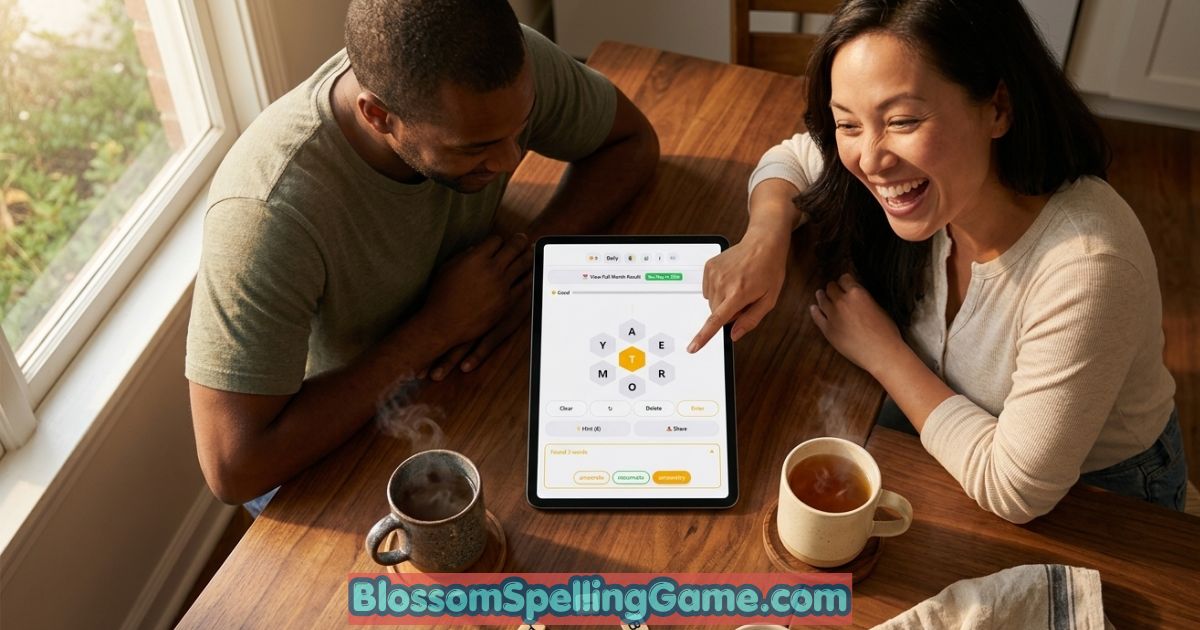
Blossom Word Game rules require you to form words of at least 4 letters using 7 given letters (arranged in a flower). Every word must include the center letter. Letters can be reused. Points are based on word length — 4-letter words earn 1 point, longer words earn 1 point per letter, and using all 7 letters (a “pangram”) earns a bonus +7 points.
Let me tell you something that happened to a friend of mine who’s a crossword fanatic. She picked up the Blossom Word Game on a rainy Tuesday afternoon, figuring she’d knock it out in five minutes. An hour and a half later, she was still at it, muttering letter combinations under her breath like someone casting a spell.
“Why didn’t I know this game existed?” she texted me later.
Honestly? That’s the reaction most people have. Blossom Word Game — developed and backed by Merriam-Webster, one of the most respected dictionary publishers in the United States — hits a very specific sweet spot. It’s not so easy that it’s boring. It’s not so hard that it’s frustrating. And the rules, while simple on paper, open up a surprisingly deep strategy layer once you understand how the scoring works.
If you’re brand new to the game, or if you’ve been playing casually but feel like you’re leaving points on the table, this is the guide you’ve been looking for. We’re going to walk through every Blossom word game rule — including the scoring details most guides either skim over or get wrong — plus practical tips you can use starting today.
- What Is the Blossom Word Game?
- The Official Rules of Blossom Word Game
- Blossom Word Game Scoring Rules — Full Breakdown
- The Pangram: The Crown Jewel of Every Puzzle
- Daily Blossom Word Game Rules (What Changes Each Day)
- Blossom Word Game Rules for Adults: Advanced Play
- 6 Common Mistakes Beginners Make
- 7 Strategies That Actually Improve Your Score
- Blossom vs. NYT Spelling Bee: How the Rules Compare
- FAQ: Your Most-Asked Blossom Questions Answered
- Final Thoughts
What Is the Blossom Word Game?
At its core, Blossom is a daily word-finding puzzle. Every morning you get a fresh set of seven letters arranged in a flower (or “blossom”) shape — one letter sits in the center petal, and the other six surround it. Your job is to make as many valid English words as possible using only those letters.
Think of it as a vocabulary workout disguised as something pleasant to look at. The floral design isn’t just aesthetic — it’s functional. The center petal represents the most important rule in the entire game (more on that in a moment).
One thing that makes Blossom stand out from other daily puzzles in 2026 is the lack of pressure. There’s no timer ticking down. No lives to lose. No streak to protect in a way that stresses you out. You can chip away at the puzzle over coffee, revisit it during lunch, and come back after dinner. The game refreshes every 24 hours, but you never feel punished for taking your time.
Blossom Word Game is free to play at blossomspellinggame.com and through Merriam-Webster’s platform. No download or subscription required. A new puzzle drops every day at midnight.
The Official Rules of Blossom Word Game
Every word must include the center letter. The letter in the middle of the flower appears in every valid submission — no exceptions. Position doesn’t matter (beginning, middle, or end are all fine), and it can appear more than once in the same word. That’s the complete rule. For how to turn it into a strategy, see our Center Letter Guide.
What words does Blossom NOT accept?
This trips people up more than anything else. Here’s what gets rejected every time:
- Proper nouns (names of people, cities, brands)
- Abbreviations (like “govt” or “dept”)
- Hyphenated words (like “well-known”)
- Very obscure or archaic words not in Merriam-Webster’s active dictionary
- Words shorter than four letters
- Any word that doesn’t include the center letter
One thing I noticed early on: the game’s word validation leans on Merriam-Webster’s comprehensive dictionary, which means some less common but legitimate words do get accepted. Don’t assume a word is too obscure to try. Submit it and see.
Blossom Word Game Scoring Rules — Full Breakdown
Most beginners understand the basic rules of blossom word game within five minutes. But the scoring? That’s where things get genuinely strategic. Understanding exactly how points are calculated changes the way you approach every puzzle.
Base Scoring: Word Length Matters
Blossom scores words by length — 4-letter words earn 1 point, 5-letter words earn 5, and every letter beyond that adds 1 point. Finding the pangram (the word using all 7 letters) adds a +7 bonus on top. One highlighted petal letter also adds +5 every time it appears in a word. For the complete breakdown with examples, see our Blossom Scoring Guide.Notice that jump between 4-letter words and everything else? That’s deliberate. A 4-letter word earns you a flat 1 point. A 5-letter word earns 5. That’s a 5x difference for adding just one letter. This is why experienced players chase longer words relentlessly.
Do Bonus Letters Factor In?
Some versions of Blossom (particularly the Word.tips variant and some third-party clones) include a highlighted “bonus petal” — a letter that earns extra points when included in a word. On those platforms, the highlighted petal can add an extra +5 to any word containing it, and there’s occasionally a separate point-per-additional-letter mechanic.
The core Merriam-Webster version uses the clean system described above. Always check which version you’re playing, because the rules of blossom word game can vary slightly depending on the platform.
Score Tiers and Rankings
Blossom doesn’t just track raw points — it grades your performance based on words found and vocabulary level. Here’s a rough tier breakdown most versions use:
The Pangram: The Crown Jewel of Every Puzzle
If there’s one concept that separates casual Blossom players from people who actually know what they’re doing, it’s the pangram. And honestly? Most beginners underestimate just how valuable it is.
A pangram in Blossom is a word that uses all seven letters on the board at least once. It doesn’t have to be exactly seven letters long — pangrams can be eight, nine, or more letters, as long as every one of the seven available letters appears in the word at least once.
Find the pangram, and you pocket a bonus 7 points on top of the word’s normal length score. That means a 7-letter pangram earns 14 points (7 for length + 7 bonus). An 8-letter pangram earns 15. Those are the single highest-value moves available in the game.
Is There Always a Pangram?
Not necessarily — and this is a rule detail some guides get wrong. In the Merriam-Webster version of Blossom, there’s at least one pangram in every puzzle. Third-party versions occasionally have puzzles with no pangram, which is worth knowing if you’re playing one of those clones and wondering why you can’t find it.
Here’s a practical tip for hunting pangrams: look at your seven letters and ask yourself what common English word roots or word families could use all of them. Think about word endings like -ING, -TION, -NESS, or -ATED that tend to pull in a wide variety of consonants and vowels. Then build backwards from those endings using your available letters.
Every puzzle contains at least one pangram — a word using all seven letters — which earns a +7 point bonus on top of its length score. It’s always there; finding it is the skill. See our dedicated Pangram Guide for hunting strategies that actually work.
Blossom Word Game Rules for Adults: Advanced Play
Most coverage of blossom word game rules for adults just repeats the beginner basics. But if you’ve been playing for a while and want to push your score higher, there’s a more sophisticated layer to explore.
Thinking in Word Families
One of the most effective advanced strategies is what I’d call “family hunting.” Once you find a root word, immediately ask what its relatives are. Found PLAY? Now look for PLAYS, PLAYER, PLAYED, PLAYING, PLAYABLE, REPLAY, REPLAYED. One root can generate five to eight valid submissions if you’re methodical about it.
Prefix and Suffix Scanning
English is saturated with prefixes and suffixes that stack onto almost anything. Scan your letters for these building blocks:
- Prefixes: RE-, UN-, PRE-, OUT-, OVER-
- Suffixes: -ING, -ED, -ER, -EST, -NESS, -ABLE, -LESS, -LY, -TION
If your letter set contains the letters for any of these, treat them as anchor points and build words outward from them.
The Shuffle Button Is Underrated
Most experienced players overlook this. The shuffle button (usually marked with an arrow icon) rearranges the six outer petals without changing any letters. A fresh visual layout genuinely surfaces word possibilities your brain missed. It’s not cheating — it’s using the tools the game gives you. Don’t be proud about skipping it.
Going for Volume vs. Going for Length
Here’s an actual strategic debate worth thinking about: is it better to find many short words or fewer long ones? The math is clear — long words win. But there’s a psychological benefit to building momentum with shorter words first. Many experienced players start with a quick sweep of 4-letter words to settle in, then switch to hunting 7+ letter words for the bulk of their points.
4 Common Mistakes Beginners Make
These aren’t abstract warnings. These are the exact sticking points I’ve watched players hit over and over again — and none of them are obvious until someone points them out.
-
❌
Forgetting the center letter
By far the most common error. You form a perfectly valid English word… and it gets rejected because you forgot the center petal must appear in every submission. Always double-check before hitting Enter.
-
❌
Chasing only 4-letter words
It feels productive to rack up word counts, but the scoring math punishes this. Fifteen 4-letter words gives you 15 points. One 8-letter pangram gives you 15 points. Do the math and adjust your priorities.
-
❌
Trying proper nouns
LONDON, MARY, AMAZON — all rejected. The game only accepts common dictionary words. Save yourself the frustration and skip capitalized words entirely.
-
❌
Not trying word extensions
Found LATE? Try LATER, LATEST, LATELY, LATERAL. Found STONE? Try STONED, STONES, STONER, STONEWORK. Extensions are free points hiding in plain sight.
7 Strategies That Actually Improve Your Score
- Start with the center letter. Write it down or keep it mentally front-of-mind. Every word you try must have it, so building your word search around it saves wasted attempts.
- Prioritize words of 5+ letters immediately. Don’t save the long words for last. The scoring jump between 4 and 5 letters is massive, and finding long words early gives you momentum.
- Do one dedicated pangram hunt before anything else. Spend your first 3–4 minutes solely trying to find the pangram. If you find it, great — you’ve secured your biggest score chunk. If not, switch to building points through other words.
- Use the shuffle button when stuck. This sounds obvious but most players wait too long to use it. Hit shuffle every few minutes if you feel your eyes glazing over the same arrangement.
- Think about plurals and verb forms early. Words ending in -S, -ED, -ING extend your list rapidly. If you have PLANT, you probably also have PLANTS, PLANTED, PLANTING — all valid, all separate points.
- Keep a mental note of less-common valid words. Over time, you’ll build a personal vocabulary of words the game regularly accepts that you didn’t expect — things like NAEVI, AALII, or AEON. These feel obscure until you’ve seen the game accept them once.
- Play consistently, even on hard days. The daily format means every puzzle is a new chance. Players who show up daily — even for just 10 minutes — improve measurably faster than those who play in bursts.
Blossom vs. NYT Spelling Bee: How the Rules Compare
The comparison comes up constantly, and it’s fair — both games use seven letters in a flower arrangement and require you to include the center letter. But the differences are meaningful.
| Feature | Blossom Word Game | NYT Spelling Bee |
|---|---|---|
| Publisher | Merriam-Webster / Blossom | The New York Times |
| Layout | Flower/blossom shape | Honeycomb hexagons |
| Min. word length | 4 letters | 4 letters |
| Center letter rule | Yes — mandatory | Yes — mandatory |
| Letter reuse | Yes | Yes |
| Scoring system | Points per letter + pangram bonus | Points by length tier + pangram bonus |
| Pangram bonus | +7 points | +7 points |
| Cost | Free | Requires NYT subscription |
| Word list source | Merriam-Webster dictionary | NYT curated list |
| Tone / vibe | Relaxed, colorful, accessible | More competitive, streak-focused |
The bottom line: if you’re a Spelling Bee player, Blossom’s rules will feel immediately familiar. The key practical difference is the word list — Merriam-Webster’s dictionary tends to accept a slightly different set of valid words than the NYT’s curated list. Words that work in one game may not work in the other, and vice versa.
FAQ: Your Most-Asked Blossom Questions Answered
Ready to Put the Rules Into Practice?
Now you know everything — the three core rules, the scoring system, the pangram bonus, and the strategies most guides skip. The only thing left is to open today’s puzzle and start finding words.
▶ Play Today’s Blossom Puzzle